


The US Food and Drug Administration (FDA) has granted limited approval to two innovative protein-degrading drugs for breast cancer, even though evidence for their overall effectiveness is unclear.
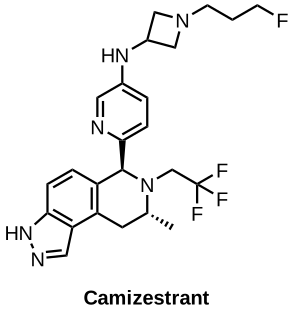
In early September, the FDA granted accelerated approval to AstraZeneca’s Etcamah (camizestrant), disregarding conclusions from its advisory panel that trial results didn’t support its planned use. The drug degrades oestrogen receptor proteins with ESR1 mutations that emerge after initial breast cancer treatment, a leading cause of drug resistance in the disease. Etcamah was approved in the EU in July and the UK in August.
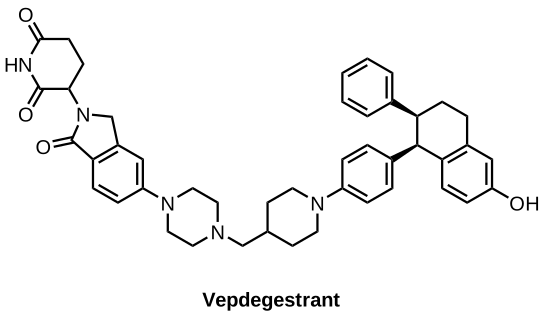
In May, the FDA approved Veppanu (vepdegestrant), developed by Arvinas and Pfizer. This was the first approval for a new class of proteolysis targeting chimera (Protac) drugs, which combine parts that bind to both the target protein and cell machinery that tags and labels proteins for disposal. Coincidentally, vepdegestrant only performed better than existing treatments among people with ESR1 mutations, meaning the approval is limited to that population. It has not yet been approved elsewhere.
The approvals ‘do not necessarily suggest that the FDA is being unusually optimistic about protein-degrader therapies’, says Glenda Walker, senior healthcare research and data analyst, oncology, at Clarivate in London, UK. Instead, ‘the agency tailored the approval to the available evidence through biomarker-restricted indications or accelerated approval mechanisms while requiring additional data to address remaining uncertainty’, she says.
Camizestrant is the latest of several approved small-molecule selective oestrogen receptor degraders (SERDs). SERDs change the receptor protein’s shape, triggering cells’ waste disposal systems to break the proteins down. AstraZeneca’s main innovation is testing circulating tumour DNA to tell when ESR1 mutations first appear, and switching patients onto camizestrant at that stage. A separate trial, testing earlier switching to camizestrant without testing for ESR1 mutations didn’t show any significant advantage.
Nick Turner from the Institute of Cancer Research and Royal Marsden NHS Foundation Trust in London, UK, co-led the trials of camizestrant. He calls the FDA’s approval an important recognition of a new precision medicine approach for advanced breast cancer. ‘Results from the Serena-6 trial showed that we can use blood tests to detect ESR1 mutations as they emerge and act on that information before the cancer progresses, helping patients remain on effective treatment for longer,’ Turner tells Chemistry World.
Serena-6 found that combination therapy including camizestrant reduced the risk of disease progression or death by 56% versus standard-of-care treatment. However, the FDA’s advisory board wasn’t initially convinced that this improved long-term outcomes enough. The agency went ahead with accelerated approval (which requires additional clinical trials after marketing) because it considered the available evidence sufficiently compelling, ‘while recognising that additional data are needed to confirm the long-term clinical benefit of early intervention’, Walker says.
Arvinas and Pfizer out-licenced commercialisation of vepdegestrant to Rigel Pharmaceuticals in exchange for an upfront payment, with the promise of future royalties and performance milestone payments. ‘For a large company such as Pfizer, a therapy approved only for patients with ESR1-mutated disease may represent a relatively modest commercial opportunity compared with other oncology programmes,’ says Walker. ‘For Rigel, however, a targeted oncology product with an established regulatory approval may be a more significant strategic asset.’
The restriction to ESR-1 mutation opens a potential pathway for vepdegestrant use to also be started when it first appears, although Walker highlights that this would require expensive trials.
The FDA enabled drug approvals exclusively for ESR-1mutated breast cancer and switching treatments on its emergence by also approving the Guardant360 companion diagnostic test. However, researchers writing in The Lancet have questioned the cost of using such tests to decide when to switch treatment, as camizestrant does. Guardant360 diagnosis costs more than $5000 per circulating DNA test. At $5000 per test, they calculate that enabling sufficient treatment to prevent one person’s cancer from progressing would require $405,000 worth of testing (across 18 patients over two years).
Walker notes that there also isn’t enough overall survival data to know whether either drug allows patients to live longer. Both drugs have side effects that impact patients’ hearts. Likewise, the kinase drugs that remain part of the combination therapy including camizestrant have their own adverse effects. Furthermore, there are now many drugs, including protein degraders, on the market to treat advanced breast cancer, with little to choose between them. For example, there is not enough data to decide which SERD is best for a given patient, Walker underlines.
Yet Walker stresses that for many patients, the benefit of delaying disease progression offered by vepdegestrant and camizestrant ‘can still be clinically meaningful’ and ‘may postpone the need for more intensive treatment’. ‘Available quality-of-life data are encouraging,’ she says. That suggests the additional time without patients’ cancer progressing may be the kind of priceless respite they so dearly want.


