


Submillimetre wireless optical chips that can monitor the temperature of a reaction vessel in real time have been developed by US researchers. The device, which is already commercially available, could provide large quantities of data for analysis in self-driving labs, as well as assisting in industrial safety monitoring of reactions.
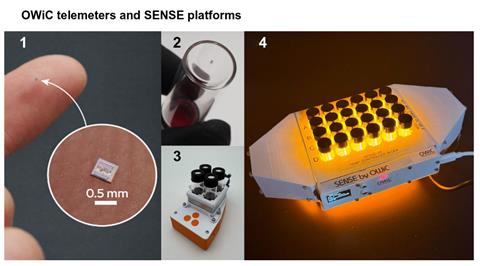
In recent years, chemists have devised increasingly sophisticated schemes for performing reactions, often with the aid of automation. Monitoring experimental reactions efficiently, however, is difficult as existing techniques, such as NMR spectroscopy, often require sample extraction and ex situ analysis. In situ spectroscopy techniques usually require special instrumentation and they give only cumulative measurements of concentration, which can be difficult to interpret. Calorimetric measurements, which provide direct information about the heat produced or absorbed, give the most direct measurement of reaction rate. Today’s best calorimeters, however, can cost over a hundred thousand dollars.
Organic chemist Song Lin at Stanford University in California, physicist Paul McEuen at Cornell University in New York and their colleagues, along with start-up company OWiC Technologies, designed the 0.5mm optoelectronic integrated circuits that can be placed inside or attached to the walls of test tubes. Light from an external LED is absorbed by a semiconductor photovoltaic and converted to electrical energy. This pumps a laser, which then emits nanosecond optical pulses whose repetition rate depends on temperature. By detecting the pulse rate with an external photodetector, the researchers were able to measure the temperature in the test tube to within 0.1°C every half second from up to 24 tubes simultaneously, accumulating over 100,000 data points per hour. Under the controlled reaction conditions of the experiment, these could be converted to heat outputs and therefore to reaction rates.
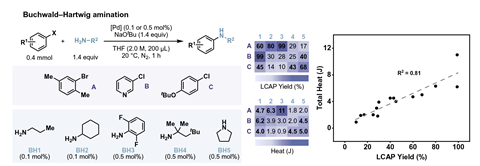
The researchers tested several important reactions including the strongly exothermic cobalt-catalysed hydrolytic kinetic resolution of terminal epoxides, which requires careful thermal management, as well as reactions that produce less heat, such as Buchwald–Hartwig amination and Suzuki–Miyaura coupling. Lin explains that, in self-driving labs, robots can be designed to perform multiple experiments in parallel but reading out the results to inform the next set of experiments is more difficult. ‘We’re trying to make that really easy by dropping little chips into each experiment to get real-time information that can help you make that decision.’
Chemical engineer Donna Blackmond of the Scripps Research Institute, US, is already familiar with these chips. ‘I just jumped right in the first time Song told me about this,’ she says. ‘We have four of his systems here in my lab and we’re just taking data every day.’ She believes the system may unlock much more potential in AI-driven discovery, where at present ‘the data science tools are getting more and more sophisticated but the experimental information going into the models is not’. Blackmond sits on the advisory council for the University of Toronto’s Acceleration Consortium that aims to speed up the discovery of materials using AI and automation and says its researchers were extremely excited by the data.
She thinks the greatest impact, however, may be in industrial process chemistry, which originally developed calorimetry for safety. ‘“Will I blow up the plant if this reaction runs away?” is an important question to answer before you make a drug,’ she says.


