Dark Mode Light Mode
Scientists Found One of The 'Chunkiest' Squid-Like Creatures Ever Known
Scientists Discovered an Amazing Practical Use For The World’s Leftover Coffee Grounds
Chemistry, medicine, materials and the technology shaping tomorrow — the best science stories from trusted sources, every day.

Scientists Discovered an Amazing Practical Use For The World’s Leftover Coffee Grounds

Scientists Discovered an Amazing Practical Use For The World’s Leftover Coffee Grounds Scientists Discovered an Amazing Practical Use For The World’s Leftover Coffee Grounds


Charred coffee grounds could make concrete up to 30 percent stronger, scientists in Australia have found.

Their clever recipe could solve multiple problems at once.

Each year, the world produces about 10 billion kilograms (22 billion pounds) of coffee waste, most of which ends up in landfills.

“The disposal of organic waste poses an environmental challenge as it emits large amounts of greenhouse gases, including methane and carbon dioxide, which contribute to climate change,” explained RMIT University engineer Rajeev Roychand when the research was first published in 2023.

With a booming construction market globally, there’s an ever-increasing demand for resource-intensive concrete, causing another set of environmental challenges.

Watch the video below for a summary of the study:

YouTube Thumbnail

frameborder=”0″ allow=”accelerometer; autoplay; clipboard-write; encrypted-media; gyroscope; picture-in-picture; web-share” referrerpolicy=”strict-origin-when-cross-origin” allowfullscreen>

“The ongoing extraction of natural sand around the world – typically taken from river beds and banks – to meet the rapidly growing demands of the construction industry has a big impact on the environment,” said RMIT engineer Jie Li.

“There are critical and long-lasting challenges in maintaining a sustainable supply of sand due to the finite nature of resources and the environmental impacts of sand mining. With a circular-economy approach, we could keep organic waste out of landfill and also better preserve our natural resources like sand.”

Organic products like coffee grounds can’t be added directly to concrete because they leak chemicals that weaken the building material’s strength.
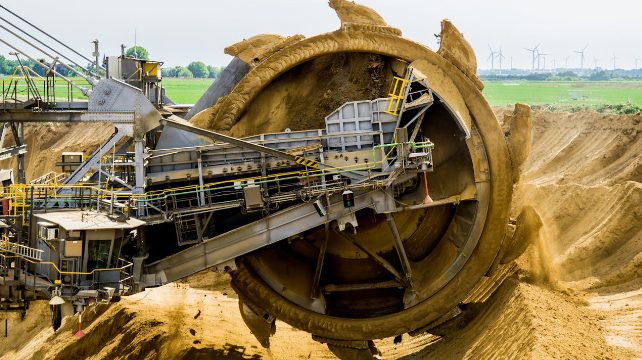
sand mining equipment
Global demand for sand is increasing, and so are its environmental impacts. (Pixabay/Pexels)

So using low energy levels, the team heated coffee waste to over 350 °C (around 660 °F) while depriving it of oxygen.

This process is called pyrolysis. It breaks down the organic molecules, resulting in a porous, carbon-rich charcoal called biochar that can form bonds with and thereby incorporate itself into the cement matrix.

Roychand and colleagues also tried pyrolyzing the coffee grounds at 500 °C, but the resulting biochar particles were not as strong.
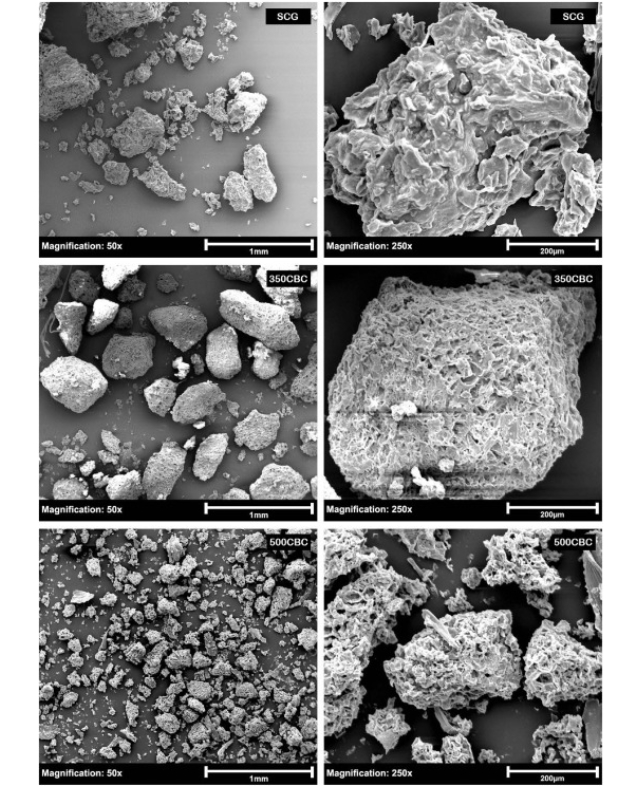
micrographs of coffee grind
Scanning electron microscope images of the surface structures on the pyrolyzed coffee grounds. (Roychand et al., Journal of Cleaner Production, 2023)

The researchers cautioned that they still need to assess the long-term durability of their cement product.

They’re now working on testing how the hybrid coffee-cement performs under freeze/thaw cycles, water absorption, abrasions, and many more stressors.

The team is also working on creating biochars from other organic waste sources, including wood, food, and agricultural.

“Our research is in the early stages, but these exciting findings offer an innovative way to greatly reduce the amount of organic waste that goes to landfill,” said RMIT engineer Shannon Kilmartin-Lynch.

“Inspiration for my research, from an Indigenous perspective, involves Caring for Country, ensuring there’s a sustainable life cycle for all materials and avoiding things going into landfill to minimize the impact on the environment.”

Related: One Way of Drinking Coffee Could Help You Live Longer, Study Finds

In 2024, RMIT and Macedon Ranges Shire Council poured a world-first real-world trial: a footpath in Gisborne, Victoria, made with the coffee biochar concrete alongside a wood-chip-biochar section and a standard-concrete control section.

Later that year, Victoria’s Big Build used coffee-biochar concrete for a footpath on the Pakenham Roads Upgrade – the first major infrastructure project to use it – with contractor BildGroup estimating the job diverted roughly 140,000 coffees’ worth of grounds from landfill and saved more than 3 metric tons (3.3 US tons) of sand.

In early 2025, the RMIT team picked up the People’s Choice Problem Solver Award at Universities Australia’s Shaping Australia Awards, and said they were working with a commercialization partner to build a business case to bring the material to market.

Their research was published in the Journal of Cleaner Production.

This article was fact-checked by Fiona MacDonald and edited by Fiona MacDonald. While we pride ourselves on our process, we are only human. If you spot a mistake, please let us know.


Source link

Previous Post
Scientists Found One of The ‘Chunkiest’ Squid-Like Creatures Ever Known

Scientists Found One of The 'Chunkiest' Squid-Like Creatures Ever Known