


Dark Mode Light Mode
Forensic Facial Specialists Can Identify People Using Just a Couple Facial Features
Scientists Just Cracked a Quantum Mystery That’s Puzzled Physicists For Decades
Chemistry, medicine, materials and the technology shaping tomorrow — the best science stories from trusted sources, every day.

Scientists Just Cracked a Quantum Mystery That’s Puzzled Physicists For Decades

Scientists Just Cracked a Quantum Mystery That’s Puzzled Physicists For Decades Scientists Just Cracked a Quantum Mystery That’s Puzzled Physicists For Decades


The Kondo effect is one of the most important in quantum physics, describing the strange interference that magnetic atoms can have in metals.

Usually, as metals cool, they become better at conducting electricity, because the reduction in energy means electrons can flow more smoothly. Add in a magnetic atom or two, though, and below a certain temperature (the Kondo temperature), electrical resistance starts to rise again.

That’s the Kondo effect, and we already know a lot about it. But in a physics first, researchers from the California Institute of Technology (Caltech) and Yale University in the US have managed to precisely quantify the effect in a real material via fundamental physics calculations.

The work, published in Science, represents a significant step forward. Previously, scientists had to use real-world experiments and simplified models to pin down the Kondo effect, without getting predictions as precise as the new method.
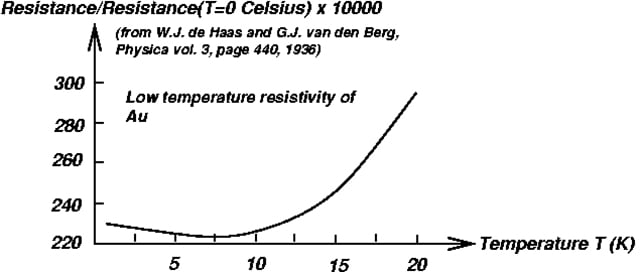
Kondo effect chart
Scientists have known about the Kondo effect since the 1930s – that magnetic impurities can cause increased electrical resistance at lower temperatures. (Public Domain)

“It is now possible to predict the properties of some complicated materials purely through computation without referring to experiments,” says physicist Garnet Chan, from Caltech.

Scientists already know what causes the Kondo effect. Electrons swarm around the magnetic impurities in the metal, canceling out the magnetism of the atoms and impeding electrical flow at the same time. 

“That is the signature of the Kondo effect, and it’s a property of the electrons in the impurity interacting with the electrons traveling through the bulk metal,” says Chan.

Knowing what’s going on isn’t the same as being able to model it with full precision, though. Such are the complexities of the electron interactions in this ‘many-body problem’ that it’s very tricky to predict when the flip in resistance will happen for different combinations of metals and magnetic impurities.

Temperatures, electron spins, and magnetism all interact at incredibly small scales in these materials as the Kondo effect takes hold. It’s way beyond the capabilities of even the most powerful supercomputers.

To overcome the challenges, the researchers adopted an ab initio (‘from first principles’) approach. They borrowed techniques from chemistry to more fully model a single magnetic atom, without simplification, as if it were a larger molecule.

With the help of some mathematical shortcuts and a lot of computer time, they then applied the basic laws of quantum physics to this newly modeled magnetic atom, repeating calculations again and again to narrow down their predictions.

YouTube Thumbnail

frameborder=”0″ allow=”accelerometer; autoplay; clipboard-write; encrypted-media; gyroscope; picture-in-picture; web-share” referrerpolicy=”strict-origin-when-cross-origin” allowfullscreen>

By comparing the modeling quantifications with lab measurements of the Kondo effect, the researchers proved the high level of accuracy of their prediction system. In some cases, the new approach was 100 times more accurate than current, simplified modeling.

The researchers picked the most basic examples of metals and magnetic atom combinations here – but further down the line, there’s the potential to study increasingly complex materials.

“These first materials that we have studied are like a baby step, or a prototype problem, along the way to more complex phenomena such as high-temperature superconductors and quantum magnets,” says Chan.

Better prediction methods mean scientists can more confidently develop and investigate materials, such as superconductors, that promise to transform the systems we use for power grids and large-scale computing.

The materials with the most potential tend to also have the most complex electron behaviors – which is where the methods used in this study could help.

There’s still a lot of progress to be made, but now that the approach has been shown to work, the researchers can begin to scale it up, giving scientists a tool to study complex quantum material behaviors without having to get lab data first.

“We are in an exciting era in which faithful predictive quantum descriptions of the full chemical complexity of real materials are coming within reach,” says chemist Linqing Peng, from Caltech.

“It is becoming realistic to predict material-specific behavior of correlated electrons from first principles, even in some of the most challenging classes of quantum materials.”

The research has been published in Science.

This article was fact-checked by Fiona MacDonald and edited by Fiona MacDonald. While we pride ourselves on our process, we are only human. If you spot a mistake, please let us know.


Source link

Previous Post
Forensic Facial Specialists Can Identify People Using Just a Couple Facial Features

Forensic Facial Specialists Can Identify People Using Just a Couple Facial Features