








There are numerous kinds of diets that can help you to lose weight if you’re overweight or obese, and if all you want to do is shed some pounds, you have options.
We also know that certain kinds of diets can offer specific benefits to our health beyond mere weight loss alone.
But what’s less clear is how popular diets stack up against one another in terms of those extra benefits, specifically with regard to reversing poor cardiometabolic health caused by obesity, such as high blood fats, fatty liver disease, and prediabetes.
In a new study published in Cell Metabolism, scientists set out to find which of three popular diets commonly recommended for obesity might pack the biggest punch for improving overall metabolic health.
“Diets can be dramatically different – high-fat, high-carb, and everything in between,” endocrinologist and first author of the study Max Petersen from Washington University in St. Louis told ScienceAlert.
“We wanted to know if the macronutrients in a diet modify the metabolic benefits of weight loss.”
To find out, Petersen and fellow researchers conducted a clinical trial with 42 adults who had obesity, prediabetes, and excess liver fat.
Each participant was randomly assigned to one of three diet groups, eating either a very low-carbohydrate ketogenic diet, the Mediterranean diet, or a very low-fat diet that was mostly plant-based.
Each participant had all their daily meals and snacks provided, with the foods on offer depending on their assigned diet category.
Amongst a large variety of meals provided, the keto group supped on offerings including egg salad, pulled pork, and chicken with asparagus.
The Mediterranean dieters got to enjoy oatmeal with almonds and blueberries, quinoa with black beans and corn, and chicken pesto pasta.
And the low-fat plant-forward diet provided fruit smoothies, vegetable tortilla wraps, and mixed grains with salmon.
For around five months on average, the participants followed their diet program, until they had lost about 10 percent of their baseline body weight.
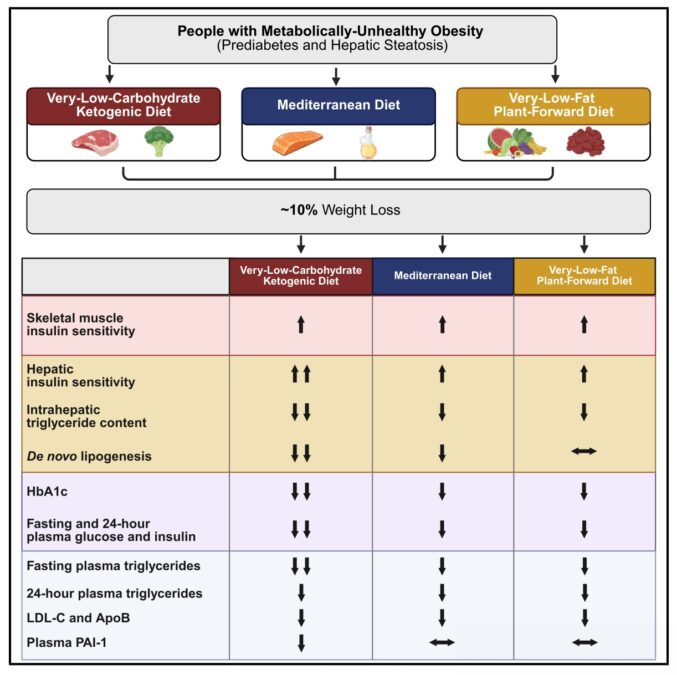
By that measure, all the diets worked, and all the participants hit their 10 percent weight-loss target.
But in terms of metabolic health improvements, blood samples and other tests showed that one diet stood out as best overall, particularly with regard to liver health markers.
“We were very interested to see that several aspects of liver health improved most on the ketogenic diet,” Petersen told ScienceAlert.
“If just one aspect of liver health had improved, it wouldn’t have been as compelling. But we saw improvements in liver fat, liver insulin sensitivity, liver fat production, liver glucose production, and other outcomes that all pointed to a uniquely beneficial effect of the ketogenic diet on liver health.”
While liver insulin sensitivity improved in all groups, the increase was two to three times greater among the keto dieters, who also saw the highest drops in liver fat (a 67 percent reduction, compared to 45 percent for both the other diets).

Even more pronounced was the keto diet’s effect on prediabetes.
Half the keto dieters in the study ended up going into prediabetes remission, compared to 29 percent of participants on the Mediterranean diet, and just 7 percent of the low-fat group.
While the researchers expected weight loss to deliver improvements in insulin sensitivity and to lower levels of liver fat, even they didn’t expect the keto diet group to see such remarkable effects.
Especially since 73 percent of the calories consumed in the keto diet came from fats, far outstripping the 35 percent and 15 percent levels for the Mediterranean and low-fat diets, respectively.

“We were surprised that in our participants with metabolically unhealthy obesity, the ketogenic diet did not cause harmful effects on blood cholesterol profiles,” Petersen said.
“Instead, cardiovascular risk factors tended to improve even on the high-saturated fat ketogenic diet.”
The researchers suggest that very low carbohydrate intake – representing just 4 percent of all calories consumed in the keto group studied – results in low levels of circulating glucose and insulin, which could lower the production of new fat in the liver, while triggering the breakdown of existing liver fat.
It’s worth noting that this is only a small study, and the researchers note that given their small sample size, they might have missed some differences among the diet groups, which larger studies in future might be able to capture.
We also don’t know if other kinds of less-restrictive low-carb diets (that don’t achieve ketosis) would deliver the same metabolic benefits.
Related: A 4-Week Diet Change May Turn Back The Clock on Aging, Study Suggests
Based on the results here, though, there are some good reasons why people who are overweight or obese might want to try keto for weight loss, as it does appear to offer a number of benefits to metabolic health.
But if you’re considering that, do your research – and know what you’re getting yourself into.
“A ketogenic diet is very different from a standard Western or American diet,” Petersen said.
“The amount of carbohydrate restriction needed to be ketogenic is quite severe. Most people understand that foods like bread and pasta contain carbs, but may not know that carbs are present in many other foods, including foods generally recognized as healthy such as starchy vegetables, fruits, and legumes.”
The findings are reported in Cell Metabolism.
This article was fact-checked by Fiona MacDonald and edited by Fiona MacDonald. While we pride ourselves on our process, we are only human. If you spot a mistake, please let us know.


