
Dark Mode Light Mode
How A Bedroom Air Filter Could Keep Your Blood Sugar in Check
Skin Regenerates Differently in Males And Females, Study in Mice Reveals
Chemistry, medicine, materials and the technology shaping tomorrow — the best science stories from trusted sources, every day.

Skin Regenerates Differently in Males And Females, Study in Mice Reveals

Skin Regenerates Differently in Males And Females, Study in Mice Reveals Skin Regenerates Differently in Males And Females, Study in Mice Reveals


Every 6–7 weeks, depending on age and body part, we get an entirely new outer layer (epidermis) of skin, due to the constant renewal of skin cells.

Now, new research suggests there are significant differences in how this happens in males and females.

This has only been shown in mice so far, so we’ll have to see whether it’s the same in people, but the discovery could eventually lead to treatments that are better tailored depending on sex – for burns, wounds, skin conditions, and even skin cancers.

The findings come from an international team of researchers, led by experts from the Université libre de Bruxelles (ULB) in Belgium and the University of Cambridge in the UK, who have published their work in Nature.

Using a microscopy technique that enables living cells to be imaged through the skin, the researchers followed the stem cells that develop into epidermal skin cells across five months – an unusually long period for this kind of study.
Skin scans
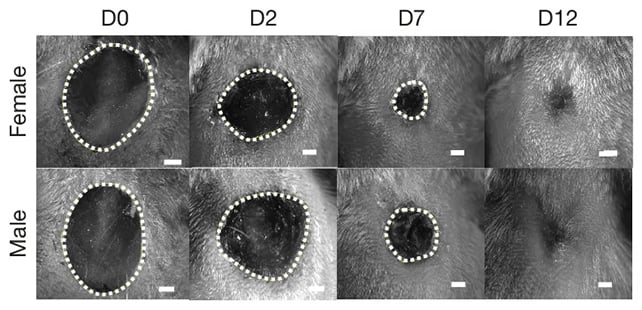
Faster wound healing was one of the differences noticed in the female mice. (Engelman et al., Nature, 2026)

“We initially set out to understand how the skin renews itself, and whether there is a hierarchy with stem cells at the top,” says medical oncologist Dan Engelman from ULB.

“We were surprised to discover strong differences in the way stem cells renew the skin in females and males.”

Stem cells act as source material for all kinds of different cell types in the body. In the bottom layer of the epidermis, stem cells multiply, forming both new stem cells and cells destined for the epidermis, where they act as a protective layer and are eventually shed.

Through their detailed, extended analysis, the researchers discovered there’s also an intermediate stage, where division is limited – this helps to amplify cell production, and the presence or absence of this stage has long been debated by scientists.

Then there were the differences between the sexes.

YouTube Thumbnail

frameborder=”0″ allow=”accelerometer; autoplay; clipboard-write; encrypted-media; gyroscope; picture-in-picture; web-share” referrerpolicy=”strict-origin-when-cross-origin” allowfullscreen>

“Critical to these conclusions was the discovery of sexual dimorphism in epidermal fate, with female mice showing a highly synchronized pattern of cell division, differentiation and delamination that contributes to accelerated wound healing,” write the researchers in their published paper.

In plainer terms, female cells are renewed in a more synchronized, coordinated way, with divided cells working in pairs and making the same choices at the same time (to divide again or head for the outer layer). For males, cells act in a more individual way.

The researchers compare it to rowers synchronizing their strokes, and further tests on the mice suggested that it’s partly why wounds heal faster in females (this is something scientists already know about, though the explanation isn’t fully clear).

“It opens up a wide range of new questions, spanning from fundamental stem cell biology to clinical issues such as wound healing, cancer development, and autoimmune diseases,” says developmental biologist Cédric Blanpain from ULB.

The researchers went further, removing the testes or ovaries from the mice to cut out testosterone or estrogen production, then replacing those hormones to see how it affected skin cell production.

Manipulating the hormones showed testosterone sped up the rate at which new skin cells left the bottom layer – without it, the male skin cells behaved more like female ones. In the female mice, removing the estrogen removed most of the coordinated actions the researchers had previously observed.

Again, it’s important to note that the study was in a small group of mice, though initial tests the team carried out on human skin cells in the lab suggest the same mechanisms are at play. More research will be needed to know for sure.

Expanding the analysis of the human skin cells is the obvious next step for the researchers, to see if this really is another way the sexes differ.

“Sex is a parameter too often overlooked in biology and medicine,” says Blanpain.

“We will now investigate the differences between males and females during the formation and progression of skin cancers, as well as the molecular mechanisms responsible for these differences.”

The research has been published in Nature.

This article was fact-checked by Rachel Garner and edited by Peter Dockrill. While we pride ourselves on our process, we are only human. If you spot a mistake, please let us know.


Source link

Previous Post
How A Bedroom Air Filter Could Keep Your Blood Sugar in Check

How A Bedroom Air Filter Could Keep Your Blood Sugar in Check