


There’s a moment in every chemist’s life when you realise you’ve been told fairytales. Not about magic or dragons – but about molecular representations. And these tales have shaped how we draw, understand and practise chemistry. Let me tell you why. And why, if we trade those tales for better ones, we might transform all three.
Once, while preparing an inorganic chemistry class, I found myself deeply unsatisfied with the way we draw diborane. The textbook describes two bridging hydrogens, each shared between two boron atoms: a three-centre two-electron bond – a bond that involves three atoms at once. The structure itself was not the problem – it’s printed in the classic 1943 paper by Christopher Longuet-Higgins and Ronnie Bell.1 My discomfort was with the dashed lines.
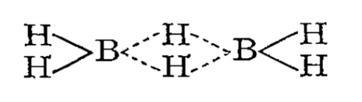
We’re taught that, in a molecular drawing, each line represents a bond between the two atoms it connects. This has been the tradition in chemistry since the second half of the 19th century. And because of the line, we’ve grown accustomed to thinking of bonds as involving exactly two atoms.
But diborane challenges the line. How do you draw a chemical bond that includes more than two atoms?
Well, we’re not short of options, as Longuet-Higgins and Bell showed. But there’s a problem with that representation: it may suggest a bond between the left boron and the hydrogen, and another between the hydrogen and the right boron. So, two bonds? No. It’s a single bond.
Chemistry kept advancing while knowing those anomalous representations were stones in the shoe of molecular representations. With time, they became known rarities that accompanied our frequent games of replacing H at one extreme of the line for Cl or some other substitution in organic chemistry molecules. But the anomalies – which challenge the two-atom bond represented by a line – are abundant in chemistry. In fact, they’re at the core of our discipline.
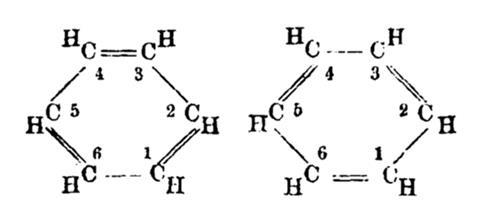
Take benzene. A six-atom ring where electrons dance across all six carbons, not just between pairs. What about ferrocene? A sandwich where a single iron atom is held by two cyclopentadienyl rings, each ring acting as a single unit, not as a collection of individual C–Fe bonds.
Of course, we’ve come up with drawings for these molecules. August Kekulé did it by drawing two benzene rings and intercalating the bonds of one into the other.2 We later adopted the familiar inner circle, and today we draw it by selecting one of Kekulé’s structures while bearing in mind the collective unity of the six atoms in the ring. In a sense, the benzene ring made of pairs of atoms shows the backbone of the molecule, which is important, but it fails to show the marvel of benzene and other aromatic compounds. The true magic is the orchestra: six carbon atoms playing together, not as duets, but as a single symphony.
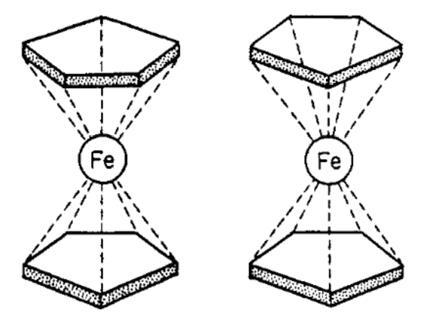
Geoffrey Wilkinson, Myron Rosenblum, Mark Whiting and Robert Burns Woodward did the same in 1952 when solving the puzzle of ferrocene’s structure.3 They wanted to emphasise the central character of the iron atom between the two ring structures. But the line failed them. So, they drew dashed lines connecting each carbon atom of the rings to iron: 10 thin threads reaching toward the metal, each one whispering what a single line could never say.
What if we stop pretending?
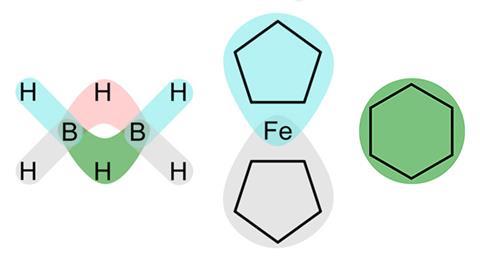
What if we admit that molecules are not always about pairs of atoms, but about sets of them? If we think that way, our molecules become something richer, something closer to our understanding of the molecular world.
Let me introduce you to molecular hypergraphs.4 They use sets to encode which atoms form each bond, while also capturing the broader structure of the molecule.
But this goes beyond molecular drawings, and beyond my discomfort with the line. It turns out that in the 19th century, mathematicians found a connection between molecular drawings and graphs. Two of the key figures were James Joseph Sylvester and Arthur Cayley.
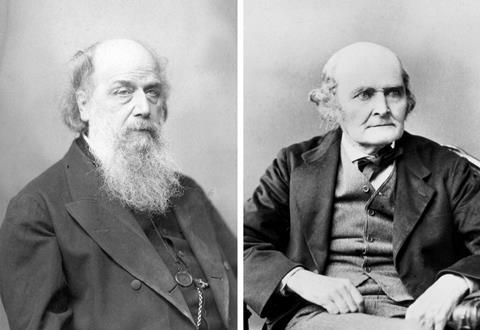
At the time, they were helping to create a new branch of mathematics: graph theory. In this context, a graph is simply a collection of objects connected by pairwise relationships. So, in the hands of Sylvester and Cayley, molecules became graphs, and the entire machinery of graph mathematics was eventually applied to molecules. Today, this approach sits at the core of algorithms – including AI ones – that estimate the properties of substances by playing with the mathematics of their associated graphs.
The good news is that the molecular hypergraphs described above receive that name because they correspond to a class of mathematical structures called hypergraphs – which literally means ‘beyond the graph’. The mathematical machinery of these hypergraphs has begun to develop in recent decades, and the first applications of that mathematics to the molecular world are already appearing. Just recently, molecules represented as hypergraphs – rather than as graphs – performed much better in AI approaches to estimate optoelectronic properties of organic semiconductors.5
But back to diborane. I wonder why we were trapped by the line? Why did we spend more than a century forcing molecules into a framework that doesn’t fit? And why did we teach students that a bond is a line, when we all know it’s not always so? That’s another story, one at the borders of history, philosophy of science and psychology.
For the moment, I’m calling on you to stop drawing lies – sorry, lines! And if you must, bear in mind that those lines are just a particular case: a set containing two atoms. Let’s embrace hypergraphs. If thinking in pairs has taken chemistry this far, what could we accomplish by representing chemical bonds through a system that integrates with higher-order mathematics?


