Tag: Agriculture

  • Israel is flooding Gaza’s tunnel network: Scientists assess the risks

    Israel is flooding Gaza’s tunnel network: Scientists assess the risks

    [ad_1]

    A picture taken with a fisheye lens on January 18, 2018 from the Israeli side of the border with the Gaza shows a tunnel that Israel says was dug by an Islamic Jihad group.

    Gaza’s underground tunnels are not all interconnected like a metro or subway system, researchers say.Credit: Jack Guez/AFP via Getty

    Israel’s military has begun injecting “high-flow” seawater into Hamas-built tunnels beneath the Gaza Strip as part of its attempt to “neutralize terrorist infrastructures”.

    On 30 January, the Israel Defense Forces (IDF) confirmed that the plan to flood tunnels under the Gaza Strip, a strategy that has been the subject of rumours since December, is being implemented at a number of undisclosed locations. The IDF’s statement added that the move was a “significant engineering and technological breakthrough” and that locations were chosen so that “groundwater in the area would not be compromised”.

    However, some water researchers are warning that flooding tunnels with seawater could have a devastating effect on Gaza’s already scarce freshwater supplies and might destabilize buildings. There are also concerns that flooding the tunnels could endanger many of the approximately 130 remaining Israeli hostages who were abducted by Hamas in its attacks of 7 October 2023. The hostages’ locations remain unknown. But one researcher Nature spoke to says he suspects the impact of the flooding will be limited, because Gaza’s aquifer is already contaminated by seawater.

    The tunnels are a “spider web” of damp passageways dug in sandy soil, former hostage Yocheved Lifshitz told the media after she was released last October. One tunnel is 50 metres deep, according to Israel’s Ministry of Foreign Affairs, and some have several entrance shafts and are reinforced with concrete and equipped with power cables and piping. The tunnels are probably used to store weapons, as well as for holding hostages captive. They extend to almost every corner of the crowded and devastated 363-square-kilometre Gaza Strip.

    Biggest concern

    One of the biggest concerns is that seawater used to flood the tunnels will contaminate an important coastal aquifer, which lies between Gaza, Egypt and Israel and supplies nearly 80% of Gaza’s water.

    Mark Zeitoun, a water engineer and director-general of the Geneva Water Hub in Switzerland, says that Gaza’s main source of drinking water is being contaminated. “If you put salty water into a freshwater source, it’s polluting, it’s contaminating, it’s poisoning,” he says.

    There’s a possibility that the seawater, once pumped into the tunnels, will simply leak out, Zeitoun adds. “If you just try filling the tunnels with water, I assume that they’re not sealed well enough to hold any water. The water would drain out and into the aquifer,” he says.

    Geographer Ahmed Ra’fat Ghodieh, based at An-Najah National University in Nablus in the West Bank, agrees that the aquifer is likely to become irreparably contaminated with salt water.

    “If they flood these tunnels, then the seawater will penetrate the geological strata, towards the aquifer,” says Ghodieh. “Such action will have severe consequences on all aspects of life in Gaza — on agriculture, on soil, on infrastructure.” Ghodieh adds that the seawater could create sinkholes that destabilize the foundations of buildings.

    But hydrologist Noam Weisbrod, who is dean of the Jacob Blaustein Institutes for Desert Research at Israel’s Ben-Gurion University of the Negev, says that those concerned that the entire coastal aquifer will be irreparably contaminated are probably overestimating the flooding’s effects. “I’m not sure that the environmental risk is as extreme as people want to believe,” he says. The impact of flooding would differ depending on where the affected tunnels are located, he adds.

    The water level of Gaza’s coastal aquifer ranges from about 60 metres below the surface in the east to just a few metres deep near the coastline, according to a 2020 study published in the journal Water1. More water is being drawn out of the aquifer than can be replaced naturally by fresh water, and as a result the aquifer is already being infiltrated by seawater.

    Weisbrod’s reasoning takes into account the fact that, in areas close to the coast, the water in the aquifer is already saline. Moreover, he says, “large sections of the aquifer water are already contaminated from unregulated sewage systems, fertilizers and more”.

    Weisbrod also says that Israel’s plan could have limited impact. The tunnel network “is not one big metro plan like in New York or in London”, he explains. “It’s not one big thing that is all connected. So, you’ll use a lot of effort and you’ll flood something quite limited, eventually. So maybe it’s not worth it.”

    A Sentinal-2 satellite image of Gaza collected on January 10th, 2024.

    The water level of Gaza’s coastal aquifer ranges from about 60 metres below the surface in the east to a few metres deep near the coastline. This satellite image of the Gaza strip was recorded on 10 January 2024.Credit: maps4media via Getty

    Gaza’s water crisis

    The debate over the tunnels highlights a problem that existed before the flooding started: clean water is scarce in Gaza, irrespective of the extent to which the aquifer is contaminated by seawater pumping. In 2020, United Nations agencies estimated that 10% of the population had access to safe drinking water.

    Some water is piped in by Israel and Egypt. A €10-million (US$10.9-million) seawater desalination plant funded by the European Union opened in Gaza in 2017, but it presumably cannot function without an electricity supply. Before the war, around half of Gaza’s electricity came from Israel, but, in October, the Israeli government cut off supplies.

    Almost 1.9 million people have been displaced by the war, with many living in tents or on the streets in the southern Gazan city of Rafah. Following torrential rains in January, many are collecting drinking water in dishes and buckets, Ghodieh says. Others buy water from tanker trucks — low-quality water from the aquifer that has been desalinated by private companies — says David Lehrer, director of the Center for Applied Environmental Diplomacy at the Arava Institute for Environmental Studies in the Arava Valley, Israel.

    When the war ends, Israel and Gaza need to start planning for a better water future, Lehrer says. In 2023, through a partnership with the Israeli company Watergen, the Palestinian non-governmental organization Damur for Community Development, and the Israeli Civil Administration, the Arava Institute installed five solar-powered atmospheric water generators at municipal health-care centres in Gaza. According to the Arava Institute, these can generate around 900 litres of clean drinking water per day by capturing humidity, condensing and filtering it.

    This initiative, and other interim measures such as off-grid wastewater treatment, Lehrer says, will “provide a glimmer of hope that the situation will eventually improve”.

    [ad_2]

    Source link

  • Transforming Agriculture With Microbial Fertilizers

    Transforming Agriculture With Microbial Fertilizers

    [ad_1]

    Microbes Could Help Reduce the Need for Chemical Fertilizers

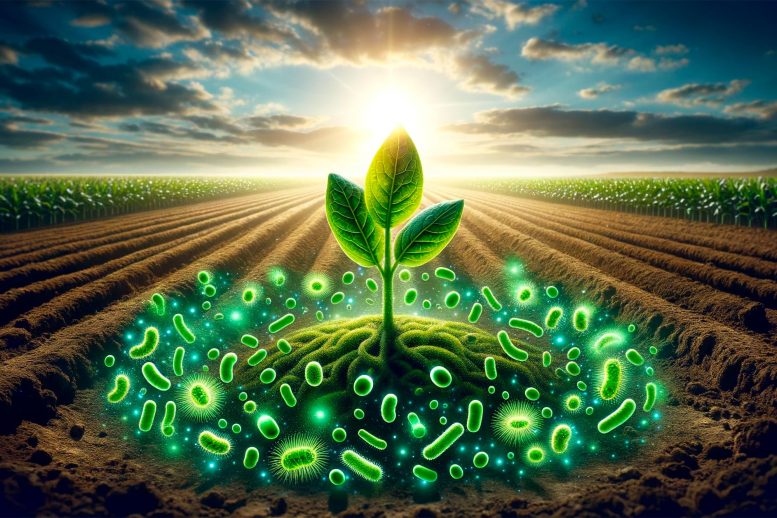
    MIT chemists are reducing the carbon footprint of chemical fertilizers by using nitrogen-fixing bacteria as a sustainable alternative. They developed a protective metal-organic coating that enables these bacteria to withstand heat and humidity, enhancing seed germination rates significantly. This innovation could make microbial fertilizers more accessible and promote regenerative agriculture. Credit: SciTechDaily.com

    New coating protects nitrogen-fixing bacteria from heat and humidity, which could allow them to be deployed for large-scale agricultural use.

    MIT chemical engineers devised a metal-organic coating that protects bacterial cells from damage without impeding their growth or function. These coated bacteria could make it much easier for farmers to deploy microbes as fertilizers. At left, the inset shows the components that create the protective shell of the microbes, as represented in the center inset by triangular formations.

    Production of chemical fertilizers accounts for about 1.5 percent of the world’s greenhouse gas emissions. MIT chemists hope to help reduce that carbon footprint by replacing some chemical fertilizer with a more sustainable source — bacteria.

    Bacteria that can convert nitrogen gas to ammonia could not only provide nutrients that plants need, but also help regenerate soil and protect plants from pests. However, these bacteria are sensitive to heat and humidity, so it’s difficult to scale up their manufacture and ship them to farms.

    Overcoming Bacterial Sensitivity

    To overcome that obstacle, MIT chemical engineers have devised a metal-organic coating that protects bacterial cells from damage without impeding their growth or function. In a new study, they found that these coated bacteria improved the germination rate of a variety of seeds, including vegetables such as corn and bok choy.

    This coating could make it much easier for farmers to deploy microbes as fertilizers, says Ariel Furst, the Paul M. Cook Career Development Assistant Professor of Chemical Engineering at MIT and the senior author of the study.

    “We can protect them from the drying process, which would allow us to distribute them much more easily and with less cost because they’re a dried powder instead of in liquid,” she says. “They can also withstand heat up to 132 degrees Fahrenheit, which means that you wouldn’t have to use cold storage for these microbes.”

    Benjamin Burke ’23 and postdoc Gang Fan are the lead authors of the open-access paper, which was recently published in the Journal of the American Chemical Society Au. MIT undergraduate Pris Wasuwanich and Evan Moore ’23 are also authors of the study.

    Protective Coating for Microbes

    Chemical fertilizers are manufactured using an energy-intensive process known as Haber-Bosch, which uses extremely high pressures to combine nitrogen from the air with hydrogen to make ammonia.

    In addition to the significant carbon footprint of this process, another drawback to chemical fertilizers is that long-term use eventually depletes the nutrients in the soil. To help restore soil, some farmers have turned to “regenerative agriculture,” which uses a variety of strategies, including crop rotation and composting, to keep soil healthy. Nitrogen-fixing bacteria, which convert nitrogen gas to ammonia, can aid in this approach.

    Some farmers have already begun deploying these “microbial fertilizers,” growing them in large onsite fermenters before applying them to the soil. However, this is cost-prohibitive for many farmers.

    Shipping these bacteria to rural areas is not currently a viable option, because they are susceptible to heat damage. The microbes are also too delicate to survive the freeze-drying process that would make them easier to transport.

    To protect the microbes from both heat and freeze-drying, Furst decided to apply a coating called a metal-phenol network (MPN), which she has previously developed to encapsulate microbes for other uses, such as protecting therapeutic bacteria delivered to the digestive tract.

    The coatings contain two components — a metal and an organic compound called a polyphenol — that can self-assemble into a protective shell. The metals used for the coatings, including iron, manganese, aluminum, and zinc, are considered safe as food additives. Polyphenols, which are often found in plants, include molecules such as tannins and other antioxidants. The FDA classifies many of these polyphenols as GRAS (generally regarded as safe).

    “We are using these natural food-grade compounds that are known to have benefits on their own, and then they form these little suits of armor that protect the microbes,” Furst says.

    For this study, the researchers created 12 different MPNs and used them to encapsulate Pseudomonas chlororaphis, a nitrogen-fixing bacterium that also protects plants against harmful fungi and other pests. They found that all of the coatings protected the bacteria from temperatures up to 50 degrees Celsius (122 degrees Fahrenheit), and also from relative humidity up to 48 percent. The coatings also kept the microbes alive during the freeze-drying process.

    Enhanced Seed Germination

    Using microbes coated with the most effective MPN — a combination of manganese and a polyphenol called epigallocatechin gallate (EGCG) — the researchers tested their ability to help seeds germinate in a lab dish. They heated the coated microbes to 50 °C before placing them in the dish, and compared them to fresh uncoated microbes and freeze-dried uncoated microbes.

    The researchers found that the coated microbes improved the seeds’ germination rate by 150 percent, compared to seeds treated with fresh, uncoated microbes. This result was consistent across several different types of seeds, including dill, corn, radishes, and bok choy.

    Furst has started a company called Seia Bio to commercialize the coated bacteria for large-scale use in regenerative agriculture. She hopes that the low cost of the manufacturing process will help make microbial fertilizers accessible to small-scale farmers who don’t have the fermenters needed to grow such microbes.

    “When we think about developing technology, we need to intentionally design it to be inexpensive and accessible, and that’s what this technology is. It would help democratize regenerative agriculture,” she says.

    Reference: “Self-Assembled Nanocoatings Protect Microbial Fertilizers for Climate-Resilient Agriculture” by Benjamin Burke, Gang Fan, Pris Wasuwanich, Evan B. Moore and Ariel L. Furst, 30 October 2023, JACS Au.
    DOI: 10.1021/jacsau.3c00426

    The research was funded by the Army Research Office, a National Institutes of Health New Innovator Award, a National Institute for Environmental Health Sciences Core Center Grant, the CIFAR Azrieli Global Scholars Program, the Abdul Latif Jameel Water and Food Systems Lab at MIT, the MIT Climate and Sustainability Consortium, and the MIT Deshpande Center.


    [ad_2]

    Source link