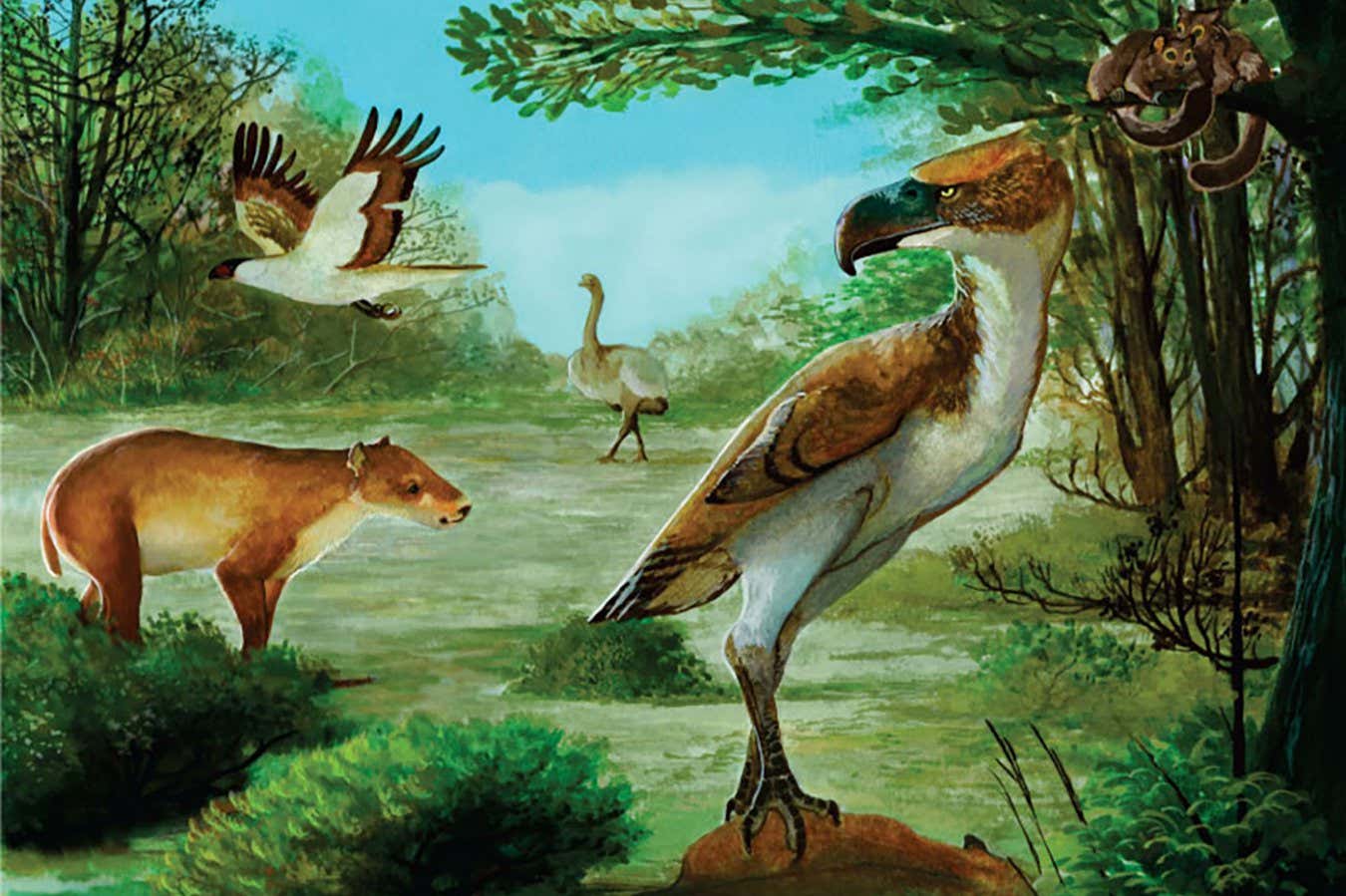
Illustration of a terror bird and other animals that may have lived in what is now Antarctica at the same time
C. Acosta Hospitaleche & W. Jones/Palaeontological Association 2024
A 2-metre-tall flightless bird may have been the top predator in what is now Antarctica 50 million years ago.
Two 8-centimetre fossil claws found on Seymour Island, near the tip of the Antarctic Peninsula, belonged to a large family of similar birds that palaeontologists call terror birds, according to an analysis by Carolina Acosta Hospitaleche at the National University of La Plata in Argentina and Washington Jones at the…
Clownfish and anemones have a symbiotic relationship
wildestanimal/Getty Images
The secret’s in the snot. Chemical changes in the mucus that coats a clownfish’s body can blunt the sting of its symbiotic anemone partner.
Researchers have long suspected that something special about the mucus of clownfish, also known as anemonefish, protects them from the microscopic venomous barbs of an anemone’s tentacles. But the precise mechanism remained a mystery, says Karen Burke da Silva at Flinders University in Australia.
To investigate, she and her colleagues raised orange clownfish (Amphiprion percula) and bubble-tip anemones (Entacmaea quadricolor) in the lab. Some of the fish and anemones were paired together, while others lived separately. The team took mucus samples from the fish at various times before and after they acclimated to their anemones, then put the mucus on microscope slides and pressed it onto an anemone’s tentacle.
Anemones sting by explosively firing tiny, coiled, venomous harpoons from stinging cells called nematocytes. Using a microscope, the researchers counted and compared how many nematocytes fired between the mucus treatments. They found mucus from clownfish partners – but not from unacquainted fish – reduced nematocyte firing.
To figure out why, the researchers analysed how glycans – chains of sugars that attach to proteins – and fats in the mucus changed as the clownfish acclimated to their host. Three weeks into a symbiotic partnership, the mucus’s chemical profile had shifted substantially. In particular, the concentrations of seven different types of glycans had changed. Getting rid of glycans or otherwise tweaking them may be one way to suppress the nematocytes’ firing, says Burke da Silva.
Alonso Delgado at The Ohio State University wonders if other anemone symbiotes, such as anemone shrimp (Ancylomenes magnificus), use a similar glycan method to stymie stings, or if they have evolved different strategies.
Additional strategies could also be at play in clownfish. The glycan change is slow and reverts within a day of the partners being split up. Instead, the fish may use an unknown chemical strategy in the very beginning to get initial access to the anemone.
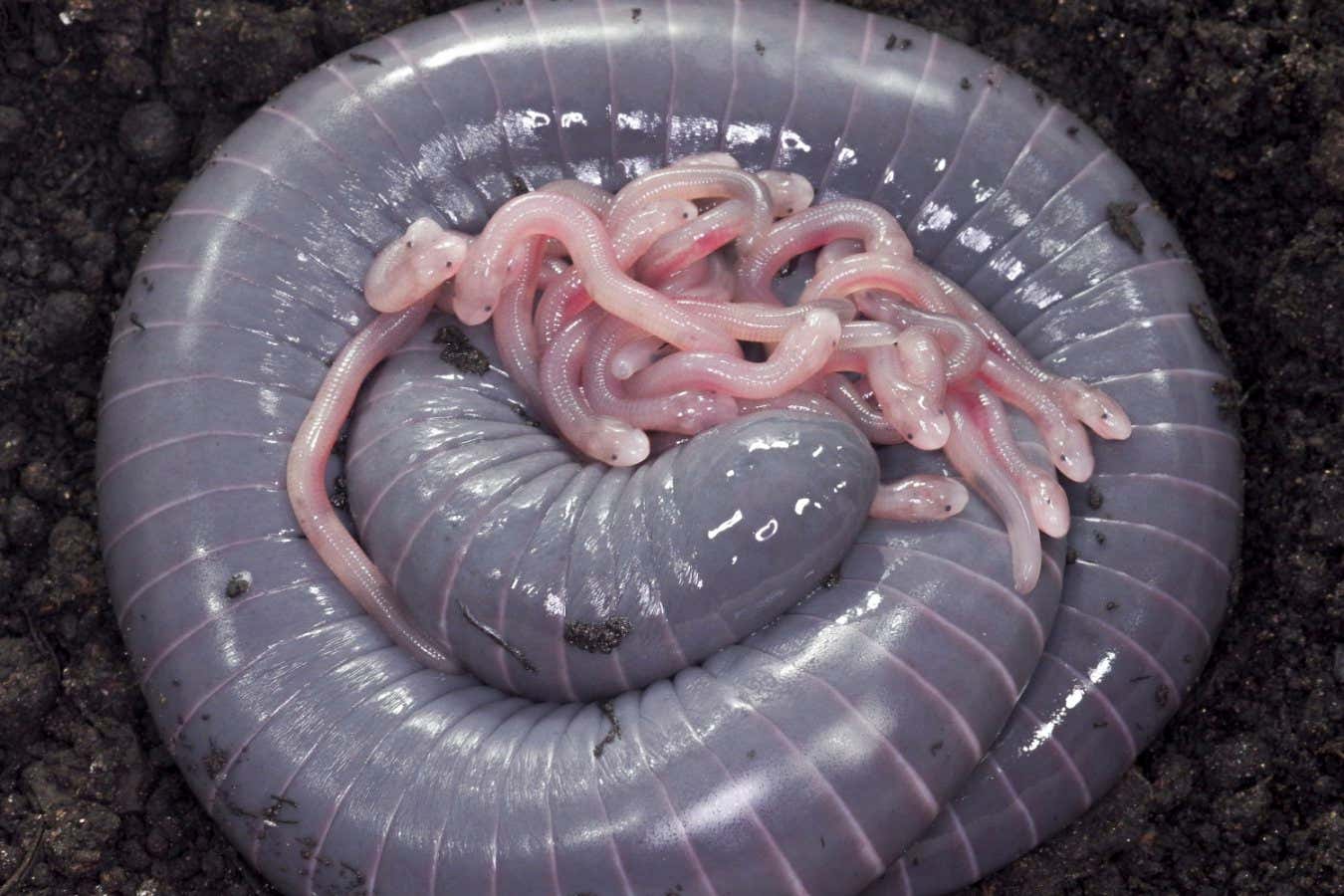
A worm-like creature secretes a nutritious milk from its rear end to feed its hatchlings, in the first known example of an amphibian feeding its young in this way.
The ringed caecilian (Siphonops annulatus) is a legless, egg-laying amphibian that can be found in dark, moist forest floors across South America. It reaches up to 45 centimetres in length, with white grooves encircling its deep blue, cylindrical body.
Ringed caecilians are born with spoon-shaped teeth. They use these to feed on their mother’s skin, which is rich in lipids and proteins.
“But this skin feeding only happens once a week,” says Carlos Jared at the Butantan Institute in São Paulo, Brazil. That isn’t enough food to sustain the rate at which the young develop, he says, with some growing 150 per cent larger within their first week of life.
To find out where their extra nutrition comes from, Jared and his colleagues recorded videos of 16 female ringed caecilians and their hatchlings.
The team observed the hatchlings wriggling around the end of their mother’s body several times a day, often nibbling and sticking their heads into a posterior orifice, known as a vent.
Closer inspection of the footage showed small drops of a milk-like substance often spilling onto the vent’s opening, which suggests that the young were actively feeding on it.
Analysis of the milk revealed that it contained lipids and carbohydrates. “These carbohydrates are very important,” says team member Pedro Mailho-Fontana, also at the Butantan Institute, as they give the hatchlings the energy they need to grow.
The team also found that touch and sound signals from the hatchlings stimulated milk production in glands within the mother’s oviduct, or fallopian tube.
Some caecilians that give birth to live young secrete nutritious fluids for the fetuses inside the mother’s body, says Mailho-Fontana, but this is the first time amphibians have been found to produce fluid to feed their young outside the body.
“Caecilians are a real surprise box,” says Jared. “They’re very secretive, living inside the subterranean world, which is different to the surface of the earth. They adapted in a world completely different to what we know and needed to invent several new behaviours to live.”
Salmon killed by an algal bloom at a fish farm in Norway
Berit Roald/EPA-EFE/Shutterstock
Farmed salmon have been dying off en masse more frequently since 2012 and in increasingly large numbers, with millions of fish being wiped out in a single event at some sites. These mass mortality events are commonly caused by stressors such as fluctuating ocean temperatures and poor living conditions, highlighting a need to improve animal welfare practices at salmon farms.
About 70 per cent of salmon sold worldwide is farmed. There are serious concerns about the environmental impact of salmon farming and the welfare of farmed fish, with high mortality rates occurring in fish before they are ready for slaughter.
Six countries produce 92 per cent of the world’s farmed salmon: Norway, Canada, the UK, Chile, Australia and New Zealand. Gerald Singh at the University of Victoria in Canada and his colleagues analysed mortality data from these nations.
The team found that high mortality events increased over time between 2012 and 2022, particularly in Norway, Canada and the UK. A total of 865 million salmon died in that period.
“We’re talking very large numbers,” says Singh. “For Norway, the worst events ranged from about 935,000 fish lost in a month to just under 5 million. In Canada, the worst 10 per cent of events lost between 150,000 and 3.8 million fish.”
If the trends continue, the researchers predict that future mortality events could cause up to 5.14 million deaths in Norway, 5.05 million in Canada and just over 1 million in the UK.
Environmental stressors – including marine heatwaves and a lack of oxygen in the water – and sea lice infestations are some of the possible triggers for these mass die-offs. To reduce the effect of these stressors on salmon, better animal welfare practices need to be implemented, such as not overpopulating fish pens, says Singh.
“These events can have huge effects on local economies, communities and ecosystems,” he says. “For example, if communities that depend on these industries get their farming permit taken away, that can have a huge local effect on the economy and livelihoods.”
About a quarter of Labradors have a hunger-inducing mutation in the POMC gene
Charles Mann/Getty images
Two dog breeds, Labradors and flat-coated retrievers, may be prone to becoming overweight because they have a mutation that both makes them hungrier between meals and lowers their metabolic rate. “It’s a double whammy,” says Eleanor Raffan at the University of Cambridge.
The mutation, which affects a gene called POMC, affects about a quarter of Labradors and two thirds of flat-coated retrievers, but no other dog breeds.
It was discovered in 2016, when it was found to change a pathway in the brain linked with body weight regulation, although exactly how it affected eating habits was unclear.
To find out, Raffan’s team gave 87 pet Labradors a “sausage in a box” test, where the dog could see and smell a sausage encased in an impenetrable container. Labradors with one copy of the mutation persisted at trying to open the box for much longer than dogs without it.
But in a different test, where they were given a can of dog food every 20 minutes until they stopped eating, they all ate similar large amounts of food, whether or not they had the gene variant. This shows that the mutation affects appetite in a specific way by raising hunger levels between meals, says Raffan.
The team also measured the resting metabolic rate of flat-coated retrievers when they were asleep and found that those with two copies of the mutation had a metabolic rate about a quarter lower than that of other dogs.
The effects are expected to be the same in either breed, says Raffan, but in the second experiment, they wanted to look at dogs with two copies of the mutation, which flat-coated retrievers are more likely to have than Labradors.
Many other genes probably affect body weight in dogs, as they do in people, says Raffan.
Dan O’Neill at the UK’s Royal Veterinary College says owners with overweight dogs should try to avoid giving treats as a way of showing affection and could instead give their dogs other forms of attention. “You could replace that treat with a walk,” he says.
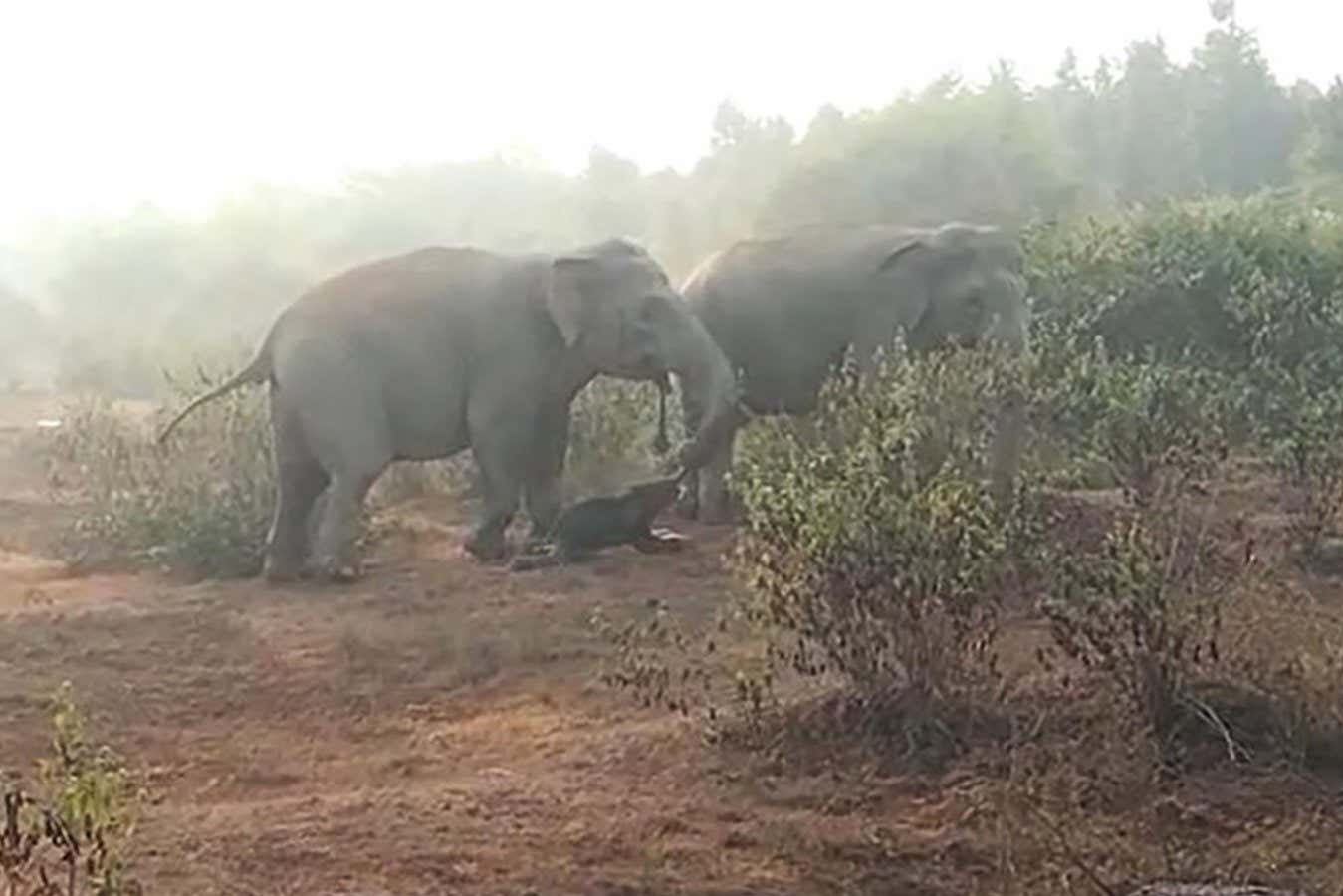
An elephant pulling a dead calf on a tea estate in north Bengal, India
Parveen Kaswan and Akashdeep Roy
Asian elephants have been documented deliberately burying the bodies of their calves in the first scientific report of such behaviour in this species.
Five buried calves were discovered in drainage ditches on tea-growing estates in north Bengal, India, all with their feet and legs protruding from the ground.
Footprints and dung of various sizes indicate that herd members of all ages contributed to each burial. Night guards at the estates reported loud elephant vocalisations, sometimes lasting as long as 30 to 40 minutes, before the herd left the area.
Akashdeep Roy at the Indian Institute of Science Education and Research in Pune and Parveen Kaswan at the Indian Forest Service suggest that these trumpeting sounds may signify mourning and that the herds showed “helping and compassionate behaviour” during the burials.
“Calf burials are extremely rare events in nature,” says Roy.
They were surprised that the calves were buried feet up, but if the herd collectively buried each calf, this is the most accessible position to place the carcass into the drainage ditch, says Roy. As social animals, it may be most important to the elephants to bury the calf’s head, he says.
An elephant calf buried on a tea estate, with its feet protruding from the ground
Parveen Kaswan and Akashdeep Roy
The calves’ bodies were later exhumed and examined. They ranged in age from 3 months to a year old, and a number of them were malnourished and had infections. Bruising along each calf’s back suggests they were dragged or carried long distances to the burial sites.
African bush elephants (Loxodonta africana) have been observed covering dead bodies with vegetation and returning to these locations later. However, the Asian elephants (Elephas maximus) in this study generally avoided returning to the burial sites, instead using alternative pathways.
“These observations offer impressive evidence of the social complexities of elephants,” says Chase LaDue at the Oklahoma City Zoo and Botanical Garden. “Others have noted that elephants appear to behave in unique ways towards their deceased relatives, [but] this paper is the first to describe what appears to be methodical and deliberate burial of elephant calves after they have been carried to the burial site.”
Still, LaDue says that “we must be careful in how we interpret these results, especially as the mental and emotional lives of elephants are still largely mysterious to us”.
He isn’t convinced that the positioning of the calves was intentional. “I could envision elephants pushing a dead calf into a narrow ditch, and given the awkward shape and weight distribution, the calf landing on their back with the feet in the air,” he says. “Then, because of the shallow depth of the ditch, the feet are left unburied, not because they deliberately buried the head, but due to the unique topography of the burial site.”
The land in which elephants once roamed freely is shrinking as humans expand – especially in India, the world’s most populous country. Only about 22 per cent of the land that elephants use is within protected areas.
“Understanding how elephants behave and respond to rapid changes in human-dominated landscapes may help us develop conservation strategies that promote the coexistence of people and elephants,” says LaDue.
The earliest known sex chromosomes have been found in an octopus species native to the Pacific Ocean. These chromosomes evolved up to 380 million years ago, and they are the first evidence of genetic sex determination in cephalopods – a group that includes squid, cuttlefish, octopuses and nautiluses.
“Cephalopod sex determination has been a complete mystery up to this point,” says Andrew Kern at the University of Oregon. Researchers have long thought that cephalopod sex is determined by environmental factors, such as temperature. But Kern and his…
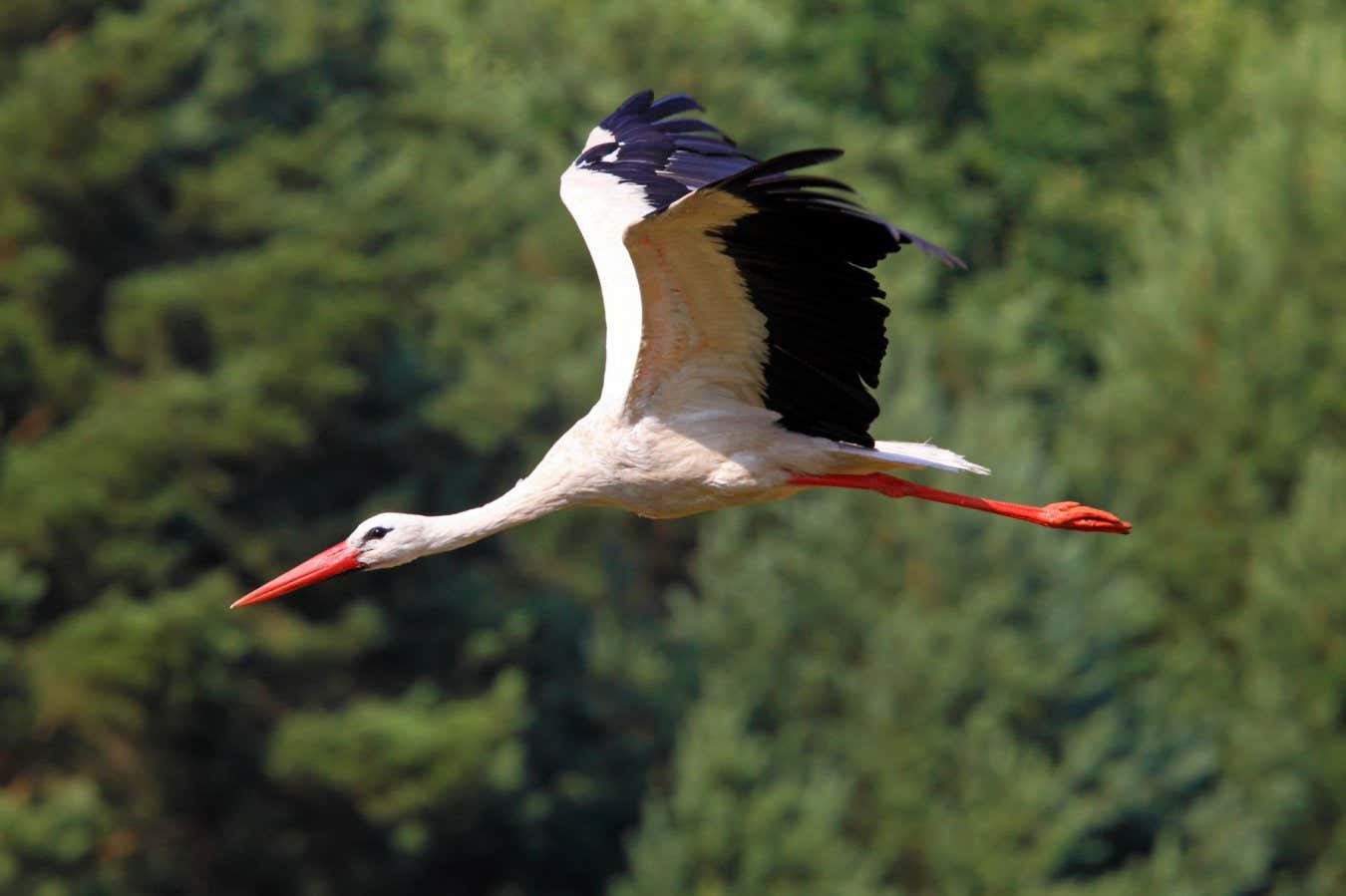
Christian Ziegler/Max Planck Institute of Animal Behavior
White storks take increasingly quicker and more direct routes for their migrations as they get older, which suggests they learn by experience to perfect these paths.
“We’ve been able to track these animals and gain detailed information on when and where they go,” says Ellen Aikens at the University of Wyoming. “But we wanted to learn more about how migration is refined and developed over the stork’s lifetime.”
White storks (Ciconia ciconia) mostly breed in Europe, but fly to central or southern Africa for the winter. Between 2013 and 2020, Aikens and her colleagues captured 258 juvenile white storks at five breeding sites in Germany and Austria. They fitted them with tags that tracked their location before releasing them.
In total, the team managed to record 301 migration events from 40 white storks, which had all completed at least two consecutive migrations.
After analysing the data, the team found that younger birds tended to spend more time exploring new places and trying out different paths each year.
“The reasoning behind this is that, in early life, they are collecting information to get to know their environment better,” says Aikens. “They aren’t breeding yet, so they have less time pressure to get to territories needed for breeding or to build nests.”
As the storks got older, however, their paths gradually became straighter and they flew much faster to get to their destination earlier.
“This suggests that they’re incrementally refining their routes to be shorter and more direct, but this came at the cost of having a more energetically expensive migration,” says Aikens. The changes occurred because, once storks mature, they must compete with others for high-quality nesting sites to successfully breed, she says.
“These storks learn just the way that we learn,” says Aikens. “We should really give them more credit for how intelligent and how amazing it is that they can successfully complete these journeys and do it better over many years.”
Humpback whales were affected by a marine heatwave in the Pacific Ocean
Nicola Ransome
The number of humpback whales in the North Pacific Ocean fell by 20 per cent between 2012 and 2021, according to a study that used artificial intelligence to identify individual whales from photos of their tails.
The decline coincided with a massive marine heatwave sometimes called the blob, which began in 2013 and lasted until 2016. The unprecedented intensity of the blob was almost certainly the result of global warming.
The findings suggest that around 7000 whales starved to death because of the marine heatwave, says Ted Cheeseman at Southern Cross University in Australia. The blob is known to have caused mass die-offs of many other animals, such as seabirds.
“This is unlikely to be a one-time event and if we do not rapidly curb the causes of climate change globally, more marine heatwaves decreasing ocean productivity worldwide will be our future,” says Cheeseman.
“This will hit humpback whales and other whale species, but we should recognise these whales are indicators of ocean health. We humans depend on that ocean health for many things,” he says.
Whale populations are usually estimated by methods such as ship surveys, where the number spotted in one area is extrapolated to get a rough idea of the overall population. This study is the first to exploit data from an international collaborative project called Happywhale, where anyone can submit photos via a website or app, along with the time and location of the sighting.
AI is used to identify individuals from the photos. In the case of humpback whales (Megaptera novaeangliae), this is based on the shape of their tail flukes and their pigment patterns.
Overall, nearly 800,000 photos have now been submitted to Happywhale, which was co-founded by Cheeseman. That has allowed more than 100,000 individual whales around the world to be identified.
“With collaborative work enabled by the AI-powered image-recognition technology, we can cost-effectively study and monitor species that have been historically too difficult to track in fine detail,” says Cheeseman.
A large international team analysed the data to provide the first detailed picture of how the North Pacific humpback population has changed over time. The researchers expected to find that the population was still slowly recovering, as it had been since whaling largely ended, or had stabilised. Instead, they found evidence of a major decline from around 33,500 in 2012 to 26,500 by 2021.
There are large uncertainties in the numbers, but the team thinks the decrease is real. “What were the exact numbers? We can’t know, but we are quite confident in a major decline, a major loss of life in the North Pacific humpback whale population,” says Cheeseman.
“If not for the breadth of this effort, I suspect we’d have never realised the extent of change caused by this one massive marine heatwave,” he says.