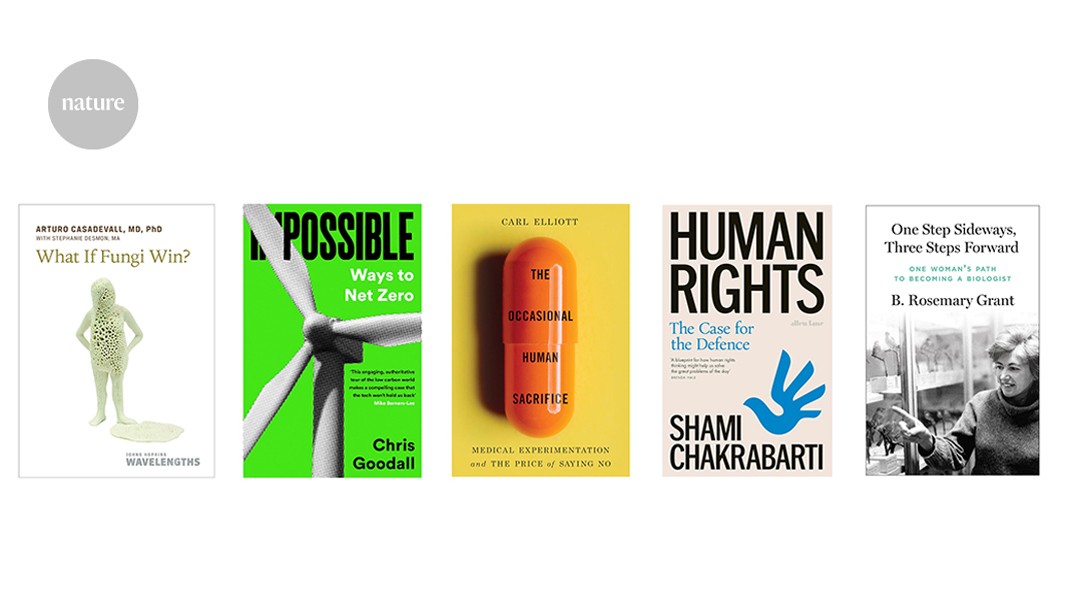
Self-driving cars have been a hot topic for decades. In 2023 in the United Kingdom, the first hands-free car was approved for use on some public roads. It monitors the driver’s eyes to ensure that they watch the road. “In other words, driverless cars are here … and they require a driver,” jokes journalist Nicole Kobie in her vivid account of why the future often takes so long to arrive. The gap between theory and successful technology can be decades — as was the case for computer scientist Alan Turing’s conception of artificial intelligence.
After 1177 b.c.
Eric H. Cline Princeton Univ. Press (2024)
In 2014, archaeologist Eric Cline published 1177 b.c.: The Year Civilization Collapsed. His new book analyses, in formidable depth, the four centuries that followed, across the Aegean and Eastern Mediterranean world, a period regarded as a dark age for Greece by most twentieth-century historians. By examining evidence for the seven criteria of civilization — including a centralized economy, literacy and impressive architecture — he concludes that this was more a time of “rebirth and renewal” than of “darkness and despair”.
Vector
Robyn Arianrhod Univ. Chicago Press (2024)
Mathematics began in ancient Mesopotamia five millennia ago. But as mathematician Robyn Arianrhod notes, “it took a very long time to create the idea of a single symbol having both magnitude and direction” — the vector. Conceived in 1843 by William Rowan Hamilton, it subsequently enabled James Clerk Maxwell’s theory of electromagnetism, Paul Dirac’s quantum field theory, Emmy Noether’s connection of mathematical symmetry with energy conservation and more, as this book describes with lively clarity.
The Atomic Human
Neil D. Lawrence Allen Lane (2024)
Computer scientist Neil Lawrence has worked on machine learning for more than 20 years at universities and technology companies: experiences that illuminate his views on intelligence in this demanding but fascinating debut book. Its title draws on the concept, proposed by the philosopher Democritus, that matter cannot be reduced beyond atoms. Lawrence argues that human intelligence is also atomic. “Although not a believer, I have sympathy with the idea that there is a spirit within us that cannot be replaced by a machine.”
The Art–Science Symbiosis
Marcelo Velasco & Ignacio Nieto Springer (2024)
“The greatest scientists are artists as well,” remarked Albert Einstein. The insight underlies this exploration of “how artistic methodologies intersect with experimental science to produce unique results”, note biologist Marcelo Velasco and art theorist Ignacio Nieto. For example, a sketch by psychologist Nicholas Wade shows the French words ‘Une pipe’ shaped into a tobacco pipe, with the caption ‘Ceci est une pipe’ — a commentary on surrealist René Magritte’s The Treachery of Images, with the words ‘Ceci n’est pas une pipe’. Andrew Robinson
The voice is strongly southern. There are variations to these accents and this one is what I would describe as country. It fits. I am standing in a marsh hours from the nearest coffee shop. Definitely country.
I don’t think it’s usually a marsh. Seems like this area was flooded in the recent storm and water has pooled in this flat yard.
“Did you hear me? You can’t be here.”
Leaning over, I push a tiny container into the overgrown grass. The substrate is sponge-like, giving up the goods with the slightest pressure. There’s a telltale snick when the container draws the sample.
Success.
I screw the cap on and tap the bottom of the vial to my work phone. It vibrates, signifying that the location has been recorded so I place it in my pocket and pull out a new one.
“Is that — are you taking samples? You don’t have permission to do that!”
I grab a pamphlet out of my inner jacket pocket and hand it to him. As he squints at the small print, I continue on my way. This property drains (poorly) into a creek that feeds into a river. That’s where the tainted water was collected. My team has sampled 17 streams, 20 ditches and 3 ponds trying to track the source of that pollution and this is the last stop —
Read more science fiction from Nature Futures
“Department of — What are you? A fed?”
I nod even though that’s a silly term. It makes me sound like a cop. I don’t investigate people.
He keeps up with me as I make my way to the far side of the property. There is a smell — sewage.
When I glance at him he says, “I’m getting the tank serviced today. Is that what you’re out here for? Septic-tank code enforcement? There was a storm, and the stream flooded our yard and —”
“I’m not investigating your septic tank.”
“Oh,” he says, looking confused. “What’re you investigating then?”
“Genetic contaminants.”
His confusion doubles. I watch his brows raise a smidge when he realizes.
“Splices,” he says. “You’re saying there’s a splice around here?”
He looks around dramatically.
“Yeah. Recently.”
“Huh.”
He continues to follow me as I collect more samples. Some obviously contaminated with sewage.
Ugh.
It is what it is. I have to deal with all kinds of biological matter. It’s the job. That’s why I’m wearing disposable gloves, goggles and waders.
“What kind of splice? Maybe I seen it.”
I shake my head. “You would know if you saw it. It’s a large mammal. Carnivorous. They haven’t mapped its genetics yet, but it was alarming enough for us to start looking right away.”
“But how will you find it if you don’t know what to look for?” he asks. This guy’s default setting seems to be perplexity.
“I’m just collecting samples.”
“Oh.”
He’s quiet as he follows me to the ditch at the edge of his property and I finish up, opening my trunk to secure the samples, tapping my phone to the sensor on the case, then peeling off my protective gear and stuffing it into a biohazard container.
“Should I be worried? We have kids —”
“It’s just a precaution,” I assure him as I mist my hair and clothes with decontaminating agent. “Scan the back of that pamphlet to access a chatbot that will answer all of your questions.”
“Uh-huh.”
“Have a good day sir.”
I get into the single-occupancy drone. It’s not mine, it’s provided by the department. It even has a government seal on the side.
When I was in school and imagined the research I would be doing in the field I never thought it would be tracking splices. I thought I would be making splices. Maybe if I had been born a decade or two earlier. Now most of the gene-crisping techniques are illegal and those that aren’t are patented. It’s not like back in the day when any layperson could alter the genes of their houseplants, pets, children as easily as they edit a spreadsheet.
When I first joined up, we focused on tracking dogs and cats. We didn’t have to kill these animals, thank goodness. They were sterilized. It was exciting work though. I have held a full-grown German shepherd in the palm of my hand. Size of a hamster. I transported an adult giant panda that was as small as a squirrel. We tracked a squirrel as big as a Rottweiler that had iridescent lime-green fur.
All of the cute cases are gone. Now it’s all plants, fungi and bacteria.
Except this outlier. The DNA had made its way into our monitor. It was set up to catch algae, but it caught — something else. Something mammalian.
As the drone hovers over the property, I can see that they have a serious sewage issue. I’d be surprised if they don’t have problems with their local government about it, with the way it’s getting into the creek.
The drone takes a moment to orient itself, spinning slowly one way, then another.
I see a woman with brightly coloured hair meet the man as he steps onto the porch. Her hair is neon green and yellow. She must colour it herself, to keep it so vibrant and be so far from town. Her skin is very — it’s green. Skin the same bright green as her hair.
Grabbing my phone, I pull up the video feed from under the drone in time to see a little girl come out of the house, exactly the same shade of green as the woman.
Gotcha.
The story behind the story
Mimi Cloutier reveals the inspiration behindSample.
Inspiration for this story first sparked a few years ago when there was a ‘bio-hacker’ in the news who had received a call from the US Food and Drug Administration warning him not to sell genetically edited dalmatians without its approval.
As I scrolled through the article, advertisements were letting me know that kits could be purchased and mailed to my home so that I could learn to make precision genome edits in bacteria.
This made me wonder what a future might look like where gene editing is commonplace. How will a tool like this be regulated? What will happen to ‘illegally edited’ plants, animals and people? What will be the ecological and cultural fallout of all this?
We were floating around Sweeps-04, normal-like, when some space storm hit us hard. Our ship got all banged up. (My Section is taught only Reproductive Arts, so don’t ask me for details.) There’s a chance that we’ll go kaboom. They’re picking people to be modified to breathe on Sweeps-04. Lombard, the ship’s AI, says I oughta stand out to get picked.
Lombard used to tell me star stories to help me sleep. But now the ship’s all creaky and mad, and it’s like we’re living in one of those spooky tales Lombard made up just for me.
Sleeveless girl
On the lower decks, we’re bred to work or breed. Me, I’m 13, I wear tank tops like everyone else, and I’m so plain I could cry.
I want to stand out. So they’ll keep me.
Pick up your life at mid-calf
Before all this mess, we were putting together a time capsule with bits of what we’re all about. Captain says to keep at it, to distract us from, well, possibly dying. I thought I’d throw in some of my messed-up poetry.
Take the line just above, this paragraph title. It means that, if you’re going to be nixed into a cloud of particles, you should live whatever time is left as well as you can. Yes, you must elevate yourself. Like, mid-calf, if you can’t hoist your life higher. It’s a reasonable goal.
So, I’m thinking, what if I become a poet? That’s gotta count for something, right?
Spiral-spiral Sections-Down
Section 45-Down. It’s where my cubby is. A long, long way down.
Spanish grey
On my deck, the walls are grey. Lombard says it’s called Spanish grey from a country on Earth.
This colour’s neither cool nor warm. It’s neutral. Like me.
Solid-colour girl
I’ve spotted a girl from Section 27-Up, a nice deck where I went because the shower cubicles are out of order from 28-Down. This girl has blue skin. And her feet, when she slipped off her socks, were like shiny porcelain. Totally couldn’t look away.
Bright blue and white-footed — that’s very noticeable.
Read more science fiction from Nature Futures
Chick on the lateral rock
My poem got me a ticket to Sweeps-04, for a visit of our future home, and guess who was there? Blue-skin girl, or Whitefoot, as I call her in my head.
As we were landing, our shuttle did a number on a big winged animal. The bird-thing squeaked in rage through our sensors. Whitefoot asked everyone to sign a letter to the Captain about protecting local fauna. She didn’t ask me to sign. Maybe I shouldn’t have hidden behind the last row of seats.
My friend Lombard suggested “greater social visibility.”
Girls are fashionable
On our deck, everybody is bred to look the same, but some girls just shine a bit brighter. I can only talk about the girls because I’ve never been on the boys’ decks. I just know about the typical boy they show you in the educational vids.
Jacket with slenderizing collar
Lombard thinks I’m chubby, and it suggested wearing a bio-tunic with a fat-melting collar. I told Lombard where it could stash its slenderizing stuff. The AI didn’t take it well.
Breathable people of high cubic capacity
Young people are being selected for the mods. I heard Whitefoot was good to go down on the planet, and I hope I’ll make it too.
Hard purple bovine on a captive nail
I was looking out the Pavilion Bay (because they let a select group from the lower decks climb up to take a look) when I saw a purple cow! It was a dance of ionized gas wrapped around a large pointy asteroid we call The Nail. Whitefoot was there, too, but didn’t even glance my way.
I was called for the assessment to ride the pods that’ll land on the planet. Maybe I’m standing out from the crowd (I was picked for the shuttle trip, and now for stargazing, right?)
Wouldn’t that be something?
Hope is a neon worm
One of my poems has gone into the time capsule!
Happy dance!
Paragraph of the empty girl
Hope is a sneeze in zero gravity.
It’s not looking good for us non-special types. The Captain, all grimy, said we must prepare for the worst.
Lombard’s voice was all reedy and low. I got it all before he could continue. Poets are down-down on the list.
My belly feels like an empty cubby.
Music-music inside the wall
The people sent down to the surface will live. The others will not. We’re about to become shards of nothing.
I said hello-goodbye to Whitefoot, and she smiled kindly, but she didn’t recognize me because I’d never talked to her before.
I’ve got nobody to talk to but the girls that didn’t make the cut, and they’re moody.
Music with no words comes out of the walls.
Lombard had one last piece of advice: “Dress up in your finest, smile wide for the cameras of the Social Studies Department — it’s our final scene.” But ‘finest’ isn’t a word for what I’ve got in my wardrobe. The only thing close is a long-long scarf I found in Whitefoot’s cubby.
The air is thin. I’m seeing black dots. My head is light-light.
I clutch Whitefoot’s scarf like it’s my lifeline.
(Whitefoot’s name is Juliette.)
Forgotten scarf
Than it hits me. The scarf in my hands, Juliette’s scarf, isn’t just fabric. It’s proof that Juliette is part of my story now. It makes me feel like I’ve lived more than my years. And maybe, just maybe, it makes it easier, knowing I’ll be remembered for my words long after we’re gone, even if just in a tin can floating among the stars.
Gio Clairval reveals the inspiration behindFound in translation.
While shopping for clothes online, I stumbled across automated translations of Chinese product descriptions. These surreal AI interpretations sparked the idea for a story: what happens when even truly unique individuals are deemed expendable, their perceived value not aligning with a community’s narrow definition of usefulness?
Why should an orangutan care what toothpaste a person uses, asks economist Dharshini David, in her appealing book about how human lifestyle choices affect the planet. Answer: some toothpastes use palm oil to create foam, whereas others don’t, and palm-oil production requires the clearing of tropical forests, eliminating the habitats of creatures such as orangutans. “Nearly every issue that affects the environment comes down, in some way, to what someone, somewhere, is doing to make (or save) money,” she writes.
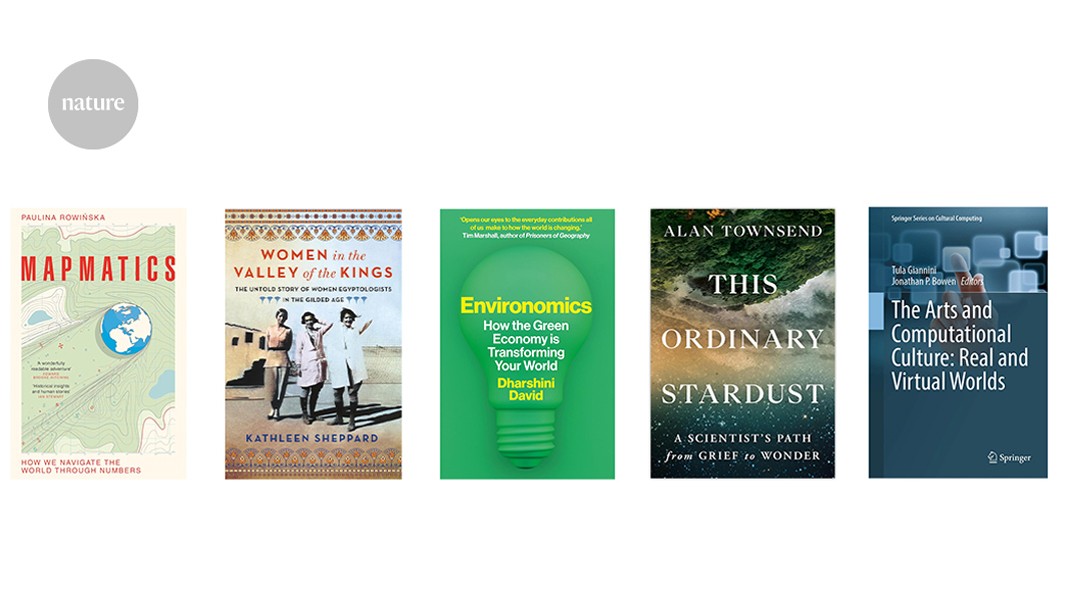
Mapmatics
Paulina Rowińska Picador (2024)
From world maps designed by geographer Gerardus Mercator for marine navigation in the sixteenth century to online maps created by Google for self-driving cars in the twenty-first century, maps rely on mathematics. “While different on the surface, the jobs of a mathematician and a cartographer are surprisingly similar,” writes mathematician Paulina Rowińska in her engaging and original history of ‘mapmatics’. Indeed, maps not only depend on mathematics but have also inspired many mathematical breakthroughs.
The Arts and Computational Culture
Eds Tula Giannini & Jonathan P. Bowen Springer (2024)
This substantial, topical collection on the arts and computing, edited by information scientist Tula Giannini and computer scientist Jonathan Bowen, begins with polymath Leonardo da Vinci’s blending of art and science and ends with a survey of modern art exhibitions that involve computing. As the editors write, “facilitated by computing, artificial intelligence, machine learning, algorithms, and simulated human senses, the arts are expanding their horizons”. Perhaps AI will eventually stand also for Artistic Imagination?
Women in the Valley of the Kings
Kathleen Sheppard St. Martin’s (2024)
Discussions of Egyptologists tend to focus on men — for example, Howard Carter, who excavated Tutankhamun’s tomb in 1922. Yet, women played an important part in Egyptology, as historian Kathleen Sheppard describes. She begins in the 1870s with Marianne Brocklehurst and Amelia Edwards’s A Thousand Miles up the Nile, and ends with Caroline Ransom Williams’s death in 1952. Lacking permission to find artefacts, these women “acquired, organized and maintained” the world’s largest collections of Egyptian objects.
This Ordinary Stardust
Alan Townsend Grand Central (2024)
Alan Townsend, dean of the college of forestry and conservation at the University of Montana in Missoula, calls himself a biogeochemist. This field can teach us, he remarks, about cornfields, fertilizers, lake colours, sea life and even planetary warming. It can also “nurture the soul”. He learnt this truth when both his beloved wife and four-year-old daughter fell ill with brain cancer, and only the child recovered. His moving memoir describes how scientific wonder rescued him from appalling grief and suicidal thoughts.
As a part-time PhD student, blocking out time both work and study helped Simone Willis to keep a good work–life balance.Credit: Paul Goode Photography, Simone Willis
When I enrolled for a part-time PhD in 2016, it was for flexibility and financial reasons. I was working as a music tutor across Cardiff and South Gloucestershire, UK , teaching violin, flute and fife. These experiences, coupled with an undergraduate degree in music, led me to apply for a PhD exploring workplace stress and well-being in classical musicians and people studying at US conservatoires.
In the second year of my PhD, I accepted a part-time job at Cardiff University as a systematic reviewer, alongside my studies. Given the topic of my thesis, I wanted to to maintain a healthy work–life balance. Since graduation, I’ve stayed in that role, assessing medical devices and conducting evidence-synthesis projects in health and social care. I’ve also co-authored 13 papers examining mental health and well-being across a variety of sectors and settings. Using my experiences as inspiration, here are seven tips that helped me to balance my work, study and well-being during my PhD.
1. Treat your PhD like a job
I set boundaries for splitting my 9-to-5 week between work and study. This meant a 50/50 split of my working hours. Before I started my job as a reviewer, I spent 20 hours a week teaching music and 20 hours on my PhD.
Aside from a few late nights and weekends, I treated my PhD exactly like a part-time job. I blocked out time in my diary for both work and study, which helped me to plan and keep focused. Sticking to these boundaries allowed me to decompress and make time for friends, family and hobbies. I’d leave the office to attend a dance class and then catch up with my husband over dinner. Studying part-time meant that the PhD was not an all-consuming process and provided perspective — life outside the PhD continued.
2. Leave tasks incomplete
When switching between work and study, I often needed to pick up a train of thought from a few days before. A technique that worked well was writing a list of any uncompleted tasks at the end of my day, either scribbled on a sticky note on top of my keyboard, or as a comment on a document. These helped me to pick up ideas again later without needing to mentally retrace my steps. For example, if I was in the middle of writing a paragraph in the discussion section of my thesis, I’d leave a note to say, “Describing x finding, relate to y theory”, before heading off.
At first, leaving paragraphs with half-finished sentences or suggestions on where to take my writing felt counter-intuitive, but making these notes allowed me to write without losing momentum and gave me time for reflection.
3. Be realistic about what you can achieve in the time available
Early on, I was overambitious when planning my studies, which led to frustration. For example, I planned to complete background reading and write my literature review in the first three months. In fact, this took much longer and was something I returned to in the final stages of putting together my thesis.
Over time, I developed a better sense of how long tasks would take, especially writing, and learnt to plan accordingly. I found a system that allowed me to write fluidly. First, I mapped out an overarching structure for my thesis, using headings and bullet points in a document. Second, I identified references and noted where they would go in the structure. Only then did I turn to writing each section in detail. In the final stages of writing my thesis, I was able to accurately map out monthly, weekly and daily writing tasks.
4. Be selective when saying ‘yes’
I also learnt to value my time and consider what opportunities to take on. It is tempting to say ‘yes’ to every opportunity that comes along, but I developed skills in being selective and saying ‘no’ when needed.
I made my decisions by reflecting on the following: have I already done something similar? Is this opportunity something I want to do or something someone else wants me to do? Do I realistically have the time? Is this a one-time-only opportunity or will there be similar chances in the future? What are the potential benefits and harms of saying ‘yes’ or ‘no’?
In my second year, I chaired the doctoral-researcher committee, which organized events and represented PhD students on academic committees. I remember being asked whether I would be on the committee for another year, and my instinct was to say ‘yes’. But after a moment of reflection on those key questions, I realized that it was better to focus on my research. I ensured that the committee was in a good position and had recruited new members before I left.
5. Connect with peers
Sharing the journey with other PhD students was invaluable for receiving advice, celebrating the highs of publication and sharing the challenges and setbacks of data collection gone awry.
I was initially registered on an master’s leading to a PhD, so had to formally transfer onto a PhD programme in my second year. I needed to submit a written report as well as pass an interview. I remember speaking to Helen, one of my peers, about the process and she advised me on how to structure my application and we discussed the questions asked in her interview. This helped me to prepare for the interview and understand the strengths and weaknesses of my work.
I also worked in a shared office alongside 15 other PhD students. This space allowed me to connect with students at different points in their studies and be part of a community of doctoral researchers. More widely, talking to friends in other professions helped to keep the PhD in perspective and understand that there are many ways to be successful.
6. Communicate regularly with supervisors
Early on in my PhD, my director of studies suggested that I send an agenda ahead of meetings with my supervisors. This gave each meeting purpose and clarity in the topics to discuss. This was especially helpful in the write-up phase, when I needed to discuss different chapters and consider the thread throughout my thesis. To keep momentum, before each meeting ended, I scheduled the next meeting.
After each meeting, I sent a brief summary over e-mail, which allowed me to revisit important decisions later in the project. It was important to discuss issues before they escalated into bigger problems — my supervisors were a source of support and encouragement throughout my PhD.
7. Write as you go
When I first started, I had no concept of what 80,000–100,000 words looked like — only that it sounded like a lot. I was advised early on to write throughout the PhD process and not leave everything to the end. This appealed to me because I like having a plan and was concerned that I’d forget why I had made particular decisions if I left the writing until the end. Initially, however, I felt like I was getting nowhere, constantly redrafting and not knowing what direction to take with each individual chapter. Because my music degree was performance-based, I hadn’t had much practice writing in an academic style and it took me a while to develop my academic voice.
One thing that really helped was writing the manuscript for the first study from my thesis. This helped me to improve the structure of my work and to communicate an argument. Writing also helped me to clarify my understanding of the research area.
Although inspired by my experiences and those I interviewed working in music, I hope that these tips are transferrable to graduate students in a variety of disciplines.
The Entry-Ant whirred and beckoned the impatient queue forward. Jeri frosted her eye-clips to black for the scan-scorch procedure.
“Jeri Ego.”
The Ant’s spark-beam flickered green as she spoke. Jeri wasn’t sure why Med\Core felt they needed to give her a burner name. She was only here because her in-line health probe had been malfunctioning — was kaput, in fact — and her credit rating was close to zero as a result. But arguing with an Ant was never advisable.
The scanner turned dark blue. “Negative ID,” the Ant hummed. Jeri’s throat tingled. The gate compressed. The Ant’s voice tone shifted to a faintly accented, faintly female chirp. “Please contact your local provider for reassessment of scan access.”
The gate decompressed for a moment. Some kind of malfunction; Med\Core weren’t known for investment in maintenance. Jeri wriggled through before the Ant could protest.
No one followed her. Med\Core really were slipping. She found her way to the reset labs unimpeded. Once she’d made it clear to the senior tech that she wasn’t going to leave without being seen she was shown to a tiny, semi-private cubicle and provided with a trainee consultant by the name of Larel^6, who looked so like Jeri’s teenage niece she wondered if they’d been clone-enhanced from the same template.
Thirty minutes later Larel was shaking her head. “I don’t want to hear it,” Jeri said. “I need a refit. This probe is faulty to its core.”
Read more science fiction from Nature Futures
“Yah, like, you could straddle onto Central?”
“Tried it. Made things worse. You know how many times a day I have to find a workaround?”
“I fathom that, Mz — er …” Larel defocused her eyes. “You’re not showing up on my clips, reason unascertained.”
“And what might that reason be? Shall we guess?” Jeri needed, in fact demanded, a refit. Intern or no, Larel^6 would accomplish the procedure. Somehow.
The younger woman bit her lip. “Like … there might be a solution?”
“A cheap one?”
“Free ride, so long as …” Larel took a quick, furtive look around and cast an aural temp-shroud over them. “Should give us about three minutes. So, there’s a mecha to piggyback this.”
“Yeah?” It sounded too easy. “Onto who?”
“Onto me.” Jeri waited for her to continue. “So, like, I’ve got something you want, yah? Cause your probe is fried out. Absolute nada. Like, sabbed.”
“I get it. So what have I got that you want?”
Larel hesitated, only for a second. “Credit.”
“Are you serious? That’s the last thing I have.”
“You repaid your scholarships, including nursery school? Earned ten years’ residence vouchers? Clean socials? Then you got credit.” Larel tapped into the assessor terminal. Jeri’s face fractalized onto the d-screen. “Some citizens can’t parallel with the probes. Figure you’re fundamentally incompatible. What diagnosis did it give you?”
“Everything you could imagine,” Jeri said. “All inaccurate. Cancers, neural degeneration, heat-dome mania for starters. Even smallpox.”
Larel whistled. “Bitter. So we can go simpatico. Two years’ yoking then we sever.”
Jeri didn’t know whether to believe her or not. A second opinion might help. But they lived in a world where your only realistic option was to submit to the threading surgery, turning your body into a mobile data-hub that allowed your wellness provider to devise ever more subtle ways to extract your surplus income. If you demurred, your credit rating would never rise above zero.
Therefore, she said, “What ’ware are you planning to use?”
“The good shit.”
“Which is what?” Larel punched at the assessor, ignoring her. “Contra?”
Larel dilated her eye-clips. “Yah, pirate. Functional. Only needs to last short-term though. So we’re on?”
“We’ll have to live together?”
Larel shrugged. “Guess. You’re nexxed?”
“Huh?”
“Like, nexus. Conjoined. Married.”
“God, no. I don’t even have an apat.”
“Cube walker? Grippy. So if we go symbiotic we can lease perma. How about the East Elevens? Plentiful apat bounty north of the river.”
“Woah, woah.” Jeri held up her hands. “Did I agree yet?”
Larel bared her wrist. Light fluctuated from salmon pink to indigo beneath the skin. “Yoke or die, yah? For mutual blessings. I don’t want to live with you either. Pure transactional, then we null. Or I find someone else.” Med\Core’s senior tech drifted past, giving them a sidelong look. “I only get limited shroud-minutes. Decide now.”
She clip-scrolled while waiting for Jeri’s answer, her face a vacant mask with twin orbs of purest black for eyes. Jeri imagined living with her and tried not to scream. Lab sounds drifted in. The shroud was diffusing. She had seconds to make the most important decision of her life.
Maybe, she told herself, it wouldn’t be so bad. And the credit she’d earn would eventually let her upgrade to modded probes, ones that wouldn’t malfunction. Hopefully.
She said, “Fine.”
Larel defrosted. The senior tech appeared out of nowhere, looming over them. “Very well, Mz Ego,” Larel intoned. Her contact details flickered into Jeri’s clips. “I’ll inform you of the next available appointment. Good day.”
Jeri headed for the door before the tech said anything. Out in the city the heat warning placards flashed double red. Her tramway carriage’s air-vents were fritzing. Much more of this and her false diagnoses would become a reality. For a moment she considered having the probes removed, living off-grid without worrying about credit or status or upgrades.
And, most probably, reducing her life expectancy to about a decade. The temperature ratcheted up a notch as she hit downtown. Sweat pooling in the small of her back, she cast her idle dreams of freedom aside, allowing herself a sneaky glance at the Eastern Communes as they rolled past, her clips frosting to indicate yet another erroneous diagnosis.
The story behind the story
Matt Thompson reveals the inspiration behindDreams of the East Elevens.
The science-fictional dreams of yesteryear promised one thing above all else: convenience. A sleek, organized world where those with the means to do so live in luxury unimagined by pre-digital generations. What could be more enticing than freedom from toil, from accidents, from disruption?
The reality, as we’ve all discovered, offers something quite different: data extraction, corner-cutting and asset stripping. Emergent technologies have a tendency to revert to the mean — the mean, in most cases, being defined by the strictures of the stock market. Regulation and maintenance of new tech equals a dent in profits. You can be sure that an innovation such as in-line health probes would suffer the same fate as other advances on the cutting edge.
And when it all goes wrong you’d hope we’d still have each other. But the voracious demands of capital ensure that the private realm must also be strip-mined for whatever profits can be extracted. Atomize society and you atomize potential. Turn the body into a machine interface and you have a captive consumer, in more ways than one. Sometimes the future can overtake us before we’ve realized it’s happened.
The many descendants of Winston Jacobs III filed through the doorway of a farmhouse that had hosted soldiers during the American Civil War. They wore black and, apart from Winston ‘Jake’ Jacobs V, who led the procession, they looked vacantly ahead. Their thoughts lay elsewhere.
The antique wooden chairs occupied the corners of the room, leaving space around the dining-room table. Jake stood at the table with his back to the doorway, facing an oil portrait of the original Winston Jacobs in a uniform from the Great War. For more than a century, the family had gathered around this table for holiday dinners. In the reverent silence, a soft hum filled the air.
It’s about his legacy, thought Jake. The family should stay together.
The family nodded and took their seats.
It would be merciful if he never woke up.
That’s horrible. You read the will. You know damn well what he wanted.
The pronouns stung. For generations, there had been no room for I and you in the Jacobs family.
Jake stepped back from the table. He glared at Amelia, who had married into the family two years ago. She had found the codicil and pressured Harold into pursuing it.
Why did Harold have to marry? She wasn’t right for him, not for this family.
“Shut up!” said Amelia, aloud. She glanced at Harold, who shifted his feet and watched the floor. Her fist clenched around a sheet of paper.
Read more science fiction from Nature Futures
“I think I speak for all of us,” said Jake, “when I say that my grandfather’s wishes are what matters. We all knew that we might never find a cure. We came to terms with that.”
It isn’t right. Even hardened criminals and murderers deserve —
Shut up, for heaven’s sake!
“We all know what it says,” said Amelia. She read from the paper. “If, in 50 years’ time there is no cure for my neurological anomaly, I am to be revived from suspended animation to live out the remainder of my natural life.”
The teenage and lanky Winston Jacobs VII stood without a word.
“Look,” said Jake. “You’re upsetting Seven. Besides, it’s time.” He looked pointedly at Seven, who nodded and left the room with him.
Jake and Seven returned a moment later from the master bedroom, wheeling a gurney into the dining room. Winston Jacobs III, wearing the same suit as when they first put him on the slab, lay atop it with his arms folded on his chest. The family worked together to carry his gaunt body from the gurney to the table.
Jake placed a biomonitor on his wrist. Heart rate: none. Breaths per minute: zero. He placed a patch on his grandfather’s forearm, just above the monitor. The monitor beeped a steady cadence. Slowly, the old man’s cheeks regained their colour.
“Grandpa,” said Jake, after what seemed like ages. “Can you hear me?”
Seven’s eyes widened, as if he’d seen a ghost.
It’s all right. You can’t feel his thoughts, but he’s in there.
Winston Jacobs III coughed.
“Junior?” he said. “No … Jakey, but you’re all grown up. Has it been 50 years already?”
Jake knelt beside him.
“We’re sorry, Grandpa. We tried to find a cure, but we failed. The neural synchronization field won’t work on you.”
Alone forever …
Seven shuddered visibly.
It’s all right, Seven.
Seven placed his fingertips on the old man’s forehead as if the physical contact might transmit thoughts.
“He doesn’t speak,” said Jake. “A lot of kids his age don’t, not if they’re raised in synced families. He’s worried you’ll be alone.”
“Alone?” The old man chuckled. “I’m here with all of you, ain’t I?”
“He means when you … pass away. If your thoughts aren’t synchronized with someone else’s, your consciousness will go away forever.”
Even condemned criminals sync with a chaplain at the end. Their souls have refuge.
Shut up!
“Oh, that,” said the old man. “It doesn’t bother me much. Junior tried to talk me into that years ago.” Sadness flickered on the old man’s features. “I don’t suppose Junior and Eloise are …? No. They wouldn’t be after 50 years, would they, unless they went into stasis like I did.”
A lifetime of memories echoed through the room.
“Mom and Dad are still here,” said Jake. “In every one of us.”
“I’ll be damned,” said the old man. “Junior gave me the same look you’re giving me now, 50 years ago. No need to pity me. Just help me sit up, will you? I feel like some sort of science experiment, lying here with everybody hovering over me.”
Jake and Seven helped him sit up with his legs hanging off the side of the table, face-to-face with the original Winston Jacobs.
“That’s better. What I want to tell you all is that I appreciate the chance to see everybody and I’m glad you kept the house up all these years, but I’m happy being alone with my thoughts. I always have been.”
Amelia gloated wordlessly until Harold elbowed her in the ribs.
Seven eyed Jake expectantly.
“What about your memories?” asked Jake. “Wouldn’t your grandfather have wanted us to preserve all your memories of him?”
“Grandpa? When I was a kid, he wouldn’t even let us turn on the radio when he was in the room. The spooky voices unnerved him. He saw more than his fair share during the war, and I think he was ready to let his memories rest.”
The old man saw disappointment in Seven’s eyes. He motioned for Seven to come closer.
“You don’t see much point in talking do you, son?”
Seven and a few nearby family members shook their heads in unison.
“Fair enough. Maybe you won’t mind listening for a while.” He looked up at the portrait as his family gathered around him. “I was sitting right where you are now, on the day that men first walked on the Moon …
The story behind the story
S. R. Algernon reveals the inspiration behindThe wake.
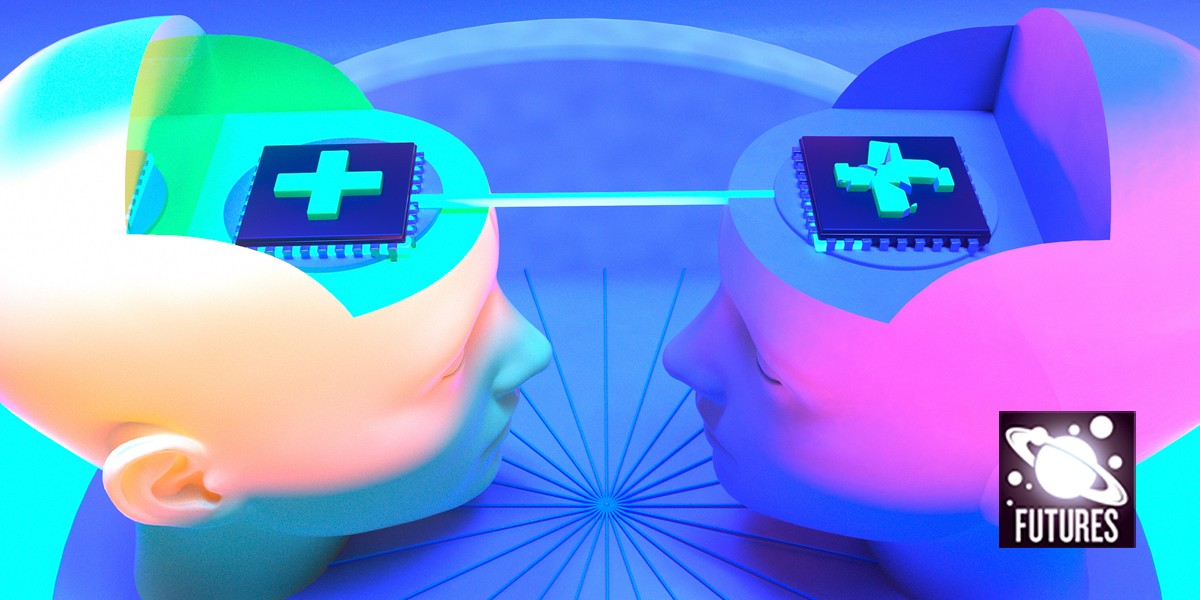
I wrote this story while I was planning for the third novel in my Cygnus series, in which technological changes and alien contact threaten the survival of a human exoplanet colony. I found myself thinking about how brain-linking technology (which is pivotal in Cygnus) might change twenty-first-century humans in light of our responses to earlier advances, such as radio and the Internet.
I wanted to explore how the advance of neural technology could affect relationships within a multigenerational family. Without, I hope, minimizing or lumping together the effects of neurodivergence and perceptual differences in the present day, I considered how public perception of autism, dyslexia, deafness, Down’s syndrome and other conditions has changed over the years. The clash of old-fashioned ideas and prejudices with new understandings and technological advances can spark conflict but also be opportunities for growth.
Current brain–computer interfaces introduce the problem of ‘BCI illiteracy’, a condition in which individuals cannot avail themselves of the technology. I asked myself, would society view someone who was unable to use brain-linking technology as disabled, as cut off from the community, as lacking some core element of human contact? Would family members view this diagnosis as a catastrophic failure or simply as a difference?
I hope that my depiction of the Jacobs family did justice to the feelings of loss and confusion that families often face when a family member thinks or perceives in a way that does not meet their expectations. I also hoped to show that the social context and values that surround our mental capabilities are fluid. One generation’s ‘normal’ becomes an aberration in the next generation and part of a spectrum in the next. I wrote The wake as a reminder that our current circumstances are not the end of the story. If we feel out of place in our modern world, with luck we can look to our past or our future to find a way to belong.
This article is part of an occasional series in which Nature profiles scientists with unusual career histories or outside interests.
In 2019, Carly McLachlan took a call from Mark Donne, a producer with the band Massive Attack. The BRIT award-winning, UK trip-hop band’s music — a fusion of hip-hop and electronica — and environmental activism have been pushing music-industry boundaries for 25 years. Donne wanted to know whether McLachlan, who directs the section of the Tyndall Centre for Climate Change Research located at the University of Manchester, UK, would assess the carbon footprint of Massive Attack’s touring practices and, in doing so, create an action plan to kick-start change across the live-music sector.
Live music is a major carbon sinner — but it could be a catalyst for change
After interviewing the band and its production team, holding workshops with industry professionals and crunching numbers on emissions, in June 2021, McLachlan and her team published the Super-Low Carbon Live Music road map for the UK live-music sector (see go.nature.com/3xdyq5j). The 17-page report is one of the first attempts not only to assess the carbon costs of the UK’s live-music industry, but also to suggest clearly defined and measurable targets that the sector could work towards to meet the aim of the Paris climate agreement to limit global warming to 1.5 °C. The road map’s key message is “that super-low carbon practices can only be delivered if they are central from the inception of a tour”.
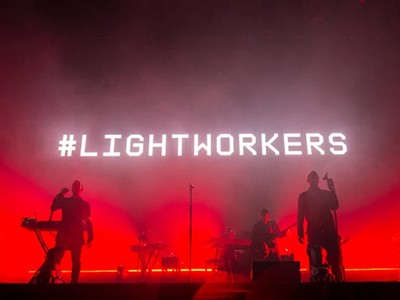
Massive Attack used the road map to deliver what the band hopes was the lowest-carbon concert of its size so far, and one that “fires a starting pistol for the music industry to embrace the multiple opportunities for change”, the band said in a statement. On 25 August, some 34,000 people swarmed Clifton Down, a 162-hectare public park in Bristol, UK, the band’s home town, to attend the Act 1.5 Climate Action Accelerator all-day event.
Using the targets in the road map, the band and Act 1.5 team introduced changes to how the event handled power, waste, travel and food. McLachlan and her research team plan to use data from Act 1.5 to assess what could become new standards for a decarbonized live-music industry. Her team will use interviews with event organizers, conducted before and after the event, to see what worked and what didn’t. The researchers plan to publish their findings, along with a quantitative analysis of the event, in a report at the end of this year. But even without the report, if the audience left the concert happy, that itself could be key to persuading the industry that these academic recommendations are not only major, but also realistic.
“If you suggest something, and people say, ‘Well that would never happen,’ but then they can see it already has happened, it just unlocks a totally different way of thinking,” McLachlan says.
Carly McLachlan’s team produced a super-low carbon road map for live music events.Credit: University of Manchester
The entire concert was powered by renewable energy and batteries, with LED and low-energy lights prioritized for all stage and artistic lighting. Electric trucks were used to assemble and move batteries on site. The event used a pre-existing festival infrastructure and one of the largest batteries ever provided for a UK music event. This saved an estimated 2,000 litres of generator diesel, slashing 5,340 kilograms of carbon emissions.
To decrease the carbon cost of audience travel, which is thought to make up around 41% of an event’s total carbon footprint, train travellers who booked through the Train Hugger app were given special incentives. These included free transfers from the city’s two main stations to the event by electric bus, and people travelling from outside Bristol received access to a special Train Hugger guest bar, which included separate toilets. Food offerings were 100% plant based and provided by local suppliers, and the event had a zero-waste-to-landfill policy.
The band partnered with the local train network, Great Western Railway, to offer five extra trains after hours for fans travelling home. Now, the band is working with local organizers to develop a renewable-energy infrastructure at Clifton Down — a power substation and distribution system — to power future events. “Massive Attack are really good at legacy,” says McLachlan. “These big artists are shifting things along each time; anything that they leave makes it easier for the next lot to ask for the next thing.”
The right fit
From her office at the Tyndall Centre, McLachlan leads a team of about 50 natural scientists, engineers, social scientists and economists who research climate policy, with projects ranging from renewable-energy efforts led by the community to UK tidal energy and the circular economy.
The commitment Massive Attack has made to help produce the road map and then test its effectiveness is exactly what McLachlan looks for in a collaboration. She appreciates the band’s desire to challenge the status quo: they are “people who don’t want you to write them a report that sits on a shelf, but they really want to have a go at making change”, she says.
‘Who will protect us from seeing the world’s largest rainforest burn?’ The mental exhaustion faced by climate scientists
Donne, who is now lead producer of Act 1.5, says that McLachlan was recommended to the band by one of her former colleagues, Alice Bell, who is head of policy in climate and health at Wellcome, a charitable funding organization in London. Massive Attack “wanted to set a clear standard to adhere to that was Paris 1.5 compatible”, says Donne. “Almost all the other schemes in the sector did not” meet that standard, he says. To do this, the team “needed scientists and analysts to make sure the work we built our own projects on was substantive, authoritative and credible”. Donne says that McLachlan “is a joy to work with: always clear, always analytical, always frank”. He especially appreciates the value that comes from the social-science element of the project. “McLachlan and [road map co-author Chris] Jones are very good at looking at knock-on effects and the possible negatives” of initiatives that the band considers, he says.
“The band knew we’d give it to them straight and not sugar-coat it,” McLachlan says, adding that good stakeholder engagement relies on building and maintaining honest relationships that are constructive and collaborative. “We’re a critical friend, but in a jolly packet,” she says of her team’s approach.
The project’s scope also appealed to her. “It’s an area that you might think is quite hard to decarbonize — artists flying around the world taking loads of stuff with them — how are you going to get carbon out of that? If you can demonstrate how to do it in a difficult sector like this, then couple that with the reach of Massive Attack — it can be powerful.”
At their Act 1.5 concert event in Bristol on 25 August, the band Massive Attack powered its show using only renewable energy sources and batteries and encouraged fans to arrive by train or electric bus.Credit: Matthew Horwood/Getty
Jones, a knowledge exchange fellow at the Tyndall Centre who has worked with McLachlan for more than a decade, says; “She’s generated a reputation for not pulling any punches with the kind of challenges we face on climate change.” He notes that there are many different perspectives and priorities in live events, beyond creating music and turning a profit. “So, there can be tensions and different camps can emerge. Carly is very good at building a collective response by bringing it back to the common ground.”
Listening to lower emissions
McLachlan joined the Tyndall Centre in 2003 as a research assistant and in 2005 she started a PhD there that examined controversies for developing renewable-energy projects. She was drawn to the centre’s interdisciplinary environment and working directly with businesses and industries, and, after a brief stint in industry, she rejoined the centre as a knowledge-exchange fellow. McLachlan enjoyed the challenge and pace of the work. “You’re running from one short-term contract to another,” she says. “I found that really exciting.”
Her current work focuses on decarbonizing cities. In 2019, McLachlan worked with the Greater Manchester Combined Authority (GMCA), the body that oversees the wider city region, to help Manchester become the first UK city region to set science-led emission-reduction targets in keeping with the Paris agreement, at a rate faster than the national target.
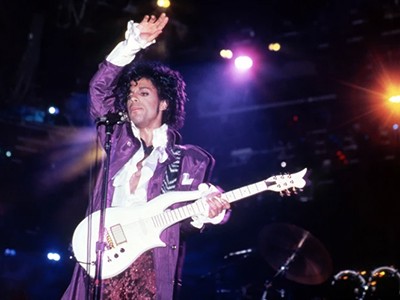
The neuroscientist formerly known as Prince’s audio engineer
McLachlan says that since 2019, more than 250 councils have used the carbon-budget tool created through the GMCA project to set or inform their own targets. “It’s not a silver bullet, but I do feel proud that we made the tool freely available,” says McLachlan. “It’s helped people think a bit more about near-term emissions reductions rather than the 2050 framing of reductions,” she says, referring to the UK government’s legal commitment to reduce its net greenhouse-gas emissions to zero by 2050. Mark Atherton, director of environment at the GMCA, says McLachlan’s “skill at translating complex research into actionable insights make her an invaluable partner”.
McLachlan thinks that acknowledging what you don’t know is essential to an effective collaboration. “You have to be willing to say that you don’t understand. When you do this, you start to learn to speak in a way that more people can understand you and where you’re coming from.”
A planet safe from harm
Working with Massive Attack is “super inspiring”, McLachlan says, because of the band’s sheer persistence. When the group learnt that local trains would stop before the event finished, “They say ‘well then, let’s get some trains running. And who do we have to speak to make that happen?’ If you could bottle that, across all levels of climate action, that’s what we need.”
Donne says more work needs to be done to scale up the changes made at Act 1.5 to make them practical for other artists and events. For example, because diesel generators are cheaper and ubiquitous in the industry, there was an extra cost to not using them — shared in this case by the band and the battery providers. “Central governments need to step up and do more to incentivize decarbonization,” says Donne.
Some critics say that performers should stop touring altogether. But McLachlan hopes this work with Massive Attack will inspire the industry to make significant changes that can protect both the power of live music and the planet. There’s evidence it already has.
The Act 1.5 team is in talks with British rock band The Smile, formed by some members of the band Radiohead, to apply parts of the road map to its upcoming tour activities. And a spokesperson for REVERB, an environmental non-profit organization in Portland, Maine that helps artists such as Billie Eilish and Dave Matthews Band to reduce their tours’ environmental impact, says that the Tyndall Centre’s work on low-carbon music has “influenced and inspired” its work.
“I look at it from the angle of, what is the world that we are trying to protect?” McLachlan says. “I think live music is a really beautiful element of being human.”
Quick-fire Q&A
Carly McLachlan directs the Tyndall Centre for Climate Change Research in Manchester, UK, and works to make live music events more sustainable. She’s also a live-music fan and concert-goer.
Best concert you’ve ever been to?
Australian pop superstar Kylie Minogue at Glastonbury Festival in Somerset, UK, at her comeback show after she’d been unwell. I thought she was incredible.
If you could only listen to one album for the rest of your life, what would it be?
The Scottish and US rock band Garbage’s Version 2.0. It’s magnificent.
Do you have any musical talents?
I play the guitar well enough to sing along to it. (Chris Jones, climate researcher at the Tyndall centre, says that McLachlan “does a particularly good rendition of Dolly Parton’s song ‘Jolene’”.)
If you could go back in time and give yourself career advice, what would it be?
It’s like a therapy session thinking about how to phrase this. I’d say — worry less and be bold. Your ideas are worth sharing and it’s fine if people don’t like them. Reach out to people to see if they want to collaborate with you. They can always say no, but you’ve got to make yourself known a bit.
What’s one thing people can do to be more sustainable when they go to concerts?
Try to get yourself there by public transport if you can. Audience travel makes up the largest proportion of live-music emissions.
This interview has been edited for length and clarity.