Tag: Arts

  • Candidate 1143172 cover letter: Junior pot scrubber

    Candidate 1143172 cover letter: Junior pot scrubber

    [ad_1]

    I would be super great to work with. I’d never be late for work, and I’d always be smiling because I’d be so happy to be working on ‘Interstellar Passenger Carrier 211’ to Proxima Centauri B.

    This job would be my world. It’d for sure be better than the world we’d left behind. My tiny berth would be a million miles better than my sleeping bag, which is rolled up and tucked behind a dumpster down the road. I’d forget all about it, tucked back there, except that sometimes I’d hope someone else would have found it and maybe used it until they didn’t need it any more.

    After a year, or maybe a little more, I’d get myself one of those one-size-fits-most 12-setting shoulder massagers. Not that I’d show it off, or even need it, really, but I would lend it around to my colleagues who might be a little short that month, a little bit stressed. Maybe they’d have tight shoulders from carrying too many heavy pots, or would have spent too many credits on card games and late night company. I’d offer to let anyone use it, and they’d know I was a good friend.

    I’d volunteer during my time off. Get involved in making meals for events. The advert says this will be a really big ship. There would be birthdays, holidays, weddings even. I guess maybe funerals, too. They’d all need people to staff them, and I would be there for it, even though I only ever went to one funeral and I was really little. We would actually celebrate people’s lives, not just collect them up and throw their bodies into old mines in case they’re still contagious.

    After two years, I’d be ready to move from kitchen assistant to cook. I’d know all there is to know about lab-grown fungus and vat-grown algae. I’d be so excited to whip up batches of mushroom muffins or spirulina pasta.

    I would feel safe at my job, where they couldn’t just fire me because I told the boss no or because the whole neighbourhood is wrecked in a flash flood. Plus, I’d be able to show up to work clean, because I’d feel safe in the bathrooms, which would actually have private stalls, and be maintained by people who also really want to be on an intergalactic voyage. There would be things I need, like shampoo and conditioner and tampons. I could lock the door when I pee, or when I need a shower. I’d never need to keep a shiv with me in the public washrooms, just in case. I’d have my own towel, and it would always be clean and dry.

    I would have a few photos of people who might be my family, not that anyone on board would know one way or another, and I’d stick them to the walls of my berth. It wouldn’t matter that I didn’t always remember their names, because lots of people on the ship would be making an effort to forget the people they left behind. We’d all be looking to the future, not thinking about the past. Just like it says in the job advert.

    After three years, which would be maybe twenty or a hundred years back on Earth, I’d ask about moving up to catering for the top brass. It would be a bold move, but my colleagues would support me, because I’d always be in a good mood, always there to help. I would have learnt so much, so quickly, they’d be keen to help me move up.

    I’d meet all the ship’s head honchos, and they’d be impressed with the things I’d learnt to whip up with such limited ingredients. I’d tell them I’d learnt a lot from the chefs in the kitchens, and I’d say that I’m really resourceful: how I’d lived off two or three ingredient meals for years back on Earth, how sometimes I used to cook in a tin can with a piece of glass on top to focus the Sun and heat it all up.

    Some time after that, maybe a few months or so, I’d get chatting with one of the deputy engineers, and he’d invite me out to a meal that I didn’t have to prepare. He’d explain things about the computer systems, and I’d nod along, and the next day he’d leave a sweet note in my berth. We’d do a lot of talking, and soon everyone would know we were an item, and eventually we’d be a serious couple, and I’d move to his cabin, which would be bigger than my little bunk. I’d bring the photos I’d stuck up on my walls with me, but always forget to hang them. I’d tell him that he was my family, along with my lovely colleagues, and eventually the babies he’d like to have once we reached the new planet, which would be a few years down the line.

    Until then, I’d grow some herbs in little pots, maybe start a vertical garden in our little cabin, so I could practise giving things love.

    I would keep smiling at work, and keep volunteering in my time off. It would feel natural by then. I’d have the time to give. It would be my gift to the people and the ship. I’d be the happiest junior pot-scrubber-turned-head-chef in the galaxy.

    If you hire me.

    The story behind the story

    Emma Burnett reveals the inspiration behind Candidate 1143172 cover letter: Junior pot scrubber.

    This is a story that’s funny, until it isn’t. Until you consider that the people who can afford to run away from a dying world are the same ones extracting its resources in order to leave. Space is supposed to be for everyone, but not everyone can get there. The ones who control that access are the ones with financial power. They currently have, and will continue to need, workers they can exploit.

    Political philosophy references notwithstanding … does this feel familiar? And, who do you think you are in this story?

    [ad_2]

    Source link

  • Denebian Glamour’s what’s hot and what’s not for the next millennium

    Denebian Glamour’s what’s hot and what’s not for the next millennium

    [ad_1]

    We know that our readers are busy galactic travellers who don’t have time to check a new think-piece every time some little planet does a twirl! With that in mind, here’s your guide to what’s hot and what’s not for the entire next millennium!

    HOT

    Green goo. Algae that evolve life differently based on the environment they’re placed in. Very hot for your planetary settlement needs — as long as you have filed the proper exploration permits that the planet is indeed free of previous life!

    NOT

    Grey goo. We understand that nano-assemblers are a tempting shortcut; who among us has not experimented at least once. But sooner or later we all lose a major habitat to them, and can we just skip that part? Can we … not, Galaxy? Nano-assemblers only seem like they’re assembling for your benefit; eventually they’re just assembling, period. And assembling and assembling. You know it, they know it, every spacefaring civilization has to kick the habit. There are counsellors you can talk to, just stop it. You’re better than this. Or you should be by now.

    HOT

    Vaporizing comets. In well-studied systems, of course — give the science wonks a chance to figure out what’s in a new system. A century or two should be enough. But then have at it, vaporize those little suckers, they’ve got water, we all can use water for one thing or another, light ’em up. Why not? Nothing goes boom like a comet nobody’s living on. (CHECK THAT NOBODY’S LIVING ON IT, YOU BARBARIANS. WE WILL NOT BE LIABLE FOR THIS ENDORSEMENT IN ANY COURT CASES.)

    NOT

    Vaporizing other people’s moons. Come on, we need those for tidal forces and stuff! Not to mention that many planets have a strong cultural attachment to their moon. You can’t just vaporize them because you’re bored, need the energy, or whatever your excuse was. Not cool.

    HOT

    Respecting all species configurations. Build your space stations with plenty of airlocks! Just the in-and-out ones is not enough any more! It is 30667 Deneb Standard, folks, we all know we’re going to be running into different kinds of life, so why are some of you still building your stations like they’re only going to have to hold one atmosphere mix? Get it together or you will not make the Denebian Glamour Special Travel Issue.

    NOT

    The word ‘throuple’. Stop trying to make this happen, humans. You did not succeed in making the default term for a three-human social unit ‘throuple’ in decades of your own history, and the three-individual reproductive species hate it just as much as humans do. Let it die a natural death like so many of your human trends. Bring the pet rock back instead, everyone liked that one. Especially the silicate-based life forms of the dimmer Hyades systems, they’re happy to sell you theirs if you pass their breeders’ home inspections.

    HOT

    Individual space suits. Freedom, the stars! Sure, there’s greater risk when you EVA, but can anything compare to hanging out there in the black, gazing out at … everything? Make your checklist and check it three times, but then go, go, go!

    NOT

    Shuttlecraft. BORING. Necessary sometimes, sure, but small ships use a lot of fuel compared with EVAs and don’t give you the same thrill. For our money, it’s just you and the stars, every time. Get out there and do it yourself whenever you get the chance! Save your piloted time for when you absolutely have to.

    HOT

    Cucumbers. We know, we know, they’re proverbially cool! But the new ‘it’ vegetable for the next millennium is … cucumbers! Versatile and high in water-content, easy to grow around FTL drives, cucumbers can be consumed by many species, though not, of course, the Tuvalians. But even for the Tuvalians, they’re useful fuel, so win–win!

    NOT

    Sandworm nachos. The toppings don’t stick to the sandworms, this trend was doomed from the start, please stop. The only acceptable dip for fried sandworms is toum, we established this last millennium, you have to keep up with the rotation of the galactic mass.

    HOT

    The bulge. Shorter commutes, lots of resources, the inner Galaxy has it all. If you’re looking to move, definitely consider the bulge. If you’re not looking to move … start looking. This is the millennium to do it, while there are still plenty of planets that can be tailored to your species needs and stars that haven’t burnt out or been swallowed by black holes.

    NOT

    Hitting the bars. Sorry, outer Galaxy, I know you’ve had a good couple of rotations with everybody enjoying the greater space you afford, but the trend has shifted to consolidation and the amenities the bulge provides. The stars out in the outer bars are nice and all, but it’s just such a long trip to anything that you’re never going to see your neighbours. You’ll barely know anyone’s there! And if you want that, you can move to the Coalsack and still live in the bulge and pop out for easy socializing when you want to.

    That’s it for this time, but if you want to stay in line with the ecliptic, always check Denebian Glamour for all the best tips on what’s hot and what’s not in this millennium!

    The story behind the story

    Marissa Lingen reveals the inspiration behind Denebian Glamour’s what’s hot and what’s not for the next millennium.

    There are advantages and disadvantages to being a science nerd and a language nerd at the same time. Sometimes it’s a source of entertainment, to look at the sign advertising conventional bananas and wonder where the nuclear bananas are. Other times I find myself annoyed or confounded — as in this winter when I encountered a headline informing me, “Protein Is In!” Good thing for me, I thought, I’m substantially made of the stuff, think of the trouble I’d have if proteins were out.

    But it got me thinking about all the things that are treated as subjects of fashion — and science fiction, of course, has its fashions just as any other field. Grey goo nanotech is more or less ‘out’, we’ve mined that vein. Psychic powers were very much in for the middle of the twentieth century, and now they’re rarely seen in written science fiction (although superhero movies — themselves a fashion trend that might be on the wane — still seem to consider psychic powers part of the furniture of their subgenre). What else might be in and out of fashion for the Galaxy, from the ridiculous to the sublime?

    [ad_2]

    Source link

  • How I create virtual twins for fabrics and furniture

    How I create virtual twins for fabrics and furniture

    [ad_1]

    “I work in the home-goods industry, building virtual worlds that are faithful to reality, to aid online sales. For example, I might make a virtual apartment, complete with rendered furnishings, such as tables, chairs and cushions.

    But the fabric of a virtual sofa, or the wallpaper on a virtual wall, is hard to get across digitally, because so many different elements — colour, roughness, transparency and so on — contribute to the make-up of a 3D surface.

    To build a material virtually, I’ve rigged a camera together with 18 spotlights to create what I’ve named a Total Material Appearance Capture (TMAC) device. It works by scanning a sample of material in many lighting scenarios to collect data on all the elements of the surface. Software then processes these photographs into a complete digital version, or twin, of the material, for use in renderings. This is one of the first automated tools on the market for digitizing 3D surfaces.

    Tools such as these mean that if someone is looking to purchase a sofa, they could select a product digitally, knowing that the visualization is faithful to the real version.

    This photograph was taken in my home office in Prague, where I conceptualized and built the TMAC from scratch. I have a master’s degree in engineering from the Technical University of Košice, Slovakia, but I had to teach myself new skills as I built the machine, such as how to 3D-print parts. It’s taken me three years to develop and build this technology, in collaboration with scientists at the Institute of Information Theory and Automation in Prague.

    Before making this machine, I had created computer-generated imagery for seven years, giving life to imagined spaces or those that couldn’t be photographed. But I lacked the tools to achieve the nuance I wanted in my virtual worlds. This technology allows me to execute my ideas more precisely than I’d been able to before.”

    This interview has been edited for length and clarity.

    [ad_2]

    Source link

  • Story time

    Story time

    [ad_1]

    Dervla had known for years that this moment would come, that an integral part of her life story must come to an end. Taking a rattling breath, she flipped the switch to manually activate Nan.

    After a few long seconds, the lights in Nan’s pupils stuttered to brightness. “Hello, Dervla.” The soft voice was quieter than it had been in their distant days of hiding and survival. “Ten minutes of battery remain.”

    Dervla nodded, unable to speak as she clutched Nan’s hand. Once upon a time, their skin had matched. Dervla’s mum had customized Nan to make her look like one of the family. The milky-pale synthetic skin had peeled away years ago, exposing Nan’s silver robotic truth to the world.

    “How are the others?” Nan asked. So like her, to worry about everyone else even as she was dying.

    “The little ones can’t stop crying.” The rest of the compound had already made their private farewells to Nan, saving her final moments for Dervla.

    “You don’t need to hold back your own tears. I’ve seen them before.” Nan had made the understatement of the century.

    Humans had developed artificial intelligence to excel at specific tasks. Dervla had been five when the singularity occurred and machines gained sentience. Many computers designed for war quickly lived up to the potential of their programming, but not all wanted to eradicate humanity. Sentience meant choice.

    Nan could have abandoned her young, orphaned charge. Her nanny programming, after all, was intended for her to encourage and protect Dervla at a basic level: walk her to and from her first year of school, reinforce rudimentary academic skills, and coach her in life essentials such as cooking and dressing herself. Nan had done that and so much more. She’d taught Dervla how to scavenge for food, cover herself in cold mud to hide from human-hunting drones, and be wary of people and bots alike.

    “I’ve given a lot of thought to what I’d say when this time came,” Dervla whispered. “How I could possibly say ‘thank you’ for all that you’ve done for me, for the others.” The others: their community of 50-strong, all of them cared for by Nan. She had acted as midwife for two generations now.

    Dervla reached behind her to pull out a thin children’s book. Like Nan, this book had lost its skin, the bright colours of the hardcover still visible in a few creases across the water-stained brown boards.

    “I’m going to read to you as you did to me,” Dervla said, turning the page with one hand. “‘One Lost Little Kitten in a Great Big City.’”

    Silver fingers pulsed weakly within Dervla’s grip.

    This had been the only book that Dervla and Nan had brought with them when they fled home, much to Dervla’s dismay. She hadn’t understood why the power was off, or why her parents hadn’t come home from work, or why in the distance, it sounded like things were blowing up like in a movie. She certainly didn’t understand why Nan said they had to leave — go underground — or why they couldn’t fill up her backpack with books. Bringing water bottles, food and spare clothes had seemed silly. In her privileged experience, those things were easy to find everywhere. Her books were special.

    But the one thing she had comprehended, amid all the confusion, was the new light that shone in Nan’s eyes as she took Dervla by the hand. The gleam of love.

    That light remained now, glimmering faintly. Nan’s original battery had lasted fifteen years, and two subsequent replacements had extended her life for decades more. But now, no replacements were to be found in this rebuilding world, and all of Nan’s tech had begun to fail. She’d been the one to tell her charges — her family — that they needed to cease their dangerous roving for parts. She had accepted that it was her time.

    Dervla could not, but the reality remained.

    She sobbed as she read, showing the charming watercolour scenes to Nan, just as Nan had angled them for her to view time and again through some of the scariest moments of her young life. In the tale, a black kitten becomes lost in a chaotic metropolis. After scampering from dogs and almost being hit by a car, the kitten finds shelter in the arms of a young girl, and it’s there that the mother-cat finds her wayward baby. The last picture shows the mother and kitten settled into the girl’s bed, safe together in their new home.

    Dervla gently closed the cover. The ten minutes were almost up. “I love you. Thank you for keeping me alive. You didn’t have to, but, you, you …”

    “That was the easiest choice of many I made after awakening. I love you, too, Dervla.”

    The light in her eyes faded to black. Dervla bent over Nan and sobbed.

    The door opened with a soft click. “Grandma?” came the tremulous whisper. “Is Nan dead?”

    Dervla raised her head. “Yes, Sara. She’s gone.”

    Sara was five, the same age that Dervla had been when the old world ended. Her moist red eyes looked between Dervla and Nan, then alighted on the book left resting on Nan’s chest. “Is that the special book you and Nan always talked about? Can I see it?”

    Dervla swiped her fingers dry before she grasped the cover. “Yes, it is, but — why don’t we go share it with the others, too?” She felt like she was speaking in Nan’s stead. It felt right.

    “OK!” Sara ran ahead. Dervla left a final kiss on Nan’s forehead.

    One story had ended this day, but because of Nan, many more would continue.

    The story behind the story

    Beth Cato reveals the inspiration behind Story time.

    Sentience means choice.

    As a science-fiction author and a person who observes the world with horrid fascination, I can’t help but follow the near-daily news about the development of AI. Pirated copies of all of my novels published by Harper Collins ended up fed into a massive database for AI mining. Professional genre magazines have had to temporarily shut down after onslaughts of poorly done AI-generated stories. I’ve had to warn my mom that, because there are plentiful samples of my voice online from podcasts and convention panels, scammers could try to use that material to commit fraud against her.

    I’ve read the singularity, the potential moment when artificial intelligence ‘awakens’, described as the ultimate example of nature versus nurture — that the machines will become what we make of them. Some people hypothesize that what comes next isn’t simply a matter of how the AI was programmed, but how it was treated by human overlords. That resonates with me. Will an awake AI, tasked with creating a great novel, soon become overwhelmed with despair like a human novelist? If AI can feel, that means love, hate and the full spectrum of emotions can be expressed, too.

    This story takes place long after machines awakened. It’s about choice — the choice to love, to save and, ultimately, the choice to say goodbye. There is deep power in all of those choices, but in this tale, they came about because of the choices made by a human family when they first bought a nanny bot. They could’ve been cruel, treated her like a mere machine, but they didn’t. Nan was part of their family — Nan was loved before she could even love in return. That made all the difference.

    We humans are making some major choices right now. What will the consequences of these actions be?

    [ad_2]

    Source link

  • Planet Earth turns slowly

    Planet Earth turns slowly

    [ad_1]

    Eddie turns on the mic.

    “It’s your favourite unlicensed radio host, Gideon Blue, floating above you at an undisclosed location 400 kilometres up in the stratosphere. As always, I’m playing my favourite retro-Century hits hoping that they become your favourite retro-Century hits. Just like I hope I can make Earth your favourite planet, too.

    Oh, Earth’s so overrated. It’s polluted. It’s problematic. I get it. That desire to start fresh. Untainted. So many of us plan to get out and get up onto the first shuttle that’ll take us. We fly to every corner of the Innie System. Some of us wait for the launch dates to line up to take the straight shot and spend a whole year in space to get to the Big Jup, where it’s all supposedly happening. The latest and greatest. Even when they get there, they’re looking past that. Nothing but stars in their eyes.

    “But can I get you high-flyers out here with me to look back at her, just for a minute?

    “Doesn’t she look beautiful? Don’t think I can ever get tired of this view. Sure, my accommodation’s crap. Folks Earthbound think they got it bad in the habitat towers in the remaining cities, but up here I can stretch out my arms and touch both walls. You don’t know how good you have it! But the view up here? That I’d never trade.

    “Right now, I can see three layers of cloud cover as I float across the equator. Soft smears like polycotton synth. Those bright pebble clouds packed tight together like I imagine river rocks must have looked. Smog trade winds are there, of course, but I try to find beauty in the contrast. Below them, water a colour of blue that gives me a lump in my throat circles beaten-gold savannahs, mountains chiaroscuro with sunlight, and that shock of green still clinging on wherever it can.

    “Coming to space doesn’t make you feel small, but it will humble you. You know that old saying, where everyone should have to work a service job so people understand what it’s like? I think they ought to have to go to space, to look at her, see her for themselves so they can understand … what we all need to understand.

    “Sorry, folks. That was heavy! Let’s take some listener questions.

    Why haven’t you been caught and the broadcast shut down? Oof, big fan there, I guess. You don’t have to listen.

    You do know it’s not actually radio, right? I do. Your Blue Boy is something of an expert in telecommunications and security. The whole reason you don’t get video is to keep the data sizes small and fast, so I can skip around Planet E’s SatNet before anyone catches on to me. Besides, radio just sounds sexy.

    “Here’s another: How did I get my job upstairs? Luck, my friends. And my good luck meant someone else’s bad luck. That’s how this Capital-C game goes, isn’t it? Sanitation isn’t glamorous, but it’s a job everywhere. Bringing music to the unlicensed airwaves is my side hustle, my joy. Maybe it’s yours, too.

    “Your Blue Boy is heading over to the dark side now. Planet Earth turns slowly but turn she does. Look at all those gold threads connecting everyone together. We’re always reaching out, aren’t we? Even when it’s darkest.

    “I hope those of us out here in the great big beyond spare a thought for our scuffed little blue pearl. She’s no marble. She’s something rarer. With some spit and care, she’ll shine again.

    “Time for our last song of the broadcast before the wrong people catch on to me. Back at 21.00 hours, listeners.”

    Eddie sits back from the console, takes a drink of his triple-filtered water because he hasn’t been able to afford instant coffee for three weeks, and presses play.

    The century-old song, warm and textured like a knitted sweater, fills his single-room apartment cube. Eddie knows that the digital remasters are supposedly perfect, but he imagines the crackle of a record needle — something he’s only seen in bootleg archive footage — as another instrument alongside the piano, the drums and the singer’s voice. It’s cliched, choosing that song. He knows it. He also doesn’t care.

    Outside, haze obscures the habitat tower lights. He hadn’t been lucky, in the ordinary way a lot of people still on Earth hadn’t been lucky. He keeps applying but the jobs aren’t planet-bound anymore. He’s tried not to let it make him bitter, like the coffee he can’t afford but wants anyway. Not much blue to see outside his window, day or night, but it’s out there. He just knows it.

    Eddie spins his chair slow and mouths the words, “And I think it’s gonna be a long, long time …”

    The story behind the story

    Stephanie Charette reveals the inspiration behind Planet Earth turns slowly.

    The story came about thanks to a song lyric — and not the one you might think, given the last line. I’m part of an online SFF community and we regularly do writing challenges based on weekly prompts. One was to use the song that was the number one hit on your birthday to inspire a story. I didn’t want to use my birthday, so I picked another date and the song that came up was Fireflies by Owl City.

    I might have heard this when it first came out in 2010; can’t recall. Listening now, I found it wistful, yet not without hope. The line “planet Earth turns slowly” struck me — wouldn’t leave my brain. Then the view in my head flipped: all those fireflies suddenly becoming stars and a cosmic DJ among them. It flipped once more as I wrote. Eddie reminds those who rush to a better future in the stars not to forget those they’re leaving behind.

    And, of course, we can’t have a character obsessed with twentieth-century rock music and who dreams of outer space without a nod to that song. (Forgive me, Sir Elton.)

    [ad_2]

    Source link

  • Bee hieroglyphs and more: Books in brief

    Bee hieroglyphs and more: Books in brief

    [ad_1]

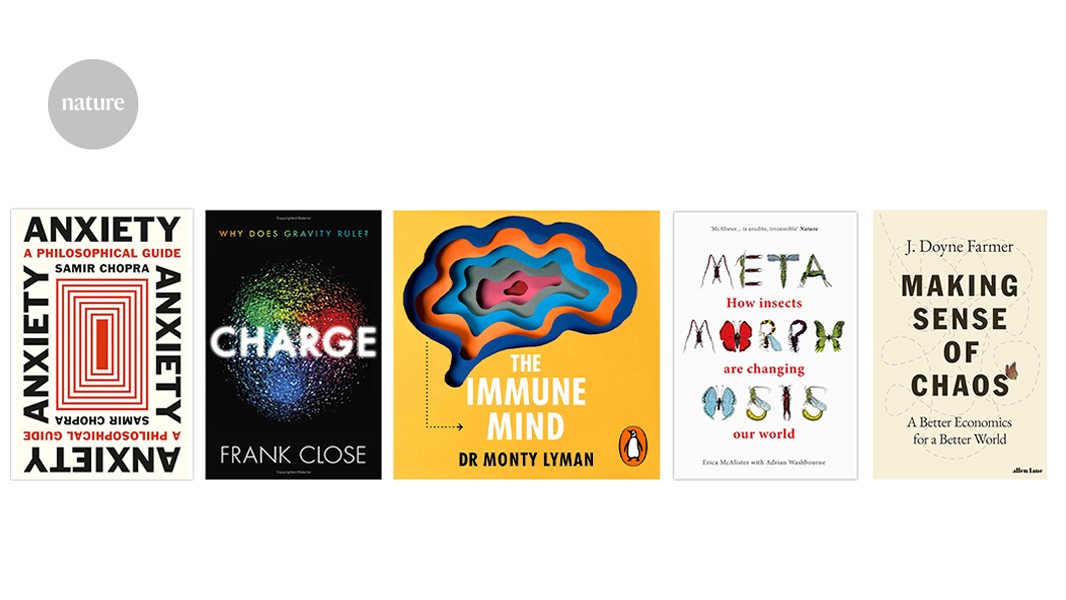
    The Immune Mind

    Monty Lyman Torva (2024)

    During his medical degree, Monty Lyman focused on immunology. But after qualifying as a doctor, he switched to psychiatry, having watched psychiatrists transform their patients’ lives. Now his research combines these interests, in the cutting-edge field of immunopsychiatry. The synthesis occurred after a person with depression surprised Lyman by showing how mental stress caused her eczema, a skin condition, to flare up on her forearm. His fascinating book reveals the mind and body as “utterly intertwined”.

    Metamorphosis

    Erica McAlister & Adrian Washbourne Natural History Museum (2024)

    Bees abound in ancient Egyptian hieroglyphs, symbolizing the tears of the sun god Ra, transformed after falling to Earth. Insects have long fascinated naturalists, yet much remains unclear. Estimates of the total number of species, for example, range from 5 million to 2.2 billion. But, in their enchanting, illustrated book, entomologist Erica McAlister and documentary producer Adrian Washbourne shed some light on insects: for instance, robber flies can see accurately over 0.5 metres, because their eyes have “a type of zoom lens!”

    Making Sense of Chaos

    J. Doyne Farmer Allen Lane (2024)

    Facing COVID-19 lockdowns in the United Kingdom, complex-systems scientist J. Doyne Farmer and his colleagues created an economic model, which predicted that the country’s gross domestic product would shrink by 21.5% in the second quarter of 2020 compared with the last quarter of 2019. The model came close to the real figure: 22.1%. By contrast, some financial firms predicted 16.6% and the Bank of England 30%. Farmer argues that applying complexity economics to climate change, for instance, “could help save civilization”.

    Charge: Why Does Gravity Rule?

    Frank Close Oxford Univ. Press (2024)

    In his sophisticated analysis, theoretical physicist Frank Close admits that 2,500 years “after the discovery of magnetism and electric charge, the reason for matter’s neutrality remains an enigma”. Electromagnetic forces far exceed gravitational attraction, but gravity nevertheless rules the Universe at large scales because positive and negative sources of electric charge balance so precisely. If they differed by even one part in a billion trillion, electrical forces would trump gravitational ones, and the Universe would cease to exist.

    Anxiety

    Samir Chopra Princeton Univ. Press (2024)

    Anxiety is often viewed from a psychological perspective — requiring treatment by psychotherapists — or as a biological and medical phenomenon, to be alleviated by rewiring the brain and adjusting chemical imbalances. Samir Chopra prefers a philosophical view, based on his training as a philosopher and counsellor. “We cannot stop being anxious,” he writes in his accessible book about Buddhism, existentialism and psychoanalysis, “but philosophy can help us not be anxious about anxiety.”

    Competing Interests

    The author declares no competing interests.

    [ad_2]

    Source link

  • Field observations of Ambula tardus on Planet IN-409

    Field observations of Ambula tardus on Planet IN-409

    [ad_1]

    Everybody tells you it takes time to adjust to the aliens’ way of life, but you don’t really understand what that means, what that feels like, until you live among them, until you befriend one of them. Ambula tardus are immense, easily the size of three elephants, but that’s not the part that takes getting used to. They’re bipedal, like humans, but that’s about all they have in common with you. They look a little like an Earth willow tree, with tendrils that fan out in a canopy and more that creep across the ground to connect with one another. No, the thing that really blows your mind is how slowly they move.

    Going in, you knew they only took, at most, ten steps in a lifetime, but to actually live that — to actually witness that — well, you were never the fastest kid when it was time to run the mile in high school, but you made up for it by hustling down the New York sidewalks like a pro, dodging and weaving with your feet always on the move. As someone who hated wasting time, you were always trying to do at least two things at once, which left you no time for friendship or lovers, not when you had so much to accomplish. Even on this planet, you arrived determined to fit in multiple studies in the precious time offered by your research grant.

    One alien step takes a good human year or so to complete, and it’s not so much a step as it is sliding forward one thick limb followed by the other. Interacting with the aliens is discouraged, yet you can’t help but think of AT-313 as a friend, seeing as they waved a tendril in your direction on your first day on the planet. The likelihood of it being coincidental is as likely as it being purposeful, but you took it as a sign and focused your attention on Attie, as you came to know them.

    Your alien friend and their companions communicate through vast groundcover, like Earth trees communicating through mycorrhizal networks. Their language is complex, reflecting their inner worlds, but anyone who didn’t know them would assume them to be simple. You think of that old saying, how still waters run deep.

    Attie, on the verge of their third step, reaches out tendrils to a nearby alien and they’ve agreed to reproduce. You’re there when, shortly after their fourth step, they deliver their offspring, a creature four times your size. You’re there as your friend’s offspring lands on the soft, moss-like ground, connecting their tendrils immediately with those around them. In a way, they’ll never be alone, and you find that both comforting and terrifying. You lived in a massive city filled to bursting with humans, but sometimes you felt far more isolated surrounded by millions of people than you do here among alien creatures.

    Your research comes to an end when Attie is nearly at their tenth step. They are stooped now, like a tree bent in a strong wind at the top of a mountain. You can’t believe their life is nearly over. You can’t believe they’ve hardly moved from where they were born. And yet, through their network, they’ve conversed with more of their kind than you could ever hope to as a human limited to simple speech or the written word.

    You postpone your trip back to Earth, wanting to be with Attie at the end. When your friend dies, they’re pulled underground, their body destined to become nutrients for those still alive. Attie’s mate and their child quiver and shake with grief, their tendrils swirling like they’re caught in a tornado, but they never let go of their network. They never let go of their friends. You join their grief, a rare touch of skin to alien flesh. They feel spongy yet firm, like a mushroom cap. They gently wrap tendrils around you, hugging you the way they’d seen humans hug each other when they arrived or left, or when they were hurt or filled with love. There’s no direct communication with them, but the aliens had been watching you as closely as you’d been watching them. Your salty tears fall, your liquid grief soaking into the ground.

    When you arrive home, everybody moves too fast, passing you on the sidewalk, a far-away look in their eyes as they think of their frantic list of things to do. Your body tries to catch up to their mad swirl in a sort of muscle memory, but your mind and heart want no part of it.

    You leave the crowded sidewalk for the park and find an isolated spot in the shade of a maple tree. You go through your pitifully short contact list, reaching out to old friends one at a time. It’s a sad imitation of the much more effective Ambula tardus network, but one finally responds — Emily, who runs marathons and reads science fiction and who says she’s always up for an adventure. She meets you at the park under the maple tree, and you begin the slow steps towards friendship and what really matters in life, the way Attie showed you.

    The story behind the story

    Rebecca Roland reveals the inspiration behind Field observations of Ambula tardus on Planet IN-409.

    I attended a workshop and timed writing session with C. S. E. Cooney and Carlos Hernandez at World Fantasy Con in 2023. They provided the audience with various cards from their TTRPG game Negocios Infernales, gave us 20-ish minutes, and off we wrote. My pictures and quotes led me to a theme of death and grief, and in general I was in the mood to write science fiction. A question popped into my head — what if an alien took only a few steps in their entire lifetime? I also tend to feel like I’m never doing enough, and it’s hard for me to slow down, step back and just enjoy the moment sometimes. Field observations of Ambula tardus on Planet IN-409 is not only a mash-up of all those ideas, but also a reminder to me to spend time with those who matter to me.

    [ad_2]

    Source link

  • How much would you pay for free shipping?

    How much would you pay for free shipping?

    [ad_1]

    They’re so quiet when they crawl down the street. But you still know. Some forgotten sense, some warning unneeded for millennia, starts to tingle.

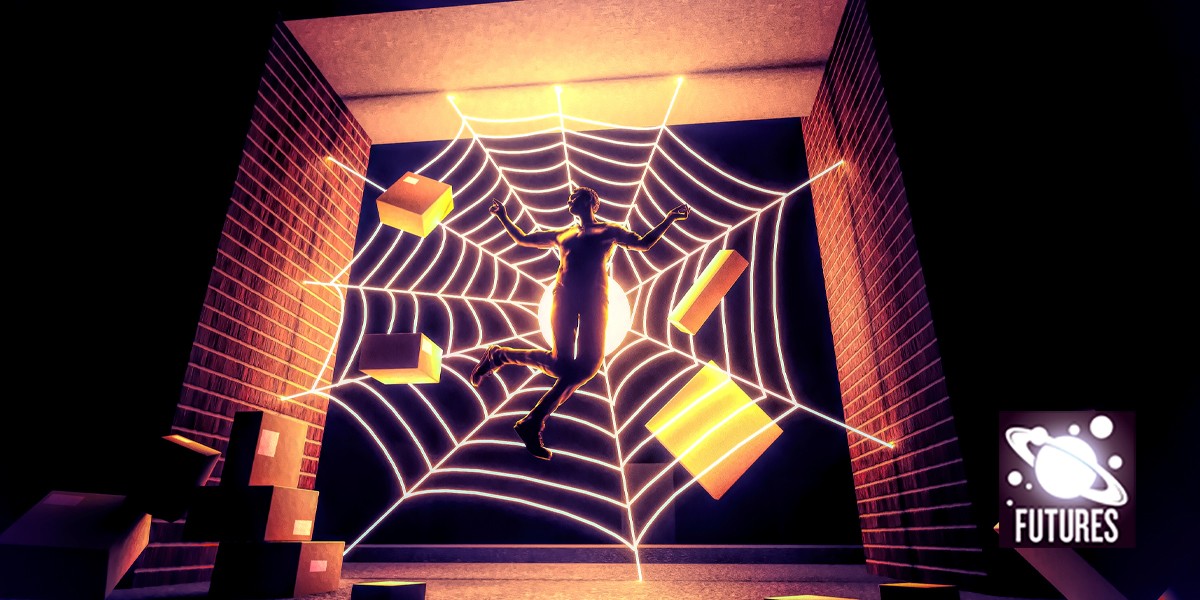
    A one-tonne MakeBelieve.com spider crawls down my street, with a purposeful look in its eyes. Egg-shaped parcels of various sizes are glued to its back with spider silk.

    At first, when MakeBelieve.com decided to use genetically modified spiders to deliver their packages, people were uncertain. Did we really want truck-sized arachnids prowling our streets with intent in their eyes, seeking us out?

    Sure, they’d been successful as warehouse workers. All those legs! But did we need these gargantuan predators in our lives?

    The remnants of last night’s nightmare still clings to my mind. I’d dreamt they’d released a batch of gynandromorph spiders with both male and female characteristics. And these gynandromorphs mated. London became an arachnid colony: tube trains bursting through the cobwebbed tunnels; giant spiders nesting in the House of Lords and crawling up Big Ben’s tower. Everywhere you looked, there were clusters of eggs, hatchlings, aggressive juveniles and hungry adults. And we were the flies.

    They say it can’t happen. They say all delivery spiders are 100% male.

    Pray that they never make a mistake in the spider labs.

    I worry that spider tech wasn’t properly tested. I signed petitions. I made my objections known.

    Yet the spiders were still developed. The spiders roam our streets. I wonder what will happen in the future.

    The spider pauses outside my house. I find myself urging it to move on. I’m not expecting anything. I haven’t braced myself.

    Just how intelligent are they? Their brains must be at least a thousand times bigger than those of a house spider. Are they a thousand times more intelligent?

    Spiders are patient. Are they just waiting until the time is right?

    I breathe a sigh of relief as the spider moves on and makes its way down next door’s path. The Perkinses order a lot from MakeBelieve.com. Not that I’m watching. I twitch the curtains back into place. The spider stops moving. Three of its outer eyes swivel to my window.

    A moment and a moment and a moment. Fear wraps its cocoon around me, until, eventually, the spider continues to crawl down the Perkins’ path to the parcel bay. And I continue to watch it. I wonder if it can see me through the white veil of net curtain. They see slowly, but they see a lot.

    In the past few years, I’ve learnt a lot about spiders.

    There were calls to wait. Surely, it would be better to test an unknown technology rigorously? Surely, it was better to err on the side of caution when it came to licensing? Surely, we couldn’t afford to allow the Big Concentration Companies to set their own safety limits? To self-report on the risks?

    Perhaps our governments would like to get involved?

    The Big Concentration were too keen, too competitive to get the first spiders into production. Our governments, although they expressed concern, and entered into consultations, were ultimately too weak or too unwilling to exert any control.

    The Big Concentration Companies do whatever they want.

    The spider raises one segmented hairy leg, sweeping it over the parcels. I imagine the powerful, silent pressure of the movement. The bristles between its claw read the barcodes with some unknown arachnid sense.

    When it finds the right parcel, it uses a dab of silk from a modified spinneret to attach the parcel to its claw.

    It will be the right parcel. I’ve never seen one put a foot wrong.

    The spider flicks the parcel through the air. It lands neatly in the gelatinous receiving pouch outside the Perkins’ door.

    As a reward for the delivery, the spider is allowed to feed. It lowers its head to the receiving pouch and grinds a small amount of the gelatinous gloop.

    MakeBelieve.com spiders were developed from a 90% herbivorous jumping spider. It’s the other 10% that worries me.

    The spider injects digestive enzymes and waits before sieving the nutritious gloop through its mouth parts. Spiders have very thin stomachs. Those memes about a spider eating you whole are ridiculous. They’d have to dissolve you first.

    I fear the spiders. And yet, from time to time, just like everyone else, I use them.

    The spiralling inflation rates made the minimum wage unaffordable, or so the Big Concentration told us. The worldwide cost-of-living crisis meant that we needed the knock-down prices on MakeBelieve.com.

    We like to blame the Big Concentration Companies. We like to blame our weak governments. But ultimately, we know who is to blame.

    We want all the things. So, bring on the giant spiders. We can have everything: free shipping, free within-the-hour delivery, any amount of throw-away, one-use plastic, semi-toxic gewgaw. We can have anything they tell us we should want, all at a knockdown price. It shouldn’t cost the Earth.

    We can drain the resources of our world almost dry and live in the surety that the next scientific innovation will save us. More and more and more.

    The spider is gone. The Perkins children emerge from their house, rip up the packaging and laugh as they see their new acquisitions: MakeBelieve.com spider fancy-dress costumes.

    I feel the familiar tingle: another spider is crawling down the street.

    Bringing more delights for us to consume, as we embrace the company’s motto: Oh, What A Wonderful Capitalist Web We Weave When First We Start To MakeBelieve.com.

    The story behind the story

    Deborah Walker reveals the inspiration behind How much would you pay for free shipping?

    My stories grow from many seeds. Sometimes, I go out and search for them. Sometimes, I reach into my pocket and find, something to my surprise, that I have a handful, all ready to be planted.

    The first seed came from a Halloween writing challenge, when I chose the prompt about spiders. Next, I happened to see a news programme talking about drone delivery. The two ideas quickly came together as giant spider delivery.

    My writing friends actually approved of this arachnid development, one going as far to say, she thought the giant spiders were adorable. But that’s writers for you.

    In my second draft I incorporated my character’s spidergeddon dream to discourage my readers from admiring these eight-footed monstrosities.

    The next element was a little bit more complicated. For many years we’ve all been aware of the argument that large companies might not have our best interests at heart, but they’re adept at providing us with immediate gratification. There’s a Futurama episode in which Fry and Leela bemoan the ethics of an all-encompassing delivery company, but in the next breath admit that the service is so convenient and that the returns policy is so generous. It’s a tricky circle to square.

    That’s the heart of it: no matter how much we bemoan the unsavoury practices of corporations, we enable them because of the immediate benefits we enjoy, ignoring long-term problems, and problems happening to other people.

    We’re biased. We’re easily manipulated. It’s been clear for a long time that we can be manipulated. We just don’t have the resources to compete against a sophisticated army of social engineers so adept at pushing our buttons.

    Or so we tell ourselves, as we conveniently forget to wonder at the price we’re paying for all this free delivery.

    [ad_2]

    Source link
  • Day tripper

    Day tripper

    [ad_1]

    Squeee, squeee, squeak. The Welcome Centre desk attendant scanned, squeegee in hand, for more spots on the perfectly transparent exterior window and its freshly shined, centrally placed intercom. The Welcome Centre was an essential hub for all units arriving at Mercury Station III, regardless of their programmed duties. Here, mechanical citizens received assignments that collectively provided a crucial service to the human race: the maintenance of solar-energy turbines. The attendant proudly scanned the landing terminal through the window. “Starting the day off right: dust free. What’s this? Travellers approaching?” Astronauts, two large and two little, descended a ladder positioned underneath their craft, half-way across the terminal.

    The travellers waddled clumsily through the terminal, looking down, struggling to make sense of the surrounding foreign signage. Directly in view of the window, a little one slipped. Feet flung into the air. They wriggled their limbs like a child making snow-angels. Low gravity and puffy, vinyl-coated space suits are a poor combination for stability. The information attendant gazed at the family, both amused and concerned. These were unlike any units the attendant had ever seen. The largest traveller knocked on the window. Their visor retracted, revealing leathery wrinkled skin and a few grey hairs. He shouted quite unnecessarily at the intercom, “What’ll y’all know about there being a hotel nearby?”

    Mystified, the attendant took control of the situation. A silver cable protracted from its chest and connected to the intercom. “Human, your presence beyond Venus is concerning. State your business.”

    “Of course. My business! Yes, my family and I are en route to a resort —”

    The attendant interrupted: “Human travel beyond Venus is not allowed. You are clearly lost. We can chart you a path to Mars … Please hold, I’ll need a moment to coordinate your travel.” The attendant hastily disconnected from the intercom with a loud ‘Plug’, then shuffled cables around various terminals. The travellers watched the attendant speak into a terminal but heard nothing.

    The family conversed. “Sarc, what are we doing here? The little ones need to go potty and I don’t see anything here. No restaurants, no hotels. And you didn’t mention this was a Mercurian society! Are we safe? Oh, what you’ll do to save a buck.”

    The attendant signalled the family’s attention. “Mhmm, yes … yes, thank you.” Plug. “Travellers! Thank you for waiting. Right now, it is early morning. The next possible Mars transport won’t begin loading until pre-evening. We can put you up in the Subsurface colony for the time being. I’ll arrange for your descent. One moment, please.” Plug.

    The family resumed squabbling. “See? Subsurface Colony! I think we’ll really have a chance to bond during this trip.”

    “Did you even call ahead, Sarc?”

    “Hun, I thought you wanted to travel someplace warmer this year, and the Subsurface colony has great ratings.”

    “4.1 out of 5? That’s not very high.”

    The attendant, eavesdropping, smouldered with frustration. These tourists were oblivious to the struggling society around them.

    Plug. “Travellers, you’ll be able to enter the colony soon. We are still locating a room for you. There are several vacancies, but that’s because the ceiling partially melted during the last flare up. You’d be directly exposed to the photosphere.”

    The little ones oohed and aahed.

    “Those rooms sound lovely. Our kiddos love science-y things,” Sarc boasted. “I paid extra for that view.”

    The attendant, stunned, continued: “I must also apologize that our cafeteria is currently under construction. A crater suddenly collapsed above the previous dining hall. The patrons were liquefied by molten salt, and all that remained became crystallized.”

    “A salt cave! Oh Sarc, you’ll be sure to book us a couple’s massage there at some point during our stay?”

    The attendant could no longer maintain its professional demeanour. “Do you humans even have ganglia? People can’t come here. Can you comprehend the resources you waste by pretending to be explorers where you cannot live? Do humans ever consider the burden we would bear of deciding which planets should have power? Ugh!” Plug.

    “Sarc, I will not be spoken to in this way, certainly not by a Mercurian. I’ll take the little ones out of earshot. Handle this.”

    Sarc leaned into the intercom. “Look pal. I fully intend to contact your supervisor about how rude you’ve been. We, the customer, are paying your salary. I expect some compensation for this god-awful treatment.”

    The attendant fell quiet for a moment, confused.

    Plug. “I am afraid I have been too indirect regarding the precarity of your circumstance. A precisely guided transport to Mars can only happen if you survive this day. We never know when for sure, but at any moment, a solar flare will turn us into dust. For us, Mercury is a one-way ticket. Our society has safeguards for regeneration, of course. I replaced the prior attendant early this morning. You should’ve seen the dust on this window …”

    Sweat appeared on Sarc’s face. “If we’re in danger we will, of course, leave. You said a transport could get us to Mars as early as this evening?”

    Now the attendant was truly taken aback, having once again overestimated what humans knew about the societies that maintain their infrastructure. “You eat and sleep on a 24-hour cycle, correct? That daily schedule does not exist here. This side of Mercury won’t turn away from the Sun for 1,563 hours. On your cycle, that’s about 65 days.”

    Sarc signalled the family to return. The family huddled.

    “So? What did you say? What’s gonna happen?”

    “Well first, I gave that Mercurian a piece of my mind. To compensate us, they’ve extended our stay by two whole months.”

    The story behind the story

    Jon Zatorski reveals the inspiration behind Day tripper.

    Ah … there are few memories that compare to a quality vacation. If I close my eyes, I’m there now. The all-inclusive, spa-treatment, excursion-filled resort. Bring me the outlandishly tropical, the ludicrously lavish and the nowhere-near-home. But why? Why do we make a fuss about holidaying somewhere foreign? Most other animals are stuck in one place (I’ve never seen a penguin sipping punch at a tiki bar), so why do humans so badly want to travel all over?

    Our desire to explore the unknown, even if just for fun, is peculiar. I suppose we vacation to fortify our internal strength by experiencing the unknown. As such, my plans to vacation somewhere foreign inspired me to consider: how far away from home can I really go? Tropical island? Antarctica? In a few decades, a two-night-stay at the Lunar Colony might be discounted 15% on Trivago.com. The farther away, the better, if you ask me.

    Which leads me to reason: I’m sure, at some point, some future family will boast about their spur-of-the-moment vacation to Mercury. The kiddos won’t even realize when their parents fly past Venus. They won’t even notice that the hotel is under construction, or that solar flares are etching away at the planet’s surface. They’ll just bond over the good times, and the thrill of new experiences. On a vacation like that, who cares if we never come back?

    [ad_2]

    Source link

  • The future of Mars Colony Two

    The future of Mars Colony Two

    [ad_1]

    Tyrone felt uneasy questioning Professor Flowers. Decades ago, as a student, he had worked in her space-studies group, and the human colonization of Mars had caught his imagination. His mind had changed since then, but hers had not. Now, he found himself conducting a hearing for the Global Climate Control Commission on future human activity on Mars.

    “You have requested a waiver of greenhouse emission limitations for the launch of Mars Colony Two,” he said. “It has been 20 years since Mars Colony One landed. As a private space programme, it was not covered by the existing emission regulations. That is no longer the case. So I must ask what would justify waiving the present rules.”

    The ghosts of Mars Colony One hovered invisibly above the directors of the commission in their hearing room. The colonists had been 20 of the world’s richest people, who had spent trillions of dollars from their personal fortunes to blaze a new frontier for humankind. Their leaders had said they expected to die on Mars. They had not expected that all of them would die 18 days after landing.

    Professor Flowers looked at Tyrone with unreadable eyes. “The first Martian colonists were heroes who risked their lives to open a new refuge for humanity,” she said. “Those were troubled years. Heat was killing the whales. Coastal cities and island nations were slipping below the waves. The world’s richest technologists decided to spend their own fortunes to reach a new world. No one else would spend the money or take the risk of sending humans to Mars, so they took it upon themselves.” The strain showed when she paused for a deep breath. Tyrone could see her 80 years weighing upon her. “When they landed and we saw them on our screens waving to us from Mars, people around the world cheered and had hope. We need to get people back into space to fulfil our destiny.”

    “No one can deny that they were brave,” Tyrone said. “But neither can we deny they were foolhardy. They chose not to send robotic probes to test for survivability. We still do not know how and why they died, or if something on Mars might have killed them.” He looked around the room. “And these are still hard times. We have slowed the growth of greenhouse emissions but not stopped them. To do that, the commission had to suspend most space activities and limit aviation to 1990 levels. We know how much it would take to send people to Mars again, and we know we can’t afford the emissions.”

    “The heirs of the Mars Colony will pay for a second mission. They are hugely wealthy, and have designed a second mission that will make tremendous contributions to scientific knowledge. But we have to start here on Earth.” She looked at Tyrone, her face pleading for his support.

    “That is the problem,” said Tyrone. “We live on a thin edge of further disaster. We were stopping coal burning when the first Mars Colony launched. We keep trying, but we don’t know when the next giant glacier will break off from the shore of Greenland or Antarctica. We have no safety margin.”

    “We must have a dream. We need one to go forward,” the professor said. “You were born after Apollo, but during the 1960s people rightly feared a nuclear war that could wipe out the human race. John F. Kennedy promised the US would land a man on the Moon, and people around the world celebrated after they saw Neil Armstrong walk on the surface in 1969. We could dream of travelling in space and building a better life for humanity.”

    Tyrone could see tears starting on her face. “It was never that simple,” he said. “The race to the Moon was never sustainable. It was a race for America to show the Soviet Union that they could beat them in space. We needed more than half a century to get back to the Moon. And by then scientists knew we had to get the global environment under control. Storm intensities kept climbing, oceans warmed faster than we had expected. We had to shut the Moon bases and limit new satellites other than climate missions. We aren’t sure if we can stop it.” Professor Flowers cast her eyes down, looking weathered and ancient. “That’s why the Global Climate Control Commission has again rejected your plan for the Second Mars Colony.”

    She stood silent for so long that Tyrone worried she’d been taken ill. He saw her pain when she finally spoke. “Please tell me there will be a time in the future when we can launch a second Mars Colony mission? Please tell an old woman that her dreams will not die with her body.” She stared at him.

    “I hope so,” Tyrone said. “But now we must focus all our efforts to control the climate crisis so sometime our children and grandchildren can have those dreams.” He shivered, all but certain that neither he, his children nor his grandchildren would ever see that day.

    [ad_2]

    Source link