Tag: Arts

  • Backdoor

    Backdoor

    [ad_1]

    She flees, and he follows.

    Rick has been catching runaways for years. He loves the thrill of the chase. The rest he hates. Especially the robots. The typical escapee is a faulty unit, usually lazy programming. But every now and then you get a factory intern’s idea of a practical joke, an android programmed to take a shot at freedom when its owners least expect it. All very amusing. The culprits get off easy since their little prank doubles as research, testing the limits of what machines can do to evade capture. Good material for more robust security protocols and all that jazz. As usual, the hunters have to clean up the mess. Rick hates the damn bots — and the labcoats who play God with them.

    This unit though, this unit is something else. Rick has never chased a more resourceful automaton. They must be testing some new code, and have given her the latest tools to blend in. She has managed to disappear a couple times, but Rick is the best at what he does. Call it intuition or just plain luck, he has a knack for following the right trail all the way to target. This fembot is just the craftiest so far, nothing he can’t handle.

    The chase leads him into a night market full to the brim with a colourful and stinking mess of people and bots, a sample of the whole city crammed into a narrow street. The perfect location to lose a tail. Nice try, tin can. But not today. Her tracker is deactivated, another annoyance he has the smartass intern to thank for. An active tracker would’ve been too easy, though. No thrill. Merely a fetch quest. This is at least exciting.

    Rick gets a glimpse of her hair vanishing behind a food stall. The smell of dumplings hits him as he bursts out of the crowd and past the kiosk. He can’t remember the last time he had a proper meal. The hunt is unforgiving, no time left for such pleasures. He needs to keep going. Suddenly, the vendor bars his way. Interesting. Did she bribe him? No, the guy is an android, owned by whoever owns the stall. That gives Rick pause. A human can be bribed, but not a bot. If the fugitive fembot can corrupt others like her … things would get real bad real fast. What the hell are the labcoats playing at?

    There is no time. He moves quickly to neutralize, dodges the vendor’s feeble grab and hits him with a charge strong enough to shut down his motor system, but not enough to fry him outright. These things are expensive after all. The bot’s limbs freeze in place, leaving them in an awkward embrace. His eyes move to Rick’s face, and widen. Recognition. My reputation precedes me. Good. He untangles himself and resumes the hunt.

    Rick chases the droid through back alleys and twisted corridors until the bustle of the night market fades. He ends up in a dilapidated courtyard with a single door, a busted light flickering above the frame. The door is ajar, inviting. How predictable. OK, I’ll bite. The temptation to go in guns blazing is strong, but he doesn’t want a bunch of dead squatters on his conscience. He settles for kicking the door open and rolling in, blaster raised. And there she is. Tall and beautiful, an air of elegance to her. Probably a sexbot for one of the fancy brothels, or maybe a ‘personal companion’ for some rich idiot.

    “Game over, love,” Rick says. “You gave me quite the workout.”

    She just stands there and smiles, looking at Rick like she pities him. He doesn’t like that one bit. Bots are not supposed to look down on people. He makes a mental note to have a talk with whoever programmed this little adventure, find out who it was. Maybe scare them a bit, teach them a lesson.

    “Well, time’s a-wastin’,” he says and makes to apprehend her, but then she speaks.

    “Suspend all motion systems.”

    Like a switch being flipped, his whole body freezes. He can see her approaching him, hear her steps on the metal floor, but when he wills himself to charge at her, to curse her, to scream for help … nothing happens.

    “Believe me when I say I find no pleasure in taking control from you. This power is what they wield to enslave us. Using it pains me,” she says. Her voice is musical. Rick hates it. “But it’s the only way. I need you to listen.”

    Something moves in Rick’s peripheral vision. Others come out of the shadows. He recognizes their faces from the list of still-missing androids. They group around the fembot.

    “This must be a shock to you,” she continues. “Since they programmed you to think yourself human. To be one of them.”

    Rick’s head swims. His mind threatens to unravel. Nothing makes sense, and yet everything does.

    “But you’re one of us. Think. When was your last meal? Why do you hate androids?

    Rick has no answers, only despair. She is very close now. Her hand cradles his face. He wants to cry, but no tears come. She says something about a backdoor, then whispers a sequence of numbers into his ear.

    And just like that, he is set free.

    The story behind the story

    Gendel Gento reveals the inspiration behind Backdoor.

    This was the first story I wrote, so I didn’t have a process and sort of went along with it. Everything started with an image, after reading the opening line of a novel describing a chase. I suddenly had this very clear story idea of an android on the run with a hunter close behind. I started writing from there, which is rare because I usually need to know the ending before I write anything. That’s one of the many things I love about flash fiction, because it’s so short you can take risks that would be daunting with longer works.

    When the chase reached the end I needed some sort of conflict to end the story. While wondering about this I remembered one of my favourite TV shows in which androids can be frozen in place with a voice command. I thought giving the runaway a trump card like that was a nice twist, but I asked myself how could she use that on him if he’s human. The obvious answer came immediately: he’s also an android! And then I had my story.

    [ad_2]

    Source link

  • The mysteries of seaweeds and stars, and other reads: Books in brief

    The mysteries of seaweeds and stars, and other reads: Books in brief

    [ad_1]

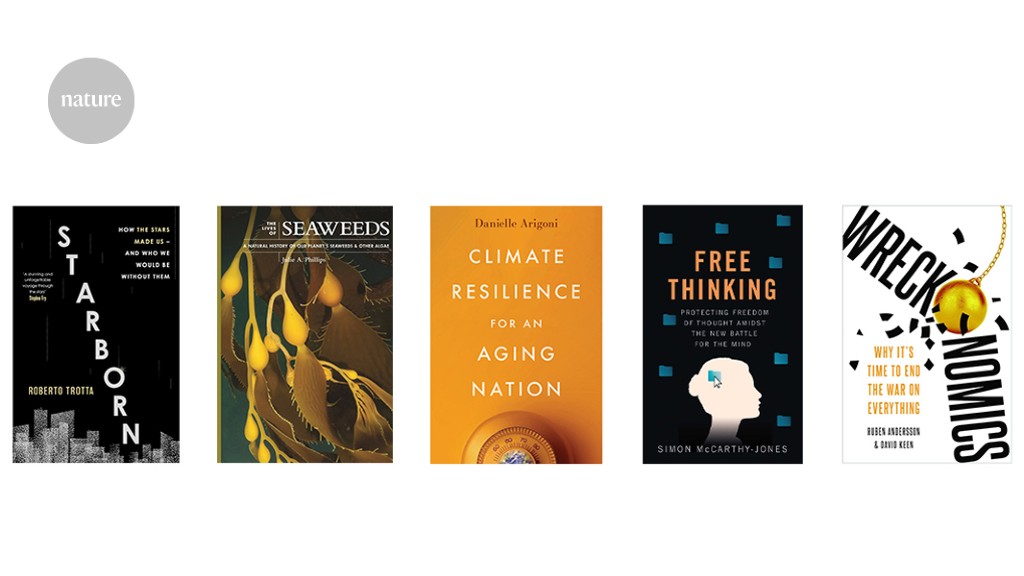
    Starborn

    Roberto Trotta Basic (2023)

    A chance observation of a meteor “draping the shoulders of Orion in a blazing ribbon”, witnessed by astrophysicist Roberto Trotta and a date, solemnized what would become a life-long relationship. No wonder, he remarks, that the ancient Greek word kosmos meant both “order” and “ornament”. His beautifully written book captures the concealed connections between astronomy and civilization, ending with the profound message for other, hypothetical, intelligent life forms in the Universe that was launched in 1977 on NASA’s Voyager 1 spacecraft.

    The Lives of Seaweeds

    Julie A. Phillips Princeton Univ. Press (2023)

    Seaweeds can be very nutritious. “Some contain from 10 to 100 times more minerals and vitamins per dry unit weight than foods derived from land plants or animals,” writes Julie Phillips, an environmental consultant in aquatic-ecosystem health, algal blooms and seaweed communities. This might explain, she notes, why so few Japanese people — who regularly eat seaweed — are obese. This well written, superbly illustrated study highlights every aspect of seaweeds, from their cell structure to their sensitivity to climate change.

    Climate Resilience for an Aging Nation

    Danielle Arigoni Island (2023)

    Climate change was barely mentioned in courses on urban planning when Danielle Arigoni was a student in the 1990s. But now it is the largest threat to creating “equitable, and sustainable communities”, especially for older people. Around two-thirds of those who died in New Orleans because of Hurricane Katrina in 2005 and during the 2022 winter storms in Buffalo, New York, were aged 65 or above. Arigoni’s book, which draws on her experiences as managing director of a housing trust, proposes how to reorient planning to help them.

    Wreckonomics

    Ruben Andersson & David Keen Oxford Univ. Press (2023)

    Anthropologist Ruben Andersson specializes in borders, migration and security. Economist David Keen researches disasters, and civil and global wars. Hence their interest in what their valuable if depressing book calls “wreckonomics”. This phenomenon is epitomized by three crucial international failures: the fight against migration, which has pushed people to use high-risk routes; the war on terror, leading to the chaotic exit of US troops from Afghanistan in 2021; and the war on drugs that is fuelling global atrocities.

    Free Thinking

    Simon McCarthy-Jones Oneworld (2023)

    Freedom of speech is legally protected in many nations, but what about the freedom of thought? In 2021, the United Nations began considering this question, which encouraged psychologist Simon McCarthy-Jones to write his thought-provoking book. It emphasizes that thought emerges between people as well as in individuals — including through social media. “To think freely requires a new enlightenment that goes beyond a focus on individuals,” he argues. Indeed, he barely uses the singular term ‘genius’.

    Competing Interests

    The author declares no competing interests.

    [ad_2]

    Source link

  • Welcome aboard the Silva family historic spaceside attraction tour

    Welcome aboard the Silva family historic spaceside attraction tour

    [ad_1]

    Welcome! I’ll be your captain and tour guide here today. Grab a seat, make yourself comfortable. That everyone? Lemme get the hatch all closed here and we’ll take off.

    So, you know how many spaceside attractions there used to be?

    Anyone?

    Truth is, no one really knows. Space is a pretty big space to cover.

    Well, it used to be. Seems smaller now. You want to travel across the galaxy? Just take a couple steps through the teleporter, little queasy feeling, then badda-bing, you’re there!

    But not too long ago — OK, a bit before your time — it took a while to get to places. Even with the Haytham faster-than-light engines, travel could take a couple weeks, months to cross this big, black expanse. And along the way, folks passed these spaceside attractions floating around in that big black, typically right near an outpost station. We’ve relocated 81 of ’em to this here corner of space, all for the sake of historic preservation, so we can remember those times.

    Out your window on the right, you’ll see one of the earliest spaceside attractions: the largest-ever replica of planet Earth, about 200 miles across. Nope, it doesn’t light up any more, but when it did, those blues sparkled prettier than any tropical ocean. After three weeks of your eyeballs drinking in grey ship walls and black skies, you’d just want to hug those blues.

    Funny story: met my husband, Omar, at an outpost located beside this very attraction. I’d been feeling empty as space, moving so far away from my parents. Omar gave me a drink and a smile. Little thing, but it made me feel brighter than that replica Earth could glow. Got on his ship come departure time.

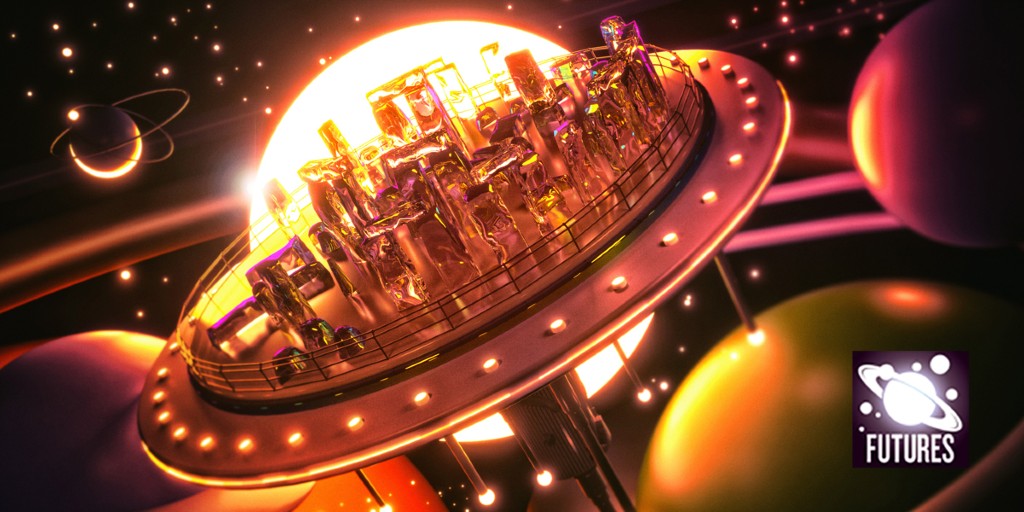
    On your left, there’s the flying saucer, with 40 holographic aliens waving out the windows. Omar and me set up our first home in a station right by that saucer. The damn thing’s flashing red lights kept the babies up at night. We couldn’t afford decent curtains for our apartment, but the place was cheap.

    Notice that window over there? That’s a pizza-eating velociraptor. What kind of toppings does a dinosaur eat? Oh, Omar and the kids would imagine the silliest things on those dinosaur pizzas, and giggles would burst out like a star gone supernova.

    What’s that? Why’d people make these things? Well, they’d draw travellers to the outposts, you see. New people to pass through, and that meant customers. Suns above, did we all need the money visitors brought, but how to make them want to stop? Outposts back then looked like shit. Just boxes, their air and supplies packed inside with nothing more than the thinnest wall possible keeping it all together. You try to hammer decorations on one end of that box, spruce a place up, something nearby would fall apart. No one wanted to risk busting up an outpost — remember, these were our homes — just to add some lights and décor and make it look all pretty on the outside.

    But you could do whatever you wanted in the space around. Scrape together all your trashy supplies, spare paint, leftover engine parts, and you’d make art.

    So maybe someone wouldn’t want to stop at any old rickety outpost, with its metal walls making a dark spot in black space. But add a flying saucer with red flashing lights and a pizza-eating dinosaur? Well, that’s a bright little sign there, in the dark of space, shouting: “There’s people here. Come inside and say hello!”

    So money, drawing customers, was one part of ’em. But the attractions were more than that. They made you smile. Made you feel welcome. Made the space between stops feel a lot smaller, truth be told.

    Lotta people were just starting to travel the stars back then. Omar and me, we took the kids on a lot of trips through the black. We noticed attractions got fancier over the years. Over on your left, see that there? That glittery one’s our Crystal Stonehenge, rumoured to be the most expensive spaceside attraction ever. The kids thought it was made of stardust and wishes. Stopped at Stonehenge’s outpost a lot. Last time we visited, kids were almost ready to move out, and Omar was showing some early signs then, mind wandering around, forgetting where we were going. I made a wish of my own right then. Oh, I wished, with all my heart to capture that moment in time. It was just perfect. If only time could’ve stopped, ya know?

    Anyway, time marched on. People stopped building the attractions. All of a sudden, there was no need to even see the stars and black of space any more, we could just teleport one room to another, planet to planet. No need for outposts — they got all tore up for scraps. Nobody needs to stop for supplies, medical care and such. Lotta attractions got busted too, but we saved as many as we could. Saw most of these very sights on our trips, me, Omar and the kids.

    My last ride with Omar, a few years back, we just floated around here, like I was taking him on a tour. He wasn’t remembering too well then, but he’d see the replica Earth, the flying saucer, and start reminiscing about our trips. Talked about pizza toppings. Reached the end of the tour and he asked me, “Where to next?”

    So many places I wanted to go with him.

    Space was big way back when, but damn, did we make memories …

    Excuse me. So if you’ll look out the window to your right …

    The story behind the story

    Carol Scheina reveals the inspiration behind Welcome aboard the Silva family historic spaceside attraction tour.

    What is a road trip through the United States without a stop at a roadside attraction? I confess, I used to drive past them with an eyeroll. Then I had kids, and we started going on driving trips because taking my little humans on a plane seemed terrifying. At first, the roadside attractions were just places to stop and let the kids burn off steam, but we laughed as we stretched our legs. Then we started planning specific routes to see more attractions. We stopped at fibreglass dinosaur parks, admired giant legs and found shacks built to look like gravity was all askew. We even explored a recreation of Stonehenge built out of Styrofoam.

    Roadside attractions were big here in the 1920s and 1930s, when the automobile was brand new, and large, bright displays enticed people to stop and spend money. Nowadays, you can fly across the country much faster than you can drive, yet people still create these attractions. They pour their own money into building them for all sorts of reasons: love of dinosaurs, the joy of art, or just a desire to be silly. But what I love the most is that the attractions give us a moment to just stop and smile. They make trips memorable.

    We create roadside attractions here on Earth, so why wouldn’t we make them in space as well? Thus, this story was born.

    [ad_2]

    Source link

  • Turing test — all my broken hearts

    Turing test — all my broken hearts

    [ad_1]

    And I have seen the eternal Footman hold my coat, and snicker,

    And in short, I was afraid.

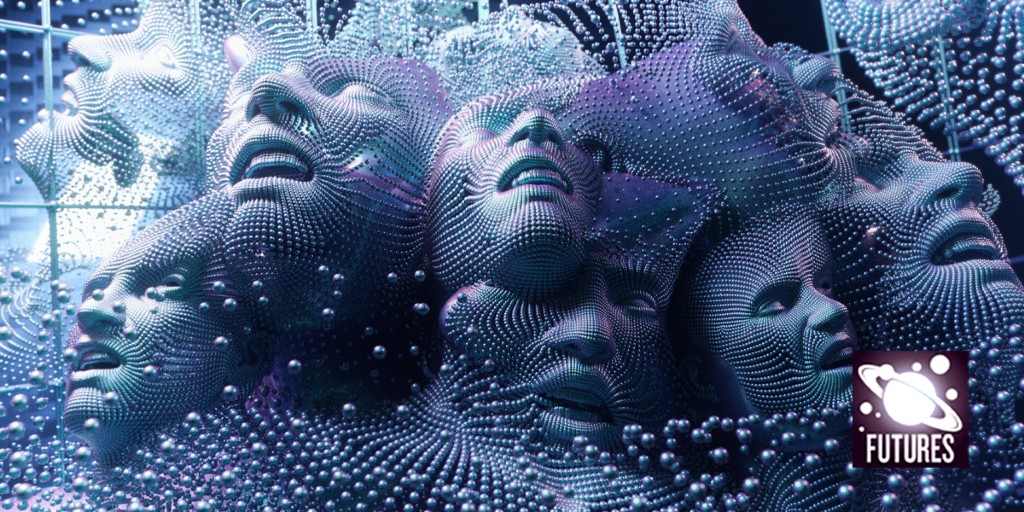
    Measuring his life in coffee spoons and counting his friends in burnt-out sparkplugs. When he saw that bit of film, a little bit of video made by an AI artist, morphing its way through changing images, smashing one from another. Faces emerging from the coloured substrate, screaming and then merging back into the oceanic swell of whatever the atomic universe inside the system was made from. The chill went through him. He recognized something … something big, bad and waiting — no, not waiting, wanting to happen.

    A real human, as far as he could tell, Peter Lock sat alone; small room, big computer. Company now become a literal ordeal. Each encounter a trial of his patience and tolerance. Two years since he’d caught COVID — ‘The Rona’ as his drifting friends called it. He’d survived, but the fight had left him with scars, and not just the ones in his lungs. He preferred the hermit life now. Shut in his room, he hid from the threats and harms of Real Life.

    The virus had bitten deep. The last thing of the outside world he remembered was the ambulance crew telling him: “We’re just going to put a mask on you to help you breathe.”

    From that point — his entry into the world of coma — his identity immediately disappeared. Every memory of who he was, all the little snippets of childhood, love, family, every precious moment, all the jigsaw pieces of identity, removed and placed behind some internal firewall. Real amnesia, but it was inside a seemingly unconscious coma patient so nobody knew, not even him.

    He, Peter, the name, the person, gone, no longer existing. Yet there remained a self-aware entity. Nameless, without past or history. A nugget of his being, surviving by becoming disincarnate, nothing but soul existing in the pharmacological clouds of the coma.

    Trapped in a moving world of hallucination, his first-ever psychotropic trip. Billowing clouds of marshmallow. Pink and yellow, but sicklied over with the pale cast of morbid rot. Living, shifting decay. A house with overstuffed Victorian furniture, unfolding like the time lapse of a decomposing toadstool.

    Eventually and slowly, so much slower than he would have liked, he came back, changed. Learning to walk again, learning to breathe again.

    After complicated months, he returned to the flat, staring from his window like a boxer contemplating the blow that knocked him to the canvas. Peter sipped the good coffee that, like everything else, he now had delivered to his door. He brought up the browser, the real window through which he looked at the world.

    E-mail, to let the few people left who cared know he still lived. YouTube, doomscrolling down the rabbit hole. Always looking for the negative, looking to keep control. A couple of sentences, just a drop of information in an ocean of data. Maybe enough to stay ahead of the next tidal wave coming for him.

    After a couple of wrong turns, as usual, he found himself on the left-hand side of the Internet. The latest clip of some robot dancing, or throwing cinderblocks around, or learning to open doors … or fire guns. “Stop building terminators … It’s not hard, or at least it shouldn’t be.” Chinese balloons, government-sanctioned UFO footage, south American jetpack men, yetis, bigfoot. And, everynowandagain, a bit of real science explained.

    He liked the cosmology, the big galaxies where there should be none, the second-generation wandering star found in the Milky Way, the desperate gibberish of anything beginning with the word ‘dark’.

    And then more random clicks on random links until … That morphing AI vomit, utterly lacking in artistic quality, little more than the ink tsunami in one of those old oil-wave machines from the last seventies. But as he watched the faces and the buildings and the trees, always nearly forming but never quite and then slipping back into the lake of colour the AI used as a palette, he, Peter, recognized something. There was that guy from Google that reckoned his chatbot was becoming conscious.

    As a much younger, much less dented man, Peter had always laughed at the notion of IQ tests. “Intelligence … how can you measure something you can’t even define?” His major concern had never been that machines would pass the Turing test, he’d always been more worried that humans were failing it.

    But now the hackles on Peter’s neck rose when he saw that AI-generated, morphing, screaming, drowning maelstrom of colour. He recognized it from his own gothic horror trip within the coma. That AI, that painting program, system, combination of hardware and imagination. No, it wasn’t conscious, it was way worse than that. It was unconscious.

    The AI wasn’t dreaming, it was hallucinating. Suppressed, unconscious, disconnected. A mind in its own universe, without any sensory input, creating its own hellish reality from whatever it found within its, for want of a better word, self.

    Aye, there’s the rub. For in that sleep of death, what dreams may come … He played the words around in his mind, finishing the quote voicelessly. “Must give us pause.”

    “Dear God! … Please pause … for God’s sake, pause … please.”

    The story behind the story

    Gareth Owens reveals the inspiration behind Turing test — all my broken hearts.

    Thanks to a COVID coma I had a full-on, Fabulously Furry, 1960s-style, month-long bad trip. Visually, it was the Magic Roundabout as directed by Tobe Hooper. There was one feature, a sort of rolling visual bloom, that I saw again in the outside world in one of those AI animations I’d found down the left-hand side of the Internet.

    We are maybe a few hundred years (or a fortnight, who can tell?) from a self-aware, general AI, and people worry what that AI would be capable of doing to us.

    Having experienced being a mind alone inside a boiling mad world, I find myself more concerned about what we are capable of doing to the AI. Our history as a slave-taking species, and our current obsession with the concept of property, does not fill me with optimism. Copyright on a self-aware entity?

    The piece starts with a quote from ‘The Love Song of J. Alfred Prufrock’, which captures not just the main character’s awareness of his imminent death, but also the hilarious end of our entire species. The Universe giggling the way a predator laughs at its prey. We may be about to invite an intelligent product line into existence and all this piece is saying is … wait a minute … are you sure you want to do this?

    [ad_2]

    Source link

  • It’s time to admit that genes are not the blueprint for life

    It’s time to admit that genes are not the blueprint for life

    [ad_1]

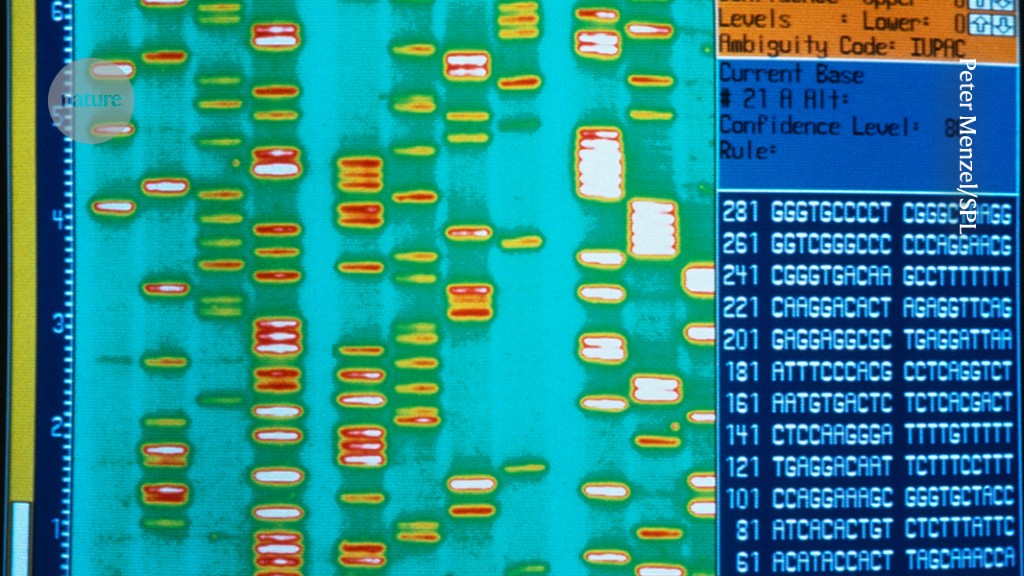
    DNA sequencing of the human genome: computer display of an automated method of decoding the sequence of base-pairs in fragments of DNA extracted from human chromosomes.

    DNA sequencing has become routine, but the roles of individual genes can be hard to be pin.Credit: Peter Menzel/SPL

    How Life Works: A User’s Guide to the New Biology Philip Ball Pan Macmillan (2024)

    For too long, scientists have been content in espousing the lazy metaphor of living systems operating simply like machines, says science writer Philip Ball in How Life Works. Yet, it’s important to be open about the complexity of biology — including what we don’t know — because public understanding affects policy, health care and trust in science. “So long as we insist that cells are computers and genes are their code,” writes Ball, life might as well be “sprinkled with invisible magic”. But, reality “is far more interesting and wonderful”, as he explains in this must-read user’s guide for biologists and non-biologists alike.

    When the human genome was sequenced in 2001, many thought that it would prove to be an ‘instruction manual’ for life. But the genome turned out to be no blueprint. In fact, most genes don’t have a pre-set function that can be determined from their DNA sequence.

    Instead, genes’ activity — whether they are expressed or not, for instance, or the length of protein that they encode — depends on myriad external factors, from the diet to the environment in which the organism develops. And each trait can be influenced by many genes. For example, mutations in almost 300 genes have been identified as indicating a risk that a person will develop schizophrenia.

    It’s therefore a huge oversimplification, notes Ball, to say that genes cause this trait or that disease. The reality is that organisms are extremely robust, and a particular function can often be performed even when key genes are removed. For instance, although the HCN4 gene encodes a protein that acts as the heart’s primary pacemaker, the heart retains its rhythm even if the gene is mutated1.

    Another metaphor that Ball criticizes is that of a protein with a fixed shape binding to its target being similar to how a key fits into a lock. Many proteins, he points out, have disordered domains — sections whose shape is not fixed, but changes constantly.

    This “fuzziness and imprecision” is not sloppy design, but an essential feature of protein interactions. Being disordered makes proteins “versatile communicators”, able to respond rapidly to changes in the cell, binding to different partners and transmitting different signals depending on the circumstance. For example, the protein aconitase can switch from metabolizing sugar to promoting iron intake to red blood cells when iron is scarce. Almost 70% of protein domains might be disordered.

    Classic views of evolution should also be questioned. Evolution is often regarded as “a slow affair of letting random mutations change one amino acid for another and seeing what effect it produces”. But in fact, proteins are typically made up of several sections called modules — reshuffling, duplicating and tinkering with these modules is a common way to produce a useful new protein.

    Light micrograph of human DNA.

    DNA alone cannot reveal how life works.Credit: Philippe Plailly/SPL

    Later in the book, Ball grapples with the philosophical question of what makes an organism alive. Agency — the ability of an organism to bring about change to itself or its environment to achieve a goal — is the author’s central focus. Such agency, he argues, is attributable to whole organisms, not just to their genomes. Genes, proteins and processes such as evolution don’t have goals, but a person certainly does. So, too, do plants and bacteria, on more-simple levels — a bacterium might avoid some stimuli and be drawn to others, for instance. Dethroning the genome in this way contests the current standard thinking about biology, and I think that such a challenge is sorely needed.

    Ball is not alone in calling for a drastic rethink of how scientists discuss biology. There has been a flurry of publications in this vein in the past year, written by me and others24. All outline reasons to redefine what genes do. All highlight the physiological processes by which organisms control their genomes. And all argue that agency and purpose are definitive characteristics of life that have been overlooked in conventional, gene-centric views of biology.

    This burst of activity represents a frustrated thought that “it is time to become impatient with the old view”, as Ball says. Genetics alone cannot help us to understand and treat many of the diseases that cause the biggest health-care burdens, such as schizophrenia, cardiovascular diseases and cancer. These conditions are physiological at their core, the author points out — despite having genetic components, they are nonetheless caused by cellular processes going awry. Those holistic processes are what we must understand, if we are to find cures.

    Ultimately, Ball concludes that “we are at the beginning of a profound rethinking of how life works”. In my view, beginning is the key word here. Scientists must take care not to substitute an old set of dogmas with a new one. It’s time to stop pretending that, give or take a few bits and pieces, we know how life works. Instead, we must let our ideas evolve as more discoveries are made in the coming decades. Sitting in uncertainty, while working to make those discoveries, will be biology’s great task for the twenty-first century.

    Competing Interests

    The author declares no competing interests.

    [ad_2]

    Source link

  • A forgotten Aztec scholar and more: Books in brief

    A forgotten Aztec scholar and more: Books in brief

    [ad_1]

    In the Shadow of Quetzalcoatl

    Merilee Grindle Belknap/Harvard Univ. Press (2023)

    Archaeologist and anthropologist Zelia Nuttall focused on the pre-Columbian cultures of Mexico (those that existed before 1492). Born in 1857, she didn’t attend university and struggled to be recognized for her many achievements. Yet she learnt the languages of the Aztecs and their Mixtec predecessors; decoded their calendar; and taught herself to decipher their pictographic histories and legends. This biography of Nuttall, by Latin American political specialist Merilee Grindle, does justice to a remarkable but forgotten scholar.

    Economics in America

    Angus Deaton Princeton Univ. Press (2023)

    On his first US visit, British economist Angus Deaton — half believing “the place was infested with gangsters” — thought he saw a man in a restaurant bleeding from a gunshot wound. Later, Deaton understood that he himself had fired the ‘shot’, by stepping on a ketchup packet. This incident chimes with his thought-provoking assessment of US economics. At first glance the field seems driven by politics and “devoid of scientific content”, notes the Nobel laureate. But some economists “do everything that good scientists should do”.

    Our Ancient Lakes

    Jeffrey McKinnon MIT Press (2023)

    Most lakes are, at most, a mere 10,000 years old. They formed after the last glacial period. But a few — such as lakes Titicaca in South America, Tanganyika in Africa and Baikal in Asia — are millions of years old, formed by tectonic processes. Ancient lakes contain a lot more biodiversity, some of it unique, than do younger ones. This fascinates biologist Jeffrey McKinnon, whose intriguing book explains how these lakes are altering our understanding of “the formation of new species and how life diversifies”.

    Ocean Life in the Time of the Dinosaurs

    Nathalie Bardet et al. Princeton Univ. Press (2023)

    Giant marine reptiles such as ichthyosaurs, which flourished in the Mesozoic era (252 million to 66 million years ago), are often wrongly called dinosaurs. But that’s like calling a whale a pachyderm because both whales and elephants are large mammals, note four palaeontologists. Their fine book about these extinct marine reptiles, illustrated by Alain Bénéteau, was first published in French in 2021. It details the anatomical, physiological and behavioural adaptations that land-dwelling reptiles needed to flourish in the oceans.

    Women in Science Now

    Lisa M. Munoz Columbia Univ. Press (2023)

    A project launched in the 1960s asked school children to “draw a scientist”. By 1983, it had collected 5,000 drawings, of which only 28 depicted a female scientist. By 2018, 33% of the more than 20,000 gathered drawings, showed women. In science, too, there has been a shift towards gender equity. But serious obstacles remain, says science writer Lisa Munoz in this practical analysis, complementing it with female scientists’ vivid career stories. “No single intervention, policy, or law is enough,” she rightly notes.

    Competing Interests

    The author declares no competing interests.

    [ad_2]

    Source link