An adage in epidemiology states that, if you’ve seen one epidemic, you’ve seen one epidemic. However, argues economist Troy Tassier in his thoughtful history, in almost every epidemic, the rich escape and survive while the poor stay and suffer. Take the London plague of 1625 — the wealthy fled, food prices soared and the poor starved, until eventually King Charles I taxed the rich refugees. To avoid future epidemic catastrophes, nations must support “universal access to high-quality health care” and “living wages for all workers”.
Write Cut Rewrite
Dirk Van Hulle & Mark Nixon Bodleian Library Publishing (2024)
The Bodleian Library in Oxford, UK, stores draft manuscripts, including one of philosopher Ludwig Wittgenstein’s Tractatus Logico-Philosophicus (1921). The last line translates to “Whereof one cannot speak, thereof one must be silent”, followed by his handwritten “Schluss!” (‘The End!’). Another, ‘The Mole & the Water Rat’ by writer Kenneth Grahame, was published as The Wind in the Willows (1908). Both are illustrated in this varied book about how authors compose and revise, by historian Dirk Van Hulle and literature researcher Mark Nixon.
The Incarcerations
Alpa Shah William Collins (2024)
India is a democracy, but between 2018 and 2020, its government imprisoned, so far without trial, 16 Indian academics, lawyers, poets and journalists, notable for defending human rights. It accused them — on fraudulent evidence — of being Maoist terrorists plotting to kill Indian Prime Minister Narendra Modi. The case is a “bellwether for the collapse of democracy in India”, argues anthropologist Alpa Shah, in her deeply researched and frequently shocking account of how Hindu nationalism has created “an Indian form of fascism”.
Wild Woman
Philippa Forrester Bloomsbury Wildlife (2024)
A prime-time TV presenter and producer of science documentaries, Philippa Forrester holds degrees in English literature and ecology. In 2015, she moved from the United Kingdom to Wyoming, where she encountered wolves, grizzly bears and moose, before returning home. In this personal and readable account of women working in nature over several centuries, Forrester calls herself “a hybrid of scientist and storyteller”, belonging to no “wild” female archetype — neither a practical “nurturer” nor a spiritual “crazy crone”.
Paranoia
Daniel Freeman William Collins (2024)
There needs to be a public discussion about trust, argues Daniel Freeman, the world’s leading paranoia researcher: on both “the forces that undermine it, and the measures we can take to restore it”. Some 1–3% of the population have severe paranoia. Such mistrust might be why conspiracy theories flourished during the COVID-19 pandemic. But there is hope, Freeman concludes, if world leaders work together, as US president Ronald Reagan and Soviet leader Mikhail Gorbachev did during the cold war.
Even before the applause had faded away, an old, balding rat was scurrying across the auditorium to overtake the raven who had given the talk.
“Interesting seminar, Dr Blackfeather,” he shouted. Blackfeather turned, smiling as widely as his beak would allow.
“Hello, Professor Shortfur. Didn’t think you’d be present.”
“Couldn’t miss your talk, could I? Though actually, today, I had a personal interest in the subject. Your theories about the monkey cities are fascinating. Although I hope you know it’ll be an uphill climb to publish them. With fossil evidence of rats and ravens in these cities since antiquity, we’re biased to think we built them ourselves.”
“I find my evidence convincing.”
“It certainly seems like bipedal monkeys did most of the work. But linking the monkeys’ extinction to our species’ rapid cognitive evolution … that’s a brave claim, and one directly relevant to my own research.”
“Indeed? How come the renowned geologist is suddenly investigating brain evolution?”
“It’s a long story. Have you read my paper about how closely the monkeys’ industrial era aligns with rising global temperatures? No? The correlation is nearly perfect. Do you think it’s possible that the Warm Age caused —”
Read more science fiction from Nature Futures
“On such short time scales? Sorry, but that makes no sense.”
“These monkeys make no sense,” Shortfur replied irritably. “Maybe they had a temperature-dependent engineer phenotype? I honestly don’t know, I’m not the evolutionary biologist here. Just saying — the fit’s too good to be a coincidence.”
“Well, correlation is not causation. Maybe … maybe it’s the other way round — the monkeys somehow changed the climate.”
They stared at each other for two full seconds, then both burst out laughing.
“Let’s be serious for a minute,” said Shortfur. “This was a normal species, like us, for millions of years. Then, within decades of the Warm Age beginning, they suddenly all went crazy.”
“By crazy you mean the overpopulation? The monkey-made cities I was talking about?”
“Yes, but also literally crazy. They drove a lot of animals to extinction — ate them, I presume — while at the same time, they were keeping wolves and dinosaurs as pets.”
“If by dinosaurs you mean chickens, we know they harvested them for amino acids.”
“No, I mean actual dinosaurs. Some of the biggest, most ferocious species.”
Blackfeather gaped. “I thought they predate monkeys.”
“Predate as in eat?”
“Predate as in pre-exist. By millions of years, if you trust Beakk’s isotopic analyses.”
“I don’t. Radiometric dating is unreliable around that period. I received some samples from ancient islands in the Pacific, with isotope ratios that Beakk would confidently date as being from the future. Anyway, the fact remains that most dinosaur fossils were found near monkey city centres. Indoors, in huge halls. My point is, monkeys were up to some seriously weird stuff during the Warm Age.”
“And you propose this was somehow caused by the changes in the atmosphere? I’ll have to think about this …”
“Wait, it gets even more interesting. Do you know Dr Whiskers from South Sewer University?”
“Heard of her. An astrophysicist, isn’t she? What’s she got to do with it?”
“As I’m sure you’ve heard, her team’s lunar probe brought back some suspected organic matter last year. They isolated something that might be DNA and sent it to my department for sequencing. I saw the results this morning. Guess what it was.”
“No way. You’re making this up.”
“I swear I’m not. The DNA was too ancient to pinpoint the species, but the conditions preserved it perfectly, and it’s a primate alright. On the Moon.”
“Nonsense. They haven’t got any wings.”
“Damned if I know how they got there, but it’s them. No other primate species was ever smart enough to get all the way up there. And then within a couple centuries they were gone, which, according to your superb talk, sparked our own cognitive evolution and current societies. What do you make of it?”
“You think they all sailed off into the sky.”
“Don’t tell me what I think. What do you think?”
“Do you want my honest opinion?”
“Always.”
“You seem confident in the DNA evidence, so I’ll accept your claim that they landed a monkey on the Moon. That’s an incredible discovery in itself, truly exciting. But this act seems to me like their desperate attempt at a last-minute escape, and they’re unlikely to have got much farther. It doesn’t outweigh the evidence — ample evidence — that they simply ran out of resources and died out fighting over leftovers. Maybe the survivors were outcompeted by more intelligent species like rats, ravens and parrots. Maybe they were weakened by the pollution or hunted down by their dinosaurs. The bottom line is, I find it hard to accept that they found a magic solution in the nick of time, then disappeared without a trace.”
“You know what I find hard to accept?” said Shortfur vigorously. “That a species intelligent enough to build the Berlin Sewer and catapult itself to outer space would meet its end like bacteria in a neglected dish. I believe — I want to believe — that some of them made it out, against all odds. That they’re still alive on some strange planet. Watching us, perhaps.”
Blackfeather’s eyes glinted as he placed a friendly wing on the old rat’s shoulder. “I want to believe it too, Professor. But I can do nothing but hope. With your permission, I’ll be returning my attention to Earth, where it belongs.”
She was taller than me. Prettier and with better muscle tone. Shinier hair and perfect skin and teeth. Which was odd because she claimed she was me — from the future.
“Mmmmf!” I said.
“Sorry about the gag. Let me loosen it.”
“What the hell!? You’re here to kill me — won’t that kill you, too?”
She rolled her eyes. “No, it didn’t. I’m here, aren’t I?”
I scoffed. “I might not be a time-travelling assassin supermodel —”
“Yet,” she interjected with a smile.
“— but even I know that’s impossible. It’s a time whatchamacallit … a paradox!”
Read more science fiction from Nature Futures
She leant forward with a gleam in her eyes like I was 101 puppies, and she was in the market for a winter coat. “Yes, exactly! I need a paradox, a large one. Killing myself is the biggest event I can put into motion at such short notice.”
I struggled against the plastic straps that bound my hands behind my kitchen-table chair. “That doesn’t make any sense!”
“Sorry, I don’t have the time to explain the general theory of paradoxity or walk you through my calculations.”
“Calculations about what?” I asked — as long as I kept her talking, she wasn’t murdering me.
“About how much energy the death will release. Don’t worry — it will have been enough.”
“Energy for what?”
She let out an exasperated sigh. “Let me make it simple: what’s the biggest paradox you’ve heard of?”
“I don’t know — everything I say is a lie?”
“No, that just means you don’t understand set theory. The greatest one is existence itself: why is there something instead of nothing? It gave rise to everything, and — together with other, smaller paradoxes — keeps everything going.
“Uh huh,” I said, humouring my future self.
“But those bastards from the CCCCCC — the Chronological Continuum Consistency Coordinated Consortium Confederacy — are obsessed with timescape integrity. They’ve pushed my team back everywhen, undoing our efforts to make the timeline a better place to live in. They will even make sure World War Three — which we’d managed to avoid, you’re welcome — will begin right on time next Tuesday. I need to finish them once and for all. They’re out of control. They’ll go too far back; undo the Paradox of Life itself —”
“Life’s a paradox?”
“Duh!” — I hadn’t realized how obnoxious it is when I do that — “Why else would dumb, entropic matter organize itself into something that can laugh, love and fart?”
I looked around and saw an old family picture. “Why kill me? Wouldn’t killing somebody like … not mum or dad, um … would grandma Georgina work? We never liked her.”
“No, we didn’t. Remember the haircut incident in third grade?” She chuckled softly. “But no, sorry, it must be me, or it won’t have enough juice. A tight timeloop like this should release ten-to-the-twelfth-power chronojoules. The CCCCCC bastards will never see it coming!”
I grasped for something, anything to distract her. “Aren’t you supposed to be older? Why do you look better than me?”
She looked down at her body. “It’s a back-echo of the energy release. It rearranges nearby systems into their optimal state. And this,” she waved at herself, “is more optimal than, well, that.” She pointed at me.
“Thanks so much for taking the time to insult me before killing me.”
“No problem.” She looked at some glowing numbers on her wrist. “This will have been fun but time has run out of time — we have to do this now.”
She pulled out a knife and slipped behind me.
“Stop!” I said, but she didn’t. I felt something shift and fell forward. There was a flash of something much brighter than ordinary light could ever be.
My hands weren’t tied behind me any more. I leapt up, trying to remember the three weeks of taekwondo I’d taken back in high school — and hoping she didn’t. I turned and saw a hotter version of myself lying on the floor with a gash on the side of her throat. Blood was spreading out on the white carpet my ex-boyfriend had picked out. Good, I never liked it, or him — wait, why was I still breathing?
I looked down — my body had changed. I looked like her now. I felt the energy and knowledge move through me. I knew what I had to do — fight those bastards from the CCCCCC and win.
There was just one thing I didn’t understand. I knelt beside her. “This doesn’t make any sense. I thought you had to kill me?”
She looked up with a small, weak smile. I leant in to hear her say, “If it made sense, it wouldn’t be a paradox, would it?”
The story behind the story
Rodrigo Culagovski reveals the inspiration behindThe real time-travel paradox was the friends we made along the way.
My offspring and I love to watch superhero team TV series. They usually feature some — or a lot — of time travel, and are full of plot holes and paradoxes, to the point where we joke that time-travel paradoxes are their real super power.
I’m also a member of Codex, an SFF writers community. We hold flash-fiction contests twice a year. Last year, one of the prompts was “Road trip! Where are you going and who are you bringing with?” I didn’t use it as is, but it got me thinking of my favourite snowclone, “The Real X Was the Friends We Made Along the Way”.
Cadence noticed the warfighter on her way to school. He was still there later, sitting in the tiny fenced park, as she walked back home along Sixth Avenue. There was a pigeon watching him, which the police had thought at one time was a good way to disguise a camera. She stopped and sat on the other bench.
“There aren’t any birds,” she said. “You know that, right?”
He was an 800-year-old 30-year-old man and he sat huddled in a large coat with the cheap sheen of post-consumer polyethylene, under which he wore a side-ventilated floral tactical shirt and adaptive camo cargo pants with sagging, empty pockets. She supposed the creases were from being repeatedly flash frozen.
“Why’s the sky grey but it never rains?” he asked.
“Salts.”
“Don’t bullshit me, kid.”
“To keep the sunlight out.”
“That’s fantastic. Thanks for taking care of the place while I was gone.”
“Where’d you fight?”
“Proxima.”
“Where else?”
“Eridani. Lacaille.”
“How old are you?”
“Let’s not do the math.”
“Why’d you come back?”
“The sunsets.”
“Seriously.”
“Come on, give me a break, kid,” he said, getting unsteadily to his feet. “I’ve had a long century.”
She followed him to a coffee kiosk across the street and read the peeling posters on a movie theatre that had closed during a run of Mild Red Pier before she was even born. He paid the machine with a plastic pendant he wore on a bright green spiral wristband, which she was sure also stopped being a thing before she was born. He cracked the lid and sniffed the coffee, then made a face, but he didn’t look back, and she watched as he wandered down the sidewalk and turned a corner, shuffling towards the river.
*****
“He’s from the Cincinnatus,” her father told her. “They returned a month ago. The numina are very interested in him. Few come back these days, and those that do don’t last long.”
“Why?”
“They kill themselves, sweet.”
She looked him up with her headset and found his service record in the National Archives. He was born in analogue New York and enlisted at a time of 77% unemployment, one of thousands to leave behind family and friends to climb into a hydrogel-filled cold tube and accelerate out into the darkness at a fraction of the speed of light. The relationship between temperature and viscosity, she was told, was a mechanism for inertial suspension in Einsteinian space travel, by which time her mind had already started to wander. She heard something about the survival rates back then being only marginally higher than the odds of finding work on the streets of any American city.
*****
She looked for the warfighter in the park the following day, but found only the pigeon perched on a streetlight, head cocked as it scanned passing faces. She threw her apple at the filthy bot, missed, and heard it smack the asphalt of the basketball court.
He was over on the pier, pitching pea gravel out into the clear, shallow Hudson.
Read more science fiction from Nature Futures
“What does a Proximan look like?”
“They’re not called that.”
“What are they called?”
“It translates as something like step-accretion. We called them steppers.”
“What do they look like?”
“Something that comes out the ass end of another stepper.”
“Why did we fight them?”
“Incompatible world views.”
“That’s not a reason.”
“Out there, it’s not about who gets more land, or access to water, or political representation. It’s about the survival of thinking people, period. We’re the only living things out there with a concept of self. Or we were. It’s just one hive mind after another. What does that tell you about the Universe?”
“What?”
“What.”
“What does that tell you about the Universe?” she repeated.
“It tells me I’m sitting out here on the short branch of a very large tree, kid.”
“I have a concept of self.”
“Oh yeah? Did they copy that over from last year’s model?”
“I don’t get a new body every year. I had one as a baby, then this one, and in a few years I’ll be a full adult. Adults get upgraded only every 25 years. It used to be longer, but they make these ones in the maquiladoras.”
“What do you think happens when you’re upgraded?”
“They move my brain from one body to another.”
“Not your brain. Your mind. And they don’t move it, they copy it. And then they put a bullet in the old one.”
“They don’t use bullets.”
“You don’t have a concept of self if everything you think and feel is a mirror image of something else. You have a copy of a concept of self.”
“What’s a mirror?”
“Jesus. Reflective glass. A copy. A duplicate.”
“I’m not a duplicate. There’s only one.”
“Not hanging onto the original doesn’t make a copy any less a copy. People don’t go to the MOMA to see a photograph of Starry Night.”
“What’s a MOMA?” she asked impatiently.
“Go up Sixth to 53rd and hang a right. It’s a peri-peri takeout now.”
*****
Cadence stayed at home the rest of the week studying for her middle-SAT, and when she returned to the pier the warfighter was gone. She watched the narrowband video that showed first landfall on Proxima Centauri b, but the faces were all unfamiliar and the video quality was poor, so she filed it away for later with her unwatched TV shows and the footage from her childhood pets.
She spent the summer on Long Island, and when she returned to school in the fourth quarter she crossed through Washington Square and ambled back down Sixth Avenue. The warfighter was there again in the park. Instead of a pigeon, the numina had deployed a pair of scruffy alleycats, which would provide better stereo.
She sat down on the other bench, but he didn’t recognize her, and after a moment she looked away.
“Why’s the sky grey but it never rains?” asked the two-month-old 800-year-old man.
“Probably smog,” she whispered, and went home.
The story behind the story
Timothy Quinn reveals the inspiration behindThe warfighter.
There’s a solution to the Fermi paradox whereby life is commonplace in the Universe, but the complexity and perishability of intelligent, conscious, technological life makes us unique. Intelligence might represent a state of disequilibrium that the Universe does not long abide.
If humanity struggles and wanes, as it does in The warfighter, it might trade evolution for algorithms, war for autocracy, individuality for replicability. To the returning veterans of tomorrow’s abandoned conflicts, Homo sapiens will seem a very different species from that which was left behind hundreds of years before, and it might be difficult to remember exactly what it was that was worth fighting for.
Cadence’s favourite park is the Golden Swan Garden on the Lower East Side of Manhattan, and if you peer over the fence you might find there’s a final matinee screening of Mildred Pierce at the IFC Center.
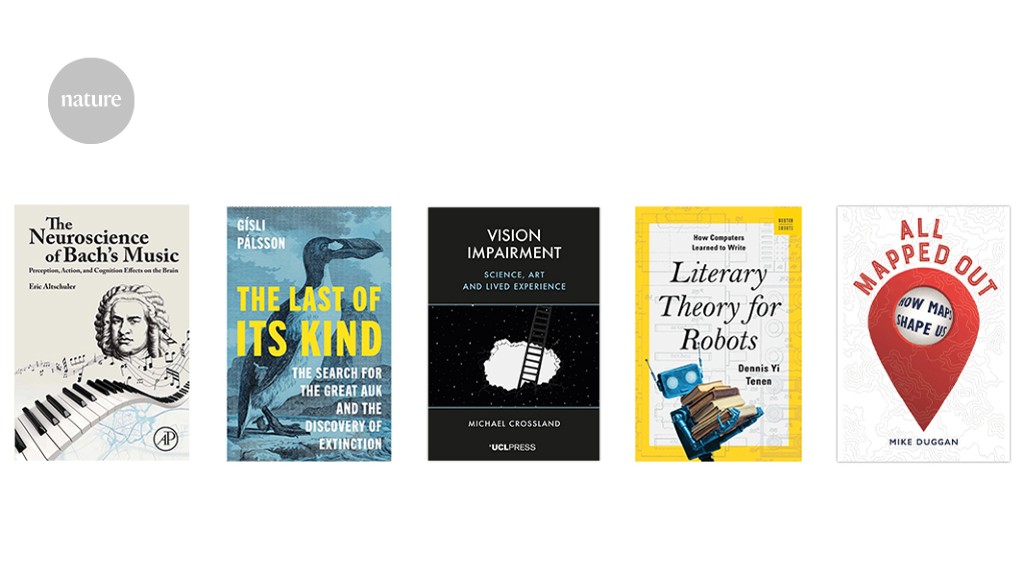
On a typical day in his clinic, London-based optometrist Michael Crossland assesses both young children and centenarians with low vision. Severe vision impairment affects 350 million people around the world, many of whom in poorer countries lack access to any eye care. His fascinating, sometimes moving, account — mixing ophthalmology with the stories of his patients and many others — reveals that life with vision impairment can be “just as rich and rewarding as life with 20/20 vision”.
Literary Theory for Robots
Dennis Yi Tenen W. W. Norton (2024)
Artificial intelligence (AI) is rooted in the humanities, argues Dennis Yi Tenen, a comparative-literature professor and former Microsoft engineer. Chatbots are trained using electronic versions of tools such as “dictionaries, style guides, schemas, story plotters [and] thesauruses” that were historically part of the collective activity of writing. Indeed, a statistical model called the Markov chain, crucial to AI, arose from an analysis of vowel distribution in poems by Alexander Pushkin. Tenen’s cogitation is a witty, if challenging, read.
The Last of Its Kind
Gísli Pálsson Princeton Univ. Press (2024)
Living species could never become extinct, thought naturalist Carl Linnaeus. Charles Darwin disagreed, saying extinction was a natural process. Then ornithologists John Wolley and Alfred Newton began studying great auks, flightless birds living on remote islands in the North Atlantic Ocean. They visited Iceland in 1858 to see great auks, but instead met locals who described killing off the birds — revealing how humans could extinguish a species. Anthropologist Gísli Pálsson tells the engaging story of this “key intellectual leap”.
All Mapped Out
Mike Duggan Reaktion (2024)
Cultural geographer Mike Duggan works in partnership with the UK national mapping agency, Ordnance Survey, to study everyday digital-mapping practices. Important as it is, digital mapping is not superseding analogue maps, he observes in his global history of cartography, which begins with Palaeolithic carvings. Sales of Ordnance Survey paper maps are rising, perhaps because of their convenience. “Although digital maps are improving constantly in accuracy and design, they do not always live up to those promises.”
The Neuroscience of Bach’s Music
Eric Altschuler Academic (2024)
Physician and neuroscientist Eric Altschuler regards J. S. Bach as the greatest composer ever, as do many others. Altschuler’s pioneering study — illustrated with numerous musical examples — aims to show how Bach-centred neuroscience “can help us better appreciate perceptual and cognitive affects in Bach” and create better performances of the composer’s work. It also teaches us how music perception is not localized to one region of the brain but occurs throughout it, and varies from person to person.
Musician Prince on stage in Detroit, Michigan, during his 1984 Purple Rain tour.Credit: Ross Marino/Getty
Working scientist profiles
This article is part of an occasional Nature series in which we profile scientists with unusual career histories or outside interests.
In 1983, Susan Rogers got a call that would change her life. She was working as an audio technician in the music industry in Los Angeles, California, when an ex-boyfriend got in touch to tell her that the musician Prince was looking for a technician.
Rogers, who at the time was one of the few female audio technicians in the United States — and maybe even the world — was already a Prince fan. His work reminded her of the soul music she had grown up listening to in the 1960s and 1970s in southern California — artists such as Sly and the Family Stone and Al Green, but with a contemporary, punk edge.
By this point, Prince had just released his album 1999. Rogers, who was 27 at the time, would begin working with him on Purple Rain, the record that would launch him into global superstardom.
Sounds of science: how music at work can fine-tune your research
She spent four years working with Prince in his home recording studio in Minneapolis, Minnesota, leaving a year before the opening of Paisley Park, Prince’s now-legendary creative and performing space. By this point, she had graduated from being an audio technician — maintaining and repairing equipment — to recording engineer, a role that has much more influence over the whole sound of a record.
“I was talking to some Prince alumni recently and they were saying ‘poor Susan, she never even got Christmas Day off’. There’s no ‘poor Susan’ about it — I was working with my favourite artist and there was nowhere I would rather be,” she says.
After Prince, she went on to work with other musicians, such as the Canadian rock group Barenaked Ladies and David Byrne, former lead singer of the new-wave band Talking Heads. At the age of 44, and with the help of the royalties she earned on the Barenaked Ladies album Stunt, she quit the music industry (see ‘Quick-fire questions’).
Higher education had not been an option growing up — her mother died when she was 14 and Rogers was married aged 17. She escaped that unhappy relationship after three years and headed to Hollywood, where she got a job as a trainee audio technician.
Susan Rogers trained as a recording engineer before pivoting to neuroscience. She continues to produce music, such as for US singer-songwriter Jeff Black.Credit: Madison Thorne
Over the years, she increasingly felt the pull of academia and a calling to study the natural world. So, in 2000, she began her undergraduate degree in neuroscience and psychology at the University of Minnesota. Initially, she wanted to study consciousness in non-human animals, but was advised that a more meaningful contribution would be a neuroscience degree that would also enable her to study music perception and cognition. She then did her doctoral work at McGill University in Montreal, Canada. Returning to education after so many years was not as difficult as she had feared — and years spent learning the intricacies of a recording console helped her to understand the complexity of the human brain.
Her PhD research focused on auditory memory. She designed experiments to test short-term memory for musical intervals, in which musicians and non-musicians listened to a piece of music containing consonance (harmonious sounds) and dissonance (clashing or unexpected sounds). The most interesting observation was that, for both groups, short-term auditory memory lasted longer than was previously thought, she says. At the time of her doctoral work, psychologist István Winkler and his colleagues had reported that auditory short-term memory persisted for roughly 30 seconds1, but Rogers’s work demonstrated it lasting for 48 seconds.
A good ear and a sound work ethic
One of Rogers’s PhD supervisors was Daniel Levitin, a cognitive psychologist, musician and record producer whose research focuses on music perception. He knew of Rogers from her work with Prince and Barenaked Ladies, and took her on “in a heartbeat”. “She was Prince’s engineer — that’s one of the top engineering jobs in the world,” he says.
Her years in the music industry greatly enhanced her academic work, he says. It gave her an astonishing work ethic and helped her to hone her all-important listening skills.
“What auditory neuroscience requires is a good ear. You’re designing experiments and you need to be able to hear subtle details that others might not hear so that you know you’ve prepared your experiments correctly. Susan has a great ear.”
Levitin describes her as very musical, “even though she doesn’t play an instrument”. As a producer, he explains, her job was to coax out of the musician “the most authentically emotional performance you could get”. “Miles Davis told her she was a musician. He didn’t throw around that term lightly,” he says of the renowned jazz bandleader and composer.
In 2008, Rogers joined Berklee College of Music in Boston, Massachusetts, where she teaches music production and engineering. She is also writing a course on music and neuroscience for the college’s online programme.
She has investigated what people visualize when they listen to music, and plans to publish the results. Some people, including Rogers, imagine the musicians playing; others make up stories based on the lyrics; and for some — particularly older people — music triggers memories. Interestingly, musicians and non-musicians do not differ greatly in their visualizations.
“One of the least musical people that I know — somebody who would almost be called tone deaf — reports that he sees abstract shapes and colours when he listens to music. And two of the finest musicians I know also visualize abstract shapes and colours. I can’t even imagine having that visualization to music,” she says.
Throughout her successful music career, Rogers admits that there were times when she felt like a bystander in the studio — because she does not play an instrument or compose, her views felt secondary to those of the professional musicians. But in her career as an academic and teacher, she is very much at home.
“Nothing in my life has brought me more joy than scientific pursuit. It is as creative as anything I ever did while making records. Had I realized in my youth that a career in science was possible for me, my hunch is that I could have made a more notable contribution. Earning a PhD at age 52 doesn’t permit that,” she says.
Common cause
Rogers also thinks that musicians and scientists have more in common than one might guess — both need to be open-minded and be able to separate relevant and irrelevant information. “The fashion and the hairstyles are different — musicians have the edge there — but there are more similarities than differences,” she says.
The sound of stars
How else are the two professions similar? “It takes guts to commit to a music career because there is no comfortable path and absolutely no light to guide you, other than your own internal one,” says Rogers. “I’ve had the privilege of knowing some outstanding scientists and my perception is that they, too, are driven more by scratching an intellectual itch than by winning a prize or being famous.”
That feeling of being a bystander in the music industry receded when she realized that listening is an “indispensable component of what music is”, as she explains in her 2022 book, co-authored with neuroscientist Ogi Ogas, This is What it Sounds Like: What the Music You Love Says About You.
“Practically speaking, without a listener, music does not exist. By perceiving, feeling and reacting to the many dimensions of a song, a listener closes the creative circle and completes the musical experience,” she writes.
Levitin thinks that one of Rogers’s main contributions through her writing and public speaking has been to elevate the importance of the listener.
“She’s also adding the social context by which we listen, and by which we decide what we like, and the developmental stages we go through as listeners, from listening to children’s nursery rhymes to more sophisticated things,” he says. Her book, he adds, is a perfect example of what a popular-science work and science communication should be — it does not dumb down the science or patronize its audience, but neither does it aim so high that it’s impenetrable.
Training: Effective science communication
Rogers hopes that, one day, all music courses will include a unit on music cognition to help creators to understand how listeners receive their craft.
“It won’t help you in the studio and it won’t help you while you’re composing. And I don’t think it should — when we’re creating works of art, we shouldn’t be thinking too deeply about the nuts and bolts,” she says. That said, a music-cognition course can help music creators to understand their audiences, “just like a chef needs to understand what food tastes like”, she adds.
When she finally left Prince and began working with other musicians, she felt she had to unlearn some elements of Prince’s intense working habits.
“Prince was doing a song a day when I was with him. That was every day. That’s how we worked,” she says.“He also had an exceptional ear for arrangement. He could foresee how the end product was going to turn out in such a way that each part — drums, bass, guitars, keyboards, backing vocals — was recorded with an ear for the subsequent parts. He had a watchmaker’s skill of putting the individual parts together to create a whole.”
She still loves listening to music and discovering new artists, particularly with the help of her students, but she remains true to soul, her first musical love.
“As Prince used to say, soul is the street I live on,” she says.
Quick-fire questions
What music do you listen to when working?
I can’t have music on in the background because it’s such a powerful attractor. If something comes on the radio while I’m driving, I have to turn it down and remind myself to pay attention to the road.
What has been your career highlight?
Working with Prince was obviously a great star in the firmament. But being the producer on the Barenaked Ladies album Stunt was amazing — it went multi-platinum. I’ve had a short science and teaching career but receiving a distinguished teaching award at Berklee was also gratifying.
Did you ever speak to Prince about your research?
Sadly, no. The last conversation I had with Prince was around 1997, before my university education. If we’d had a chance to talk about my research, he would have argued with me on every point, which would have been welcome. I heard him say that if he’d gone into something other than music, he would have liked teaching. With his creativity, intelligence and self-discipline, he would have been an outstanding researcher.
Do you have a memorable mentor?
Musically, the producer Tony Berg taught me a lot. He hasn’t sold as many records as others, but he has influenced so many people. Stephen McAdams at McGill University would be my scientific mentor — he took over supervising my PhD because Daniel Levitin was on a book tour. He is a world expert on timbre perception and is everything a scientist should be — kind, generous of spirit, funny.
Is there any music you don’t enjoy listening to?
I used to have zero interest in heavy-metal music, but two of my students shared their love of it with me, and, as good listeners, they explained why it was so great. I picked up on their love for it. Sometimes we don’t like something because we don’t know it well enough.
If you could save only one record from your collection, what would it be?
It’s so hard to choose when you love so many things, but just off the top of my head I’d probably choose Al Green’s Greatest Hits album.
This interview has been edited for length and clarity.
Tess and Gemma have been camped out on their tartan picnic blanket for days already and they plan on staying until the very end … of the concert or the world, whichever happens first. Smart money is on the latter. The way those lads are going at their bass lines and anthems up on stage, they’re in this until the lights go out for good.
Night is coming soon. The fireflies are out, blinking in electric blue. The Plutonian sunset is apocalyptic but pretty, with blood-red rays flooding the outdoor amphitheatre and the crowds gathered around it in scarlet hues.
“Good evening, ladies.”
“Drinks for the table … um, or blanket?”
The Tiernan boys stop by Tess and Gemma’s spot on their way back from the concession stands. Danny carries a pyramid of cups, filled to the brim with purple-dyed spirits. It’s a local drink, squeezed out from a native plant that their ancestors likened to something called agave, except this plant grows with fuchsia roots and a heart that has to be split open with an axe. No wonder, since it spent millennia buried in ice before the Great Thaw. The hangover feels like an anvil dipped in hot lightning.
“Bring it on,” Gemma says, bravely, scrambling up to her knees to claim the tip-top of Danny’s pyramid. Tess abstains.
“Are you sure?” Atticus tempts her further. But she’s stubborn about it, answering with the same conventional wisdom they’ve all heard a thousand times before: “That stuff will take years off your life.”
“Years off my life? Really, Tess?” Gemma replies with mild sarcasm, while spinning her twisty, psychedelic straw through ice.
Read more science fiction from Nature Futures
They descend into laughter at this, even Tess, because the idea that any of them have ‘years’ left is as absurd as, well, attending a music festival on the eve of humankind’s final demise.
But what else are they supposed to do? Sit at home with the doors locked, eyes shut and hands over their ears, waiting for the end to come? That’s just not how Homo sapiens roll. Or rock and roll, as the case may be.
Anyway, the species has had a good run. Literally, running and leap-frogging through the Solar System like Goldilocks leapt from bed to bed — too hot, too many poisonous gases, too hot again — all while the ageing Sun up there just kept growing rounder and redder. Tonight, it’s a ripe tomato in the sky, ready to burst. And so big that everyone in Persephone’s Meadow can see, by naked eye, the solar flares erupting off its surface.
Those powerful flares will scorch them all to ash by the next sunrise. But they have about an Earth week’s worth of night to enjoy before then, so that’s something.
“Get ready to be proper lost souls in the underworld,” Tess warns, nodding towards the dimming horizon. There’s daylight left but not much. In twilight, the red-giant Sun turns the blue-moss meadow that same shade of violet that fills Gemma’s cup.
“Let’s make some noise, Pluto!” the lead singer of the aptly named The Grateful Dead Suns calls out to his congregation.
Gemma sets her cup down on cyan grass, to give a rousing finger-whistle. The high-pitched trill echoes across the field, mixing with others. Applause and hollers come from all corners, drowning out the music briefly. Even Tess is caught up in it, clapping her hands together above her head, “Woo!”
The energy at Plutopalooza can’t be defeated. Not by dying Sun, eerie eventide or impending night. Not by anything.
They dance with the boys. They dance with each other. They sing until their throats are hoarse and jump around until their legs give out. The sisters finally collapse back onto their quilt, giggling like children, gazing up at distant stars, sharing Gemma’s dwindling drink while reminiscing about good times.
In the meantime, the Sun sets and the meadow goes black.
“We’re still with you!” Tess calls out, hands around her mouth, while Gemma strikes a lighter and lifts it high. A guitar riff answers out of the darkness. By flickering lighter-candle, the sisters exchange grins and whistles, and cheers break out all around them. The whole place clamours for another song. And then another.
They say the band played ‘Nearer My God to Thee’ as the Titanic sank. And if these descendants of the Last Earthers knew the song, maybe they’d play it too. Instead, The Grateful Dead Suns choose a familiar ballad that would’ve made their namesakes proud.
It’s a song of goodnights between friends and warm farewells, melancholy but hopeful. The band beckons and the crowd sings along, verse after verse, chorus after chorus. Those voices rise, filling the field, the atmosphere and spilling out over the edges of the dwarf planet, even after everything else goes silent.
The scout cruiser off the Alpha Centauri system isn’t expecting to find life out here. Given the state of this Sun, their astrobiologists wrote the whole system off as uninhabitable centuries ago. The captain thinks his navigator is crazy when she tells him they need to check out the source of this strange but wondrous noise coming — and it just keeps coming — from a little speck of rock out in the middle of nowhere.
So small, it could never be called a planet.
When the cruiser turns on its lights, twin bow lanterns flood Persephone’s Meadow with golden glow. The ship comes in from the direction of Pluto’s largest moon, which is a little too on-the-nose for those tipsy Plutopaloozians, still dancing their final night away.
“Charon’s ferry?” Tess expects, thinking it’s come out of myth to take them down to Hades. Forgetting, for a moment, that Hades is Pluto and Pluto is Hades. That’s her sister’s drink talking.
“Maybe,” Gemma concedes with a wise little smirk, optimistic about everything except their hangovers tomorrow. She gives a friendly wave to the newcomers, adding, “I think this ferry’s headed the other way.”
The story behind the story
Gretchen Tessmer reveals the inspiration behindPlutopalooza.
As promised in one of my previous ‘story behind the story’ write-ups, I’m here to talk about Pluto, the Little-Planet-That-Was, a casualty of size bias, a cautionary tale for those of us who believed certain grade-school facts to be immoveable, and a crying shame besides.
No, I’m still not over it. Thanks for asking.
Yes, yes, I understand. We change, we grow, we fix old mistakes as we go along. Maybe it was too small to be a planet in the first place. I get it. Thank goodness Clyde W. Tombaugh didn’t live to see the Day of Demotion. But poor Pluto. To be cast aside like an old shoe, to be removed from the team roster for the crime of being ‘too little’. The IAU didn’t give us much warning either. One day, it’s all “Pluto, you’re so precious and cute, I could just carry you around in my pocket” and next, it’s “Here’s your pint-sized hat, what’s your hurry?”
For. Shame.
Anyway, I love Pluto, and I’ve been wanting to write a Pluto-centric story for ages. Over the summer, as I was looking at the year’s line-up for Lollapalooza, an idea sparked in my head for a music festival at the literal end of the Solar System. The rest just flowed from there.
For your curiosity, the song that The Grateful Dead Suns play at the end of their set list is ‘And We Bid You Goodnight’ because it’s very appropriate for this sort of situation, one of my all-time favourites and would sound amazing echoing out into the wilds of deep space. Yes, I know that’s scientifically impossible. But just imagine.
If I was zipping along in the next galaxy over, I might follow those voices over to Plutopalooza, too. In fact … get us some drinks. I’ll meet you there.
The film Dune: Part 2 might feature human actors Timothée Chalamet and Zendaya, but the biggest stars — at least literally — are the sandworms. The sandworms are central to the desert ecosystem of the fictional planet Arrakis, the film’s main setting, and to the culture of its inhabitants, the Fremen. Sandworms live underground and excrete a substance that becomes the all-important drug called spice, and the Fremen ride them like giant sandy freight trains. In the film’s first glamour shot of a sandworm, a house-sized mouth ringed with teeth erupts out of the sand to swallow a whole platoon of soldiers.
To find out whether the fictional worms in Dune share anything in common with real worms, Nature spoke with palaeontologist Luke Parry at the University of Oxford, UK. He studies worms from the Cambrian and Ordovician periods, which together lasted from roughly 540 million to 443 million years ago.
Dune’s sandworms can grow to a length of at least 450 metres, about 15 times that of the longest blue whale. How big do real-life worms get?
There [are] annelid worms that get up to several metres in length called eunicid worms [bristle worms]. They’re pretty gnarly, they have big jaws, they look a bit like Graboids from [the film] Tremors. Some of them are ambush predators. They eat octopuses, squid, vertebrates.
There are some earthworms that get really big as well. Megascolides [reaches] up to 2 metres. The biggest ones are from Australia.
The ambush predator called the bobbit worm (Eunice aphroditois) can reach 3 metres in length.Credit: Constantinos Petrinos/Nature Picture Library
Do any of them have teeth?
The worms in Dune have lots of teeth around their mouths, and that’s what the Fremen use to make their crysknives. There are worms like that, [called] priapulids. These are the sorts that were making those first complex burrows in the early Cambrian. They use all of these teeth, called scalids, on a proboscis to drag themselves through burrows. Alitta worms — sandworms — and ragworms have teeth for catching prey. Some leeches have teeth.
The sandworms in Dune have totally changed their planet by excreting the valuable drug called spice, making the weird blue liquid called the Water of Life and other more. Have worms on Earth changed our planet?
Worms [on Earth] were responsible for burrowing into sediments over half a billion years ago and changing marine ecosystems forever. It’s part of what we call the Cambrian explosion, one of the most profound changes on the planet.
Before the advent of worms, the sea floor would have been smothered with what are called microbial mats. All the sediment would have been anoxic [without oxygen]. If you’ve ever gone swimming in a river or a lake and it’s muddy and you plunge your foot into it, and it’s smelly and anoxic, that’s basically what the entire sea floor environment would have been around the world.
Then all of a sudden, some animals evolve a wormy body plan that allows them to move in three dimensions. They start burrowing into sediments, and that means that oxygen can get into the sediments and complex animal life can live there. It opens up new ways of making a living. Worms are part of this fundamental restructuring of the world.
When the Fremen in Dune want to ride a sandworm, they summon one with a device called a thumper that drums the ground. Do real worms sense vibrations?
Yeah, a common thing that birds do for catching earthworms is drumming on the ground, to bring them to the surface of the soil. Seagulls do it. Unfortunately, I don’t think the seagulls ride around on them.
If you were the right size to ride on a worm, do you think it would be similar to riding a sandworm in Dune?
It depends what sort of worm it was and where it was going. There are lots that crawl around on the surface of sediments — maybe you could ride those around. For worms that burrow, I think you’d find it quite uncomfortable and confining.
Any other favorite worm facts?
There are about 30 animal body plans — what we call the animal phyla, the big groups that we chop up animal diversity into — and [more than half] of them are worms. It’s a really good, versatile way of making a living. Lots of things that didn’t start off as worms just become worms. There are groups of lizards that lose their limbs, like snakes and amphisbaenians, worm lizards. There are worms that live in hydrothermal vents in the deep sea.
How do you feel about having the organisms you study portrayed on screen?
I think it’s awesome. Although there’s nothing like the worm in Dune that’s alive today, some of the things that it does, or some of the ways it looks, are actually like some of these really unfamiliar organisms that we find in the ocean. If a handful of people find out about those animals as a result of watching Dune, I think that’s awesome, because these things are — life is — amazing and diverse.
This interview has been edited for length and clarity.
Are humans the only animals with a language? asks zoologist Arik Kershenbaum. Laboratory studies of animals suggest we are. But analyses of animals in the wild produce a more complex answer, Kershenbaum argues in this highly readable book, based on field investigations globally. Its seven chapters consider communication in wolves, dolphins, parrots, hyraxes, gibbons, chimpanzees and humans. Maybe the difference between human communication and that of other animals is one of degree, rather than kind, he proposes.
The Logic of Immunity
B. J. Cherayil John Hopkins Univ. Press (2024)
Vaccines against diseases such as smallpox are perhaps some of medicine’s greatest triumphs. But, writes physician-scientist B. J. Cherayil, the immunology underlying vaccination still puzzles both specialists and the public because of its unpredictability. In his book, motivated by COVID-19, he describes the human immune system with elegant clarity and explains the “exponential” advances in understanding brought about over his decades of research, but admits that we still don’t know why immunity protects only some people.
Capitalism and Crises
Colin Mayer Oxford Univ. Press (2024)
As a professor of management studies, Colin Mayer has long explored capitalism’s effect on business, government and society. Despite recognizing its benefits, he suggests that capitalism causes “terrible suffering, disasters, inequality, environmental degradation, and social exclusion”, because profits come from “causing as well as solving problems”. His hard-hitting analysis argues that, although capitalists embrace Adam Smith’s The Wealth of Nations (1776), they have unwisely disregarded his 1759 book The Theory of Moral Sentiments.
Moral AI
Jana Schaich Borg et al. Pelican (2024)
The industrialization of machines in the nineteenth century and of chemicals in the twentieth century led to both gains and disasters. Artificial intelligence (AI) will produce even more complex effects, argue three interdisciplinary researchers. Indeed, they introduce their book’s stimulating analysis of moral dilemmas in AI with snippets of both good and bad AI-related news — from the worlds of art, environment, investment, law, media, medicine, the military, politics and more. AI “deserves both pessimism and optimism”, they note.
Invisible No More
Eds Raymond Foxworth & Steve Dubb Island (2023)
In the film Oppenheimer, J. Robert Oppenheimer proposes in late 1945 that Los Alamos be returned “to the Indians” — and then-US president Harry Truman laughs. “Often, Native Americans have been treated as vestiges of the past, not living people,” notes Steve Dubb, who edited this collection with Raymond Foxworth, a citizen of the Navajo Nation. Native American leaders write about philanthropy, climate justice and economics, including how Yosemite National Park’s Native residents were expelled “in the name of conservation”.
A turn and the Dial displaces Aleksandre and Jules through time. The paved road is layers of muck. Horse manure steams in a fine mist. It’s too early. With his debts, Aleksandre can’t have an unhappy tourist, and if he doesn’t fulfil the assignment, someone less kind will. He readjusts. Walls appear, weather and wear. The dome of St Catherine’s blushes with every sunset. Monks dance. Silver crosses dangle from their chains, flickering twilight shafts of trapped daylight. Another turn and they’re in the mid-twentieth century, when prayers turn to screams and church stone becomes the Sukhanovka. The monks vanish, they haven’t been born. It’s good ghosts don’t exist. The dead won’t know Aleksandre is a reluctant tour guide helping tourists get off on the past.
Engines running, fumes spouting, prisoners are shoved from the black marias.
“It’s like we’re here
with them,” Jules says. History plays out like a movie.
The subject of historical interest stumbles out, bruised waist-down from early labour and waist-up from her arrest.
In training, Aleksandre thought he would be a steward of history. Each tourist proves him wrong.
Jules wants a tour. Aleksandre must oblige. They go to the private cells first. The windows are muzzled and thick-glassed so that to tell the time by natural light it is always twilight perceived or darkness descended; it is always eternity.
Next, the punishment cells, where a man is trussed. His breathing is slow and sore. When Jules turns to leave, Aleksandre whispers futile words of comfort to the man who can’t hear him.
Read more science fiction from Nature Futures
They tour the hot cells, a special feature in this prison. Hell spits from vents, showering the room in searing heat even when the winters are cold enough to win wars.
They peek into the tiny isolation box, where prisoners have no room to stand.
“Can you imagine?” Jules tries to hide a smile.
The Dial makes imagining unnecessary.
Last, they return to the main subject. Her interrogator holds a handkerchief over his face to stamp out the thick stench. He pushes papers for her to sign. She must sign, lie and betray everyone she knows. Her reward will be freedom into a cell’s cold comfort. Then more false confessions.
“My baby?” she dares ask.
The interrogator laughs and removes a tool from his jacket. In a decade, he’ll be in a room like this one, accused of treason himself and stripped of his medals. A small justice.
“What happened to her kid?” Jules asks, as if she didn’t choose this subject, pregnancy and gulag, at random.
“Orphanages weren’t kind during the famines.” Aleksandre hopes it doesn’t give her ideas.
The papers reveal her name: Ekaterina Yureyivna Kozala. Aleksandre won’t tell Jules. He can help Ekaterina keep this much of her dignity without risking protocol.
He knows he should do more. Aleksandre lets the Dial slip. Hopes Jules can see the person mistaken for entertainment. It means his own time will be unpaused and lost to undocumented time travelled. What’s a few years for his soul?
“It was just about to start!” Jules says.
Ekaterina’s full name makes her easier to find across time. She’s catching snowflakes on her tongue.
“I’m bored,” Jules says, threatens.
Aleksandre can’t make her stay or see. He time corrects, hoping Jules won’t mention this in her review.
On fast forward, the girl twirls and fades into vapour until she’s again the woman in the chair.
Jules sits as one with Ekaterina, their four knees shaking. The interrogator forces the tool under their nails.
Jules covers her face as though she can feel Ekaterina’s pain.
“We can tour a happier time —” Aleksandre hopes again.
“No, just tell me what happens.”
As tour guide, Aleksandre doesn’t have the luxury to turn away. Witnessing his discomfort is another perverted pleasure for Jules.
“Well?” she says.
“Well …” Aleksandre tells all, fighting to keep his voice steady, to keep his eyes dry. Tells of Ekaterina’s loyalty. Jules will remember how she broke; Aleksandre will remember her resistance.
Peeking through gaps in her fingers, Jules releases a cathartic sob. “She’d have wanted me here.”
“She doesn’t know you exist,” Aleksandre says. It’s the least he can do. Tourists always make excuses for why they watch the past for tear-jerker porn.
Jules leaves the tour satisfied. Aleksandre offers to let her hear Mozart in concert, to see cures discovered, anything else. She wants to witness the sinking of the
Titanic next.
After hours, Aleksandre breaks his oath to the service and travels back despite the years he’ll lose.
He finds Ekaterina young and free, her hair crowned with dandelion heads. She sings to an audience of wheat stalks. The tourists would gorge on this, too, so their cries at her end would be fuller. It’s not why he’s here. He needs to restore these bits of dignity for her sake and his own, else the tours will make him bitter and time-mad like the other Diallers.
Aleksandre lets the Dial work its way forward slowly. It is the late twentieth century, just before the monks’ restoration, when the worst is too fresh to forget and too raw to repeat.
The church is abandoned, its field untended and overgrown. Winter’s first flakes fall in a wail to fill the empty space. Knees aching, Aleksandre sings Ekaterina’s song into the same broken windows that once dimmed light and the passage of time. Song and snow suffocate the Sukhanovka and its blushing dome.
Earth, asphalt and elbow grease is all it will take for the monks to bleach history out of the cellars. Cover up what it had once been. Stone stands, amnesiac and crackling in the frost. Aleksandre will remember, for Ekaterina and all those ghosts who don’t exist, and time moves on.
The story behind the story
Yelena Crane reveals the inspiration behind
Eyes on history .
Since the Russian–Ukrainian war, I’ve been reading a lot of depressing literature on the gulags of the Soviet Union. In learning about such a painful subject, I wanted to explore the trap many writers and other entertainment media fall into of fetishizing torture and trauma when trying to shed a light on history. My attempt with
Eyes on history is to speak about the horrific aspects of this largely forgotten piece of Soviet history (gulags persist to this day!) and the exploitation of historical trauma in which narratives of injustice get commodified, turned into entertainment or feel-good stories, and perpetuate a cycle of exploitation. Is there a way to stop this and still learn from history’s mistakes? I don’t know, but I think we’re moving in the right direction by asking the question.