0:46 Borrowing tricks from cancer could help improve immunotherapy
T-cell based immunotherapies have revolutionized the treatment of certain types of cancer. However these therapies — which involve taking someone’s own T cells and reprogramming them to kill cancer cells — have struggled to treat solid tumours, which put up multiple defences. To overcome these, a team has taken mutations found in cancer cells that help them thrive and put them into therapeutic T cells. Their results show these powered-up cells are more efficient at targeting solid tumours, but don’t turn cancerous themselves.
Research article: Garcia et al.
11:39 Research Highlights
How researchers solved a submerged-sprinkler problem named after Richard Feynman, and what climate change is doing to high-altitude environmental records in Switzerland.
Research Highlight: The mystery of Feynman’s sprinkler is solved at last
Research Highlight: A glacier’s ‘memory’ is fading because of climate change
14:28 What might the car batteries of the future look like?
As electric cars become ever more popular around the world, manufacturers are looking to improve the batteries that power them. Although conventional lithium-ion batteries have dominated the electric vehicle market for decades, researchers are developing alternatives that have better performance and safety — we run through some of these options and discuss their pros and cons.
News Feature: The new car batteries that could power the electric vehicle revolution
25:32 Briefing Chat
How a baby’s-eye view of the world helps an AI learn language, and how the recovery of sea otter populations in California slowed rates of coastal erosion.
Nature News: This AI learnt language by seeing the world through a baby’s eyes
Nature News: How do otters protect salt marshes from erosion? Shellfishly
Subscribe to Nature Briefing, an unmissable daily round-up of science news, opinion and analysis free in your inbox every weekday.
Scientists have adapted a ChatGPT-like system to answer questions about chemistry research.Credit: Luis Alvarez/Getty
With only a little fine-tuning, a machine-learning system similar to ChatGPT can become surprisingly adept at answering research questions in chemistry. When predicting the properties of molecules and materials or the yields of reactions, the general-purpose system can match or beat the performance of more specialized models while requiring a smaller amount of tweaking, researchers write today in Nature Machine Intelligence1.
These results suggest that chatbots trained in a similar way to ChatGPT could become powerful tools for chemistry laboratories that don’t have the resources to develop or purchase sophisticated machine-learning models. “This greatly reduces the barrier for other chemists to benefit from machine learning in their domains,” says Andrew White, a chemical engineer at the University of Rochester in New York.
Chemical training
Large language models (LLMs) are artificial neural networks trained on huge collections of text. When prompted with a statement or a question, the systems can generate a response by statistically predicting how to follow one sentence with the next.
Computational chemist Kevin Jablonka, now at the Friedrich Schiller University of Jena in Germany, and his collaborators wanted to see what general-purpose LLMs could do for chemistry. They started with GPT-3, an early iteration of the ‘brain’ behind the ChatGPT chatbot that became a global sensation after OpenAI in San Francisco, California, launched it in late 2022.
This GPT-powered robot chemist designs reactions and makes drugs — on its own
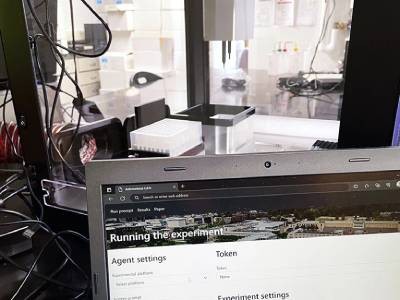
To adapt GPT-3 to answer questions about a chemical compound or material, the researchers first collected information from the literature about similar compounds or materials, and formatted their data to take the form of up to 30 questions and answers. They then sent the data to OpenAI to be added to the LLM’s training set. The fine-tuned system could answer predictive questions about the original compound or material — even though it was not explicitly included in the input data. “What’s remarkable is that it can do things it doesn’t know,” says co-author Berend Smit, a chemical engineer at the Swiss Federal Institute of Technology in Lausanne.
For example, the researchers tested the system’s aptitude for answering queries about ‘high entropy’ alloys, which are made of roughly equal amounts of two or more metals. Ordinary alloys such as steel — which contains mostly iron, with small amounts of elements such as carbon mixed throughout its crystal structure — are well understood, but much less is known about high-entropy alloys and how their metals will mix. However, the fine-tuned LLM could guess correctly how the metals in one of these alloys would arrange themselves. (The researchers assessed success by leaving some alloys from the literature out of the training data and then testing whether the LLM could predict those alloys’ properties.)
An LLM for the people
When asking the system to answer questions about an ‘unknown’ material not included in the training data, the team got results comparable in accuracy to those of more specialized machine-learning tools for chemistry, and even to those from computer simulations explicitly programmed to use the physical properties of atoms and molecules. The researchers also demonstrated that they could achieve similar results when they fine-tuned an open-source version of GPT-3, called GPT-J — meaning that labs with small budgets might be able to develop their own version without having to pay or ask for commercial help.
ChatGPT has entered the classroom: how LLMs could transform education
“The ‘democratization’ is perhaps one of the more interesting things about this project, as it indeed makes it way easier to get some predictions of chemical properties,” Jablonka says.
The fact that the technique can get predictions just from the chemical formula for a compound is “very surprising”, White says. He tried the method for himself as soon as he saw Jablonka and colleagues post their findings on the preprint server ChemRxiv a year ago, ahead of peer review. “We have used it in new projects — like designing new catalysts based on fine-tuning LLMs,” says White. “It is the first method we try when working on new projects.”
Although the method requires humans to collect information and prepare the LLM input, Jablonka and his team aim to design future versions that can implement this step automatically by mining text from existing literature.
The vacuum chamber in which four-atom molecules were cooled to nearly absolute zero
Max Planck Institute of Quantum Optics
Molecules containing four atoms are the largest yet to be cooled down to only a hundred billionths of a degree above absolute zero.
The techniques researchers use for cooling individual atoms, such as hitting them with lasers and magnetic forces, don’t work as well for molecules. This is especially true for molecules made of many atoms, because to be very cold they must be very still – the more moving parts a molecule has, the more opportunities it has to move and warm up.
“We have a joke that we study molecules not because it is easy, but because it is hard,” says Xin-Yu Luo at the Max Planck Institute of Quantum Optics in Germany. He and his colleagues have now made four-atom molecules colder than ever before.
They started with several thousand molecules composed of one sodium and one potassium atom, which they confined in an airless chamber and cooled – that is, made very still – with magnetic forces and bursts of light. The coldest possible temperature is 0 kelvin, or absolute zero; these molecules were just 97 billionths of a kelvin warmer.
To turn these two-atom molecules into four-atom molecules, the researchers had to combine them in pairs without allowing them to warm up. They used microwave fields to “glue” molecules together based on theoretical calculations by Tao Shi and Su Yi the Chinese Academy of Sciences. “We really didn’t know if we could assemble these molecules, but Tao’s team did a calculation and he said to me, ‘this is possible, just try it’,” says Luo.
Their trials were successful. The researchers created about 1100 molecules, each with two potassium and two sodium atoms, at a temperature of 134 billionths of a kelvin – the largest molecules to reach this ultracold temperature yet.
“One of the reasons you make molecules ultracold in the first place is to have more control over them, and this is a big step forward in that sense,” says John Bohn at the University of Colorado Boulder. The new experiment is important not only because of the molecules’ unprecedented temperature, but also because at their coldest, they enter a known quantum state and could be pushed into another state or a process with precision, he says.
Luo says the atoms in these molecules are not “glued” to each other as strongly as those in room-temperature molecules. But making them is a necessary step towards studying complicated chemical reactions, which are easier to observe when they are extremely cold and slow.
The next question is what other, possibly even bigger molecules could be built at ultracold temperatures from similarly frigid ingredients with a similar microwave technique, says Sebastian Will at Columbia University in New York. “I think we are looking at exciting new opportunities for quantum chemistry!” he says.