What sorts of offsets do you focus on? People have different opinions as to what is good enough, and they’re not all equal.
We primarily focus on the creation of renewable energy, since that’s what gives the best positive impact to using electric vehicles. Where we can, it’s technology in the countries in which we race—so solar and wind farms in Mexico City, to give one example.
We’re investing in carbon capture and removal technology as well, and we look at ways of supporting the development of that technology. It’s developing pretty quickly, but it’s still a very emerging technology.
What makes you an order of magnitude less carbon-intensive than Formula One?
The amount of product that we allow ourselves to take on the road. The number of cars, tires, spare parts, people that travel, we do that with the absolute bare number minimum to get it into the minimum number of crates to transport. And where possible we transport via road or sea freight. We only fly when we have to fly our entire racing series, and we can fit everything into three airplanes. We’re looking at how to bring that down to two.
And where we do take planes, we’re looking at technologies like sustainable aviation fuel. We actually trialed that at one of the races last year—moving from Berlin onto the next race.
Has tech from the sport has trickled down into consumer vehicles since the first race back in 2014?
Well, it works both ways. We’ve benefited from motor manufacturers around the world investing in EV technology, having some of the brightest minds in the original equipment manufacturers working on battery development and EV powertrains. They’ve benefited from being part of a racing series where we are pushing the boundaries on technology every single race.
A good example is Jaguar Land Rover. The Jaguar Formula E team learned something on the racing track about efficiency between the battery and the powertrain. They were able to take that learning, and update over the air the software on the I-PACE range, which is their range of electric cars on the road. That delivered somewhere near 25 to 30 kilometers more battery range into those cars overnight.
If you look at someone like Porsche, they’ve used other things. So we have things in the car like attack mode, an additional level of power: 50 extra kilowatts during a particular part of the race. They now have that button in their car, where you can push the car on the new Taycan, and it unlocks additional power in the car.
Back when Formula E started, there weren’t that many EVs on the road. Now they’re everywhere and seen as high-performance and desirable. A lot of arguments about electrification have been won. Does this change the future goals of Formula E?
You’re right, you can’t compare the vision of the sport in 2014 to its vision now. I think in 2014, when the sport started, there were 800,000 EVs sold in the world that year. In the last 12 months, it’s probably somewhere between 15 and 20 million.
It’s not like 2014 when we were saying, please consider buying an electric vehicle. Now the aim is to get the current 50 percent rate of EV take-up to 100 percent, and to assist doing that by making the technology even better. We’re absolutely obsessed with that—whether through improving the technology for longer range, faster charging times, better performance. Everything we focus on around battery tech, fast charging, efficiency, it’s all ultimately to speed the take-up of EVs.
Hear Jeff Dodds speak at the WIRED x Octopus Energy Tech Summit at Kraftwerk in Berlin on October 10. Get tickets at energy-tech-summit.wired.com
On Monday, the UK saw the closure of its last operational coal power plant, Ratcliffe-on-Soar, which has been operating since 1968. The closure of the plant, which had a capacity of 2,000 megawatts, brought to an end to the history of the country’s coal use, which started with the opening of the first coal-fired power station in 1882. Coal played a central part in the UK’s power system in the interim, in some years providing over 90 percent of its total electricity.
But a number of factors combined to place coal in a long-term decline: the growth of natural-gas-powered plants and renewables, pollution controls, carbon pricing, and a government goal to hit net-zero greenhouse gas emissions by 2050.
From Boom to Bust
It’s difficult to overstate the importance of coal to the UK grid. It was providing over 90 percent of the UK’s electricity as recently as 1956. The total amount of power generated continued to climb well after that, reaching a peak of 212 terawatt hours of production by 1980. And the construction of new coal plants was under consideration as recently as the late 2000s. According to the organization Carbon Brief’s excellent timeline of coal use in the UK, continuing the use of coal with carbon capture was given consideration.
But several factors slowed the use of fuel ahead of any climate goals set out by the UK, some of which have parallels to the situation in the US. The European Union, which included the UK at the time, instituted new rules to address acid rain, which raised the cost of coal plants. In addition, the exploitation of oil and gas deposits in the North Sea provided access to an alternative fuel. Meanwhile, major gains in efficiency and the shift of some heavy industry overseas cut demand in the UK significantly.
Through their effect on coal use, these changes also lowered employment in coal mining. The mining sector has sometimes been a significant force in UK politics, but the decline of coal reduced the number of people employed in the sector, reducing its political influence.
These had all reduced the use of coal even before governments started taking any aggressive steps to limit climate change. But, by 2005, the EU implemented a carbon trading system that put a cost on emissions. By 2008, the UK government adopted national emissions targets, which have been maintained and strengthened since then by both Labour and Conservative governments up until Rishi Sunak, who was voted out of office before he had altered the UK’s trajectory. What started as a pledge for a 60 percent reduction in greenhouse gas emissions by 2050 now requires the UK to hit net zero by that date.
These have included a floor on the price of carbon that ensures fossil-powered plants pay a cost for emissions that’s significant enough to promote the transition to renewables, even if prices in the EU’s carbon trading scheme are too low for that. And that transition has been rapid, with the total generations by renewables nearly tripling in the decade since 2013, heavily aided by the growth of offshore wind.
How to Clean Up the Power Sector
The trends were significant enough that, in 2015, the UK announced that it would target the end of coal in 2025, despite the fact that the first coal-free day on the grid wouldn’t come until two years after. But two years after that landmark, however, the UK was seeing entire weeks where no coal-fired plants were active.
To limit the worst impacts of climate change, it will be critical for other countries to follow the UK’s lead. So it’s worthwhile to consider how a country that was committed to coal relatively recently could manage such a rapid transition. There are a few UK-specific factors that won’t be possible to replicate everywhere. The first is that most of its coal infrastructure was quite old—Ratcliffe-on-Soar dates from the 1960s—and so it required replacement in any case. Part of the reason for its aging coal fleet was the local availability of relatively cheap natural gas, something that might not be true elsewhere, which put economic pressure on coal generation.
Microsoft announced on 20 September that it had struck a 20-year deal to purchase energy from a dormant nuclear power plant that will be brought back online. And not just any plant: Three Mile Island, the facility in Londonderry Township, Pennsylvania, that was the site of the worst-ever nuclear accident on US soil when a partial meltdown of one of its reactors occurred in 1979.
Nuclear energy, ten years after Fukushima
The move, which symbolizes technology giants’ need to power their growing artificial-intelligence (AI) efforts, raises questions over how shuttered nuclear plants can be restarted safely — not least because Three Mile Island isn’t the only plant being brought out of retirement.
Palisades Nuclear Plant, an 805-megawatt facility in Covert, Michigan, was shut down in May 2022. But the energy company that owns it, Holtec International, based in Jupiter, Florida, plans to reopen it. This reversal in the facility’s fortunes has been bolstered by a US$1.5-billion conditional loan commitment from the US Department of Energy (DoE), which sees nuclear plants — a source of low-carbon electricity — as a way of helping the country to meet its ambitious climate goals. The Palisades plant is on track to reopen in late 2025.
“It’s the first time something like this has been attempted, that we’re aware of, worldwide,” says Jason Kozal, director of the reactor safety division at a regional office of the US Nuclear Regulatory Commission (NRC) in Naperville, Illinois, and the co-chair of a regulatory panel overseeing the restart of Palisades.
Here, Nature talks to nuclear specialists about what it will take to restart these plants and whether more are on the way as the world’s demand for AI grows.
A change in fortunes
Since 2012, more than a dozen nuclear plants have been shut down in the United States, in some cases as a result of unfavourable economics. Less cost-effective plants — such as those with only a single working reactor — struggled to remain profitable in states with deregulated electricity markets and widely varying prices. Three Mile Island, owned by the utility company Constellation Energy in Baltimore, Maryland, is a prime example. Today, 54 US plants remain in operation, running a total of 94 reactors.
The Three Mile Island nuclear power plant on 28 March 1979, the day one of its reactors experienced a partial meltdown.Credit: Bettmann/Getty
Nuclear energy, which accounts for about 9% of the world’s electricity, has seen some resurgence internationally, but is also competing with other energy sources, including renewables. After the 2011 Fukushima Daiichi disaster, Japan suspended operations at all of its 48 remaining nuclear plants, but these are gradually being brought back online, in part to cut dependence on gas imports. By contrast, Germany announced a phase-out of its nuclear plants in 2011, and shut down its last three in 2023.
In the United States, nuclear energy’s fortunes might be turning as technology companies race to build enormous, energy-gobbling data centres to support their AI systems and other applications while somehow fulfilling their climate pledges. Microsoft, for instance, has committed to being carbon negative by 2030.
“It’s further confirmation of the value of nuclear, and, if the deal is right — if the price is right — then it makes business sense, as well,” says Jacopo Buongiorno, the director of the Center for Advanced Nuclear Energy Systems at the Massachusetts Institute of Technology in Cambridge.
A new start
This isn’t the first time that the United States has brought a powered-down reactor back online. In 1985, for example, the Tennessee Valley Authority, a federally owned electric utility company, took the reactors at its Browns Ferry Nuclear Power Plant in Athens, Alabama, offline. After years of refurbishment, they were brought back online, with the final reactor restarted in 2007.
The cases of Palisades and Three Mile Island are different, however. When those plants closed, their then-owners made legal statements that the facilities would be shut down, even though their operating licenses were still active. Three Mile Island, which will be renamed the Crane Clean Energy Center under the proposed restart, shut down its single remaining functional reactor in 2019.
Is Fukushima wastewater release safe? What the science says
Because the plants were slated for shutdown and safety checks were therefore stopped, regulators and companies must now navigate a complex licensing, oversight and environmental-assessment process to reverse the plants’ decommissioning.
Safety checks will be needed to ensure, among other things, that the plants can operate securely once uranium fuel rods have been replaced in their reactors. When these plants were decommissioned, their radioactive fuel was removed and stored, so the facilities no longer needed to adhere to many exacting technical specifications, says Jamie Pelton, also a co-chair of the Palisades restart panel, and a deputy director at the NRC’s Office of Nuclear Reactor Regulation in Rockville, Maryland.
It will be no small feat to reinstate those safety regulations: to meet the standards, infrastructure will need to be inspected carefully. According to Buongiorno, any metallic components in the plants that have corroded since the shutdowns, including wires and cables used in instrumentation and controls, will need to be replaced.
The plants’ turbine generators, which make electricity from the steam produced as the plants’ fuel rods heat up water, will also get a close look. After sitting dormant for years, a turbine could develop defects within its shaft or corrosion along its blades that would require refurbishment. In the case of Palisades, the NRC announced on 18 September that the plant’s steam generators would need further testing and repair, following inspections conducted by Holtec.
Nuclear’s prospects
As the plants near their restart dates, their operators will also have to contend with a challenge faced by even fully operational plants: the need to source fresh nuclear fuel. US nuclear utility companies have long counted on the international market to buy much of the necessary raw yellowcake uranium and the services that separate and enrich uranium-235, the isotope used in nuclear reactors’ fuel rods. Russia has been a major international supplier of these services, even after the country’s 2022 invasion of Ukraine, because US and European sanctions have not targeted nuclear fuel. But to minimize its reliance on Russia, the United States is building up its own supply chain, with the DoE offering $3.4 billion to buy domestically enriched uranium.
Ukraine nuclear power plant attack: scientists assess the risks
There probably won’t be too many other restarts of mothballed nuclear plants in the United States, however, even as demand for low-carbon electricity grows. Not every US plant that has been shut down is necessarily in good enough condition to be easily refurbished — and the idea of reopening some of those would meet with too much resistance. As an example, Buongiorno points to New York’s Indian Point Energy Center, which was closed in 2021. The plant’s proximity to New York City had long provoked criticism from nuclear-safety advocates.
But that doesn’t mean that all of these sites will remain unused. One option is to build advanced reactors — including large reactors with upgraded safety features and small modular reactors with innovative designs — on sites where old nuclear plants once stood, to take advantage of existing transmission lines and infrastructure. “We might see interest in the US in building more of these large reactors, whether that’s fuelled by data centres or some other applications,” Buongiorno adds. “Utilities and customers are exploring this at the moment.”
The sight of solar panels installed on rooftops and large energy farms has become commonplace in many regions around the world. Even in the gray and rainy UK, solar power is becoming a major player in electricity generation.
This surge in solar is fueled by two key developments. First, scientists, engineers, and those in industry are learning how to make solar panels by the billions. Every fabrication step is meticulously optimized to produce them very cheaply. The second and most significant is the relentless increase in the panels’ power conversion efficiency—a measure of how much sunlight can be transformed into electricity.
The higher the efficiency of solar panels, the cheaper the electricity. This might make you wonder: Just how efficient can we expect solar energy to become? And will it make a dent in our energy bills?
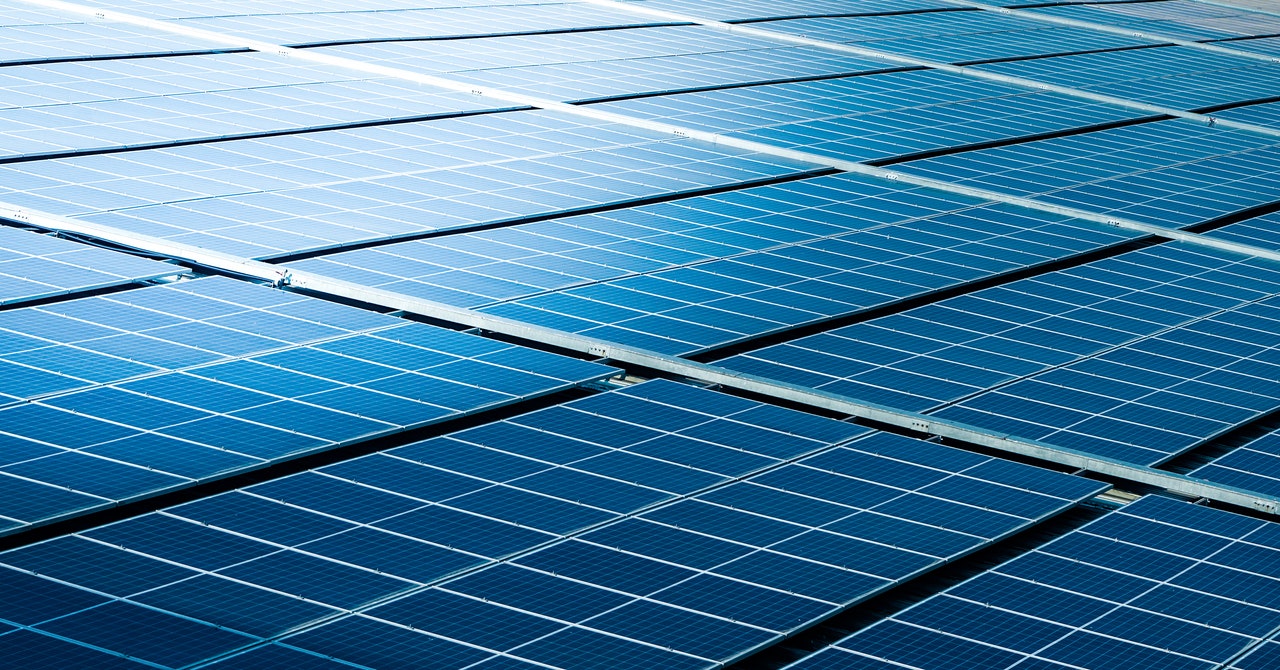
Commercially available solar panels today convert about 20 to 22 percent of sunlight into electrical power. However, new research published in Nature has shown that future solar panels could reach efficiencies as high as 34 percent by exploiting a new technology called tandem solar cells. The research demonstrates a record power-conversion efficiency for tandem solar cells.
What Are Tandem Solar Cells?
Traditional solar cells are made using a single material to absorb sunlight. Currently, almost all solar panels are made from silicon—the same material at the core of microchips. While silicon is a mature and reliable material, its efficiency is limited to about 29 percent.
To overcome this limit, scientists have turned to tandem solar cells, which stack two solar materials on top of each other to capture more of the sun’s energy.
In the new Nature paper, a team of researchers at the energy giant LONGi has reported a new tandem solar cell that combines silicon and perovskite materials. Thanks to their improved sunlight harvesting, the new perovskite-silicon tandem has achieved a world record 33.89 percent efficiency.
Perovskite solar materials, which were discovered less than two decades ago, have emerged as the ideal complement to the established silicon technology. The secret lies in their light absorption tunability. Perovskite materials can capture high-energy blue light more efficiently than silicon.
In this way, energy losses are avoided and the total tandem efficiency increases. Other materials, called III-V semiconductors, have also been used in tandem cells and achieved higher efficiencies. The problem is they are hard to produce and expensive, so only small solar cells can be made in combination with focused light.
The scientific community is putting tremendous effort into perovskite solar cells. They have kept a phenomenal pace of development with efficiencies (for a single cell in the lab) rising from 14 percent to 26 percent in only 10 years. Such advances enabled their integration into ultra-high-efficiency tandem solar cells, demonstrating a pathway to scale photovoltaic technology to the trillions of watts the world needs to decarbonize our energy production.
The Cost of Solar Electricity
The new record-breaking tandem cells can capture an additional 60 percent of solar energy. This means fewer panels are needed to produce the same energy, reducing installation costs and the land (or roof area) required for solar farms.
It also means that power plant operators will generate solar energy at a higher profit. However, due to the way that electricity prices are set in the UK, consumers may never notice a difference in their electricity bills. The real difference comes when you consider rooftop solar installations where the area is constrained and the space has to be exploited effectively.
As soon as the Russian invasion of Ukraine started, Yuliana Onishchuk knew she had to help her country. News coverage of the initial occupation of the Kyiv region showed that Irpin City and Bucha, just outside the capital, had sustained huge damage, and it was clear to Onishchuk that critical infrastructure would need to be repaired. “I saw the schools, and I was sure that we would have to rebuild them,” Onishchuk says. She saw an opportunity. “I realized: We have to rebuild them in a new way.”
Putting her expertise as an energy lawyer and solar power project manager to good use, Onishchuk set up an NGO, the Energy Act for Ukraine Foundation. “I was already in renewables, and I love renewables.” The foundation would help rebuild schools and hospitals and equip them with solar panels, offering them energy independence while at the same time helping Ukrainians understand the importance of clean energy.
Then, in October 2022, Russia started attacking Ukraine’s energy system. Very quickly half of the country’s grid was damaged. In 2023, attacks moved from hitting just the grid to targeting energy production. Millions of Ukrainians faced widespread blackouts across the freezing winter months of 2023.
With the country plunged into energy poverty, designing schools and hospitals with energy independence wasn’t just a smart step on the road to the green transition—it was a vital solution for keeping them functioning during the invasion. And so now, the foundation’s mission is two-fold: to rebuild Ukraine with both sustainability and energy security in mind.
Ahead of speaking at the WIRED & Octopus Energy Tech Summit in Berlin on October 10, Yuliana sat down with WIRED to discuss the foundation’s work. This interview has been edited for length and clarity.
WIRED: How badly has Russia’s invasion impacted the energy supply in Ukraine?
Yuliana Onishchuk: Before the war, 55 percent of Ukraine’s generation was nuclear, and one of the biggest nuclear power plants, which supplied more than half of this nuclear power, was Zaporizhzhia. Now it is occupied.
Again, before the invasion, 35 percent of energy generation was from thermal power plants, which became a particular focus of Russia this year. They realized that this supply was exactly what they should attack, because you can hardly protect that 35 percent, and it is not as dangerous to target as nuclear.
We lost 80 percent of the wind power because almost all wind turbines are located in the south. Mostly, the south is occupied. Solar farms that are situated on the east and south were either attacked or stolen—they dismantled solar panels and stole them.
So, we lost a lot. Russia has destroyed 50 percent of our electricity-generation capacity.
This must make life incredibly difficult for people.
With the Zaporizhzhia plant occupied, for the past two years we have repaired extra generation units at other nuclear plants, as not all units were on when the war started. We could not be without the 55 percent of our energy generation that comes from nuclear—it’s a huge amount. Now, as far as I know, all units in all plants are on in Ukraine.
Yuliana Onishchuk.Photograph courtesy of the Energy Act for Ukraine Foundation
That has helped us to get out of blackouts that were happening in May, June, and July of this year. For almost three months, we experienced very long-lasting blackouts for up to 12 hours. Right now, we don’t have lots of large blackouts; only the settlements, villages, and cities that are at the frontline areas are in blackouts all the time.
But we still have a percentage of the rest of the population that is experiencing blackouts because the generation units—whether it’s renewables or thermal power plants—are being attacked, together with the distribution grids. For the past three months, absolutely every city in the country experienced a blackout.
AI data centers are so hot right now. Each time generative AI services churn through their large language models to make a chatbot answer one of your questions, it takes a great deal of processing power to sift through all that data. Doing so can use massive amounts of energy, which means the proliferation of AI is raising questions about how sustainable this tech actually is and how it affects the ecosystems around it. Some companies think they have a solution: running those data centers underwater, where they can use the surrounding seawater to cool and better control the temperature of the hard working GPUs inside. But it turns out just plopping something into the ocean isn’t always a foolproof plan for reducing its environmental impact.
This week on Gadget Lab, WIRED writers Paresh Dave and Reece Rogers join the show to talk about their reporting on underwater data centers and how the race to power AI systems is taking its toll on the environment.
Show Notes
Read Paresh and Reece’s story about the plan to put an underwater data center in the San Francisco Bay. Read Reece’s stories about how this is AI’s hyper-consumption era and how to wade through all the AI hype. Read Lauren’s story about the social network inhabited only by bots. Read Karen Hao’s story in The Atlantic about how companies like Microsoft are taking water from the desert to use for cooling down AI data centers. Here’s the Black Cat substack article about the character Harper from Industry. Follow all of WIRED’s AI and climate coverage.
You can always listen to this week’s podcast through the audio player on this page, but if you want to subscribe for free to get every episode, here’s how:
If you’re on an iPhone or iPad, open the app called Podcasts, or just tap this link. You can also download an app like Overcast or Pocket Casts, and search for Gadget Lab. If you use Android, you can find us in the Google Podcasts app just by tapping here. We’re on Spotify too. And in case you really need it, here’s the RSS feed.
For five years, reactor one at Three Mile Island nuclear power station in Pennsylvania has lain dormant. Now, thanks to a deal with Microsoft, the reactor will start running again in 2028—this time to exclusively supply the tech firm with oodles of low-carbon electricity.
It’s all part of an ongoing flirtation between Big Tech and nuclear power. In March, Amazon Web Services agreed to buy a data center powered by Susquehanna nuclear power station in Pennsylvania. At an event at Carnegie Mellon University on September 18, Alphabet CEO Sundar Pichai mentioned small modular nuclear reactors as one potential source of energy for data centers. The links don’t stop there either: OpenAI CEO Sam Altman chairs the boards of nuclear startups Oklo and Helion Energy.
The AI boom has left technology companies scrambling for low-carbon sources of energy to power their data centers. The International Energy Agency estimates that electricity demand from AI, data centers, and crypto could more than double by 2026. Even its lowball estimates say that the added demand will be equivalent to all the electricity used in Sweden or—in the high-usage case—Germany.
This surge in energy demand is music to the ears of the nuclear power industry. Electricity demand in the US has been fairly flat for decades, but the sheer scale and intensity of the AI boom is changing that dynamic. One December 2023 report from a power industry consultancy declared the era of flat power demand over, thanks to growing demand from data centers and industrial facilities. The report forecasts that peak electricity demand in the US will grow by 38 gigawatts by 2028, roughly equivalent to 46 times the output of reactor one at Three Mile Island.
“[AI] is really taking off, and it’s garnering a lot of attention in the energy industry,” says John Kotek, senior vice president for policy development and public affairs at nuclear industry trade association the Nuclear Energy Institute. Kotek says there’s also a national security angle. “People legitimately see AI as a field of competition between the US and our global competitors.” The US falling behind in the AI race because it doesn’t have enough power “is something that’s really causing people to focus attention,” he says.
Nuclear power is attractive to tech companies because it provides low-carbon electricity round-the-clock, unlike solar and wind, which run intermittently unless coupled with a form of energy storage. Reactivating reactor one will provide Microsoft with 835 megawatts of low-carbon energy over the 20 years that the deal will run for. Since Microsoft has pledged to be carbon negative by 2030, spiraling electricity demand from AI poses a major threat to the firm’s climate plans unless it can find sources of low-carbon power. In 2023, Microsoft’s emissions increased by 29 percent compared with 2020, primarily driven by the construction of new data centers.
Three Mile Island nuclear power station has two reactors. The second reactor was infamously the site of a partial meltdown in 1979 and it has remained out of action ever since. But reactor one kept on chugging away without incident until 2019, when it was taken offline for financial reasons—mainly due to competition from gas- and wind-powered electricity. Kotek says there are relatively few idle reactors that could also be brought back online fairly quickly, but that a lot of power plant owners are interested in extending their operating licenses of their existing plants to try and ride the AI power wave.
Conventional high-voltage transmission lines lose a portion of the electric energy as heat
Limbofu/Shutterstock
The following is an extract from our climate newsletter Fix the Planet. Sign up to receive it for free in your inbox every month.
Last year, researchers in South Korea made a splash after claiming to have discovered a room-temperature superconductor that they called LK99. One reason for the excitement was that such a material could enable ultra-efficient power lines, helping distribute the gigawatts of clean electricity now coming online while minimising the amount of new infrastructure needed.
Returning for its second edition this October in Berlin, the WIRED & Octopus Energy Tech Summit is bringing together Europe’s leading experts and visionaries in the green energy sector to explore how to accelerate the creation of a fully carbon-free energy system.
Last year’s summit focused on the urgent need for green technology in the wake of the energy crisis. Audiences heard from business leaders, startup founders, politicians, inventors, and even an astronaut.
Watch highlights of the 2023 summit.
This year, energy leaders from across the EU will meet to carve the path to a rapid global energy transition. Join us on October 10 to witness energy innovation in action and collaborate with more than 500 experts and thinkers on making the green transition a reality.
Here’s everything you need to know.
When and Where Is the Event Taking Place?
The summit is on Thursday, October 10, at Kraftwerk Berlin—the former power station of Berlin’s Mitte district and a piece of the city’s industrial history. Constructed around the same time as the Berlin wall, the building has since been renovated into an iconic event space in the center of the capital.
We encourage everyone to arrive either on foot, by bike, or via public transport—there are good public transport links nearby, including Heinrich-Heine-Str. station on the U-Bahn and the Heinrich-Heine-Str. and Michaelkirchstr. bus stops. You can see the location of Kraftwerk here.
Doors will open for registration and breakfast at 8 am, with the day’s programming beginning at 9 am.
Kraftwerk is a striking example of how fossil fuel infrastructure can be repurposed.
Photograph: Leon Strachewski for Kraftwerk Berlin
Who’s Speaking?
Onstage will be an extraordinary mix of changemakers, business leaders, and futurists drawn from the worlds of politics, sport, energy, architecture, film, and transport.
Bertrand Piccard
Photograph: Philipp Böhlen
Hear from Bertrand Piccard, who made history when he achieved the first nonstop round-the-world solar-powered balloon flight; Jeff Dodds, who is taking Formula E to the next level; Fredrika Klarén from Polestar, who aims to build a completely climate-neutral car by 2030; and internationally acclaimed architect Francis Kéré, who is pushing the boundaries of design with community-focused and sustainable approaches. Watch this space for more big names as they’re announced in the coming weeks.
Francis Kéré
Photograph: Lars Borges
Fredrika Klarén
Photograph: Ida Bolin
The event will cover everything from the future of EVs and global transport, to the challenges of sustainable building design and greening AI’s growing environmental footprint. Talks will range from interviews and fireside chats to panels and keynote speeches.
Also returning this year will be Yuliana Onishchuk, CEO and founder of the Energy Act for Ukraine Foundation, which is installing solar power capacity on key Ukrainian infrastructure—such as hospitals and schools—to protect against blackouts caused by the Russian invasion.
What Else Is On?
The full agenda and list of speakers is available on the summit’s website. The day will begin with coffee and breakfast before the stage sessions start, with a networking lunch and then a drinks reception at the end of the afternoon.
During the day, the Waldorf Project, a radical immersive experience, will bring VIRTUAL SERENITY, the world’s largest digital empathy engineering experiment, to the summit stage.
In what promises to be the first full realization of the potential of a connected world in the metaverse, 300 strangers will have the chance to take part in a mind-merging consciousness experience. Using cutting-edge biometric sensors and bespoke VR technology with surround-sound, participants will go on a journey of deep introspection.
Octopus Energy will also be exhibiting leading renewable and sustainable energy solutions and technology throughout the day.
How Can I Attend?
Tickets are available on the WIRED & Octopus Energy Tech Summit website, with all ticket proceeds donated to the Energy Act for Ukraine Foundation. More speakers will be announced in the following weeks—trust us, you won’t want to miss them.
Fresh water is becoming increasingly scarce in many countries, but not in Greenland. Its ice sheet contains around 6.5 percent of the world’s fresh water, and over 350 trillion liters are estimated to run into the ocean annually. And with climate change accelerating Arctic melting, more and more of Greenland’s water is set to flow off the island every year.
In some places facing water shortages, those very same water molecules are potentially being taken from the sea and turned back into fresh water using desalination, at large electrical and financial cost. This has inspired a startup to pursue an unusual and ambitious business venture that has been partially approved by the Greenland government—harvesting glacier meltwater and shipping it abroad.
“We have one of the world’s finest resources in this area and plenty of it, and we want to push that message out to investors and potential markets,” says Naaja H. Nathanielsen, Greenland’s minister for business and trade.
The startup behind the idea, Arctic Water Bank, plans to build a dam in South Greenland, capture meltwater, and then transport it around the world by boat in bulk water carriers. If all goes according to plan, the company says the project will be completely carbon-neutral and inflict minimal damage to the local environment.
“This is some of the cleanest water in the world. Anyone who has tried Greenlandic water knows that it’s pure, white gold,” says Samir Ben Tabib, cofounder and head of international relations at the startup.
Arctic Water Bank is first and foremost, Ben Tabib stresses, a business, but he believes it could also provide a service to Greenlanders and the wider world. He argues that his company will help the people of Greenland by leveraging the country’s natural resources and paying taxes on income generated from them, and it’s an ambition the government shares. “The goal is twofold,” says Nathanielsen. “It is about new sources of income for the national treasury, and local business development and the associated creation of jobs.”
In the long run, Ben Tabib says, Arctic Water Bank might even help mitigate the impending global water crisis. “It’s probably not something our little business can solve alone, but in Greenland, fresh water is a resource that is just washing into the sea.”
Right now, the startup has the initial permissions it needs. In documents seen by WIRED, the government grants the company sole rights for the next 20 years to use all water and ice from a river near the town of Narsaq. On average, this river produces 21.3 billion liters of water each year, almost entirely meltwater from the Greenland ice sheet. But before any water can be shipped, a dam must be built, and Arctic Water Bank will need an Environmental Impact Assessment (EIA) to be completed to get started on construction.
This isn’t as great a hurdle as it might seem. Greenland may be one of the most untouched environments in the world—roughly the size of Western Europe and home to fewer than 60,000 people—but the construction of dams is not unheard of, says Karl Zinglersen, head of the Department of Environment and Minerals at the Greenland Institute of Natural Resources. In the early 1990s, the first hydroelectric dam was built to serve the capital of Nuuk, and since then, a handful of smaller hydroelectric dams have been built around the country. The EIA process is very thorough, says Zingerlsen, but in his experience it rarely if ever stops a project.






.jpg)




%2520-%2520Sander%2520Manse.jpg)