Tag: Energy

  • New Catalyst Revolutionizes Hydrogen Production

    New Catalyst Revolutionizes Hydrogen Production

    [ad_1]

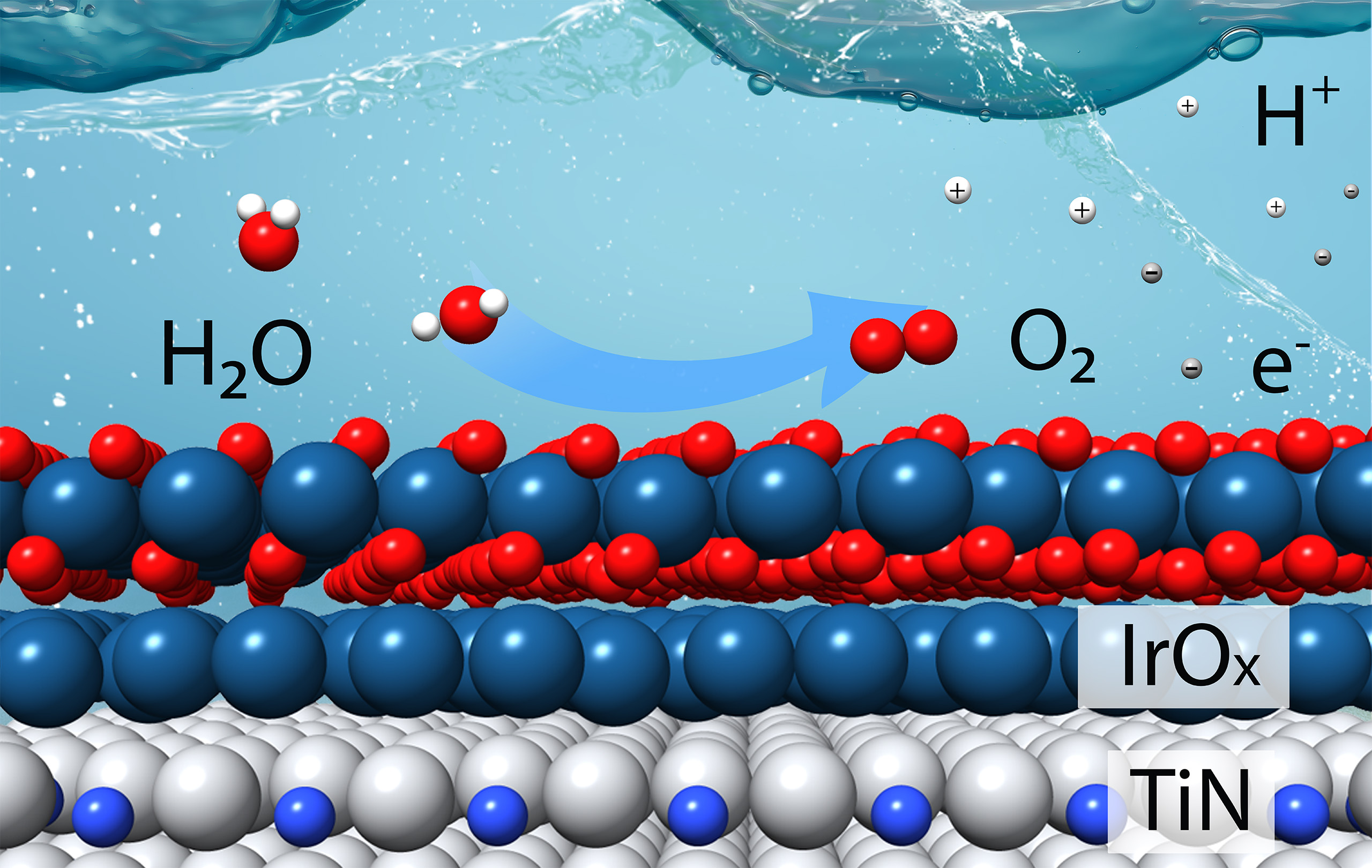
    Oxygen Evolution Reaction Schematic of Iridium Catalyst on Titanium Nitride

    This schematic shows how a catalyst composed of a few layers of iridium oxide (IrOx) over a support made of titanium nitride (TiN) can efficiently produce oxygen (O2), hydrogen ions (H+), and electrons (e) from water molecules (H2O) in an acidic electrolyte. This “oxygen evolution reaction” is the more challenging of two reactions needed to split water to produce hydrogen gas (H2). Credit: Tianyou Mou/Brookhaven National Laboratory

    A successful demonstration could enhance the production of hydrogen from water.

    Hydrogen (H2) holds great potential as a fuel to reduce greenhouse gases, particularly when produced by using renewable energy to split water molecules (H2O). However, despite the apparent simplicity of breaking water into hydrogen and oxygen, the underlying chemistry is quite complex.

    Two separate simultaneous electrochemical reactions each require catalysts, chemical “deal makers” that help break and remake chemical bonds. Now, scientists at the U.S. Department of Energy’s (DOE) Brookhaven National Laboratory and Columbia University say they’ve developed a new efficient catalyst for the more challenging part: the oxygen evolution reaction.

    As described in a paper just published in the Journal of the American Chemical Society, the catalyst was designed “from the bottom up” based on theoretical calculations seeking to minimize the amount of iridium, an expensive metal used as a catalytic material, and to maximize the catalyst’s stability in acidic conditions. When the team created models of the catalyst and tested them in the lab, the results validated the predictions. Then, the scientists made a powder form of the catalyst, like those used in industrial applications, and showed it can efficiently produce hydrogen in a water-splitting electrolyzer.

    “In this real-world test, our catalyst is about four times better than the state-of-the-art commercially available iridium catalyst,” said Jingguang Chen, a chemical engineer at Columbia University with a joint appointment in the Chemistry Division at Brookhaven Lab who led the research. In other words, the new catalyst requires four times less iridium to produce hydrogen at the same rate as the commercial variety — or produces hydrogen four times faster for the same amount of iridium.

    Brookhaven Lab theoretical chemist Ping Liu, who led the calculations that underpin the catalyst’s design, said, “This study demonstrates how you can go from a theory-driven understanding of what’s happening at the atomic level to designing a catalyst for a practical use. Our work gives us a better understanding of how this catalyst works and gets us closer to the real-world application.”

    The remaining challenge is to scale up production.

    “We are only making milligrams of catalyst per batch,” Chen said. “If you want to make megatons of green hydrogen, you’d need kilograms or tons of catalyst. We can’t make this at that large scale yet.”

    Reducing iridium

    Iridium is the catalyst of choice for the oxygen evolution reaction, which takes place at the anode of an electrolyzer. It provides the electrically charged active sites that separate tightly bound hydrogen ions (H+) from oxygen (O). In addition to freeing the H+ ions — which contribute to the harshly acidic reaction conditions — the reaction produces oxygen gas (O2) and electrons. Those electrons are needed for the second, less challenging “hydrogen evolution” reaction: the pairing up of hydrogen ions to form hydrogen gas at the electrolyzer’s cathode.

    “Iridium is currently one of the only stable elements for the oxygen evolution reaction in acid,” Chen said. That’s “unfortunate,” he noted, because “iridium is even more rare, and more expensive, than platinum.”

    Hence, the motivation for reducing the amount of iridium.

    “In industrial catalysts made of nanoscale particles, only atoms on the surface participate in the reaction,” Chen said. “That means most of the iridium on the inside of the particle is wasted.”

    Maybe instead of using a particle that is all iridium, a catalyst could be made of a less-expensive material with iridium only on the surface, the team reasoned.

    With funding from a DOE initiative to advance clean-energy technologies, they had been exploring the use of earth-abundant elements such as titanium. They found that combining titanium with nitrogen provided enough stability for these “titanium nitrides” to survive acidic reaction conditions. Perhaps titanium nitride could serve as the core of iridium-coated catalytic particles.

    But how much iridium should be layered on top? This is where the theoretical calculations come in.

    Calculating an ideal structure

    “We used ‘density functional theory’ calculations to model how different overlayers of iridium on titanium nitride would affect the stability and activity of the catalyst under acidic oxygen evolution reaction conditions,” said Liu. She and her team used computing resources at Brookhaven Lab’s Center for Functional Nanomaterials (CFN) and at the National Energy Research Scientific Computing Center (NERSC) at DOE’s Lawrence Berkeley National Laboratory to run the simulations.

    The calculations predicted that one layer of iridium would not be sufficient to drive the oxygen evolution reaction but that two or three layers would improve both performance and catalytic stability.

    “These were sort of pre-screening experiments,” Liu said. “Then, we turned these screening results over to the experimental team to make real catalysts and evaluate their catalytic activity.”

    Validating the predictions

    First, the team created thin films in which they could create carefully controlled layers that closely resembled the surfaces used in the theoretical modeling calculations. They also created powdered samples composed of small nanoscale particles, the form the catalyst would take in industrial applications. Then, they studied the thin films — including the interfaces between the layers — and the nanoparticles using a variety of techniques.

    These included transmission electron microscopy at CFN and X-ray spectroscopy studies at the Quick X-ray Absorption and Scattering (QAS) beamline of the National Synchrotron Light Source II (NSLS-II), a source of bright X-rays for deciphering samples’ chemical and physical properties.

    “Our hypothesis was that if the iridium bonds to the titanium nitride, this bonding would stabilize the iridium and improve the reaction,” Chen said.

    The characterization studies bore out the predictions.

    “The synchrotron studies revealed the oxidation states and local coordination environment of the iridium and titanium atoms under reaction conditions,” Chen said. “They confirmed that the iridium and titanium are interacting strongly.”

    “Mapping the elements of the nanoparticles at CFN confirmed the particle sizes and compositions, including the presence of iridium oxides on the surface over titanium nitride supports,” he added.

    Liu emphasized that the characterization studies informed the scientists’ understanding of the catalyst.

    “We found that the interaction between iridium and titanium is not only helpful to the stability of the catalyst but also in fine-tuning its activity,” she said. “The charges change the chemistry in a way that improves the reaction.”

    Specifically, charges transferred from titanium to the iridium surface alter the electronic structure of the iridium active sites to optimize the binding of reaction intermediates, she explained.

    “Going from one to three layers of iridium, you increase the charge transfer from the nitride to the top iridium significantly,” Liu noted. But the difference between two and three layers was not very large. Two layers might be enough to allow high stability, activity, and low cost.

    To make this catalyst ready for real-world use, the scientists pointed out that, in addition to tackling the challenge of scaling up production, there could also be improvements to optimize the consistency of the powders.

    “When we make thin films, we can control the layers, but with powder synthesis, we don’t have that kind of control,” Chen said. “Our powder particles don’t have a continuous iridium shell around them. But this study provides guidelines industrial chemists could use to make true core-shell structures with a uniform thin layer of iridium,” he said.

    Such catalysts could help lower the cost of water splitting and bring scientists closer to producing large quantities of green hydrogen.

    Reference: “Theoretical Prediction and Experimental Verification of IrOx Supported on Titanium Nitride for Acidic Oxygen Evolution Reaction” by Xue Han, Tianyou Mou, Arephin Islam, Sinwoo Kang, Qiaowan Chang, Zhenhua Xie, Xueru Zhao, Kotaro Sasaki, José A. Rodriguez, Ping Liu and Jingguang G. Chen, 10 June 2024, Journal of the American Chemical Society.
    DOI: 10.1021/jacs.4c02936

    This work was funded by the DOE Office of Science. CFN, NSLS-II, and NERSC all operate as DOE Office of Science user facilities.

    Brookhaven National Laboratory is supported by the Office of Science of the U.S. Department of Energy


    [ad_2]

    Source link

  • Transforming Waste Chicken Fat into Clean Energy

    Transforming Waste Chicken Fat into Clean Energy

    [ad_1]

    Supercapacitor Energy Storage Device Art Concept

    In a recent study, scientists have successfully converted chicken fat into electrodes for supercapacitors, offering a sustainable alternative to conventional materials like graphene. This innovative process creates high-performance electrodes from a cost-effective and eco-friendly source, demonstrating improved energy storage capabilities and the potential to utilize bio-waste for green energy solutions. (Artist’s concept.) Credit: SciTechDaily.com

    Researchers have developed a novel method to convert chicken fat into carbon-based electrodes for supercapacitors, offering an eco-friendly alternative to traditional materials.

    This innovation not only addresses the cost and environmental issues associated with existing storage devices but also enhances the performance and efficiency of energy storage technologies.

    Global Shift to Sustainable Energy and Storage Needs

    The global move toward more sustainable, green energy has increased power reserves and the demand for energy storage devices. Unfortunately, some materials for these devices can be expensive and environmentally problematic. Producing alternative energy storage devices from things that are usually thrown away could help resolve these challenges.

    Now, researchers in ACS Applied Materials & Interfaces report a method to transform chicken fat into carbon-based electrodes for supercapacitors that store energy and power LEDs.

    Extracted Chicken Fat for Supercapacitor

    This extracted chicken fat created a carbon-based material for a supercapacitor. Credit: Mohan Reddy Pallavolu

    Renewable Energy Growth and Storage Challenges

    In 2023, global renewable energy capacity experienced an unprecedented almost 50 percent increase versus the previous year, according to the International Energy Agency. But that excess energy must be stored somewhere for the world to benefit from its production later.

    For example, sunny days in California have recently triggered negative energy prices due to excess supply from rooftop solar panels. Recent efforts to design high-performance storage devices have taken advantage of carbon materials, such as graphene, because of their efficient charge transportation and natural abundance, but their fabrication is expensive and generates pollution and greenhouse gases.

    Looking for an alternative carbon source material, Mohan Reddy Pallavolu, Jae Hak Jung, Sang Woo Joo, and colleagues wanted to develop a simple, cost-effective method for converting waste chicken fat into electrically conductive nanostructures for supercapacitor energy storage devices.

    Innovative Use of Chicken Fat for Energy Storage

    The researchers first used a gas flame gun to render the fat from a chicken and burned the melted oil using a flame wick method, much as one would use an oil lamp. They then collected the soot on the bottom of a flask, which was suspended above the flame.

    Electron microscopy showed that the soot contained carbon-based nanostructures that were uniform spherical lattices of concentric graphite rings, like the layers of onions. The researchers tested a way to enhance the electrical characteristics of the carbon nanoparticles by soaking them in a solution of thiourea.

    Chicken Fat Sourced Carbon Material Electrode

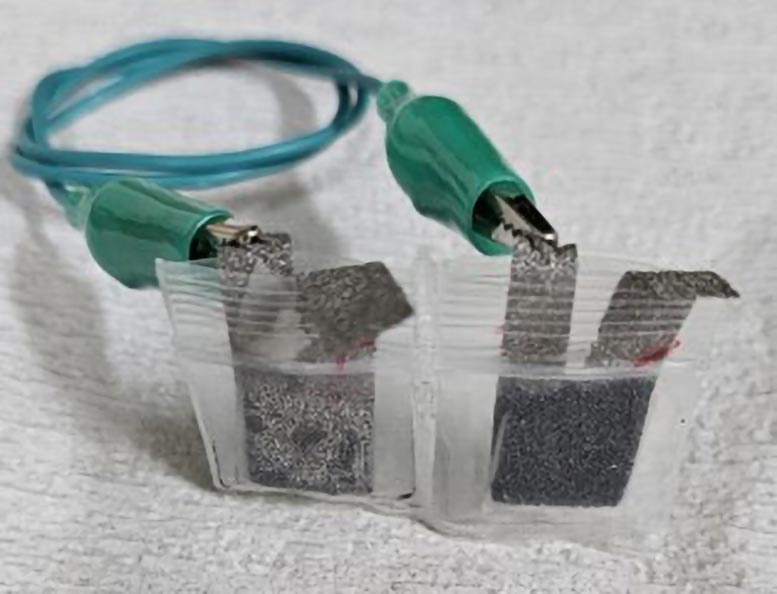
    An LED can light up when a chicken-fat-sourced carbon material is used as an electrode in these asymmetric supercapacitors. Credit: Mohan Reddy Pallavolu

    Development and Testing of Carbon-Based Electrodes

    Assembled into the negative electrode of an asymmetric supercapacitor, the chicken fat-sourced carbon nanoparticles demonstrated good capacitance and durability, as well as high energy and power density. As predicted, these properties were improved further when the electrodes were made of the thiourea-treated carbon nanoparticles.

    The researchers then demonstrated that the new supercapacitor could perform real-time applications — charging and connecting two of them to light up red, green, and blue LEDs. The results highlight the potential advantages of using food waste like chicken fat as a carbon source in the search for even greener green energy.

    Reference: “Strategic Way of Synthesizing Heteroatom-Doped Carbon Nano-onions Using Waste Chicken Fat Oil for Energy Storage Devices” by Jyothi Nallapureddy, Thupakula Venkata Madhukar Sreekanth, Mohan Reddy Pallavolu, P. S. Srinivasa Babu, Ramesh Reddy Nallapureddy, Jae Hak Jung and Sang Woo Joo, 24 April 2024, ACS Applied Materials & Interfaces.
    DOI: 10.1021/acsami.4c02753

    The authors acknowledge funding from the National Research Foundation of Korea through the Regional Leading Research Center (RLRC) for Autonomous Vehicle Parts and Materials Innovation.


    [ad_2]

    Source link

  • Fusion Sparks an Energy Revolution

    Fusion Sparks an Energy Revolution

    [ad_1]

    In 2024, fusion technology will finally make the transition from basic research to commercial application. The reason for that will be the construction and completion of the first commercial fusion demonstrators. These cutting-edge facilities are smaller than fusion power plants. For instance, a laser-based fusion demonstrator might use five to ten laser beams, while a commercial power plant can use several hundred. However, they have a crucial role—to prove that fusion technology works on a small scale, paving the way for the construction of larger fusion-power plants. In 2024, they will do just this, starting to build devices that will finally achieve the elusive goal of energy gain– in other words, outputting more energy than the quantity needed to kickstart the fusion process. Hitting this milestone is a critical step in addressing the steeply increasing global energy demand, as fusion energy has the potential to provide an abundant, carbon-free source of power.

    In 2022, researchers at the National Ignition Facility (NIF) in California became the first to demonstrate experimentally that a fusion process could indeed produce a net energy gain. This experiment used high-power lasers to deposit energy in a small fuel target—a millimeter-sized capsule containing frozen deuterium and tritium—creating the conditions for fusion to occur. The lasers delivered 2.05 megajoules of energy to the target, resulting in a fusion energy production of 3.1 megajoules. This was a scientific experiment—unlike fusion demonstrators, the NIF is not designed to operate continuously like a power plant. However, as a result of this scientific breakthrough, nuclear fusion has attracted considerable research, political, and investor attention in recent months.

    National fusion strategies have been developed in the US, UK, Japan, Germany, and other countries to advance research and testing of the technology. Currently, the US and the UK are leading the race: The US Department of Energy funds fusion research with an annual budget of about $1.4 billion and encourages private enterprises to accelerate commercialization. The UK similarly fosters public-private partnership by raising a fusion cluster with universities and companies combining their expertise. High-profile investors recognize the opportunity of fusion technology, with over $5 billion of private capital flowing into fusion companies in the last two years.

    The initiatives are bearing fruit: Several fusion companies worldwide, including Commonwealth Fusion Systems, Helion Energy, and General Fusion have announced plans to begin constructing facilities in 2024 to demonstrate their technological approach. According to the latest report by the Fusion Industry Association, over half of all fusion companies believe that fusion energy will be delivered to the public power grid during the 2030s. In May 2023, Microsoft signed a power purchase agreement with Helion Energy, to secure a supply of fusion-generated electricity by 2028. In August 2023, Marvel Fusion (a fusion energy firm I cofounded) announced a partnership with Colorado State University worth $150 million, the largest public-private partnership to date, with the aim of building the only laser facility tailored to a commercial laser-based fusion technology and the most powerful short-pulse laser system in the world. With these advances and commitments in place, 2024 is set to show that fusion is no longer a distant dream but an achievable future of clean and sustainable energy.

    [ad_2]

    Source link

  • Instead of Mining the Deep Sea, Maybe People Should Just Fix Stuff

    Instead of Mining the Deep Sea, Maybe People Should Just Fix Stuff

    [ad_1]

    Barron counters that the life in the abyssal zone is less abundant than in an ecosystem like rainforests in Indonesia, where a great deal of nickel mines operate—although scientists discovered 5,000 new species in the CCZ in 2023 alone. He considers that the lesser of two evils.

    “At the end of the day, it’s not that easy,” You can’t just say no to something. If you say no to this, you’re saying yes to something else.”

    RRRRR

    Barron and others make the case that this ecosystem disruption is the only way to access the minerals needed to fuel the clean-tech revolution, and is therefore worth the cost in the long run. But Proctor and the others behind the report aren’t convinced. They say that without fully investing in a circular economy that thinks more carefully about the resources we use, we will continue to burn through the minerals needed for renewable tech the same way we’ve burned through fossil fuels.

    “I just had this initial reaction when I heard about deep sea mining,” Proctor says. “Like, ‘Oh, really? You want to strip mine the ocean floor to build electronic devices that manufacturers say we should all throw away?’”

    While mining companies may wax poetic about using critical minerals for building clean tech, there’s no guarantee that’s where the minerals will actually wind up. They are also commonly used in much more consumer-facing devices, like phones, laptops, headphones, and those aforementioned disposable vape cartridges. Many of these devices are not designed to be long lasting, or repairable. In many cases, big companies like Apple and Microsoft have actively lobbied to make repairing their devices more difficult, all but guaranteeing more of them will end up in the landfill.

    “I spend every day throwing my hands up in frustration by just how much disposable, unfixable, ridiculous electronics are being shoveled on people with active measures to prevent them from being able to reuse them,” Proctor says. “If these are really critical materials, why are they ending up in stuff that we’re told is instantly trash?”

    The report aims to position critical minerals in products and e-waste as an “abundant domestic resource.” The way to tap into that is to recommit to the old mantra of reduce, reuse, recycle—with a couple of additions. The report adds the concept of repairing and reimagining products to the list, calling them the five Rs. It calls for making active efforts to extend product lifetimes and invest in “second life” opportunities for tech like solar panels and battery recycling that have reached the end of their useful lifespan. (EV batteries used to be difficult to recycle, but more cutting-edge battery materials can often work just as well as new ones, if you recycle them right.)

    Treasures in the Trash

    The problem is thinking of these deep sea rocks in the same framework of fossil fuels. What may seem like an abundant resource now is going to feel much more finite later.

    “There is a little bit of the irony, right, that we think it’s easier to go out and mine and potentially destroy one of the most mysterious remote wildernesses left on this planet just to get more of the metals we’re throwing in the trash every day,” Lamp says.

    [ad_2]

    Source link

  • Light-Based Chips Could Help Slake AI’s Ever-Growing Thirst for Energy

    Light-Based Chips Could Help Slake AI’s Ever-Growing Thirst for Energy

    [ad_1]

    “What we have here is something incredibly simple,” said Tianwei Wu, the study’s lead author. “We can reprogram it, changing the laser patterns on the fly.” The researchers used the system to design a neural network that successfully discriminated vowel sounds. Most photonic systems need to be trained before they’re built, since training necessarily involves reconfiguring connections. But since this system is easily reconfigured, the researchers trained the model after it was installed on the semiconductor. They now plan to increase the size of the chip and encode more information in different colors of light, which should increase the amount of data it can handle.

    It’s progress that even Psaltis, who built the facial recognition system in the ’90s, finds impressive. “Our wildest dreams of 40 years ago were very modest compared to what has actually transpired.”

    First Rays of Light

    While optical computing has advanced quickly over the past several years, it’s still far from displacing the electronic chips that run neural networks outside of labs. Papers announce photonic systems that work better than electronic ones, but they generally run small models using old network designs and small workloads. And many of the reported figures about photonic supremacy don’t tell the whole story, said Bhavin Shastri of Queen’s University in Ontario. “It’s very hard to do an apples-to-apples comparison with electronics,” he said. “For instance, when they use lasers, they don’t really talk about the energy to power the lasers.”

    Lab systems need to be scaled up before they can show competitive advantages. “How big do you have to make it to get a win?” McMahon asked. The answer: exceptionally big. That’s why no one can match a chip made by Nvidia, whose chips power many of the most advanced AI systems today. There is a huge list of engineering puzzles to figure out along the way—issues that the electronics side has solved over decades. “Electronics is starting with a big advantage,” said McMahon.

    Some researchers think ONN-based AI systems will first find success in specialized applications where they provide unique advantages. Shastri said one promising use is in counteracting interference between different wireless transmissions, such as 5G cellular towers and the radar altimeters that help planes navigate. Early this year, Shastri and several colleagues created an ONN that can sort out different transmissions and pick out a signal of interest in real time and with a processing delay of under 15 picoseconds (15 trillionths of a second)—less than one-thousandth of the time an electronic system would take, while using less than 1/70 of the power.

    But McMahon said the grand vision—an optical neural network that can surpass electronic systems for general use—remains worth pursuing. Last year his group ran simulations showing that, within a decade, a sufficiently large optical system could make some AI models more than 1,000 times as efficient as future electronic systems. “Lots of companies are now trying hard to get a 1.5-times benefit. A thousand-times benefit, that would be amazing,” he said. “This is maybe a 10-year project—if it succeeds.”


    Original story reprinted with permission from Quanta Magazine, an editorially independent publication of the Simons Foundation whose mission is to enhance public understanding of science by covering research developments and trends in mathematics and the physical and life sciences.

    [ad_2]

    Source link

  • Hybrid design could make nuclear fusion reactors more efficient

    Hybrid design could make nuclear fusion reactors more efficient

    [ad_1]

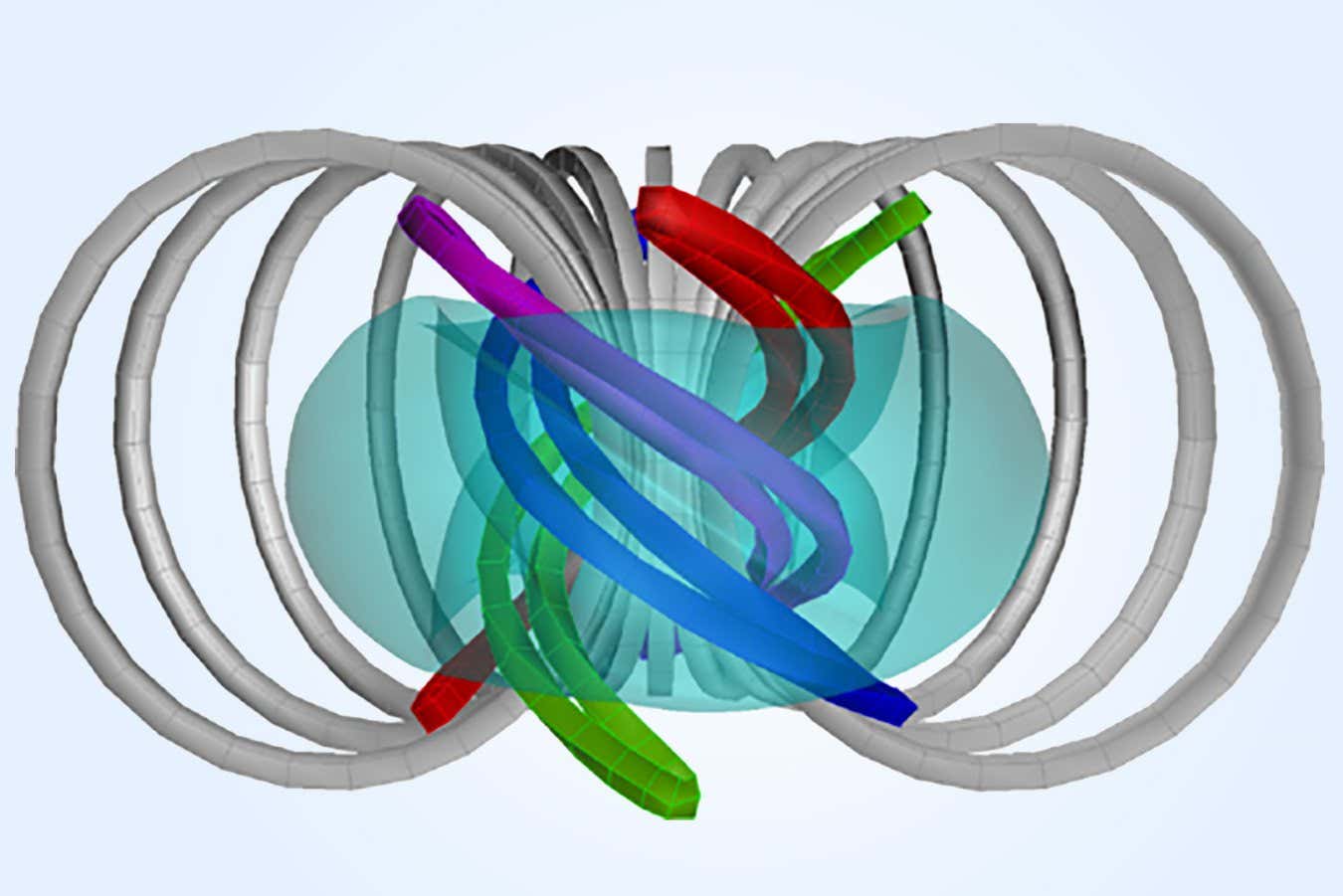
    Two types of fusion reactor called tokamaks and stellarators both have drawbacks – but a new design combining parts from both could offer the best of both worlds

    [ad_2]

    Source link

  • More than a billion people live in ‘energy poverty’

    More than a billion people live in ‘energy poverty’

    [ad_1]

    Nature, Published online: 30 May 2024; doi:10.1038/d41586-024-01530-6

    Satellite data help to show that many people with access to electricity cannot take advantage of it.

    [ad_2]

    Source link

  • How Many Charging Stations Would We Need to Totally Replace Gas Stations?

    How Many Charging Stations Would We Need to Totally Replace Gas Stations?

    [ad_1]

    Buyers curious about making the switch to electric vehicles have made it clear in survey after survey after survey: Charging kind of freaks them out.

    In many ways, drivers report, owning an EV is the same if not better than owning a gas-powered car. But fueling an electric vehicle is different, and can be inconvenient depending on where you live, and is therefore sometimes scary to even those interested in buying electric.

    The majority of today’s American EV owners charge at home, but more than 20 percent of US households don’t have access to consistent off-street parking where they can plug in overnight. The public charging network, meanwhile, can be spotty, and drivers have complained that chargers aren’t always well maintained or even functioning.

    The good news is that automakers, governments, and other policy players realize the US has a charging problem. They want more people in electric cars. Automakers are scaling up EV production and want people to buy them, and legislators realize that nixing gas-powered cars in favor of zero-emissions electrics will be an important part of staving off the worst effects of climate change.

    As a result of the early efforts to make the switch to EVs, the US currently has 188,600 public and private charging ports, and 67,900 charging stations, according to data collected by the US Department of Energy—figures that have more than doubled since 2020. Another 240 stations are currently planned. Compare that to today’s gas infrastructure: The country has about 145,000 gas fueling stations, according to the American Petroleum Institute.

    At WIRED, the whole situation got us interested in a thought experiment: If we could magically snap our fingers and turn every auto electric, how many charging stations would the US need to add?

    Number-crunchers at Coltura, an alternative fuel research and advocacy group, crunched the numbers:

    The upshot? The nation needs to build lots and lots more chargers before it gets to full electrification, a point experts suggest should come in the 2040s. But the task may not be as insurmountable as it looks.

    The number of public chargers will have to grow by a factor of six, as estimated by Matthew Metz, Coltura’s executive director, and Ron Barzilay, its data and policy associate. “We’re not necessarily off-track,” says Metz.

    [ad_2]

    Source link

  • US Offshore Wind Farms Are Being Strangled With Red Tape

    US Offshore Wind Farms Are Being Strangled With Red Tape

    [ad_1]

    This article is republished from The Conversation under a Creative Commons license.

    America’s first large-scale offshore wind farms began sending power to the Northeast in early 2024, but a wave of wind farm project cancellations and rising costs have left many people with doubts about the industry’s future in the US.

    Several big hitters, including Ørsted, Equinor, BP, and Avangrid, have canceled contracts or sought to renegotiate them in recent months. Pulling out meant the companies faced cancellation penalties ranging from $16 million to several hundred million dollars per project. It also resulted in Siemens Energy, the world’s largest maker of offshore wind turbines, anticipating financial losses in 2024 of around $2.2 billion.

    Altogether, projects that had been canceled by the end of 2023 were expected to total more than 12 gigawatts of power, representing more than half of the capacity in the project pipeline.

    So, what happened, and can the US offshore wind industry recover?

    I lead the University of Massachusetts Lowell’s Center for Wind-Energy Science, Technology, and Research (WindSTAR) and Center for Energy Innovation, and follow the industry closely. The offshore wind industry’s troubles are complicated, but it’s far from dead in the US, and some policy changes may help it find firmer footing.

    A Cascade of Approval Challenges

    Getting offshore wind projects permitted and approved in the US takes years and is fraught with uncertainty for developers, more so than in Europe or Asia.

    Before a company bids on a US project, the developer must plan the procurement of the entire wind farm, including making reservations to purchase components such as turbines and cables, construction equipment, and ships. The bid must also be cost-competitive, so companies have a tendency to bid low and not anticipate unexpected costs, which adds to financial uncertainty and risk.

    The winning US bidder then purchases an expensive ocean lease, costing in the hundreds of millions of dollars. But it has no right to build a wind project yet.

    Before starting to build, the developer must conduct site assessments to determine what kind of foundations are possible and identify the scale of the project. The developer must consummate an agreement to sell the power it produces, identify a point of interconnection to the power grid, and then prepare a construction and operation plan, which is subject to further environmental review. All of that takes about five years, and it’s only the beginning.

    For a project to move forward, developers may need to secure dozens of permits from local, tribal, state, regional, and federal agencies. The federal Bureau of Ocean Energy Management, which has jurisdiction over leasing and management of the seabed, must consult with agencies that have regulatory responsibilities over different aspects in the ocean, such as the armed forces, Environmental Protection Agency, and National Marine Fisheries Service, as well as groups including commercial and recreational fishing, Indigenous groups, shipping, harbor managers, and property owners.

    [ad_2]

    Source link

  • Everyone’s Pumped About Heat Pumps

    Everyone’s Pumped About Heat Pumps

    [ad_1]

    Lauren Goode: Yeah. You recommended a podcast episode with her too.

    Michael Calore: I did, yeah.

    Lauren Goode: Was it the Fresh Air one?

    Michael Calore: Yeah. To you. Yeah. Yeah, because you were like, “Who is Kathleen Hannah?” I’m like, “Oh, you got to check her out.” So yeah, I think she was on another podcast last week. Anyway, the book is brand-new. You can get it as an ebook or an audiobook. She reads it, and if you’re a Spotify Premium subscriber, I think you can listen to it as part of your subscription, so I would recommend doing that. That’s how I’m enjoying it, in her voice.

    Matt Simon: I think I saw that at Green Apple actually.

    Michael Calore: Yeah.

    Matt Simon: San Francisco local people might be able to find it there.

    Michael Calore: Yes.

    Matt Simon: You should be there. Anyway. It’s a great bookstore.

    Lauren Goode: Oh yeah. We just walked by it the other day.

    Michael Calore: Yeah, it’s the best. One of the best in the world.

    Lauren Goode: You had a great story about the book that you let go.

    Michael Calore: Oh, yeah.

    Lauren Goode: And it came back to you.

    Michael Calore: Yeah. Between the Clock and the Bed?

    Lauren Goode: That’s right.

    Michael Calore: Edvard Munch. Yeah. That’s a boring story though.

    Lauren Goode: I enjoyed it.

    Michael Calore: Glad you did.

    Lauren Goode: Yeah.

    Michael Calore: What is your recommendation?

    Lauren Goode: My recommendation, I just came up with this, because I came into the studio today without one prepared. Staycations.

    Michael Calore: Say more.

    Matt Simon: You mean as a concept or as a piece of media?

    Lauren Goode: Oh, as a concept. Is there a piece of media called Staycations?

    Matt Simon: I don’t know.

    Lauren Goode: Is that like a magazine? We should start one.

    Matt Simon: Yeah.

    Lauren Goode: I like that idea. It’s a great time in media to be starting magazines. Staycation, so I have a good friend who has been loaning me access to her home office, and it’s great because it is not far from where I live, but sometimes on weekends I go there and it’s a different perspective. It’s a different place. I’m not thinking about laundry or cleaning or to-do’s or whatever I have to order from Amazon.com or whatever it is. I’m away, but I’m not far, and I really appreciate that. It’s been really head clearing. I’m also working on a book, so it’s helpful for that. I mean, that’s the primary thing.

    But then also in the past couple months, I’ve had the opportunity to stay just north of here, like 30 minutes, and so I’m away, but I’m not away away, and it’s great. It’s just, get away for a staycation if you can. If you have the means, if you have friends who are saying, “Hey, I need someone to pet sit,” or “Do you want to take over my house for a weekend?” Or something like that. Just do it. Stay local, but just get a totally different perspective on where you live, your neighborhood, the people around you, try new restaurants, new venues, just yeah, do a staycation if you can.

    [ad_2]

    Source link