Tag: Energy

  • Novel Catalyst Model Sets New Standards in Fuel Cell Technology

    Novel Catalyst Model Sets New Standards in Fuel Cell Technology

    [ad_1]

    Chemistry Catalyst Concept

    Researchers at Tohoku University have developed a novel method to predict the performance of molecular metal-nitrogen-carbon (M-N-C) catalysts, which are essential for the advancement of fuel cell technology. Their study highlights a new predictive tool that relies on computer simulations to study the interactions between electric fields and pH levels. This breakthrough provides a more efficient pathway for developing catalysts that operate effectively in different environmental conditions, potentially overcoming one of the major hurdles in the widespread adoption of fuel cell technology.

    Tohoku University researchers have devised a method to predict the performance of new catalysts for fuel cells, potentially hastening the development of more efficient clean energy solutions.

    Tohoku University researchers have created a reliable means of predicting the performance of a new and promising type of catalyst. Their breakthrough will speed up the development of efficient catalysts for both alkaline and acidic environments, thereby saving time and effort in future endeavors to create better fuel cells.

    Details of their research were recently published in the journal Chemical Science.

    Structures of Long Chain Fe Azaphthalocyanines Molecular Catalysts

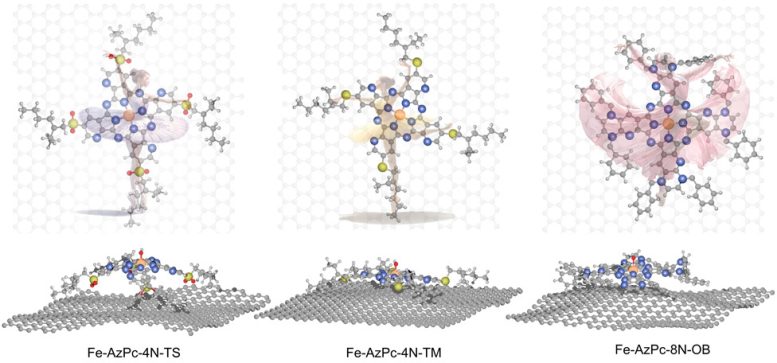
    Structures of long-chain Fe-Azaphthalocyanines (AzPc) molecular catalysts. After DFT geometric relaxations with more than 650 atoms, different “dancing patterns” emerged due to the varying interactions between the molecular side chains and the graphene substrate. Credit: Hao Li, Hiroshi Yabu et al.

    Fuel cell technology has often been touted as a promising solution for clean energy; however, issues with catalyst efficiency have impeded its broad adoption.

    Molecular metal-nitrogen-carbon (M-N-C) catalysts boast distinctive structural properties and excellent electrocatalytic performance, particularly for the oxygen reduction reaction (ORR) in fuel cells. They offer a cost-effective alternative to platinum-based catalysts.

    Unique Properties of M-N-C Catalysts

    One such variant of M-N-C catalysts are metal-doped azaphthalocyanine (AzPc). These possess unique structural properties, characterized by long stretching functional groups. When these catalysts are placed on a carbon substrate, they take on three-dimensional shapes, much like a dancer placed onto a stage. This shape change influences how well they work for ORR at different pH levels.

    Experimental RDE Polarization Curves

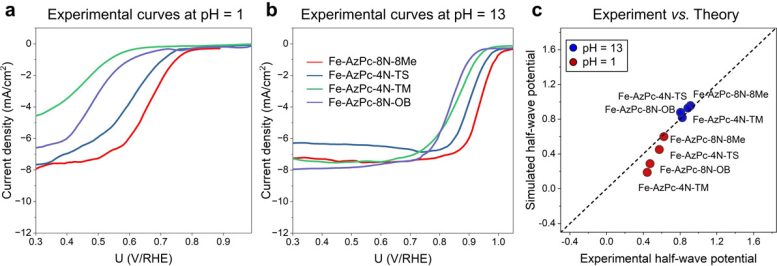
    Experimental RDE polarization curves are provided at pH = 1 and pH = 13. This figure offers direct comparisons between the experimental and simulated half-wave potentials. Credit: Hao Li, Hiroshi Yabu et al.

    Still, translating these beneficial structural properties into increased performances is a challenge, one that requires significant modeling, validation, and experimentation, which is resource intensive.

    “To overcome this, we used computer simulations to study how the performance of carbon-supported Fe-AzPcs catalyst for oxygen reduction reactions changes with different pH levels, by looking at how electric fields interact with the pH and the surrounding functional group,” says Hao Li, associate professor at Tohoku University’s Advanced Institute for Materials Research (WPI-AIMR) and corresponding author of the paper.

    pH Dependent ORR Volcano Models and the Simulated LSV Curves of Fe AzPc Derivatives

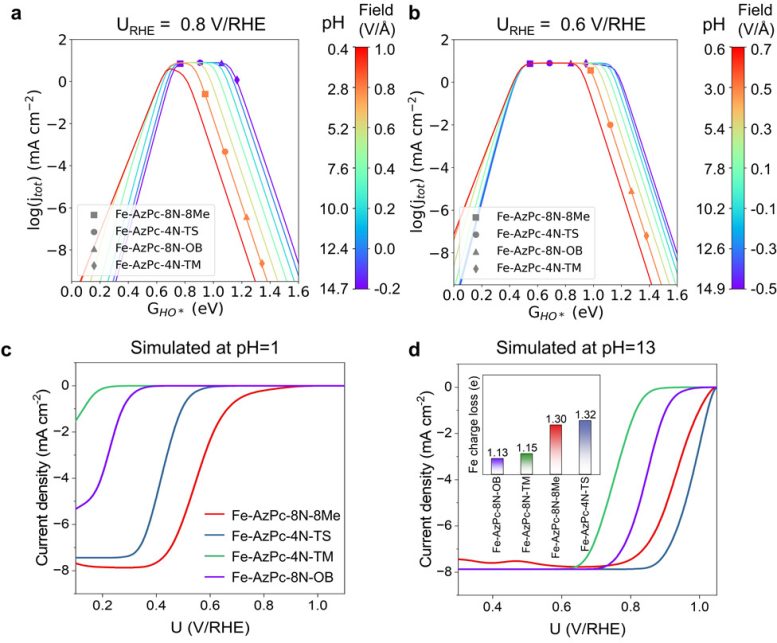
    pH-dependent ORR volcano models and the simulated LSV curves of Fe-AzPc derivatives. pH-field dependent volcanos. The left and right sides of the color bar represent the correlation between the electric field and pH. This figure serves as a benchmark for our experiments. Credit: Hao Li, Hiroshi Yabu et al.

    In analyzing Fe-AzPcs performance in ORR, Li and his colleagues incorporated large molecular structures with complex long-chain arrangements, or ‘dancing patterns,’ with arrangements of over 650 atoms.

    Crucially, the experimental data revealed that the pH-field coupled microkinetic modeling closely matched the observed ORR efficiency.

    “Our findings suggest that evaluating the charge transfer occurring at the Fe-site, where the Fe atom usually loses approximately 1.3 electrons, could serve as a useful method for identifying suitable surrounding functional groups for ORR,” adds Li. “We have essentially created a direct benchmark analysis for the microkinetic model to identify effective M-N-C catalysts for ORR across various pH conditions.”

    Reference: “Benchmarking pH-field coupled microkinetic modeling against oxygen reduction in large-scale Fe–azaphthalocyanine catalysts” by Di Zhang, Yutaro Hirai, Koki Nakamura, Koju Ito, Yasutaka Matsuo, Kosuke Ishibashi, Yusuke Hashimoto, Hiroshi Yabu and Hao Li, 15 March 2024, Chemical Science.
    DOI: 10.1039/D4SC00473F


    [ad_2]

    Source link

  • Infrastructure projects need to demonstrate a return on investment

    Infrastructure projects need to demonstrate a return on investment

    [ad_1]

    Fabio Pulizzi 00:10

    Hello, this is How to Save Humanity in 17 Goals, a podcast brought to you by Nature Careers in partnership with Nature Water. I’m Fabio Pulizzi, chief editor of Nature Water.

    Welcome again to the series where we meet the scientists working towards the Sustainable Development Goals, agreed by the United Nations and world leaders in 2015.

    For almost a decade, in a huge global effort, thousands of researchers have been using those targets to tackle the biggest problems that the planet faces today.

    In episode 9, we look at Sustainable Development Goal number 9: infrastructure, industrialization and innovation.

    And we meet an electrical engineer who sees efficient energy provision as central to a country meeting these aims.

    Sinan Küfeoğlu: 01:02

    I am Sinan Küfeoğlu. I am working as a senior policy manager at the UK Office of Gas and Electricity Markets, OFGEM.

    Previously I worked at Oxford, Cambridge, University College London, Alto University in Finland, on various energy, economics and policy-related subjects.

    I’d like to clarify that the perspectives I express are my own as a researcher, and do not necessarily represent or reflect the official or unofficial stances or views of OFGEM, or the UK civil service.

    Goal number 9 is about building a resilient infrastructure and promoting sustainable industrialization and fostering innovation.

    So it has kind of three pillars: ifrastructure, industrialization and innovation.

    For the infrastructure in SDG number nine, the three main themes are to provide transportation, information and communication infrastructures.

    So these are the enablers for a sustainable development in industrialization and innovation.

    You know, without transport, without information, and without communication, we can’t enable economic activity, industry and innovation.

    So these are the main pillars picked up by the SDG number 9.

    I’m originally from Turkey. When I was a little child, Isaac Newton was my hero. That is why I was quite interested in physics. That was my favourite topic in the school.

    And when I started university in Ankara, in the Middle East Technical University, I wanted to study electrical engineering, just to continue all this. Faraday’s works, Maxwell’s work, you know, I started being more and more interested in this electricity and energy fields.

    At the age of 14, I gave a seminar on the the importance and future of nuclear energy to the city representatives in my city in Turkey.

    So I was quite interested in energy related subjects. That’s why I studied electrical engineering in Turkey.

    Then, I wanted to do research and get into academia. That is why I moved to Finland to do my Masters and PhD, again in electrical engineering.

    But when I finished my PhD, I said: “Okay, this is a time for a bigger challenge to see, you know, to be exposed to the outer world.”

    Because Finland is more of a reserved place. You know, well, it’s a happy country. Yeah, everyone, let’s say in my university, Aalto University, we were all electrical engineers.

    Imagine a corridor. Forty people, they’re all electrical engineers, and they look at the world from the same perspective, from the same window.

    So I wanted to change that, to expose myself for differences and different, you know, problems, peoples, backgrounds.

    That’s why I moved to UK. And in Cambridge, I found exactly that sort of environment. I, for example, from this school of electrical engineering, I moved to business school, in Cambridge.

    So in there I worked with business people, finance people, people from sciences, humanities, backgrounds, any backgrounds.

    And I started working with companies, industry, the public authorities, the companies from all around the world, and getting questions from them. You know, a company approaches you and says: “Okay, we have this problem. Can you do research for us?”

    I say, “Okay, yeah, we can do this. And we need these skills and experiences.”

    They fund us. They go around our network, find the necessary skills. Altogether truly interdisciplinary research. We come up with answers. And we publish our answers. In a short time period, we can see the real impact in the world. And that is what motivates me the most, to see the impact what I do, what I publish in the end.

    After that, I experienced the same thing in Oxford, now with the World Bank, EBRD, OFGEM, the civil service, we do regulations of policymaking, and everything we do, whatever we change, immediately, the next day, there’s enough impact in the orders of hundreds of millions, even billions of pounds.

    So this is quite, you know, tempting and motivating. And energy is the enabler of everything.

    Sinan Küfeoğlu 05:54

    The biggest infrastructure challenge, I think, as a power engineer, I can say the access to electricity, the power network.

    Because power network, in my opinion, is the biggest engineering achievement of humankind to this date, because it enables other sectors and other economies to continue.

    And five, seven years ago, in Cambridge, we published a paper on the future of power distribution in the world, and investigated what parts of the world has access to continuous power, what kind of netoworks they have.

    So around 1 billion people in the world right now lack continuous power access.

    And the concentration of these people are mainly in the Global South. So there is an equality problem as well, as well as technical problems of accessing electricity.

    So in my opinion, this is the biggest challenge to provide electricity to everyone, so that they will have an economy, they can create jobs and businesses and they can sustain their more than social lives.

    In addition to electric power, I can say, access to clean water and sanitation is another infrastructure problem.

    Because it is necessary to, as I said, sustain daily lives of, you know, dignified human beings. And again, this concentration of lacking access to clean water and sanitation is almost geographically the same with the lack of access to power.

    So these two are going you know, side by side, I think, in terms of challenges.

    So solving one will naturally solve the other I guess, if the necessary actions are taken. As SDG number 9 reminds me of transportation, it says information and telecommunications.

    But transportation wise, I think the world is at okayish levels. So we can connect and travel to all, to even the remotest areas in the world.

    It is fine, I think. Information, well it comes to telecommunications and internet. Yes, we should just distribute the Internet to all regions in the world.

    Some companies, you know, are doing this, some widespread big projects that are promising that anyone on Earth can access to internet. I hope that will work out.

    In terms of telecommunications, 2G network is almost everywhere on Earth. But the adoption of 4G is slower and 5G is much lower. I’m sure those will increase in time as well, as we achieve 2G.

    So, you know, information and telecommunications are okayish in terms of when you compare with other problems in the infrastructure.

    Sinan Küfeoğlu 09:03

    When we talk about infrastructure, everyone thinks of investments. What would happen in the future? What we should do more to add on top of the existing one. But people tend to miss the thing that the existing infrastructure is aging as well.

    For example, in the energy network, the usual lifetime of you know, equipment is around like 50-60 years, if you’re lucky, 70 depending on the quality of the manufacturing.

    So replacing the existing infrastructure, the aging infrastructure, is another big challenge. I remember back in the day, we went to a factory in Turkey. I was in the university there.

    And they wanted to change the electricity infrastructure to a new one, to a smarter one, you know, Smart Grid, Smart Energy Systems.

    Yep. Popular ones, Let’s do that. So that was the year 2010. We went to that factory. And I saw that the equipment for installed back in 1920s.

    They were German-made, still working after 90 years, you see. But they had to be replaced maybe after 60 years. So they made it to 90 years. So these are huge costs, you see.

    Sinan Küfeoğlu 10:22

    In the developed world, while the infrastructure is ageing, and it needs to be replaced, this is the biggest challenge.

    And the industry, it’s transforming into, you know, more digitalized, more green industries, more sustainable.

    Whereas in the developing countries, they still lack businesses infrastructure. So basic infrastructure should go there first.

    I remember back in the day, we had a chat with the retired senior officer of one of the biggest oil companies in the world.

    I asked him a question said that, you know, he gave a speech about sustainability. Imagine an oil company former CEO talking about sustainability. That’s a bit ironic. I said, “Okay, you say were going to create a sustainable world in the in the future.” And I said, “In that sustainable world, there is no place for you, you know, oil companies. What are you going to do in terms of business.”

    And he laughed at that bit and said, “I understand your enthusiasm, young man, but about a billion people lack energy right now in the world. And we are the first ones, the oil and gas companies, to reach these people before the electricity goes to them.”

    So you know, the industrialization, the needs, they change rapid, vary widely between geographies. I think when we talk about the challenges the solutions, we should we should address what we’re talking about and where we’re talking about.

    Sinan Küfeoğlu 12:00

    So, the solution for this industrialization challenge, the practical and sensible solution, would be to provide decentralized and smart systems to the developing countries, and less developed countries.

    For example, these solar systems, you know, solar PV systems, together with energy storage assets, and clean water and sanitation assets, they could be deployed, so that these regions will have the sufficient amount of basic infrastructure to run their daily errands.

    And these self-sufficient mini and micro infrastructure could be a solution in these underdeveloped regions.

    As long as financing mechanisms exist and provided to these regions, that’s another problem. We know financing mechanisms. For the developed world the challenge is digitalization and ageing infrastructure.

    So in one hand, we are going to incorporate more digital solutions. In the other we are going to green it by decarbonizing it. In the meantime, of course, we will replace the ageing infrastructure with the new ones.

    Sinan Küfeoğlu 13:24

    We had this kind of a trend, maybe 20 years ago, saying that, “Okay, let’s decentralize everything, our energy systems. Why not go for micro grids, mini grids, self sustaining cities, self sustaining university campuses? Everything should be self sufficient.”

    You have self-sufficient homes. These ideas emerged everywhere in the world. So we wanted to decentralize these power systems, for example. But after 20 years, two decades, when we see now that we are creating more bigger, gigantic centralized entities, rather than decentralization.

    For example, it happened in the UK 20 years ago, when we’re talking about mini grids, micro grids right now, we are creating this future energy system, future system operator.

    So it’s going to be bigger, heavier in terms of physics, and more, you know, authorities and technical capabilities will be concentrated on the centralized entity.

    So everything is going for centralized entities. So that’s, that’s a kind of a big irony in the developed world. I think. that should be mentioned here.

    Sinan Küfeoğlu 14:39

    There are various innovation challenges. First, we can mention of this research and development expenditure.

    Again, there’s this inequality in the developed world. The, you know, a higher percentage of GDP is being spent for research and development.

    Whereas in developing countries it is almost half of that, or maybe lower than half of that.

    Similarly, the number of researchers and academic activities in the developed world is much, much, much higher than the developing countries.

    So that means that the gap in between is going to get larger, bigger, when time passes. So, when we, you know announced these SDGs, back in 2015, the main idea was to support, you know, these developing countries so that there’ll be more research and development innovation activities, so that the gap would be smaller.

    But the numbers tell us exactly a different opposite way. So, more research and development activities are concentrated in the developed world, less in the developing world.

    The other thing, in innovation, I think we should mention something really, really important here is the viability of innovation. Because the countries are, you know, funding the research work. Projects are the projects, and everything.

    What I’ve witnessed in my professional career, I’ve been quite active in Brussels back in the day, attending, you know, European Commission meetings about funding announcements, all these you know, Horizon projects etc.

    In many chats, I realized that they don’t run proper return-on-investment analysis, cost-benefit analysis. So in the developed world, I can say that the biggest challenge with innovation is that people tend to use these buzzwords.

    What are these buzzwords? Green, stainable, holistic approach, inclusive, circular economy. So as long as you bombard your research proposal, or, you know, innovation proposal with these words, you can easily sell it to people, to the funding authorities.

    And those authorities don’t measure the impact after that. Imagine, you propose a research project of five years, and you’re funded less than 100 million euros.

    And after five years, no one is asking how much of value you created. So how much of this money returned back to the society, returned back to the economies?

    And I can give you two solid examples about this innovation challenge. The first one could be blockchain.

    Five years ago, it was the biggest hype in the world, especially in the energy world. Everyone said, “Oh, it’s gonna decarbonize the whole world.”

    We will say it. Blockchain is the hero. And many countries, primarily Germany, invested a huge amount of money in this in the sphere, funded projects, companies, startups.

    But after five years, now we can see that most of those companies failed. They perished from the business world.

    They couldn’t create any real value. They couldn’t create revenue streams. And what happened to those fundings? They are just gone, you see. Right now the similar thing is happening with hydrogen, similar big hype, it’s going to decarbonize everything.

    You’re going to achieve net zero through hydrogen, and billions of euros are being spent everywhere, in North America, in Europe, even in Britain. But no one is actually, you know, asking the question: “How much of this money is going to return back to the economies also societies as real real value?“

    So I think in terms of innovation, when we talk about innovation, we should really highlight and underscore the term viability.

    The SDGs are not solid or binding targets. Rather, these are accumulation of numerous recommendations and roadmaps. And so we don’t have to achieve any solid targets by 2030.

    They’re not binding, or legally binding. So these are recommendations. But when we asked the questions, “Will we achieve SDG number nine by 2030? The answer is yes and no. Both.”

    Because some parts of the world you know, we already talked about the inequalities, you know the geographical differences, they’re going to achieve it maybe some pas have already achieved this, you know, SDG number nine target sub targets, there are various sub targets in there, but some other parts of the world may be they will never achieve it.

    What I can say from my kind of professional experience, the ship has already set sail. These SDG ships in particular as SDG number nine, yep, it’s traveling now.

    And it has a direction and ultimate kind of target It’s going there. But the main question is who is traveling in the first class, and who is traveling below the deck below the engines, below the sea level.

    So some peoples are traveling first class, some people just below the engine rooms. So that is the problem because after all, I’m an engineer, and I believe in science and engineering and I really, really believe in the potential in mankind.

    I definitely think that that we are going to achieve these climate goals, the sustainable development goals one way or another, maybe in 2030, maybe in 2050.

    But eventually, we will achieve these, but it’s not going to be an equal journey for everybody.

    Fabil Pulizzi 21:06

    Thanks for listening to this series: How to Save Humanity in 17 Goals.

    Join us again next time when we look at Sustainable Development Goal number 10: to reduce inequality in and among countries. See you then


    [ad_2]

    Source link

  • Tesla’s Controversial Factory Expansion Is Approved

    Tesla’s Controversial Factory Expansion Is Approved

    [ad_1]

    The controversial expansion of Tesla’s only European gigafactory was approved on Thursday, as the local council in the German municipality of Grünheide voted in favor of the carmaker’s plans to grow its facility near Berlin.

    The majority of 19 council representatives supported Tesla’s plans to expand its only European gigafactory. Eleven councilors voted in favor of the expansion, six voted against, while two abstained. The vote improves Tesla’s chances of being able to build more space for logistics, including a train station, although the company still has to secure the approval of local environment authorities. In July, Tesla announced plans to build 1 million electric cars per year at the site.

    Around 50 protesters gathered outside the local government building as the result was announced, according to local reports. “It’s pretty disappointing,” says Esther Kamm, spokesperson for the anti-Tesla protest group, Turn Off the Tap on Tesla (TDHA), who watched the vote take place. She said the group would still try to stop the expansion by continuing to hold protests while exploring their legal options.

    “It was a bad decision today, and this makes things harder, but it’s definitely not the end of the story.”

    TDHA is just one of a wide alliance of environmental groups who oppose the expansion, claiming that the factory’s presence threatens to pollute local water supplies and describing the carmaker’s reputation as an environmentally friendly company as misleading.

    “I’m pissed,” says Manu Hoyer, spokesperson for the Citizens Initiative Grünheide (Bürgerinitiative Grünheide), which represents local residents who oppose the factory, in a statement. “Today the local council ignored the vote of me and my fellow citizens.” In February, 65 percent of locals voted against the expansion plan in a nonbinding poll.

    Last week, during a demonstration against the expansion, hundreds of protesters attempted to storm the factory, amid clashes with police. As part of a five-day protest, police said 23 demonstrators were detained and 27 officers injured.

    Anti-Tesla protesters say they want to draw attention to the mineral mining necessary to build electric car batteries and the problems that can pose to local communities. Compared to conventional cars, electric car batteries require 170 kilograms more minerals such as lithium, nickel, and cobalt, according to 2021 figures published by the International Energy Agency.

    Since February, a handful of protesters have been living in treehouses in the forest, just footsteps away from the Tesla factory, in another attempt to stop the site’s expansion. They currently have permission to stay until May 20. An attempt by police to force the camp to leave before that date was rejected today by a German court.

    [ad_2]

    Source link

  • Sunlight-trapping device can generate temperatures over 1000°C

    Sunlight-trapping device can generate temperatures over 1000°C

    [ad_1]

    Thermal-trapping device reaching 1050 degrees Celsius CREDIT Device/Casati et al. USAGE RESTRICTIONS Credit must be given to the creator. Adaptations must be shared under the same terms.

    The heat-trapping device reached 1050°C in experiments

    mark bulmer/Alamy

    Engineers have developed a device that can generate temperatures of over 1000°C (1832°F) by efficiently capturing energy from the sun. It could one day be used as a green alternative to burning fossil fuels in the production of materials such as steel, glass and cement.

    Manufacturing these materials involves heating raw materials to above 1000°C by burning fossil fuels, which is extremely energy intensive. “About half of the energy we use is not actually turned into electricity,” says Emiliano Casati at ETH Zurich in Switzerland. “It’s used to produce many of the materials that we need in our daily lives and our industries.”

    Solar furnaces, which use an array of moveable mirrors to focus sunlight onto a receiver that reaches high temperatures, could be used at manufacturing sites as an alternative to burning fossil fuels. However, they are currently quite inefficient at converting solar energy to temperatures higher than 1000°C, says Casati.

    To improve the efficiency of such devices, Casati and his colleagues have designed a heat-trapping solar receiver with a 300 millimetre layer of quartz around it.

    Quartz is a semi-transparent material that allows light energy to pass through it but blocks thermal energy. This means that as the silicon heats up from the concentrated sunlight, the quartz prevents thermal energy leaking back out, trapping the heat and reducing energy loss in the system.

    The team tested the modified solar receiver in a facility that simulates sunlight using LEDs. Their initial experiments found that the silicon absorber easily reached 1050°C.

    According to heat transfer models, the silicon shield could enable receivers to get to temperatures of up to 1200°C while keeping 70 per cent of the energy input in the system. Without the silicon shield, the energy efficiency drops to just 40 per cent for the same temperature.

    While this is just a proof-of-concept device, Casati hopes that it will one day be widely used as a green way of producing the high temperatures needed in manufacturing. “We really need to tackle the challenge of decarbonising these industries, and this could be one of the solutions,” he says.

    Topics:

    [ad_2]

    Source link

  • These Electric School Buses Are on Their Way to Save the Grid

    These Electric School Buses Are on Their Way to Save the Grid

    [ad_1]

    The school bus is in many ways ideal for V2G. “There’s no uncertainty in terms of the use of the bus,” says Patricia Hidalgo-Gonzalez, director of the Renewable Energy and Advanced Mathematics Lab at UC San Diego, who studies the grid but wasn’t involved in the project. “Having that clarity on what the transportation needs are—that makes it much easier for the grid to know when they can make use of that asset.”

    Zum’s buses start operating at 6 or 6:30 am, drive kids to school, and finish up by 9 or 9:30 am. While the kids are in class—when there’s the most solar energy flowing into the grid—Zum’s buses plug into fast-chargers. The buses then unplug and drive the kids home in the afternoon. “They have large batteries, typically four to six times a Tesla battery, and they drive very few miles,” says Vivek Garg, cofounder and COO of Zum. “So there’s a lot of battery left by end of the day.”

    After the kids are dropped off, the buses plug in again, just as demand is spiking on the grid. But instead of further increasing that demand by charging, the buses send their surplus power back to the grid. Once demand has waned, around 10 pm, the buses start charging, topping themselves up with electricity from nonsolar sources, so they’re ready to pick up kids in the morning. Zum’s system decides when to charge or discharge depending on the time of day, so the driver just has to plug in their bus and walk away.

    On weekends, holidays, or over the summer, the buses will spend even more time sitting unused—a whole fleet of batteries that might otherwise be idle. Given the resources needed to make batteries and the need for more grid storage, it makes sense to use what batteries are available as much as possible. “It’s not like you’re placing a battery somewhere and then you’re only using them for energy,” says Garg. “You’re using that battery for transportation, and in the evening you’re using the same battery during the peak hour for stabilizing the grid.”

    Get ready to see more of these electric buses—if your kid isn’t already riding in one. Between 2022 and 2026, the EPA’s Clean School Bus Program is providing $5 billion to swap out gas-powered school buses for zero-emission and low-emission ones. States like California are providing additional funding to make the switch.

    One hurdle is the significant upfront cost for a school district, as an electric bus costs several times more than an old-school gas-guzzler. But if the bus can do V2G, the excess battery power at the end of the day can be traded as energy back to the grid during peak hours to offset the cost difference. “We have used the V2G revenue to bring this transportation cost at par with the diesel buses,” says Garg.

    For the Oakland schools project, Zum has been working with the local utility, Pacific Gas and Electric, to pilot how this works in practice. PG&E is testing out an adaptable system: Depending on the time of day and the supply and demand on the grid, a V2G participant pays a dynamic rate for energy use and gets paid based on the same dynamic rate for the energy they send back to the system. “Having a fleet of 74 buses—to be followed by other fleets, with more buses with Zum—is perfect for this, because we really want something that’s going to scale and make an impact,” says Rudi Halbright, product manager of vehicle-grid-integration pilots and analysis at PG&E.

    [ad_2]

    Source link

  • Around half the world could lose easily accessible groundwater by 2050

    Around half the world could lose easily accessible groundwater by 2050

    [ad_1]

    EKXM2R Groundwater well and standpipe for crop irrigation. Porterville, Tulare County, San Joaquin Valley, California, USA

    Reaching peak groundwater pumping could impact agriculture across the globe

    Peter Bennett / Alamy

    Groundwater extraction is set to peak globally within the next three decades as unsustainable pumping depletes accessible stores. This could reshape the food and water systems that serve at least half the world’s population.

    Between 1960 and 2010, global groundwater extraction increased by more than 50 per cent, largely to irrigate crops. Today, one-fifth of all food is produced using groundwater. Much of this water is extracted from aquifers faster than they naturally refill, driving declining water levels. This…

    [ad_2]

    Source link

  • Catalyst Slashes Iridium Use by 95% in Hydrogen Electrolyzers

    Catalyst Slashes Iridium Use by 95% in Hydrogen Electrolyzers

    [ad_1]

    Hydrogen Production Green Energy Reaction Vessel Art

    Researchers have developed a new method that reduces the iridium required to produce “green” hydrogen by 95%, maintaining production rates and promising to enhance the feasibility of a carbon-neutral hydrogen economy. Credit: SciTechDaily.com

    A breakthrough in hydrogen production has been achieved by a Japanese research team, reducing the need for iridium by 95% without compromising efficiency, paving the way for sustainable, large-scale hydrogen energy solutions.

    As the world is transitioning from a fossil fuel-based energy economy, many are betting on hydrogen to become the dominant energy currency. But producing “green” hydrogen without using fossil fuels is not yet possible on the scale we need because it requires iridium, a metal that is extremely rare.

    In a study published today (May 9) in the journal Science, researchers led by Ryuhei Nakamura at the RIKEN Center for Sustainable Resource Science (CSRS) in Japan report a new method that reduces the amount of iridium needed for the reaction by 95%, without altering the rate of hydrogen production. This breakthrough could revolutionize our ability to produce ecologically friendly hydrogen and help usher in a carbon-neutral hydrogen economy.

    Synthesized Iridium Oxide

    Scanning electron microscope image of the synthesized iridium oxide (D) and scanning transmission electron microscope images of the iridium (bright spots) dispersed on manganese oxide electrodeposited on a corrosion-resistant platinum-coated titanium mesh (E,F,G). Credit: RIKEN

    Hydrogen Production Challenges

    With 70% of the world covered in water, hydrogen is truly a renewable source of energy. However, extracting hydrogen from water on a scale that can rival fossil fuel-based energy production is not yet possible. Current global energy production is almost 18 terawatts, meaning that at any given moment, about 18 trillion watts of power is being produced on average worldwide. For alternative green methods of energy production to replace fossil fuels, they must be able to reach the same rates of energy production.

    The green way to extract hydrogen from water is an electrochemical reaction that requires a catalyst. The best catalysts for this reaction—the ones that yield the highest rate and the most stable hydrogen production—are rare metals, with iridium being the best of the best. But the scarcity of iridium is a big problem. “Iridium is so rare that that scaling up global hydrogen production to the terawatt scale is estimated to require 40 years’ worth of iridium,” says co-first author Shuang Kong.

    Innovations in Catalyst Development

    The Biofunctional Catalyst Research Team at RIKEN CSRS is trying to get around the iridium bottleneck and find other ways of producing hydrogen at high rates for long periods of time. In the long run, they hope to develop new catalysts based on common earth metals, which will be highly sustainable. In fact, the team recently succeeded in stabilizing green hydrogen production at a relatively high level using a form of manganese oxide as a catalyst. However, achieving industrial level production in this manner is still years away.

    “We need a way to bridge the gap between rare metal- and common metal-based electrolyzers, so that we can make a gradual transition over many years to completely sustainable green hydrogen,” says Nakamura. The current study does just that by combining manganese with iridium. The researchers found that when they spread out individual iridium atoms on a piece of manganese oxide so that they didn’t touch or clump with each other, hydrogen production in a proton exchange membrane (PEM) electrolyzer was sustained at the same rate as when using iridium alone, but with 95% less iridium.

    Potential and Future Directions

    With the new catalyst, continuous hydrogen production was possible for over 3000 hours (about 4 months) at 82% efficiency without degradation. “The unexpected interaction between manganese oxide and iridium was key to our success,” says co-author Ailong Li. “This is because the iridium resulting from this interaction was in the rare and highly active +6 oxidation state.”

    Nakamura believes that the level of hydrogen production achieved with the new catalyst has high potential for immediate usefulness. “We expect our catalyst to be easily transferred to real-world applications,” he says, “which will immediately increase the capacity of current PEM electrolyzers.”

    The team has begun collaborating with partners in industry, who have already been able to improve on the initial iridium-manganese catalyst. Moving forward, the RIKEN CSRS researchers plan to continue investigating the specific chemical interaction between iridium and manganese oxide, with hopes of reducing the amount of necessary iridium even more. At the same time, they will continue collaborating with industrial partners, and plan on deploying and testing the new catalyst on an industrial scale in the near future.

    Reference: “Atomically dispersed hexavalent iridium oxide from MnO2 reduction for oxygen evolution catalysis” 9 May 2024, Science.
    DOI: 10.1126/science.adg5193


    [ad_2]

    Source link

  • Renewables supply 30 per cent of global electricity for the first time

    Renewables supply 30 per cent of global electricity for the first time

    [ad_1]

    The rapid growth of solar power in China has changed the world’s electricity mix

    Costfoto/NurPhoto/Shutte​rstock

    Renewables generated a record share of global electricity in 2023 thanks to the rapid growth of wind and solar power. The year marked a turning point in the transition to low-carbon energy, according to think tank Ember, with coal and gas power on the cusp of a long-term decline.

    Green electricity jumped from 29.4 per cent of total generation in 2022 to 30.3 per cent last year, a new high. This was driven by the rapid rollout of wind and solar power, particularly in China. Hydropower and other renewables, such as bioenergy, made up the remainder of renewable generation.

    Solar is by far the fastest-growing electricity source, increasing its share of generation from 4.6 per cent in 2022 to 5.5 per cent in 2023. That is the continuation of a long-running trend; since 2000, wind and solar power have gone from generating just 0.2 per cent of global electricity to a record 13.4 per cent today.

    The share generated by fossil fuels fell from 61.4 per cent in 2022 to 60.6 per cent in 2023, but the amount of electricity produced by these fuels rose slightly because of a 2.2 per cent hike in overall energy demand, mostly in China. Nuclear provided 9.1 per cent of electricity, the same as in 2022.

    A further surge in wind and solar deployment means that, in absolute terms, fossil fuel generation should fall in 2024 – for the first time outside economic crises or pandemics – even as demand for electricity grows, says Ember’s Hannah Broadbent.

    “We really think that 2023 was a major turning point in the history of energy,” she says. “Not only did renewables reach this historic milestone, we also believe that it will be the peak of fossil generation as well. We expect from this year that fossil generation will start to decline at a global level.”

    Fossil fuel generation would have declined in absolute terms in 2023, says Broadbent, but severe droughts in China, India, Vietnam and Mexico curtailed hydropower. Coal plants stepped in to fill the gap, leading to a 1 per cent increase in power sector emissions.

    Assuming a partial return to normality for hydropower in 2024, Ember says it expects emissions from electricity generation to fall by 4 per cent in 2024, the start of a long-term decline for fossil fuels in the mix.

    However, green electricity deployment must increase even more rapidly over the coming years to meet the world’s climate goals. Models suggest wind and solar must deliver 40 per cent of global electricity generation by the end of the decade, around triple its current contribution, in order to meet the target of stopping global warming exceeding 1.5°C.

    Topics:

    [ad_2]

    Source link

  • Inside the Climate Protests Hellbent on Stopping Tesla

    Inside the Climate Protests Hellbent on Stopping Tesla

    [ad_1]

    Mara is sick. The 24-year-old has been living in a mosquito-infested forest near Tesla’s German gigafactory since March, and despite the 78 degrees Fahrenheit heat, a cold is spreading through the camp. Sitting on a makeshift bench, she tells me how she left Berlin to live among the pine trees, roughly an hour’s drive outside the city, in an attempt to stop the company from expanding.

    This week, she will be joined by the notorious German climate group Here And No Further (Ende Gelände), known for its theatrical, often law-breaking blockades, for a five-day-long protest. Anticipating the arrival of hundreds of demonstrators, Tesla said it would shut the factory for four days, telling its employees to work from home, according to an internal email obtained by the German newspaper Handelsblatt.

    Despite the absence of Tesla workers, the company employees and local authorities will be on high alert for troublemakers. The factory is separated from the forest by only a thin fence, and as I walk the forest track tracing the factory’s perimeter, a police car lumbers slowly past, carrying out patrols. On the two days I visit, a black Tesla stands guard at the end of the path connecting the factory fence and the forest camp.

    Mara, who declines to share her surname, vaguely estimates that there are 50 to 100 people involved in this anti-Tesla movement. But on a Thursday afternoon, the camp is quiet. Above us is a city of treehouses. She shows me where she sleeps, a broad wooden platform—built 10 or so meters aboveground and draped in green tarpaulin. The height provides some respite from the mosquitoes, she says, as I catch three sinking into my arm at once. A man with a partially shaved head lies on a salmon-colored sofa eating cake. Closer to the road, activists talk in raised tones about Israel. Several people are barefoot. The group expresses its politics in banners hanging from the trees—electric cars are not “climate protection”; “water is a human right”; “there is no anticolonialism without a free Palestine.”

    Germany is Europe’s car-manufacturing heartland, the birthplace of BMW, Volkswagen, and Porsche. So why Tesla? The company’s presence threatens everything from local water supplies to democracy itself, she argues. “This is an existential issue.”

    Their reasons for being here are part environmental, part anti-capitalist, Mara explains, turning a piece of bark between dirt-encrusted fingernails. Tesla’s ambition, to produce 1 million electric cars a year in Germany, isn’t in service to the climate, Mara says. Instead she describes the 300-hectare Tesla factory as a byproduct of “green capitalism,” a plot by companies to appear environmentally friendly in order to convince consumers to keep buying more stuff. “This has been completely thought up by such companies to have more growth, even in times of an environmental crisis,” she says, adding that the protesters have had no contact with Tesla.

    To people like Mara, Tesla is a symbol of how the green transition went wrong and, as a result, the company’s German gigafactory has become the target of increasingly radical protests. The activists moved into the forest in February, in an attempt to physically block Tesla from clearing another 100 hectares of forest for its expansion. One month after the forest camp appeared, unknown saboteurs blew up a nearby power line, forcing the factory to close for one week. (A left-wing protest group called Vulkan, whose members are anonymous claimed responsibility for the action.)

    [ad_2]

    Source link

  • Argentina’s pioneering nuclear research threatened by huge budget cuts

    Argentina’s pioneering nuclear research threatened by huge budget cuts

    [ad_1]

    A drone view shows the Argentine Modular Elements Power Plant (CAREM), which is the small modular reactor (SMR) project at the most advanced stage of construction worldwide in Argentina, in 2023.

    Construction of the small modular reactor CAREM, shown here in 2023 on the outskirts of Buenos Aires, in Argentina, has been paused owing to funding constraints.Credit: CNEA/Reuters

    Owing to massive budget cuts and lay-offs of government employees, Argentina’s nuclear sector — which includes power plants and research facilities — is at risk, scientists say. The country was the first in Latin America to adopt nuclear energy, has three operating plants that provide about 5–10% of the nation’s electrical energy and runs numerous reactors used for research.

    But because Argentina’s current administration, led by far-right president Javier Milei, has held the federal budget flat compared with that in 2023, the sector is facing a financial crisis. Inflation reached more than 200% last year — meaning that, in real terms, a stagnant budget is equivalent to a funding drop of at least a 50%. Milei, who took office in December after pledging to diminish the role of government in Argentina and bring the country’s debts under control, has also laid off 15,000 federal employees in the past five months.

    With its current budget, the National Atomic Energy Commission (CNEA) will be able to carry out its activities only “until May or June”, according to a statement published in March and signed by the agency’s leaders. The CNEA has been operating since 1950; it sets the country’s nuclear policy and carries out research to improve “the quality of life for society”, among other responsibilities.

    “All these [activities] could be in danger,” Adriana Serquis, former head of the CNEA, tells Nature. On Friday, the Milei administration at last accepted Serquis’s resignation, which she had submitted before the president took office in December.

    Portrait of Adriana Serquis at her desk, taking notes in front of a computer.

    Adriana Serquis was replaced as head of Argentina’s National Atomic Energy Commission last week.Credit: Karl Mancini

    “We cannot operate with this budget,” she says. The agency has taken out loans with private firms in the past few months to keep working, she adds. CNEA authorities stressed to the Milei administration that the agency would need a 2024 budget of US$270 million to operate at a minimal level. The government guaranteed the CNEA only $100 million.

    Milei has made moves towards at least partially privatizing Argentina’s nuclear sector. Yesterday, he appointed Germán Guido Lavalle, founder of candoit, an engineering and technology consulting firm based in Buenos Aires, to lead the CNEA — a move that aligns with that push.

    The agency has had to pause construction on two projects that could have brought even more renown to Argentina’s nuclear sector: one is a ‘small modular reactor’ prototype that is among the first in the world to be built for electricity generation, and the other is a research reactor that might have produced enough of the radioisotope molybdenum-99, commonly used in medical diagnostic imaging, to meet 20% of global demand.

    If this continues, Serquis says, “Argentina will lose its place in the ‘nuclear club’” — referring to the country’s prowess in nuclear research, a global status it has maintained among wealthy nations.

    Projects stagnate

    One of the stalled nuclear projects is the small modular reactor CAREM, intended to supply low-carbon electricity to rural areas where large power plants can’t be built. Nuclear scientists have been working for decades to create this type of reactor, and countries, including Argentina, have been in a race to get theirs fired up quickly. CAREM, a prototype, would use uranium fission to supply around 30 megawatts of electrical power. If successful, it could be scaled up to larger, commercial versions supplying 300 megawatts of electric power. More than $600 million has been invested into CAREM since construction began in 2014, but another $200 million to $300 million is needed to finish it.

    “It has less electrical production capacity than a nuclear power plant, but it’s also cheaper and safer,” says Tomás Avallone, a chemist and nuclear-reactors operator at the CNEA. It could be installed anywhere, be used for high-energy-consumption activities such as water desalinization and bring power to 300,000 people, he says.

    Another stagnating project is RA-10, a 30-megawatt reactor that would use neutron beams to produce medical radioisotopes. Scientists could also use RA-10 to conduct materials research. “It is a multipurpose reactor,” says Rodolfo Kempf, nuclear-waste manager at the CNEA. The main construction on RA-10 has been completed, Kempf says, but its instruments haven’t been installed.

    Argentina has so far invested more than $400 million in building the reactor, and another $80 million is needed. The commercial sale of the reactor design should provide a significant return on investment, say researchers who spoke to Nature.

    Privatization push

    The Milei administration has been advocating for the privatization of science and education in Argentina. In April, it sent a bill to Congress that includes a list of state companies to be fully or partially privatized. Nucleoeléctrica Argentina, a state-run firm based in Buenos Aires that oversees the country’s three nuclear plants, is on the list to be partially privatized. If this comes to pass, the government would maintain the majority of Nucleoeléctrica shares, and its vote would be needed for actions including expanding the capacity of a power plant, building a new one or adding shareholders to the company.

    Alfredo Caro, a nuclear physicist and former director of the CNEA’s Bariloche Atomic Centre, estimates that a 30% stake in Nucleoeléctrica would be worth between $700 million and $1 billion. If that stake were sold, it might allow the government to finalize the construction of CAREM and RA-10, as well as to complete a planned upgrade of the Atucha I power plant, located about 120 kilometres northwest of Buenos Aires, to extend its lifetime, he says. “A partial privatization could help the sector carry on,” Caro says, “but only if the funds that are raised remain in the sector and are not spent on other areas of the state” — a big ‘if’, given the financial crisis in Argentina. The country’s gross domestic product is expected to drop 3.3% this year, according to the Organization for Economic Co-operation and Development.

    Officials at Argentina’s Secretariat of Energy and Nucleoeléctrica didn’t respond to questions from Nature about their plans for the nuclear sector. Meanwhile, the bill to privatize state companies has been approved by the lower chamber of Argentina’s Congress, and will now be considered by the Senate.

    [ad_2]

    Source link