Tag: Hydrogen

  • Huge deposit of natural hydrogen gas detected deep in Albanian mine

    Huge deposit of natural hydrogen gas detected deep in Albanian mine

    [ad_1]

    The team of scientists exploring the mine galleries

    An Albanian mine where hydrogen naturally seeps up through the rock

    F-V. Donzé

    The largest flow of natural hydrogen gas ever recorded has been measured deep in an Albanian mine. The find could help us work out where to locate underground deposits of this clean fuel.

    “The bubbling is really, really intense,” says Laurent Truche at the University of Grenoble Alpes in France, who measured the gas in a pool of water nearly a kilometre underground. “It’s like a Jacuzzi.”

    Companies are now searching for deposits of natural hydrogen all over the world as a source of clean fuel, but evidence for large accumulations of this “gold hydrogen” is sparse. Most claims about vast hydrogen deposits beneath the surface rely on extrapolation, rather than direct measurements.

    In search of more substantial proof, Truche and his colleagues descended into the Bulqizë chromite mine in Albania, where hydrogen gas seeping out of the rocks has caused several explosions. The mine is also located within an exposure of iron-rich rock, known as an ophiolite. Water is known to react with such rock to generate hydrogen in other places, such as Oman.

    The researchers found that the gas bubbling from the pool was more than 80 per cent hydrogen, with methane and a small amount of nitrogen mixed in. It was flowing at a rate of 11 tonnes per year, almost an order of magnitude greater than any other flows of hydrogen gas measured from single-point sources elsewhere on Earth’s surface.

    To determine the source of the gas, the researchers also modelled different geological scenarios that could produce such a flow. They found the most likely scenario was that the gas was coming from a deeper reservoir of hydrogen accumulated in a fault beneath the mine. Based on the geometry of the fault, they estimate this reservoir contains at least 5000 to 50,000 tonnes of hydrogen.

    “It’s one of the largest volumes of natural hydrogen that has ever been measured,” says Eric Gaucher, an independent geochemist focused on natural hydrogen.

    But it still isn’t a huge amount, says Geoffrey Ellis at the US Geological Survey. However, evidence for a stable accumulation of hydrogen supports the notion that much more is stored underground, he says. “We really should be looking deeper.”

    Topics:

    [ad_2]

    Source link

  • New impermeable hydrogen barrier coating system to solve 100-year-old problem

    New impermeable hydrogen barrier coating system to solve 100-year-old problem

    [ad_1]

    Triton Hydrogen has unveiled its game-changing Tritonex Hydrogen Barrier Coating System – a solution to the long-standing hydrogen containment challenge.

    Certain quests redefine the frontiers of possibility in the landscape of scientific discovery. Such is the story of Triton Hydrogen, a saga of innovation and the relentless pursuit of a solution to a 100-year-old problem. The story begins with visionary Henning Syversen, the CEO of the R&D company Triton Norway. Syversen and his team embarked on an ambitious mission: to contain the most elusive molecule in the Universe – hydrogen.

    Hydrogen, despite its promise as a clean energy source, has long been a slippery challenge. Its tiny molecular size allows it to escape even the tightest of confines, including permeating through solid steel. A group of talented scientists at Triton Norway took on the momentous challenge, combining nanotechnology, electrochemistry, and material science to contain hydrogen and help unlock its vast potential for our planet.

    Many other organisations, including scientists at world-renowned institutes, had tried and failed to create a hydrogen barrier and spent billions. Until now, nobody has succeeded in creating a 100% impermeable barrier that does not react to hydrogen.

    Grappling with hydrogen and solving the problem

    Triton’s journey took on an epic narrative in a world grappling with environmental challenges. Like alchemists of the modern age, Syversen’s team harnessed the enigmatic secrets of nano-sequencing and electro-osmosis. Their pursuit was not without trials and tribulations. Each failure was a teacher, each setback a catalyst for greater resolve. Against the odds, they developed the Tritonex Hydrogen Barrier Coating System (HBCS) – a nano-engineered marvel that heralds a new era of energy efficiency and environmental stewardship.

    Tritonex’s genesis marked the birth of Triton Hydrogen Ltd in the UK, a testament to the team’s visionary approach and commercial acumen. Tritonex wasn’t merely a scientific breakthrough but a green revolution in disguise. Tritonex HBCS may seem like an ordinary paint product which can be easily applied using all of the traditional methods from brush to spray gun, but its water-based composition holds the secret nano-ingredient.

    Tritonex has other properties too. It is electrically inert and does not react to any chemicals, which means it stops corrosion entirely – another remarkable property. Tested to temperatures of over 1,000°C, Tritonex is designed to withstand extreme temperature variations, and it is remarkably flexible and able to follow the thermal expansion and contraction movements of pipes and storage vessels. It is non-toxic, ensuring safety in handling. Its smooth surface also provides flow assurance.

    Its unique properties, including barrier efficiency, position it as an indispensable tool for the hydrogen infrastructure, storage, and transport sectors. It emerges as a universal solution, applicable across substrates from steel to composites, carbon fibre, plastic and even rock.

    Every manufacturer across the hydrogen value chain and every sector will benefit. Wherever hydrogen is involved, you need a hydrogen barrier containment solution; you need Tritonex.

    The real magic of Tritonex lies in its versatility. It can be applied manually and robotically, making it a boon for original equipment manufacturers (OEM) and field retrofitting. Tritonex has shown zero hydrogen permeation in rigorous tests, attaining its ISO 17081:2014 certification – the only barrier coating to hold this ISO – a feat that cements its place as a leader in containment technology.

    © shutterstock/Gorodenkoff

    Applications and impact of hydrogen barrier coating

    Tritonex’s applications are as diverse as they are impactful: From hydrogen storage to pipelines, electrolysis plants, shipping, and infrastructure. It’s a guardian angel in aerospace, enabling lightweight materials to construct fuel tanks and systems. For the transportation industry, it boosts safety and efficiency for vehicles using or transporting hydrogen fuel.

    The coating’s impact on the environment could be profound, preventing hydrogen leaks and curtailing the indirect global warming effects caused by escaped hydrogen molecules. Hydrogen molecules can extend the lifetime of other greenhouse gases, such as methane, increasing atmospheric warming.

    A report by Ocko and Hamburg (2022) suggests that over ten years, the warming impact of leaked hydrogen could be approximately 100 times stronger than that of carbon dioxide, highlighting the urgency of addressing this issue. This makes Tritonex not just a technological marvel but also an environmental saviour.

    Tritonex’s economic implications are equally significant. Enhancing the efficiency and lifespan of infrastructure paves the way for cost savings and reduced carbon emissions. Its retrofitting capabilities in gas pipelines and storage tanks make it a valuable asset in the energy sector.

    Additionally, its role in fuel cells, particularly high-temperature solid oxide fuel cells (SOFCs), could be revolutionary. Tritonex potentially enhances the efficiency and longevity of these cells, heralding a new dawn in fuel cell technology.

    What does the future hold for Triton?

    As Triton Hydrogen strides into the future, its legacy will continue to grow. From a visionary idea, it will blossom into a symbol of industrial innovation and environmental responsibility. The story of Triton Hydrogen is a beacon of hope, a narrative of overcoming insurmountable challenges to pave the way for a brighter, cleaner future.

    In conclusion, Triton Hydrogen’s journey, spearheaded by the indomitable spirit of Henning Syversen and his team, is a testament to human ingenuity and perseverance. It’s a story that intertwines the threads of scientific brilliance, commercial success, and ecological consciousness.

    With Tritonex HBCS, Triton Hydrogen is not just changing the game; it’s rewriting the rules, one atom at a time. This journey is more than a chapter in corporate history; it’s a blueprint for a sustainable future, a narrative that resonates with the spirit of innovation and the relentless pursuit of excellence.

    Please note, this article will also appear in the seventeenth edition of our quarterly publication.

    [ad_2]

    Source link

  • Turning Renewable Energy Into Green Hydrogen

    Turning Renewable Energy Into Green Hydrogen

    [ad_1]

    Green Energy Hydrogen Production Concept

    A new method for green hydrogen production, introduced by Technion researchers, leverages renewable energy for a cleaner, efficient, and cost-effective alternative to fossil fuels, marking a significant advancement in the fight against global warming. Credit: SciTechDaily.com

    Professor Avner Rothschild’s research group at the Technion – Israel Institute of Technology developed a new green technology for producing hydrogen.

    A group of researchers from the Technion Faculty of Materials Science and Engineering is presenting a new technology for producing green hydrogen using renewable energy. Their breakthrough was recently published in Nature Materials. The novel technology embodies significant advantages compared to other processes for producing green hydrogen, and its development into a commercial technology is likely to reduce the costs and accelerate the use of green hydrogen as a clean, sustainable alternative to fossil fuels.

    Using hydrogen as a fuel instead of coal, gasoline, and “natural” gas will reduce the use of these fuels and greenhouse gas emissions from various sources, including transportation, the production of materials and chemicals, and industrial heating. Unlike these fuels, which emit carbon dioxide into the atmosphere when they combust in the air, using hydrogen produces water and is therefore considered a clean fuel.

    However, the most common way to produce hydrogen involves using natural gas (or coal) and the process emits large amounts of carbon dioxide into the atmosphere – thereby canceling out its advantages as a green, sustainable alternative to fossil fuels. In 2022, global consumption of hydrogen stood at approximately 95 million tons – a quantity suitable for improving various fuel products, and especially to produce ammonia, which is needed for manufacturing agricultural fertilizers.

    Dr. Anna Breytus, Matan Sananis, Dr. Yelena Davidova and Ilya Slobodkin

    From right to left: Dr. Anna Breytus, Matan Sananis, Dr. Yelena Davidova, and Ilya Slobodkin. Credit: Technion

    Nearly all of the hydrogen that is consumed today is produced from fossil fuels, which is why it is called “gray hydrogen” (made from methane) or “black hydrogen” (made from coal). Hydrogen production using these methods is responsible for around 2.5% of the annual global carbon dioxide emissions into the atmosphere as a result of human actions. Replacing gray hydrogen with green hydrogen is necessary in order to reduce this significant source of emissions and replace polluting fossil fuels with clean, sustainable hydrogen.

    Various estimates predict that green hydrogen is likely to account for around 10% of the global energy market at net zero emissions – the current target for mitigating climate change and global warming as a result of the greenhouse effect due to increased concentration of carbon dioxide in the atmosphere. That is the reason for the enormous importance of green hydrogen in combatting global warming.

    Technological Advances in Electrolysis

    Green hydrogen is produced through electrolysis – electrochemical decomposition of water into oxygen and hydrogen using energy from renewable sources such as wind and sun. Electrolysis was discovered more than 200 years ago, and since then it has undergone many developments and improvements. However, it is still too expensive for producing green hydrogen at a competitive price.

    One of the technological challenges that limit the use of electrolysis for producing large amounts of green hydrogen – amounts that would help achieve plans to attain net zero carbon emissions – is the need for expensive membranes, gaskets, and sealing components to separate the cathodic and anodic compartments.

    Avner Rothschild

    Professor Avner Rothschild. Credit: Technion

    Several years ago, Technion researchers presented an innovative and efficient electrolysis technique that doesn’t require a membrane and sealing to separate the two parts of the cell, since the hydrogen and the oxygen are produced at different stages of the process, unlike in regular electrolysis where they are created simultaneously.

    This novel process, called E-TAC, was developed by Dr. Hen Dotan and Dr. Avigail Landman under the supervision of Prof. Avner Rothschild and Prof. Gideon Grader. They partnered with the entrepreneur Talmon Marco to fulfill the process’s potential and develop commercial applications.

    Details of the New Technology

    The researchers from Prof. Rothschild’s group at the Technion are now presenting a new process whereby hydrogen and oxygen are produced simultaneously in two separate cells, unlike the E-TAC process where they are produced in the same cell but at different stages. The new process was developed by Ilia Slobodkin as part of his master’s thesis, with the help of Senior Researcher Dr. Elena Davydova and Dr. Anna Breytus and master’s student Matan Sananis.

    This novel process bypasses operational challenges and limitations of the solid electrode where the oxygen is produced in the E-TAC technique by replacing it with NaBr aqueous electrolyte in water. This replacement paves the way for a continuous process (as opposed to a batch process with E-TAC) and repeals the need to swing cold and hot electrolytes alternately through the cell.

    The bromide anions in the electrolyte are oxidized to bromate while producing hydrogen in a cathode, and they then flow with the aqueous electrolyte to a different cell, where they are turned back into their original state while at the same time producing oxygen, and this process keeps repeating itself. In this way, hydrogen and oxygen are produced at the same time in two separate cells in a continuous process without any temperature changes, unlike with E-TAC.

    Moreover, the oxygen is produced in the aqueous electrolyte and not in the solid electrode as in E-TAC, and it is therefore not dependent on the rate and capacity limitations typical of those types of electrodes, such as chargeable batteries.

    In the article published in Nature Materials, the researchers describe their basic experiments which prove the preliminary feasibility of the proposed process, and present results that demonstrate its high efficiency and ability to work at high electric current, meaning that hydrogen can be produced at a high rate.

    At the same time, there is still a long way ahead for developing a new technology based on the scientific breakthrough depicted in the article. Such a technology is likely to get past the many obstacles on the way to industrial production of green hydrogen as a sustainable alternative to fossil fuels.

    eference: “Electrochemical and chemical cycle for high-efficiency decoupled water splitting in a near-neutral electrolyte” by Ilya Slobodkin, Elena Davydova, Matan Sananis, Anna Breytus and Avner Rothschild, 9 January 2024, Nature Materials.
    DOI: 10.1038/s41563-023-01767-y

    Prof. Rothschild is a member of the Nancy and Stephen Grand Technion Energy Program, the Stewart and Lynda Resnick Sustainability Center for Catalysis, and the National Research Institute for Energy Storage. The research was supported by the Ministry of Innovation, Science and Technology and JNF-KKL’s Climate Solution Prize.




    [ad_2]

    Source link

  • Let’s hope gold hydrogen’s potential as a green fuel matches the hype

    Let’s hope gold hydrogen’s potential as a green fuel matches the hype

    [ad_1]

    Excitement is growing over hints Earth has vast reserves of carbon-free natural hydrogen that we could extract and burn to power our economies, but it is way too soon to declare it a climate saviour

    [ad_2]

    Source link

  • The gold hydrogen rush: Does Earth contain near-limitless clean fuel?

    The gold hydrogen rush: Does Earth contain near-limitless clean fuel?

    [ad_1]

    Prospectors around the world are scrambling to find reserves of “gold hydrogen”, a naturally occurring fuel that burns without producing carbon dioxide. But how much is really out there and how easy is it to tap into?

    [ad_2]

    Source link

  • MoS2 Reimagined: Scientists Unveil Electronic Secrets

    MoS2 Reimagined: Scientists Unveil Electronic Secrets

    [ad_1]

    MoS2 Lattice Structure

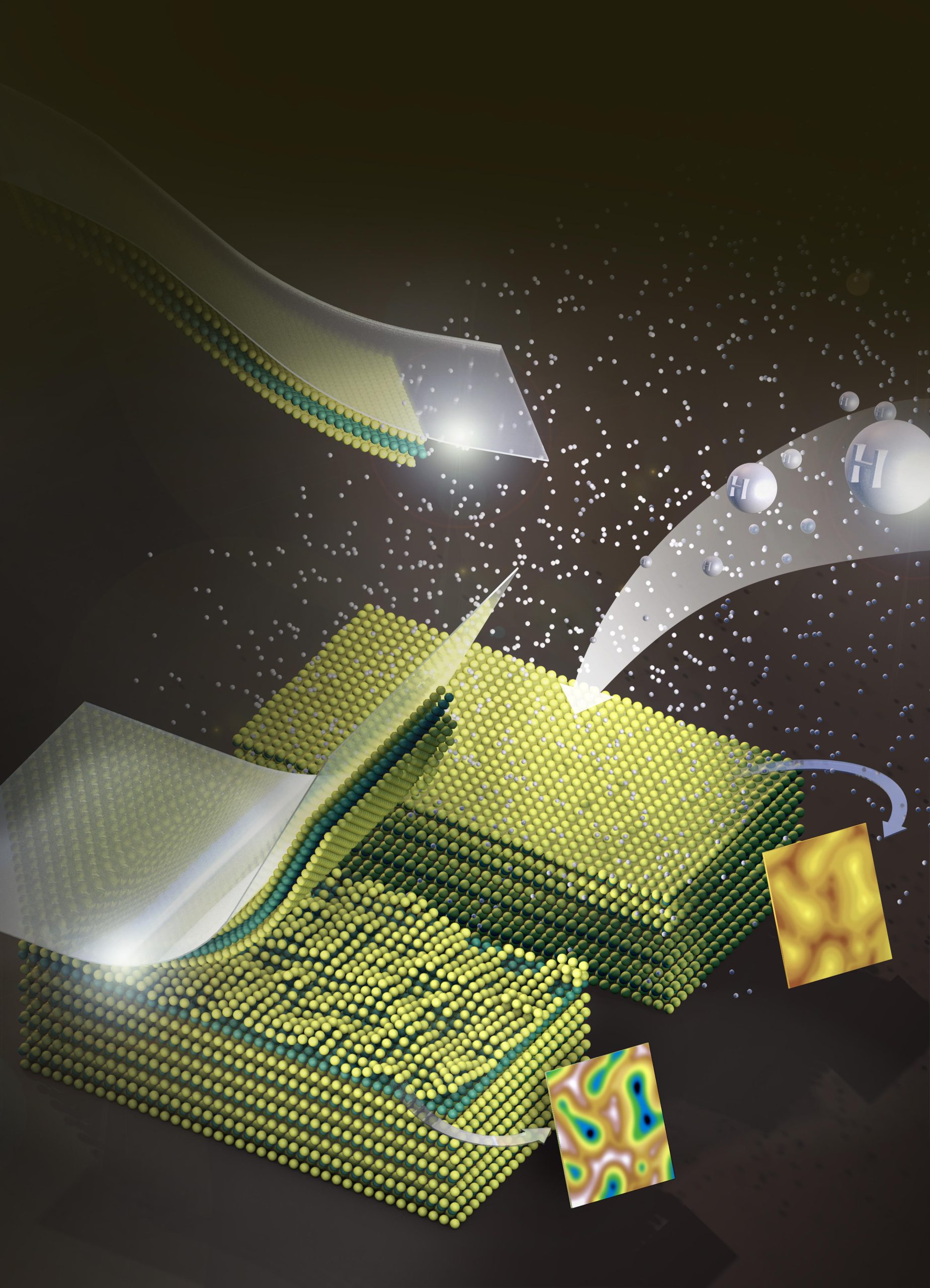
    The illustration shows the MoS2 lattice structure (green: Mo, yellow: S). The material after cleaving is shown in the forefront, the surface is jagged, and the measured surface electronic structure is inhomogeneous (coloured map). In the back is the cleaved material after exposure to atomic hydrogen (represented by the white balls). The measured surface electronic structure, shown in the map, is more homogenous. Credit: Martin Künsting / HZB

    Molybdenum disulfide (MoS₂) is an extremely adaptable substance with applications ranging from gas sensing to serving as a photocatalyst in the production of green hydrogen. Typically, the study of a material begins with its bulk crystalline form. However, in the case of MoS₂, the focus has been more on exploring its mono and few-layer nanosheets.

    The few studies conducted thus far show diverse and irreproducible results for the electronic properties of cleaved bulk MoS₂ surfaces, highlighting the need for a more systematic study, which has been done now at the light source BESSY II.

    Systematic Study at BESSY II

    Dr. Erika Giangrisostomi and her team at HZB carried such a systematic study at the LowDosePES end-station of the BESSY II light source. They utilized X-ray photoelectron spectroscopy technique to map the core-level electron energies across extensive surface areas of MoS2 samples.

    Using this method, they were able to monitor the changes in the surface electronic properties after in-situ ultra-high-vacuum cleaving, annealing, and exposure to atomic and molecular hydrogen.

    Key Findings and Implications

    The results from this study point to two main findings. Firstly, the study unambiguously reveals sizeable variations and instabilities in electron energies for the freshly cleaved surfaces, demonstrating how easy it is to come to diverse and irreproducible outcomes.

    Secondly, the study shows that room-temperature atomic hydrogen treatment is remarkably effective in neutralizing the surface electronic inhomogeneity and instability. This is rationalized by the ability of hydrogen atoms to either accept or give away an electron and calls for further characterizations of the functional properties of the hydrogenated material.

    “We hypothesize that atomic hydrogen helps to rearrange sulfur vacancies and excess of sulfur atoms yielding a more ordered structure”. Erika Giangrisostomi says.

    This study marks a fundamental step in the investigation of MoS2. Due to the extensive use of MoS2 in all kinds of applications, the findings of this research have the potential to reach a wide audience in the fields of electronics, photonics, sensors, and catalysis.

    Reference: “Inhomogeneity of Cleaved Bulk MoS2 and Compensation of Its Charge Imbalances by Room-Temperature Hydrogen Treatment” by Erika Giangrisostomi, Ruslan Ovsyannikov, Robert Haverkamp, Nomi L. A. N. Sorgenfrei, Stefan Neppl, Hikmet Sezen, Fredrik O. L. Johansson, Svante Svensson and Alexander Föhlisch, 31 August 2023, Advanced Materials Interfaces.
    DOI: 10.1002/admi.202300392


    [ad_2]

    Source link