In a milestone moment on the journey to deliver the UK’s first prototype fusion energy plant, leadership of the STEP (Spherical Tokamak for Energy Production) programme today transitions to UK Industrial Fusion Solutions Ltd (UKIFS).
UKIFS is a wholly owned subsidiary of the UK Atomic Energy Authority (UKAEA) Group. It was established to lead a public-private partnership to design, build, and operate the STEP prototype plant at the West Burton site in Nottinghamshire.
UKAEA will continue to be STEP’s fusion partner, working alongside two industry partners – one in engineering and one in construction – to spearhead the development of a UK-led fusion industry.
Selecting long-term partners for the STEP programme
A major procurement exercise is currently underway to select strategic, long-term industry partners for the STEP programme, with the shortlist expected to be announced by the end of the year.
Paul Methven, CEO of UK Industrial Fusion Solutions and Senior Responsible Owner for STEP, said: “The launch of UK Industrial Fusion Solutions demonstrates significant progress and commitment to developing fusion as a viable clean energy source and also to creating a UK-led fusion industry.
“The STEP programme is a national endeavour with global impact, and we will continue to work closely with public and private sector partners to ensure the UK remains at the forefront of a revolutionary sustainable new energy source that will drive economic growth.”
Paving the way for commercial fusion energy in the UK
The STEP programme aims to pave the way for the commercial viability of fusion by demonstrating net energy, fuel self-sufficiency and a viable route to plant maintenance.
The programme’s holistic approach was recently published in a special edition of the Royal Society Journal, Philosophical Transactions A.
“UKIFS brings together an experienced team dedicated to translating decades of fusion research into a functioning prototype plant that will be capable of supplying low-carbon, safe, and sustainable energy to the grid,” explained Professor Sir Ian Chapman, CEO of UKAEA Group.
“UKIFS will integrate partners in a national endeavour to build STEP as well as focussing on delivering enormous social and economic benefits to the UK, especially for the East Midlands region where the plant will be built.”
The West Burton site in Nottinghamshire was chosen as the home for STEP due to its infrastructure, proximity to skilled workforces, and community support for innovative energy solutions.
For the latest updates about UK Industrial Fusion Solutions and the STEP programme, visit the newly launched website.
The passive design philosophy used in small modular reactors can create a safer, more economical future for nuclear power – but proof is essential!
Energy production lies at the foundation of modern society. By powering industries and technologies that have dramatically increased worker productivity, much of the world has achieved a higher quality of life in the present day than at any other time in human history. The cost, however, will be steep: The vast majority of energy has been produced by burning various fossil fuels such as coal, oil, and natural gas, releasing immense quantities of carbon dioxide into the atmosphere, as well as a plethora of carcinogenic and asthma-inducing substances. The direct health impact of the latter notwithstanding is that carbon dioxide acts as a greenhouse gas, trapping the energy of solar radiation and warming the atmosphere.
This process, referred to as global warming, represents an existential threat to the majority of life on our planet – ourselves and our way of life included. That carbon dioxide acts as a greenhouse gas, that the release of carbon dioxide by human industrial activity has induced global warming, and the general catastrophic implications of global warming for life on Earth are a matter of virtually unanimous consent by the scientific community.¹
Small modular reactors: An innovative solution?
In an effort to halt additional damage to the environment and with an eye to improving energy security, many nations are rapidly researching and adopting carbon-neutral energy policies. This has led to a renewed interest in nuclear technologies, manifesting in research spanning the entire spectrum of the field, from advanced Generation-IV reactor designs to accident-tolerant fuels and closed-fuel cycles.
A common thread of this resurgence, however, is a trend towards smaller designs, which, it is hoped, will overcome the difficulties faced by the nuclear industry in commissioning new plants. Project C1 within ANItA, a Swedish national competency centre for nuclear power technology, seeks to expand knowledge surrounding the safety of such smaller designs, termed small modular reactors (SMRs).
SMRs, defined broadly by the IAEA as reactors with power capacities up to 300 MWe that can be factory fabricated and transported as modules², offer several distinct advantages over their larger counterparts.
Firstly, large reactors are not a realistic option for many localities; by reducing the size and cost, SMRs provide flexibility, allowing for the introduction of nuclear power to regions that do not need the immense output of large reactors. Next, SMRs generally enjoy much simplified designs thanks to their smaller, more easily cooled cores; this, combined with their factory fabrication, can reduce construction times.
Finally, these factors combined can help reduce their cost by minimising interest payments and time without revenue, mitigating the reduced economy of scales inherent to using a smaller design. Whether these factors will make SMRs competitive with large reactors will likely depend on the region of interest and the ability of the manufacturers to scale production.³
The focus of ANItA Project C1, however, centres on the fact that their smaller energy output allows for the shutdown core to be cooled entirely using passive systems which rely on natural circulation. This is in contrast to most Generation III and older plants, which rely on active systems (e.g., pumps) to remove decay heat from the core after the reactor is shut down.
While some large, Generation III+ designs adopt the use of passive cooling systems (see the AP1000 and ESBWR), the inclusion of passive systems is practically universal among light water SMR concepts.²
It is typically believed that this design philosophy will further enhance safety,⁴ ensuring that the risk of a severe accident is reduced and justifying changes in plant siting that could enhance the economics of SMRs. This includes co-siting many reactors adjacent to one another or locating plants closer to population centres for the purpose of district heating and producing clean water through desalination.
However, this will require new regulations and licensing practices adopted for SMRs, necessitating rigorous scientific evidence backing up the claims of enhanced safety. Evaluating such evidence is one goal of ANItA, with research in this project being conducted at the Royal Institute of Technology in Stockholm, in collaboration with Vattenfall, Westinghouse, and the rest of the ANItA competency centre. On this basis, a discussion about passive systems and natural circulation is warranted.
Passively safe through natural circulation
A passive system is defined by the IAEA as either a system which is composed entirely of passive components and structures, or a system which uses active components in a very limited way to initiate subsequent passive operation.⁴ While conceptual SMR designs utilise a number of different passive features to improve safety, such as accident-tolerant fuels, virtually all light water SMR designs utilise natural circulation in some fashion as a passive mechanism to accomplish their safety objectives.
Because passive systems do not rely on an active power source, they are generally considered more reliable than their active counterparts. However, the methods with which the reliability of a system is most often evaluated, e.g., using fault tree analysis with historical data for failure rates of active system components, can be difficult to apply to passive systems.
First, there is no such set of historical data to turn to for assessing the failure rate of some passive functions. Second, what constitutes passive system failure may not be as well defined, as a passive mechanism may operate between what is traditionally defined as success or failure. Third and finally, the applicability of current reactor system codes to model passive systems for the purpose of safety analysis and licensing is still an open question.⁵
These points readily apply when considering the natural circulation-driven cooling systems used for the core and containment of many SMR designs, which operate on the principle of buoyancy-driven flow. Plainly speaking, hotter water and steam are less dense and so will tend to flow up, whereas colder water is more dense and will tend to flow down; therefore, by placing the heat sink (e.g., a heat exchanger which will transfer heat to the atmosphere) above the heat source (e.g., the reactor core, or another heat exchanger if the system is to cool the containment), we can ensure flow from the latter to the former, accomplishing the function of a pump without an external source of power.⁶
Thus, while there are component failure rates for parts of the system crucial for establishing system flow, such as valves that must be opened or heat exchangers which cannot be obstructed, natural circulation itself does not have a traditional ‘failure rate.’
Additionally, even if sufficient flow is not established during a casualty to prevent damage to the plant, some limited flow may still exist, which can slow down accident progression, give additional time for accident management, and limit damage to the plant. Finally, while system codes are capable of simulating natural circulation, the results are generally less accurate compared to models for forced circulation systems.
While these concerns are themselves legitimate, one may nonetheless ask, ‘Why does this matter? If flow by natural circulation is guaranteed, why bother assigning a failure rate, and what difference do slight modelling errors make?’ A possible concern regarding natural circulation is its susceptibility to flow instabilities, especially at lower system pressures; essentially, the flow rate can oscillate, or even reverse, in a chaotic fashion.⁷
Further, these oscillations may occur as a result of variations in a large number of system parameters, many of which will be different depending on when the associated system is needed. Assessing the impact these oscillations can have on the safety function of a natural circulation system will be necessary for their widespread adoption.
Ongoing research
Resolving these overlapping challenges will require a multifaceted approach. To briefly summarise the research goals of ANItA project C1:
Validate system codes
By simulating thermal-hydraulic experiments and tests conducted on operational nuclear power plants with deterministic codes used in safety analysis, we can improve the models and assess uncertainties of predicted natural circulation flow rates and heat removal efficiency in order to realise sufficient safety margins in SMR designs that rely on natural circulation.
Assess the reliability of natural circulation systems With a level of confidence established in our codes, we can model safety systems driven by natural circulation and evaluate their reliability. This can be achieved through various methods, such as conducting multiple simulations while varying system parameters that carry some uncertainty – like confidence intervals related to material property measurements. Using statistical methods and probabilistic safety codes, we can estimate the probability of system failure while also testing the design’s robustness.
Analyse a generalised boiling water SMR
In addition to only modelling a passive safety system, it would be enlightening to evaluate an entire SMR design to compare their safety to their larger counterparts. In this case, a boiling water reactor would be most interesting, as newer designs – such as the ESBWR and BWRX-300, both by GE Hitachi – utilises natural circulation in lieu of recirculation pumps to drive flow through the core during normal operation. Testing the stability and load-following characteristics of such systems, as well as performing a full safety analysis, would provide both academic and industrial value.
Compiling the results of this research will provide designers, regulators, policymakers, and researchers in adjacent fields with the necessary context to form an educated opinion on the reliability of natural circulation-based passive safety systems. It is hoped that this work will form a foundation for improving light water reactor safety and facilitate an efficient and timely implementation of new nuclear power within Sweden.
B Mignacca and G Locatelli, “Economics and finance of Small Modular Reactors: A systematic review and research agenda,” Renewable and Sustainable Energy Reviews, vol. 118, p. 109519, Feb. 2020, doi: 10.1016/j.rser.2019.109519.
L Burgazzi, “Addressing the challenges posed by advanced reactor passive safety system performance assessment,” Nuclear Engineering and Design, vol. 241, pp. 1834–1841, 2011, doi: 10.1016/j.nucengdes.2011.02.002.
U Rohatgi and R Duffey, “Natural circulation and stability limits in advanced plants: The Galilean law,” presented at the International conference on nuclear systems thermal hydraulics, United States, Jun. 1994. [Online]. Available: https://www.osti.gov/biblio/10137311
Please note, this article will also appear in the 20th edition of our quarterly publication.
The Palisades Nuclear Plant in Covert Township, Michigan, is poised for a groundbreaking revival, thanks to $2.8bn funding from the US Government.
The Department of Energy (DOE) and Department of Agriculture (USDA) are spearheading this effort to ensure reliable, affordable, and clean energy for the Midwest. The project will bring the Palisades Nuclear Plant back online, marking the first recommissioning of a decommissioned nuclear facility in US history.
A key component of this initiative is a $1.52bn loan guarantee provided by the DOE’s Loan Programs Office under the Inflation Reduction Act’s Energy Infrastructure Reinvestment (EIR) program.
This funding will support the restoration of the Palisades Nuclear Plant, which has been offline since May 2022.
Once operational, the 800-MW plant will produce clean, carbon-free energy for decades, reinforcing the nation’s commitment to the nuclear energy sector and the broader goal of reducing greenhouse gas emissions.
With the plant’s anticipated operational extension until 2051, subject to approval from the Nuclear Regulatory Commission (NRC), the Palisades facility will help meet America’s growing energy demands while reducing its reliance on fossil fuels.
White House National Climate Advisor Ali Zaidi commented: “From day one, President Biden and Vice President Harris have taken historic steps to keep existing nuclear plants from shutting down, restart previously shuttered nuclear plants, and bring new reactors online.
“The results are visible across the country – more clean power and more union jobs. It’s a powerful clean energy comeback story that represents a chance to build our manufacturing capacity and rebuild our middle class.
“This announcement – which will catalyse the first recommissioning of a nuclear power plant in US history – creates hundreds of long-term union jobs, supports workforce development, and feeds our nation’s energy demand while reducing emissions.”
Investment in rural clean energy
In conjunction with the DOE’s efforts, the USDA has allocated over $1.3bn through the Empowering Rural America (New ERA) program to enhance rural energy infrastructure.
Wolverine Power Cooperative and Hoosier Energy, two rural electric cooperatives, will benefit from this funding, using clean energy from the Palisades Nuclear Plant to lower electricity costs for rural communities in Michigan, Illinois, and Indiana.
Wolverine Power Cooperative will receive more than $650m in New ERA financing, while Hoosier Energy will gain over $675m.
These funds will support the purchase of carbon-free energy from Palisades and other clean energy sources, contributing to lower energy costs and a reduction in carbon emissions for their customers.
The investment is expected to save Hoosier Energy members around $35m annually while also supporting job creation and community programmes.
The Palisades Nuclear Plant will boost job creation
An additional 1,000 jobs will be supported during routine maintenance and refuelling cycles every 18 months.
From an environmental perspective, the Palisades plant’s restart is projected to eliminate 4.47 million metric tonnes of greenhouse gas emissions annually, equivalent to the yearly emissions of about 882,000 homes.
Over the next 25 years, this will prevent approximately 111 million metric tonnes of emissions, making a significant impact in the fight against climate change.
The Palisades Nuclear Plant will play a crucial role in the Midcontinent Independent System Operator’s (MISO) energy mix, particularly as coal plants are phased out.
With long-term power agreements already in place, Wolverine Power Cooperative and Hoosier Energy are on track to provide 100% carbon-free energy by 2030, enabling rural communities to transition to cleaner energy sources and lower their carbon footprints.
The investment will pass savings directly to rural households and businesses, helping to keep electricity costs low while improving energy efficiency and supporting local communities through various programmes.
The revival of the Palisades Nuclear Plant marks a major milestone in America’s clean energy journey, supporting both the nation’s climate goals and economic growth.
The Roadmaps to New Nuclear 2024 conference, held on 19-20 September in Paris, saw government officials and industry leaders gather to discuss the expansion of nuclear energy.
Hosted by the Nuclear Energy Agency (NEA) and Sweden’s Ministry of Climate and Enterprise, the event aimed to identify practical solutions to scale up nuclear projects, enhance energy security, and promote economic growth.
Representatives from 21 nations reaffirmed their commitment to leveraging nuclear technology as a vital tool in the fight against climate change.
Nuclear energy: A critical path to net zero
At the heart of the discussions was the challenge of achieving net zero carbon emissions through nuclear energy expansion.
With the global demand for clean energy growing, the conference participants underscored the urgency of speeding up nuclear developments. A joint communiqué from the attending energy ministers stressed the need to triple nuclear energy capacity worldwide by 2050.
“Recognising the urgency of the climate crisis and the need for enhanced energy security, we underscore the strategic importance of nuclear energy in achieving a clean, sustainable, climate-neutral future,” the ministers stated.
Their commitment reflected the growing global consensus that nuclear energy is key to both decarbonisation and energy independence.
Collaboration and commitment to nuclear growth
The conference focused on practical steps to accelerate nuclear energy expansion, including the construction of new reactors and the extension of the lifespan of existing ones.
Small modular reactors (SMRs) also featured prominently, with delegates highlighting the need to expedite their deployment. SMRs are seen as a game-changer in the nuclear sector due to their flexibility and lower upfront costs.
International cooperation was a major theme throughout the event. Regulatory bodies, including the NEA Committee on Nuclear Regulatory Activities (CNRA), called for stronger collaboration between countries to streamline safety regulations and ensure efficient and safe development of nuclear power.
The regulators emphasised the need for an efficient framework that promotes the peaceful use of nuclear energy while maintaining high safety standards.
Overcoming workforce and financing challenges
One of the key barriers to nuclear energy expansion is the need for a skilled workforce. To meet the demands of a growing nuclear sector, ministers acknowledged the importance of training a new, diverse generation of professionals.
In parallel, supply chain resilience was identified as critical for the success of new nuclear technologies like SMRs.
Financing was another significant focus, with participants exploring strategies to attract both public and private investment.
International financial institutions and multilateral development banks were seen as potential partners in unlocking climate financing for nuclear projects.
Sweden’s Deputy Prime Minister, Ebba Busch, emphasised her country’s commitment to nuclear growth, revealing plans to add 2.5 GW of new nuclear capacity by 2035.
The future of nuclear energy expansion
The conference concluded with a call for sustained international efforts to expand nuclear energy. The next edition of the Roadmaps to New Nuclear conference, to be co-chaired by the Government of Korea in 2025, will continue to focus on collaborative solutions for nuclear energy expansion.
William Magwood, IV, Director-General of the NEA, highlighted the urgency of acting now to meet the world’s rising energy needs and address climate change. “This is exactly the right time to deal with these issues. We have to take action now,” he said, reinforcing the collective determination to advance nuclear energy as a key solution to the climate and energy crises.
As the global community moves towards a low-carbon future, nuclear energy expansion will remain central to ensuring sustainable, secure, and reliable energy for all.
Constellation Energy has announced a 20-year power purchase agreement with Microsoft to power the tech giant’s AI endeavours with carbon-free energy.
This agreement will support the relaunch of the Three Mile Island nuclear plant, specifically Unit 1, which was shut down five years ago due to economic challenges.
The plant will be rebranded as the Crane Clean Energy Center (CCEC) and is expected to play a pivotal role in providing reliable, clean energy to power Microsoft’s data centres and contribute to the energy grid.
A historic comeback for the Three Mile Island nuclear plant
The Three Mile Island nuclear plant, once considered one of the safest and most reliable energy producers in the US, is set to return to service.
Unit 1 of the plant, which was originally retired in 2019, will undergo extensive renovations as part of the CCEC project.
The plant’s return comes after Microsoft committed to purchasing energy from the facility as part of its larger goal to match its data centre operations with carbon-free power sources.
Microsoft’s Vice President of Energy, Bobby Hollis, highlighted the importance of this agreement in advancing Microsoft’s decarbonisation strategy.
“This agreement is a major milestone in Microsoft’s efforts to help decarbonise the grid in support of our commitment to become carbon negative,” Hollis said.
The revived Three Mile Island Unit 1 will be renamed the Crane Clean Energy Center, honouring Chris Crane, the former CEO of Constellation’s parent company.
Crane, who passed away in April 2024, was a staunch advocate for nuclear energy and played a pivotal role in shaping the industry.
During his career, he helped build critical organisations like the Institute for Nuclear Power Operations (INPO) and served on the boards of the Nuclear Energy Institute (NEI) and the World Association of Nuclear Operators (WANO).
Major investments in upgrades
Restarting the Three Mile Island nuclear plant is no small feat. Constellation plans to make major investments in the plant’s infrastructure, including upgrades to the turbine, generator, main power transformer, and cooling systems.
Before the facility can return to operation, it must undergo comprehensive safety and environmental reviews by the U.S. Nuclear Regulatory Commission, as well as receive necessary state and local permits.
Constellation also aims to extend the plant’s operational license until at least 2054, ensuring the plant’s contribution to Pennsylvania’s energy grid for decades to come.
The plant is scheduled to be fully operational by 2028, providing over 800 megawatts of carbon-free electricity to the grid.
Economic and environmental benefits for Pennsylvania
The revitalisation of the Three Mile Island nuclear plant is expected to bring substantial economic benefits to Pennsylvania.
In addition, the project is expected to create 3,400 direct and indirect jobs, providing a major boost to the local economy.
Rob Bair, President of the Pennsylvania State Building and Construction Trades Council, emphasised the long-term impact of the CCEC: “The CCEC will support thousands of family-sustaining jobs for decades to come.
“It will help make Pennsylvania a leader in attracting and retaining the types of reliable, clean energy jobs that will define the future.”
Strong public support for nuclear energy
Public opinion in Pennsylvania is overwhelmingly in favour of restarting the Three Mile Island nuclear plant.
A recent poll conducted by Susquehanna Polling & Research found that state residents support the plant’s reopening by a 2-to-1 margin.
The poll also revealed that 70% of Pennsylvanians back the continued use of nuclear energy as a source of reliable, carbon-free power.
The renewed interest in nuclear energy is not limited to Pennsylvania. Globally, nations are increasingly looking to nuclear power as a key component in their efforts to transition to cleaner energy sources and combat climate change.
Nuclear energy is unique in its ability to provide consistent, carbon-free power 24/7, regardless of weather conditions, making it an essential part of the global energy transition.
A new era for Three Mile Island
The restart of the Three Mile Island nuclear plant marks a new chapter in Pennsylvania’s energy landscape.
With the backing of Microsoft and the commitment of Constellation Energy, the Crane Clean Energy Center is set to become a cornerstone of the state’s clean energy future.
By 2028, this historic facility will once again generate reliable, carbon-free electricity, contributing to both economic growth and environmental sustainability.
As the world moves toward a more electrified and digital economy, the role of nuclear energy in powering data centres, industries, and homes will continue to grow.
The International Atomic Energy Agency (IAEA) has raised its projections for nuclear power growth for the fourth consecutive year.
With the global shift towards sustainable energy, nuclear energy capacity is now expected to increase 2.5 times by 2050 compared to current levels.
This surge will be driven in part by the rising importance of small modular reactors (SMRs), a technology that has captured global attention for its potential to aid both electrification and broader environmental goals.
What are small modular reactors?
Small modular reactors are a new generation of nuclear reactors designed to be more compact and versatile than traditional large-scale nuclear plants.
Their smaller size allows them to be built in factories and transported to sites, significantly reducing construction time and costs.
SMRs typically produce less than 300 megawatts of electricity (MWe) per unit, compared to the 1,000 MWe or more that large reactors generate.
SMRs are particularly appealing for countries or regions with smaller grids, limited space, or less demand for power.
They offer flexibility in deployment, making them suitable for remote areas, industrial sites, or even replacing fossil fuel plants.
Furthermore, small modular reactors are considered safer due to their innovative designs, which often feature passive safety systems that automatically shut down the reactor in case of an emergency.
Beyond electricity generation, SMRs have the potential for non-electric applications such as desalination, hydrogen production, and district heating, making them a versatile solution for various energy needs.
At COP28 in Dubai, nuclear power featured prominently for the first time in the Global Stocktake, a landmark move that underscored the role of low-emission technologies, including nuclear, in achieving rapid decarbonization.
At the 68th IAEA General Conference, held in Vienna, IAEA Director General Rafael Mariano Grossi emphasised the momentum behind nuclear energy, particularly small modular reactors, as countries aim to meet climate targets while ensuring a reliable energy supply.
“The new IAEA projections reflect increasing acknowledgement of nuclear power as a clean and secure energy supply, as well as increasing interest in SMRs to target both electric and non-electric applications to meet climate goals,” Grossi said.
Nuclear capacity to more than double by 2050
Currently, 413 nuclear reactors operate worldwide, with a combined capacity of 371.5 gigawatts (GW).
By 2050, the IAEA’s high-case scenario envisions a global nuclear capacity of 950 GW, more than doubling today’s output.
Even in the low-case scenario, capacity is expected to rise by 40% to 514 GW. Notably, SMRs are anticipated to contribute significantly to this growth, accounting for around a quarter of the added capacity in the high-case scenario.
The projections take into account several factors, including lifetime extensions for existing reactors, new construction projects, and potential reactor shutdowns.
Around 30 countries, many of which are newcomers to nuclear power, are currently exploring options for incorporating nuclear energy into their mix.
Key factors for success
Despite the promising outlook, the IAEA report outlines several enabling factors that are critical to achieving the projected growth.
These include national policies that support nuclear development, increased financing opportunities, a skilled workforce, and international regulatory harmonisation, particularly for SMRs.
Demonstration projects, investment in grid infrastructure, and supply chain management are also highlighted as essential components for scaling up nuclear energy.
Next month, the IAEA will host the International Conference on SMRs and their Applications, bringing together stakeholders from across the nuclear sector to discuss how to accelerate the safe and secure deployment of SMRs globally.
As the world faces increasing pressure to reduce emissions and secure a stable energy supply, nuclear power, with a significant contribution from small modular reactors, is poised to play a crucial role.
With the right policies and investments in place, SMRs could be key to unlocking the full potential of nuclear power in the coming decades.
The UK nuclear industry has played a pivotal role in shaping modern Britain, from powering homes with low-carbon energy to bolstering national defence.
To honour this legacy, the Nuclear Decommissioning Authority (NDA) has launched its first-ever heritage vision and strategy, designed to preserve and celebrate the rich cultural and historical contributions of the UK nuclear industry.
UK nuclear industry: A legacy of innovation
Since the 1950s, the UK has been a global pioneer in nuclear technologies, creating both energy solutions and strategic defence programmes.
From the early days of nuclear power development to the decommissioning of legacy nuclear sites, the industry has been a cornerstone of British scientific and industrial progress.
The NDA, which is responsible for decommissioning the UK’s legacy nuclear facilities, has now expanded its role to ensure that the history of the UK nuclear industry is preserved for future generations.
Simon Tucker, Managing Director of NDA Archives Limited, emphasised the significance of this new initiative: “It’s a real privilege to be tasked with preserving and showcasing the origins of the civil nuclear industry.
“Capturing the legacy of the nuclear industry will enrich the NDA mission and help us to deliver our outcomes more effectively.”
Heritage strategy overview
The newly published heritage vision and strategy aims to safeguard both tangible and intangible assets associated with the UK nuclear industry.
This includes physical objects, such as equipment and documents, as well as memories and stories from the people and communities that were integral to the industry’s development.
The strategy has been developed in collaboration with heritage experts from within the NDA group and external heritage organisations. It outlines the governance processes required to ensure effective implementation, focusing on three key areas:
Preserving history: Ensuring that historical assets, such as documents, tools, and machinery, are archived for future study.
Community engagement: Connecting with local communities to share the industry’s history, fostering a sense of pride and ownership.
Digital accessibility: Leveraging modern technology to digitise archives and make them more accessible to the public and researchers.
One of the most exciting aspects of the strategy is the use of digital platforms to increase accessibility.
By digitising records and collections, the NDA will make it easier for both the public and researchers to explore the rich history of the UK nuclear industry.
Educational and community initiatives
The heritage strategy is not just about preserving physical artefacts; it also aims to educate and engage future generations.
For example, the NDA and Sellafield have developed a history workshop tailored for local schools. This initiative supports the Cold War module in the current GCSE syllabus, using documents from the Sellafield archive to illustrate the nuclear industry’s role in this pivotal period of world history.
Such educational initiatives highlight how the heritage vision connects the past with the present. By integrating historical lessons into contemporary education, the NDA is ensuring that the UK nuclear industry’s contributions to global history are recognised and remembered.
Nucleus: The Center of Nuclear Heritage
A key part of the strategy is the role of Nucleus, the Nuclear and Caithness Archives located in Wick, Scotland.
Nucleus serves as the central hub for storing and preserving nuclear records from across the UK. With this new heritage strategy in place, Nucleus will expand its collection, becoming an even more vital resource for historians, researchers, and the public.
The archives not only store historical records but also serve as a focal point for showcasing the heritage of the UK nuclear industry.
From early innovations in nuclear technology to today’s decommissioning efforts, Nucleus will be the primary custodian of the industry’s legacy.
The importance of preserving nuclear heritage
The UK nuclear industry has made profound contributions to both national and global progress. By preserving this history, the NDA is not only honouring the work of past generations but also ensuring that valuable lessons are carried forward.
These lessons will help guide future nuclear developments, particularly as the world shifts towards cleaner, more sustainable energy sources.
In a time when the UK is striving to meet its carbon reduction goals, commemorating the role of nuclear power in providing low-carbon energy is essential.
The heritage strategy thus serves as both a historical archive and a forward-looking initiative, ensuring that the lessons, challenges, and triumphs of the UK nuclear industry are not forgotten.
Through education, community engagement, and the use of technology, the NDA is not only preserving the past but also shaping the future of the UK nuclear industry.
Tim Parkes and Karen Garesse detail how the Office for Nuclear Regulation is responding to the UK government’s challenge for all regulators to consider how processes can be streamlined to support effective nuclear power expansion.
Following the January 2024 launch of the government’s Civil Nuclear Roadmap as part of its energy security and net zero plans, we stand ready to independently regulate the country’s anticipated growing nuclear sector.
The UK has a widely respected regulatory system and we have been preparing for the expansion of nuclear for some time.
Throughout our work on the Advanced Nuclear Technologies (ANT) programme, we have: • Developed our capability and capacity to regulate light water small modular reactors (SMRs) and the next generation of advanced modular reactors (AMRs); • Reviewed our guidance and processes to ensure they are fully compatible with the regulation of SMRs. • Advised the Department for Energy Security and Net Zero (DESNZ) on its AMR Research, Development and Demonstration (RD&D) programme. • Engaged with regulators internationally, including participation in International Atomic Energy Agency and Nuclear Energy Agency forums. • Provided regulatory advice to vendors. • Streamlined the Generic Design Assessment (GDA) process and provided greater clarity on options for design assessment. • Considered how to streamline our licensing process. • Developed a new early engagement process.
We responded to the challenge set by the UK government’s Energy Security Strategy for all regulators to consider how their processes can be accelerated.
To maximise potential for this, ONR is continuing to innovate how we engage with vendors, developers, aspirant licensees and international regulators.
Mark Foy (right), ONR’s Chief Nuclear Inspector, signs a Memorandum of Cooperation between ONR, the Canadian Nuclear Safety Commission (CNSC) and the United States Nuclear Regulatory Commission (NRC)
Two significant milestones that we achieved earlier this year are:
• The launch of the joint ONR and Environment Agency Early Engagement process1 for organisations wishing to deploy nuclear reactor technology. • Signing a trilateral Memorandum of Cooperation between the UK’s Office for Nuclear Regulation (ONR), Canadian Nuclear Safety Commission (CNSC) and US Nuclear Regulatory Commission (NRC).2
Early engagement
Early engagement is a voluntary process which is available to any party requesting early regulatory engagement on a proposed nuclear reactor deployment in Great Britain – including reactor technology vendors, developers, or aspirant licence/permit holders (or a consortia of these).
Launching the early engagement process enabled us to meet a key part of the government’s civil nuclear roadmap to 2050, delivering our commitment to enabling regulation and supporting innovation.
Early engagement is designed to be flexible and to help applicants develop their understanding of regulatory processes and expectations when projects are at an early stage.
It is not a prerequisite for subsequent formal processes, but it does yield benefits in enabling readiness for those processes.
It aims to: • Facilitate access to regulators as early as possible, before undertaking more formal processes, so that organisations can benefit from early advice and guidance. • Gain early confidence in the potential for new nuclear projects to meet regulatory expectations, so that we can make informed decisions on the deployment of regulatory resource.
How does early engagement work?
There are three approaches, or tiers, to the early engagement process:
One-day engagement
This is a single event for regulators to set out the UK regulatory framework and explain the available pathways, highlight early and major risks, and define information requirements and key hold points for each stage. It is also an opportunity for applicants to set out their proposals for deployment of reactor technology in Great Britain.
The information provided during the one-day engagement will inform our decision on whether the organisation is ready to progress to the subsequent tiers of early engagement, and on what timescales.
Regulatory process and technical engagements
This comprises a series of up to ten structured engagements on a range of topics to be agreed between the applicant and the regulators, based on technical risk, building on the one-day engagement and explaining in much greater detail the specific matters of interest.
The objective of the structured technical engagements is for regulators to gain a greater understanding of the applicant’s proposals, and to provide advice on regulatory expectations for the agreed topics.
Preliminary design review
The preliminary design review consists of a technical review of up to six regulatory submissions on specific topics agreed between the regulators and the technology vendor.
The objective is for regulators to provide advice and guidance to technology vendors on specific aspects of their designs, to identify any potentially significant shortfalls against regulatory expectations while designs are in the early stages of development, and to agree how any shortfalls might be addressed as the design matures.
At the end of the preliminary design review, the regulators will produce a summary report. This will set out the advice provided in relation to each submission and will provide an indication of the regulators’ confidence that expectations can be met should the design be taken forward into subsequent regulatory processes.
Early Engagement Case Study – Regulatory Support to Advanced Modular Reactor Research, Development & Demonstration: Phase B
ONR has been engaging with organisations who have indicated their hope to deploy nuclear reactor technology in the UK.
For example, ONR and the Environment Agency are working jointly to carry out a focused programme of work to support the development of the projects in Phase B of the AMR RD&D programme.
In AMR RD&D Phase B, the Department for Energy Security and Net Zero is providing development funding for two high temperature gas reactor (HTGR) designs to undertake FEED+ (Front End Engineering Design and supporting activities) studies to help enable deployment of a HTGR demonstrator by the early 2030s.
Phase B is also supporting the development of a programme for manufacture of the advanced fuel required for AMRs, through the UK Coated Particle Fuel (CPF) – Step 1 Programme.
We have been providing regulatory advice and guidance to vendors going through the programme following the preliminary design review process, as described above.
Benefits we are realising through the early engagement with these organisations include:
Improved vendor understanding of regulatory process and routes to deployment. This is allowing vendors to more accurately account for regulatory processes in their deployment plans.
Gaining an understanding of the novel technologies proposed for deployment and operation, and the status of the safety, security and environmental justifications. This has allowed us to develop our processes and guidance to ensure we are ready to regulate effectively and efficiently when technology vendors and prospective developers are ready to proceed through formal regulatory processes.
Vendors are gaining an understanding of key regulatory expectations and requirements for the justifications required by regulators. By receiving regulatory advice and guidance ahead of entering formal regulatory processes, applicants can de-risk later project stages.
Through early engagement, we are gaining an understanding of the maturity and readiness of applicants to progress through the regulatory and legislative framework, which will allow us to effectively prioritise and manage the deployment of regulatory resource.
International regulatory collaboration
There are clear advantages in learning from international experience and considering this as part of regulatory decision making.
We consider the greatest potential for acceleration and streamlining of regulatory processes is offered by greater collaboration with international regulators on reactor design assessment and leveraging of technical assessments undertaken by other regulatory bodies.
When a reactor design has been assessed by an established nuclear regulator in another country, it is likely that aspects of the safety and security cases submitted to the relevant regulator could be used as the basis of submissions to the UK regulators.
If the regulatory evaluations and conclusions on those submissions are available, it is also likely that they could significantly accelerate our ability to reach a conclusion on the adequacy of the design to meet internationally-recognised standards.
The extent to which this is achievable would depend on the similarities and differences between regulatory requirements and expectations in the respective countries.
Ultimately, a future site-specific safety and security case will need to explicitly demonstrate how activities on that site meet applicable UK regulatory requirements.
We are increasingly seeing that reactor vendors are seeking to deploy their technologies in multiple countries and are engaging with regulators in those countries regarding assessment of their designs.
Where a reactor design is undergoing assessment in the UK concurrently with other countries, the assessment activities could potentially be aligned, enabling close collaboration between ourselves and international regulators.
This presents the opportunity for assessments to be ‘shared’ between regulators, thus avoiding the duplication of effort and allowing regulators to establish common positions with regard to the safety and security of new reactor designs
International Collaboration Case Study – Memorandum of Co-operation between ONR, US NRC and CNSC
This MoC between ONR, the US Nuclear Regulatory Commission (NRC) and the Canadian Nuclear Safety Commission (CNSC), was signed at the NRC’s Annual Regulatory Information Conference (RIC) in Maryland, United States.
The agreement signals a partnering approach that will improve both regulatory effectiveness and efficiency, which is essential given the rapid growth in reactor technologies that are seeking regulatory consideration and approval.
It will enable both good practice and experience of reviewing SMR and AMR designs to be shared between regulators, and ensure the efficient use of regulators’ time and resources through a willingness to share technical knowledge and judgements.
This streamlining of regulation maintains safety standards, acting as an exemplar of how regulators can work together in today’s global nuclear sector operating climate.
With multiple Generic Design Assessments for SMRs currently underway in the UK and abroad, the agreement will help realise opportunities for efficiency.
As part of the MoC, we are actively working with both NRC and CNSC to identify opportunities for information exchange and collaboration on our assessments of the GE-Hitachi BWRX-300 and Holtec SMR-300 reactor designs, both of which are currently undergoing GDA.
Current GDA processes
We are currently assessing three reactor designs through the GDA process. Each step gets progressively more detailed as the GDA continues and, as such, the length of steps varies.
We carry out our assessment in three steps, and an indicative timescale for a ‘full’ GDA of three steps is approximately four years.
The first step is about project mobilisation and agreeing the scope. The second step consists of a fundamental review of safety, security and safeguards by ONR and environmental protection by the Environment Agency and Natural Resources Wales.
This would identify if there are any major safety or security shortfalls, meaning a reactor would not meet regulatory expectations in its current design.
For a ‘full’ GDA, vendors will continue to Step 3 which involves a detailed assessment of their design and safety and security cases.
A design acceptance confirmation (DAC) would be issued after the successful completion of a three-step GDA, and only when we have concluded that the design is capable of being safely and securely built and operated in the UK, subject to future site-specific assessment and licensing.
Rolls-Royce SMR Ltd’s 470 MWe Small Modular Reactor (SMR) design successfully completed Step 2 and entered into Step 3 during the summer.
We are the first nuclear regulator to assess this reactor design, determining whether it meets our robust safety, security, safeguards and environmental protection standards in Great Britain.
It is also the first time we have followed the modernised GDA process, looking at an SMR design.
Holtec International’s Small Modular Reactor (SMR) design also completed Step 1 of its GDA in recent months and has entered Step 2, the fundamental assessment of the design which is expected to last for 14 months. This will be the first time we have conducted a GDA ending at Step 2.
In January, we announced that we had started a two-step GDA for GE Hitachi’s BWRX300 reactor following a review from DESNZ.
As detailed above, this GDA is actively looking to explore opportunities to maximise the value of international regulatory collaboration and identify efficiencies in processes.
As published in a recent special Royal Society edition, the UK is leading the way in fusion energy power plant design.
The edition details the technical progress of STEP, a pioneering programme to design and build the UK’s first prototype fusion power plant.
This is the first time a complete snapshot of the design has been captured for publication. It outlines the technologies required for a first-of-a-kind prototype and how they will be integrated into a power plant to produce electricity from fusion.
STEP: Paving the way for commercial fusion power
STEP (‘Spherical Tokamak for Energy Production’) aims to make fusion commercially viable by demonstrating net energy, fuel self-sufficiency, and a viable route to plant maintenance.
By doing so, it stimulates the development of a new industry, positioning the UK at the forefront commercially.
The programme is taking a holistic approach to delivering a fully operational prototype fusion power plant that also considers decommissioning as part of the design.
A tokamak approach was chosen as it is the most advanced way of making fusion happen. A spherical tokamak is more compact than traditional tokamaks, aiming to minimise cost while maximising energy output, potentially making it easier to scale.
STEP will be built at the former coal-fired power station site of West Burton, Nottinghamshire, where characterisation works surveying ground and environment are well underway. First operations are expected in the early 2040s.
What makes STEP different to other programmes?
One key area that makes STEP different to other fusion programmes is the formation of an integrated delivery organisation based on a public-private partnership model that will deliver the prototype fusion power plant. This includes designing for cost and at pace.
Additionally, the STEP programme is currently in the process of selecting potential major industry partners, one in engineering and one in construction, to work alongside STEP’s fusion partner, UKAEA.
The 15 peer-reviewed papers in the STEP edition of Philosophical Transactions A cover themes ranging from design, plasma, maintenance, magnets, and re-mountable joints to net energy, breeding, and fuel self-sufficiency.
Paul Methven, CEO of UK Industrial Fusion Solutions, a subsidiary of UKAEA Group that will be responsible for delivering STEP, said: “STEP is a UK-led national endeavour for the world. It’s about unlocking the potential of cutting-edge science and technology that could revolutionise humanity’s future and, for the UK, secure a leading position in a new strategic technology.
“We don’t yet have all the answers, but we are a trailblazer in fusion powerplant design, built on a solid foundation of decades of innovative and world-leading fusion research at the United Kingdom Atomic Energy Authority (UKAEA).”
The MOSAIC platform at IJCLab in France combines various ion beam equipment into a unique facility for state-of-the-art R&D in ion beam modification, structural and chemical analysis of materials.
The MOSAIC¹ platform is located in two buildings at the Orsay valley campus and is one of the platforms under the leadership of IJCLab (Laboratoire de Physique des 2 Infinis – Irène Joliot-Curie), a research lab supported by Université Paris-Saclay and CNRS (National Centre for Scientific Research, IN2P3 Institute). MOSAIC is labelled as an IN2P3² platform.
A diverse range of scientific fields
MOSAIC is an interdisciplinary research platform open to numerous scientific fields: Materials science, astrochemistry, nuclear astrophysics, nuclear physics, geology, biology, and environmental sciences, to name a few. Applications cover fields as vast as: Nuclear energy (fusion/fission) and renewable energy, micro- and nano-electronics, medical isotope production, materials for accelerators and detectors, space applications, etc.
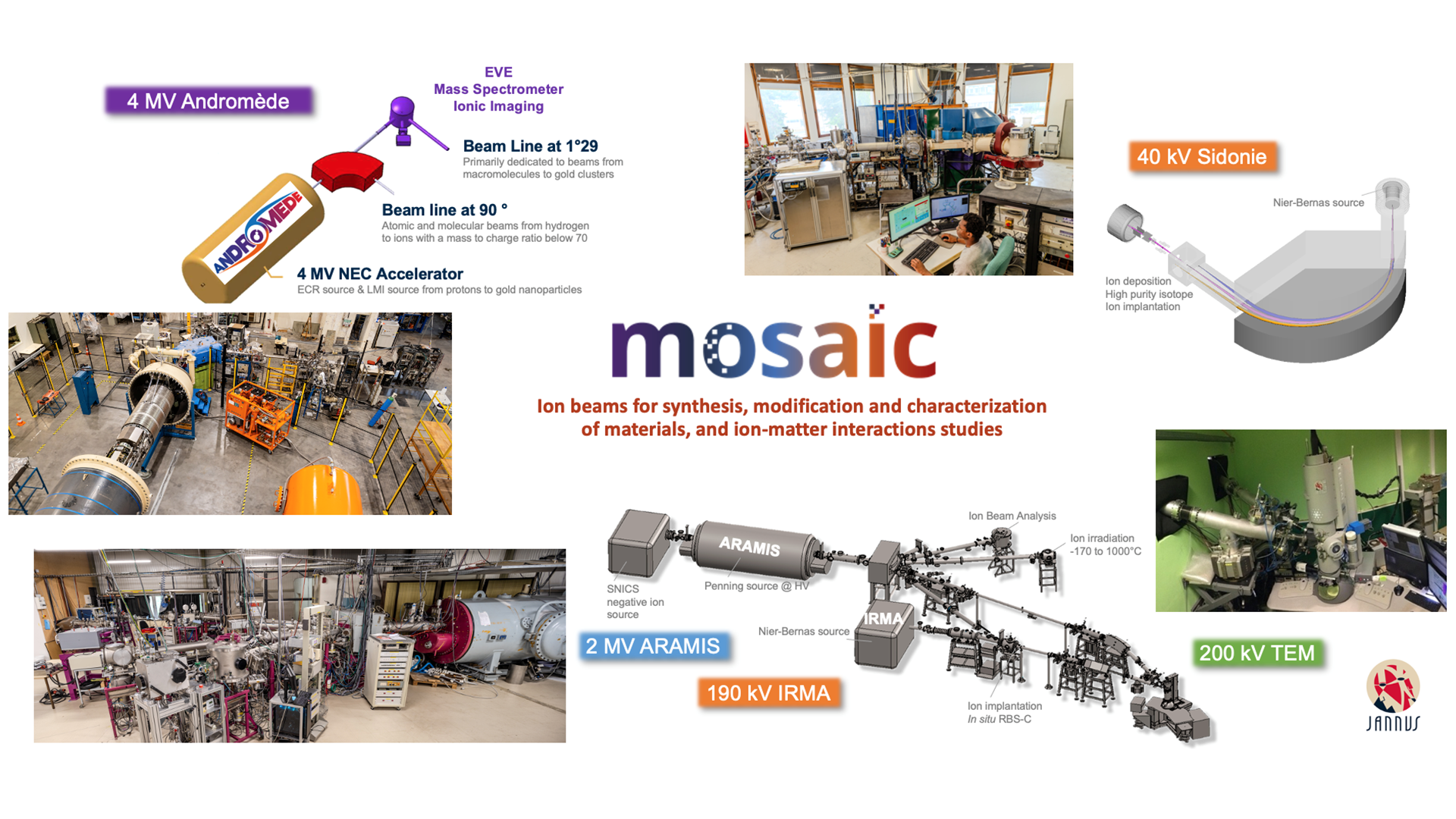
The MOSAIC platform combines various ion beam facilities (a 4 MV Andromede Pelletron, a 2 MV ARAMIS electrostatic ion accelerator, a 190 kV IRMA ion implanter, and a 40 kV SIDONIE isotope separator) into a unique, multi-purpose facility, mainly used for ion beam modification of materials (implantation/irradiation/synthesis/deposit), and structural and chemical analysis using a variety of techniques (RBS, ERDA, PIXE, PIGE ion beam analysis techniques, and microscopies). The facility also hosts capability to perform spectrometry (an MSI Mass Spectrometry Imaging), and advanced multi-scale microstructure characterization with transmission electron microscopy (TEM), scanning electron microscopy (SEM), and atomic force microscopy (AFM) instruments.
In support of these experiments, the facility is equipped with dedicated experimental tools for sample preparation especially for thin foils relevant for in situ irradiations and TEM studies (cutting, polishing, carbon deposition).
Fig. 1: Overview of the MOSAIC platform at Université Paris-Saclay, CNRS/IN2P3, IJCLab, France
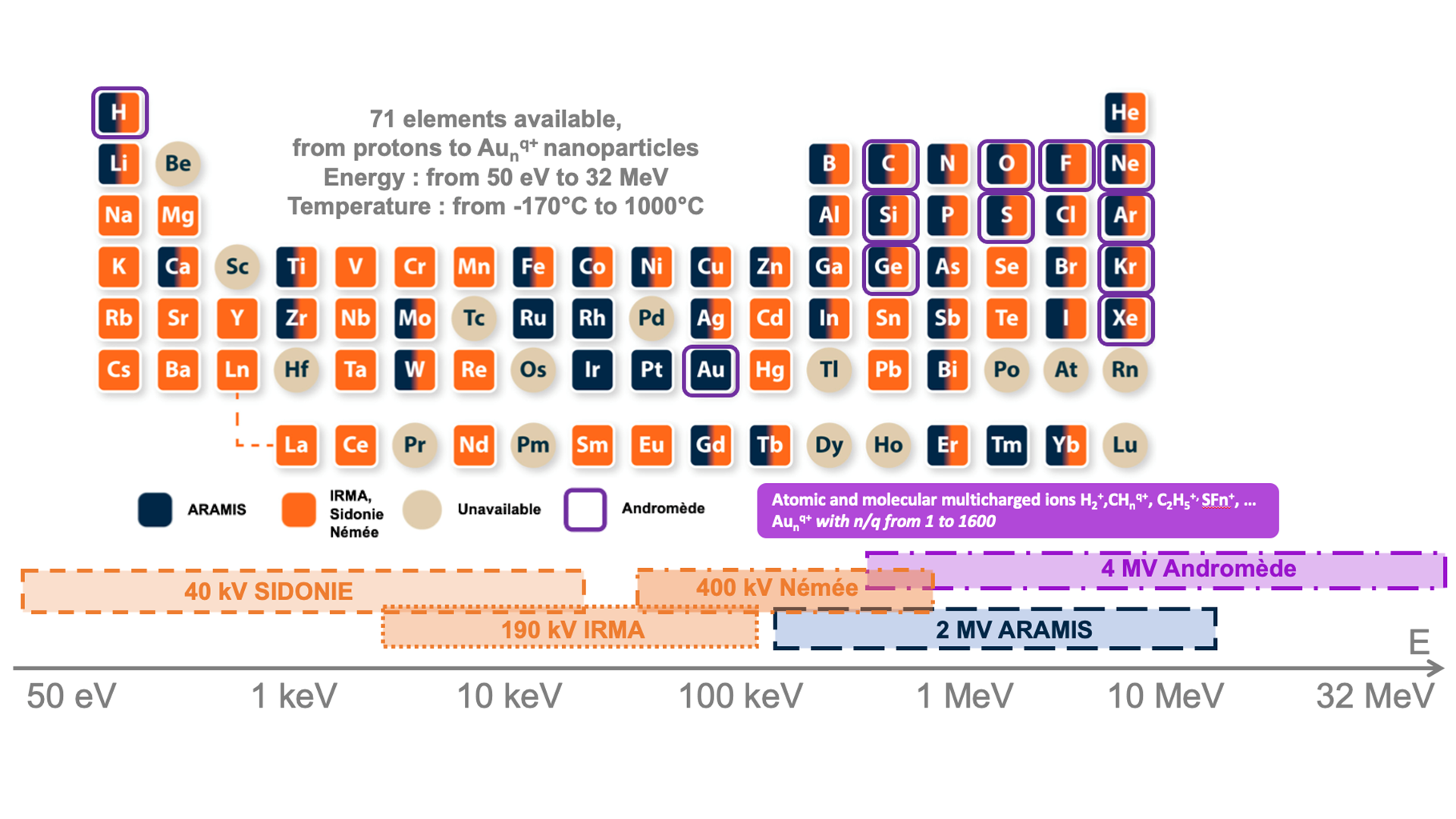
The facility benefits from years of technical and scientific expertise in operating numerous accelerators coupled to dedicated precision end-stations. A key MOSAIC speciality is its ability to provide Aunq+ nanoclusters and ion beams from most of the stable elements in the periodic table (from proton to bismuth) over a wide energy range from 50 eV to 32 MeV. Such diverse beams can be provided for end-station sample temperatures ranging from -170°C to 1000°C.
World-class facilities
The MOSAIC facility offers several experimental capabilities:
Ion deposition on substrates, and ion implantation and irradiation of solids, with a wide energy range, a large variety of light and heavy ions and gold nanoparticles are available, over an exceptionally wide temperature range,
In situ observation and analysis at the nanoscale enables studying the evolution of the materials’ microstructure under single/dual ion irradiation, using in situ dual ion beam Transmission Electron Microscopy, with with added capabilities of EELS and EDX,
Ion beam analysis of materials to obtain an elemental distribution versus depth with RBS channeling, ERDA, PIXE techniques, including in situ RBS-C with ion implantation,
High-energy nanoparticle beam as a powerful probe for surface analysis by time-of-flight secondary ion mass spectrometry (ToF-SIMS) in various types of solids: Atomic and molecular imaging with nanometric resolution in situ, surface analysis impact-by-impact with high-yield secondary ion emission (multiplicity, angular distribution, correlation of secondary ions),
Hosting experimental facilities (international collaboration) for the study of reactions at very low nuclear energies: E.g. STELLA (led by IPHC) to reproduce and study nuclear reactions in massive stars to resolve stellar nucleosynthesis mechanisms; or NewJEDI (GANIL) for the existence of light dark bosons,
Surface and topography analysis of materials using Scanning Electron Microscopy and Atomic Force Microscopy.
One of the specialities of the platform is the in situ techniques available that are world-renowned for materials structure and chemical characterisation (i.e. in situ Rutherford Backscattering Spectrometry in Channelling geometry (RBS-C), in situ Transmission Electron Microscopy (TEM) with single/dual ion beam irradiation), and mass spectrometry imaging (MSI).
The isotope separator SIDONIE is one of the few in Europe that can still produce high-purity isotopes. Owing to its age (built in the late sixties), an upgrade is ongoing.
Fig. 2: Available chemical elements delivered by the ion accelerators of the MOSAIC facility and associated energy range. A Bernas-Nier ion source is available on Sidonie, IRMA and Némée. ARAMIS is equipped with a positive Penning ion source located at the voltage terminal and an external Cs sputtering source (SNICS). Andromède uses an electron cyclotron resonance (ECR) source or a liquid metal ion source (LMIS) in the high-voltage terminal of the electrostatic accelerator
Widespread applications in research and industry
The ion beams of the MOSAIC facility are used for highly interdisciplinary research within several research groups at IJCLab, such as materials for nuclear energy, nuclear physics and interdisciplinary studies for surface analysis, radioisotopes production for health, nuclear astrophysics, astrochemistry, and materials for detectors and accelerators. MOSAIC also welcome students for internships and lab work for Master studies at the Université Paris-Saclay. The facility has been offering its facilities and services to users from industry and academic research in French and foreign Universities and organisations for more than 40 years.
The Andromede NEC Pelletron accelerator was acquired in the framework of Equipex funding (2011-2020) of the French government. IRMA ion implanter and ARAMIS ion accelerator were home-built in the late seventies and eighties, respectively.
A Transmission Electron Microscope was connected to 190 kV IRMA in the early eighties, updated in 1994, and a second beamline coming from the ARAMIS accelerator was connected to a 200 kV LaB6 FEI Tecnai TEM in 2007.
Since 2005, the JANNuS-Orsay experimental hall (bringing together the ARAMIS accelerator, IRMA implanter, the associated beamlines and the in situ TEM) has been closely linked to the triple ion beam JANNuS-Saclay facility at CEA Saclay (French Alternative Energies and Atomic Energy Commission), France, through the JANNuS Scientific Interest Group (GIS).³
In 2009, JANNuS was a founding member of the EMIR&A⁴ French network of accelerators for irradiation and analysis of molecules and materials (now a Research Infrastructure in France). It combines 15 complimentary electron and ion accelerators and in situ instruments installed at 11 platforms distributed over six sites in France.
Beam time is available each year through the EMIR&A call for proposals to users worldwide, and in particular for the MOSAIC platform at Andromede for ToF-SIMS experiments using MeV gold nanoparticles and at JANNuS-Orsay for the in situ TEM connected to one or/and two ion beams.
It is worth noting that developments and upgrades are continuously made to keep the facility at the state-of-the-art level. As an example, the 30 kV test bench Tancrede, built in the 2000s to deliver intense beams of multi-charged atomic and molecular ions with a 10 GHz ECR ion source, is being re-installed and optimised. The upgrades will enable ion manipulation and trapping techniques and to measure ionic desorption yields of materials of interest for high energy particle accelerators.
Another ongoing project is the construction of a new ion beam line at the ARAMIS 2 MV ion accelerator to be connected to an advanced high-performance X-ray diffractometer. This will allow in situ structural characterisation of solids as a function of the ion irradiation, from hundred keV to few MeV light and heavy ions – to our knowledge, such a unique capability is otherwise not duplicated anywhere else in the world.
Particularly, the results from experiments using MOSAIC will be of great importance for research on materials under irradiation (elastic deformation, point defects, phase changes, basic understanding of ion-solid interactions, …) and especially for nuclear materials.