Tag: Research data

  • How South Korea can build better gender diversity into research

    How South Korea can build better gender diversity into research

    [ad_1]

    When designing a research study, integrating sex and gender as variables, such as by including both female and male participants and ensuring transgender people and those who do not fall into binary categorizations are also accounted for, is key to ensuring robust and reproducible results. But this is not being done nearly enough. In medical research, for example, centuries of female exclusion have led to inadequate knowledge and funding of diseases that affect women. In the development of generative artificial intelligence (AI), a lack of sex and gender considerations has perpetuated biases and stereotypes in areas such as image creation and language translation. Such oversights not only skew research findings but also undermine opportunities for discovery. Significant advancements have been made in fields such as cancer immunotherapy, cardiovascular disease and osteoporosis as a result of using sex and gender analysis (SGA) in research, and it has revealed important differences in how men and women metabolize drugs, leading to safer and more effective doses.

    Heisook Lee

    Heisook Lee.Credit: GISTeR

    Despite the clear need for SGA to become the norm in experimental design, there is much work to be done before the practice is standardized in research globally. In South Korea, SGA integration is encouraged and promoted through government initiatives, but more policy development and capacity building is needed to drive uptake. At the Korea Center for Gendered Innovations for Science and Technology Research (GISTeR) in Seoul, we are investigating the use of SGA in South Korean research. One analysis showed that between 2017 to 2021, just 5.65% of South Korean biomedical articles, on average, included SGA in the experimental or study design. This figure, which relies heavily on individual researchers choosing to engage with the practice, is lower than in countries where the integration of SGA is mandatory for research funding.

    The increasing complexity of study designs makes SGA integration a challenge for scientists in South Korea, especially early career researchers, who are not typically taught the practice. The limited availability of sex-disaggregated resources — data, animals, cells and other materials that have been collected and analysed separately for male, female and non-binary participants — further complicates matters and emphasizes the need for training to encourage more researchers to consider SGA in their work. As the South Korean government ramps up funding and support for international collaboration, its researchers will need to get up to speed on SGA integration. Horizon Europe, the European Union’s flagship research-funding programme that South Korea joined in March, mandates SGA integration in the research it funds, for example.

    Heajin Kim

    Heajin Kim.Credit: GISTeR

    Recent policy changes from the South Korean government have been encouraging, but they have not moved the needle much in terms of researcher and institution uptake of SGA. In 2020, amendments were made to the Korean Framework Act on Science and Technology to emphasize the importance of sex and gender characteristics. Two years later, Korea’s Fifth Science and Technology Master Plan, which outlines the country’s medium-to-long-term goals and priorities for 2023 to 2027, emphasized the importance of SGA integration.

    We need buy-in from funding agencies, publishers and institutions to ensure that researchers are equipped and incentivized to implement the practice. We propose the following strategies. First, funding agencies in South Korea should consider mandating SGA integration in the research they fund, and more academic journals need to strengthen their editorial policies by requiring SGA integration in manuscript submissions.

    The research community needs to ensure the management and standardization of resources, such as cells and biological models, and data that are sex or gender specific, so they can be used throughout the entire research process, from the initial design to the final analysis. At GISTeR, we are running training and outreach programmes in an effort to help researchers understand how to achieve this.

    Line chart showing the proportion of biomedicine research papers that integrated sex and gender analysis into their studies for selected countries for the period 2000 to 2021

    Source: Gendered Innovation for Science and Technology Research Center

    Last, it is important that indicators of SGA integration in research outputs are being developed at a global level, mirroring established metrics on quantity and quality. This approach would highlight where SGA is needed and encourage its use.

    It is crucial for South Korean science that improvements are made to SGA integration rates. This will not only elevate the quality of its outputs, but could help to solidify South Korea’s role in developing equitable and impactful solutions to the world’s most urgent societal challenges.

    Competing Interests

    The authors declare no competing interests.

    [ad_2]

    Source link

  • Cyberattacks are hitting research institutions — with devastating effects

    Cyberattacks are hitting research institutions — with devastating effects

    [ad_1]

    Blue text of computer code laid out to create the image of a skull.

    Ransomeware attacks lock users out of their systems until a payment is made.Credit: solarseven/Getty

    Last October, a cyberattack hit the Berlin Natural History Museum and brought research to a standstill. Scientists were left without access to the data and programs required for their work, putting projects on hold and leaving students in limbo. Months later, systems have only just begun to crawl back online.

    The museum is not alone. In the past year, cyberattacks have struck several research institutions in Germany and beyond. Most involve ransomware, in which data or systems are locked until a payment is made. The attacks are part of a growing trend at academic institutions worldwide, where they can have devastating effects — delaying research projects, disrupting student enrolment and affecting researchers’ mental health.

    “In the 13 years I’ve been here, this is by far the most painful thing I have experienced,” says Johannes Vogel, director-general of the Berlin Natural History Museum, which conducts research in a wide range of fields including palaeontology, geology and genetics. “The attack is an ongoing challenge.”

    In the past few years, cyberattacks have hit institutions including the British Library in London, the University of Manchester, UK, Carnegie Mellon University in Pittsburgh, Pennsylvania, and Stanford University in California.

    Cleaning up after such an attack can be arduous. To contain the damage from the ransomware attack, which, according to a criminal investigation by German authorities, came from a group of Russian hackers, the Berlin museum took its entire system offline. As a result, the museum’s roughly 450 employees lost access to e-mail and other digital services. For researchers, this meant being unable to access data and specialized programs required for their work. In addition, data — including some personal information from visitors — were stolen by the attackers. Although the museum was able to stay open by outsourcing parts of visitor services and administration, most of its research was put on hold. In the months since the attack, the museum has been working with cybersecurity experts to clean up and rebuild the digital infrastructure. Information-technology services might not be completely restored until the end of the year, says Vogel.

    Severed connection

    It was a February morning at the Berlin University of Applied Sciences and Technology, (BHT) when staff received red alerts informing them that digital services were shutting down. The university had been hit with a ransomware attack from Akira — a well-known hacker group that, as of this January, claimed roughly US$42 million from attacks on more than 250 organizations. In response, the university shut down all its servers and severed its connection to the Internet.

    The shutdown meant that professors and students were completely locked out of digital services — and those who could continue their work remotely did so off-site, according to Peter Tröger, head of the computer and information-systems laboratory at BHT. The loss of e-mail was especially difficult, because making appointments, scheduling PhD defences and accessing journals all require a university e-mail address, Tröger says.

    The attack also affected student enrolment. Because it occurred in between terms, an estimated 100 or so students couldn’t enroll, and ended up at other universities instead.

    Internet connectivity is being re-established in steps, prioritizing services such as payroll and student enrolment. E-mail was restored after a few weeks, but many labs — mostly those heavily reliant on IT — remain partly offline as a team goes into each lab’s digital infrastructure to investigate how it was affected by the attack, and whether its security measures are up to date. “There’s a long waiting line,” Tröger says. Without digital services, “people need to find different ways to spend their time in a reasonable and useful manner”.

    The Helmholtz Centre for Materials and Energy in Berlin, a materials-research institute, experienced a cyberattack last June. This delayed many projects by anything from weeks to months, says Ina Helms, the head of communication at the centre. “Inability to access research software was one of the factors that caused many projects to experience delays,” she says.

    View of dinosaur skeletons on display at the The Natural History Museum in Berlin.

    Berlin Natural History Museum was struck by a ransomware attack last October.Credit: Imago/Alamy

    For students, losing the ability to work is especially disruptive. The cyberattack has affected projects at the Berlin Natural History Museum to varying degrees — some researchers were able to focus on literature reviews or work on external computers. Others were unable to work at all. Because master’s and doctoral students have a limited time frame in which to conduct work, the disruption meant that many needed to request for extensions from universities, funding bodies and collaborators, according to a group representing early-career researchers at the museum. “Many of the early career scientists were very stressed about the situation,” the representatives said in an e-mail. “It also affected their mental health.”

    ‘Easy targets’

    For hackers, academic institutions are desirable targets for two reasons: some have deep pockets from which to pay a ransom, and they contain valuable data that can be sold such as employee records and intellectual property linked to cutting-edge research, says Harjinder Singh Lallie, a cybersecurity expert at the University of Warwick, UK. “This is why ransomware is such a good attack, because you’ve got two lines of potential monetization.”

    Educational institutions are also more likely to have outdated security systems, says Lallie, and their digital infrastructure is more diverse than that of, say, financial institutions, which often use a single operating system and have highly secured computers. At universities, for instance, in addition to the computers in labs and offices, students and staff have personal devices — each of which hackers can use to infiltrate the institution. And the diversity of collaborators and suppliers from outside the university add layers of vulnerability. “The number of possibly entry points we have is quite remarkable,” Lallie says. “All an attacker needs is for one student to have a lousy phone.”

    Lallie notes that there are several things institutions can do to protect themselves from an attack. This includes introducing multi-factor authentication for log-ins, securely backing up data and teaching its students and staff about cyberawareness.

    For academic institutions, the question now might not be whether they will be attacked — but when. “You’ve got to assume now that your systems are going to be hit with a ransomware attack,” Lallie says. “If you make that assumption, you can prepare to a certain degree to ensure minimal disruption.”

    [ad_2]

    Source link

  • Open access is working — but researchers in lower-income countries enjoy fewer benefits

    Open access is working — but researchers in lower-income countries enjoy fewer benefits

    [ad_1]

    A researcher working on biofuel in a laboratory in Indonesia.

    Indonesia is among the low-income countries that have embraced open-access publishing, with more than 80% its research output being freely available.Credit: Donal Husni/NurPhoto via Getty

    Open-access publishing can help to drive the flow of academic papers to and from researchers, especially those in resource-poor settings. But for scientists in low-income countries, power imbalances and a lack of visibility are making it harder for them to take full advantage of this access.

    Calls to ensure that the open-access movement actually helps researchers in low-income countries — which often have a history of colonial occupation — have escalated after a study showed that these regions are not benefiting as much as they should.

    The study, published in January1, compared citations of open-access papers with those of non-open access papers to show how making research freely available can affect how widely it’s read around the world.

    “It was important to put some real effort into proving the benefits that we are claiming for open access,” says study co-author Cameron Neylon, who studies research communications at Curtin University in Perth, Australia.

    Neylon and his colleagues examined 420 million citations over the period 2010–19 for 19 million research outputs and found that the open-access papers garnered more citations than non-open-access ones did. For example, open-access papers that were published in 2010 had an average of 44 citations each, compared with 28 each for non-open access articles from that year. Furthermore, open-access papers were cited by authors in a more diverse set of countries and disciplines.

    Among all open-access articles examined, those that were made available through a platform other than the publisher, such as a repository on a university website (classified as green open access) had the most citations.

    Researchers in low-income countries received relatively few extra citations from making their papers open access, says Neylon. Authors in Northern Europe were found to get the biggest boost, whereas those from African countries got among the smallest.

    The results reveal that, although the proliferation of open access has enabled wider dissemination of findings, more research is needed to determine whether authors in low-income countries are actually benefiting from the increased availability.

    Open access from and to low-income countries

    The past decade has seen rapid progress in open-access publishing. Almost half of the world’s research output in 2020 is now available to be read or downloaded without payment, according to the Global State of Open Access 2021 report, which draws on data from several bibliometric services2. Those advocating for open access often argue that there is a moral obligation for researchers to share knowledge with their peers in countries that do not have the funds to cover access fees.

    Open access also plays a part in improving the flow of research from poorer countries to the rest of the world.

    Many low-income countries have extensive open-access-publishing infrastructure for researchers to share their work with others. Governments of several Latin American nations have funded open-access journals since the late 1990s, and more recently, a surge in local open-access journals and publishing portals in Indonesia has led to more than 80% of the country’s research output being freely available.

    Susan Murray, who leads African Journals OnLine, a bibliographic database of African-published peer-reviewed research based in Grahamstown, South Africa, says that there are now thousands of open-access journals based in low-income countries. But without changing some of the more entrenched aspects of local research systems, the full benefits of open access for researchers in low-income countries might not be realized, she says. Murray notes that those researchers are often more affected by power and resource inequalities than their counterparts in high-income countries — a problem that local incentives and rewards systems can exacerbate.

    Another issue is that scientists in low-income countries might choose to focus on research topics that are of interest to editors of prestigious journals based in wealthy nations, in an attempt to advance their career, which further skews the research agenda. It also undermines the knowledge-sharing systems that exist in low-income countries and could prevent strong, relevant research from being distributed to those who need it.

    “It is important to change this,” says Murray, to ensure that the research agendas of low-income countries focus attention on their needs, challenges, priorities and interests, such as climate change, malnutrition and infectious diseases. “Without research in, for and from these countries — along with channels to readership of the outputs — these problems will persist,” she says.

    Greater support from high-income countries

    The challenge for organizations that run low-cost options — such as journals and platforms that do not charge author or reader fees — is that they tend to be centrally funded or run by volunteer work, says Elizabeth Marincola, an open-science adviser to the Science for Africa Foundation in Nairobi. “It is hard to maintain editorial and peer-review consistency and speed using this model,” she says. But the fact that they are gaining traction is positive for low-income countries, she adds.

    Speed is an important factor in ensuring that research from low-income nations is more widely read, because if the quality of work is consistent, the faster it is published and the more citations it gets, says Marincola. This is particularly true in the life sciences, she adds, in which research tends to move quickly.

    A major policy change by one of the world’s largest funders for research in low-income countries could lead to reports being shared faster. In April, the Bill and Melinda Gates Foundation, based in Seattle, Washington, announced changes to its open-access publishing requirements, including a requirement, from 2025 onwards, for grant recipients to post their manuscripts on an open-access preprint server. The organization will also no longer fund article-processing charges (APCs) for articles to be published in peer-reviewed journals.

    There are also emerging reports from South America and Indonesia that suggest that some open-access journals are discussing the introduction of APCs. This is troubling because these fees are inequitable, says Juan Pablo Alperin, who studies publishing at Simon Fraser University in Vancouver, Canada, and he questions how important the citation advantage is for researchers.

    “APCs can appear as an attractive solution for individual journals, but their proliferation will ultimately defund the vibrant and diverse publisher and reader fee-free open-access ecosystem in the global south,” says Alperin. “With limited funds, institutions that are currently supporting publishing programmes will divert resources to ever-growing APCs, with devastating consequences for local publishing capacity.”

    [ad_2]

    Source link

  • How a few days in space can disrupt a person’s biology

    How a few days in space can disrupt a person’s biology

    [ad_1]

    Hayley Arceneaux had plenty to worry about before journeying into space for the first time. Her health history was unusual for a space traveller: she would be the first childhood cancer survivor to enter Earth’s orbit, and the first with a prosthetic — a metal rod standing in for a cancerous segment of bone that had been removed from one leg.

    But on the morning before lift-off in September 2021, she felt strangely calm. “I kept thinking, ‘When am I going to get nervous?’” she says. “The 9-minute ride to space — I was just having the time of my life.”

    Arceneaux is a sign of what’s to come, as companies such as SpaceX, based in Hawthorne, California, ferry more and more civilians to space on massively expensive commercial flights. For decades, the health effects of space travel have been mapped by studying professional astronauts, many of whom trained mentally and physically for years to get the job. A suite of scientific reports published on 11 June now aims to chart how spaceflight affects space tourists with a wider variety of health histories.

    The studies show that just a few days in orbit can cause immune-cell disruption, dehydration and cloudy thinking — but that most of these conditions revert to normal soon after the travellers return to Earth.

    Taken together, the 44 reports — written by authors at more than 25 countries and 100 institutions — comprise the largest catalogue of data detailing space travel’s impact on the human body1. “This is the beginning of precision medicine for spaceflight,” says Christopher Mason, a geneticist at Weill Cornell Medicine in New York City, who is a co-author on some of the papers. “Let’s bring the full armamentarium of modern molecular biologist tools to bear for these crews who are regular people.”

    A ‘strange environment’

    Most of the data on the health effects of spaceflight have so far been collected from white men aged 30 years old and beyond, many with a military background, says Mathias Basner, an epidemiologist who studies astronaut behavioural health at the University of Pennsylvania Perelman School of Medicine in Philadelphia, and a co-author on some of the papers. Little is known about how other groups of people will respond to the unique stresses of spaceflight, including radiation exposure and microgravity.

    That means that the risks could be higher. “Space is a very strange environment,” says Basner.

    On the other hand, commercial spaceflights also launch more often than governmental ones, run by national space agencies such as NASA, do. So, on the plus side, researchers can collect data more quickly than before — and potentially from a more diverse population, Basner adds.

    Among the latest studies are some evaluating the health of the crew of SpaceX’s 2021 Inspiration4 flight, which was the first all-civilian spaceflight to orbit Earth. The four passengers on that flight, including two men and two women — one of whom was Arceneaux — ranged from ages 29 to 51 years old.

    For the roughly three days that they were in orbit, Arceneaux and her crewmates collected saliva, urine and blood samples, conducted ultrasounds on themselves, took cognitive tests and wore fitness trackers2. Researchers assessed those specimens and data and found some physiological changes that had previously been registered only on longer spaceflights. These included alterations in immune-cell function, and a lengthening of telomeres, the caps at the end of chromosomes.

    Four astronauts in new suits for use in space.

    The crew of Inspiration4 (from left) were avionics engineer Chris Sembroski, geoscientist and artist Sian Proctor, billionaire businessman Jared Isaacman and physician’s assistant and childhood cancer survivor Hayley Arceneaux.Credit: Inspiration4 crew/John Kraus

    However, about 95% of the changes reverted soon after the crew landed, Mason says. Some of the remaining changes persisted for at least three months after landing, suggesting a longer recovery period.

    With data from only four people, it is difficult to draw firm conclusions about the effects of spaceflight on civilians. Where possible, the researchers compared their results with data from astronauts that worked with NASA or the Japan Aerospace Exploration Agency. They also drew upon data from mice and cell cultures that were grown in space, exposed to radiation or grown in microgravity.

    When you see the same biomarker levels rising over and over again across three different missions and three different sets of people, “that’s when you start believing it”, says Afshin Beheshti, a systems biologist at the Blue Marble Space Institute of Science in Seattle, Washington, and a co-author on several of the studies.

    A spaceflight catalogue

    Mason and his colleagues developed a database called the Space Omics and Medical Atlas (SOMA) to collect this and future health information from civilian space travellers and professional astronauts, as well as a biobank to store their samples. These, along with the wide range of data collected from Inspiration4, are exciting developments for the field, says Susan Bloomfield, a systems physiologist who studies the biological effects of spaceflight at Texas A&M University in College Station.

    But Bloomfield would like to see more demographic details, such as age, sex and past medical history, included in these and future publications that use the SOMA database. Although privacy concerns have limited the release of such information in the past, Bloomfield argues that it is important for researchers to have access to data that could help to ensure the safety of future space travellers. Mason notes that SOMA contains such data, but cannot release it publicly.

    It’s a surprise that the Inspiration4 flight — a relatively short trip — prompted some of the same physiological changes seen in astronauts who have been on much longer missions, says Catherine Yeung, a pharmacist who studies the effects of spaceflight on people’s kidneys at the University of Washington in Seattle. Gathering more of this data could help researchers to design interventions that mitigate or at least predict the effects of spaceflight on the body, for both civilians and astronauts alike, says Basner.

    For example, someone’s data might point to them being at particular risk for severe motion sickness in space, he says, and knowing that could allow physicians to provide a treatment — or at least advise the person to avoid going altogether. “If you’re going to spend three days vomiting in a bag, you might not want to pay US$10 million for that ticket.”

    [ad_2]

    Source link

  • Chinese research collaborations shift to the Belt and Road

    Chinese research collaborations shift to the Belt and Road

    [ad_1]

    Although China is expanding its international research collaborations rapidly, the composition of these interactions is shifting, according to data from the Nature Index. Specifically, China’s researchers are increasingly working with scientists in countries taking part in the Beijing government’s Belt and Road Initiative (BRI).

    The BRI is often described as a modern-day reboot of the Silk Road, an ancient system of trade routes that connected China’s heartland with the eastern edge of Europe. Officially, the BRI is a bid to strengthen the resilience of China’s trade networks, both overland — across Asia into the Middle East and Africa — and by sea — upgrading ports and building maritime fuelling stations throughout the Asian continent.

    In reality it is about far more than just infrastructure. Sometimes referred to as Chinese President Xi Jinping’s signature policy, it’s an attempt to boost China’s economic and political influence by strengthening its ties with neighbours and other strategic partners around the world. The Green Finance and Development Center at Fudan University in Shanghai has been keeping track of the BRI’s progress. It estimates that China has spent more than US$1 trillion on the initiative since 2013 and that 151 countries have so far signed up to the project and the funding that comes with it.

    In science, the BRI has spearheaded a range of initiatives, from Chinese researchers helping to design key pieces of infrastructure in Africa, to countries in central Asia working with China on lunar-exploration plans. Data trends in the Nature Index seem to reflect this. The number of natural-sciences research papers involving China and at least one BRI country has risen by 132% between 2015 and 2023 (data for 2023 are approximated by a 12-month window from August 2022 to July 2023). Such articles accounted for 28% of all of China’s international collaboration in the index in 2023, up from 22% in 2015. At the same time, the overall number of internationally collaborative papers involving China has increased at a slower rate — growing by 83% in the same time period. Collaborative research output with the United States in the natural sciences, measured by bilateral collaboration score (CS), decreased by 15% between 2020 and 2022 — and it has stagnated since then. The data suggest that researchers in China are starting to favour working with countries that are closer to home or deemed to be strategically important by the central government, over others, particularly in the West.

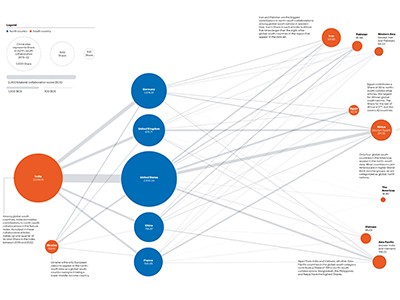
    Proportional circles showing the change in bilateral collaboration score for Nature Index research conducted between China and 15 Belt and Road countries

    Source: Nature Index

    “I’m not at all surprised,” says Caroline Wagner, a researcher at Ohio State University in Columbus who specializes in public policy that relates to science and innovation. “I did a study for the US state department, looking at all of the diplomatic agreements that China has made on science and tech with different countries, and we could see a tremendous rise [in BRI collaborations].”

    Of the collaborations between China and BRI countries in the Nature Index, Singapore and South Korea come out on top. Singapore is China’s fifth largest research partner on papers in the database overall, including health sciences, with its bilateral CS rising by 8.4% between 2022 and 2023. These changes are likely to have been driven from the bottom up, says Jenny Lee, a science-policy researcher at the University of Arizona in Tucson. “It’s not like the Chinese Communist Party is saying to Chinese researchers that they must collaborate with these countries,” she says. Part of what the data are showing could also stem from China’s COVID-19 policy, which involved strict lockdowns and closed borders. “People didn’t go abroad to make connections at conferences during that time and it could just be that people in China are only just starting to do that again,” says Lee. Chinese scientists might still be wary of travelling farther afield to the United States and Europe, she says, and they might prefer to stay closer to home.

    Part of the growth in China–BRI research collaborations could be explained by quirks in how academics identify themselves on research papers, says Robert Tijssen, a science and innovation studies researcher at Leiden University in the Netherlands. “A growing number of ‘cosmopolitan’ academic researchers have multiple institutional affiliations in different countries, especially countries that share a language or a common research culture. This may apply to China and Singapore,” he says. On papers, that could look like international collaboration when it’s more like Chinese researchers working with Chinese researchers.

    Line chart showing the change in research publications from China from 2015 to 2023* by collaboration type

    Source: Nature Index

    China’s domestic research collaborations are also skyrocketing: the number of natural-science papers in the Nature Index authored solely by China-based researchers grew by 194% between 2015 and 2023. The implication, says Lee, is that US hegemony as the ‘go-to place’ for researchers around the world is in peril. “It’s yet another demonstration of how global science is shifting away from the West. International collaboration will continue to grow,” she says, but it “may be shifting to a more regionalized model”.

    Part of this is driven by geopolitics, she adds. Several countries, including the United Kingdom and United States, have banned Chinese firms such as Huawei from engaging in projects that involve key technology or infrastructure, such as telecommunications and electrical grids. The European Union is considering similar policies. That has a knock-on effect; researchers in China who are interested in working in these areas don’t change fields — they look for collaborators in other countries.

    “You can’t collaborate with Chinese nationals if you have NASA funding” in the United States, says Lee. “When we look at sensitive areas of research, or anything to do with national security, the United States is closing access to data and resources. I suspect that this is probably where this trend away from the West is happening. These are areas and fields that are growing in Singapore and South Korea, so it makes sense.”

    This article is part of Nature Index 2024 China, an editorially independent supplement. Advertisers have no influence over the content. For more information about Nature Index, see the homepage.

    [ad_2]

    Source link

  • Chinese science still has room to grow

    Chinese science still has room to grow

    [ad_1]

    Strong potential

    Chemistry and physical sciences are clear areas of focus for China, accounting for 85% of the country’s total Share in the Nature Index in 2023*. But output in other subjects is growing fast. China’s adjusted Share in biological sciences increased by 15.8% from 2022 to 2023* — the highest percentage among the four natural-sciences subjects shown below.

    Line chart showing China’s change in adjusted Share in four natural-science subjects from 2019 to 2023

    Source: Nature Index. Analysis by Bo Wu. Infographic by Simon Baker, Bec Crew and Tanner Maxwell

    Topic trends

    The top fields of research (FORs) in each of the five subjects tracked by Nature Index are shown. The most dominant FORs across the respective areas are biochemistry and cell biology, at 36% of biological-sciences output, and materials engineering, which represents 34.7% of physical-sciences output. FORs can relate to more than one subject: biochemistry and cell biology is also among the top five FORs for health sciences, for instance.

    Bar chart showing China’s top field of research for the five subject areas covered by Nature Index

    Source: Nature Index. Analysis by Bo Wu. Infographic by Simon Baker, Bec Crew and Tanner Maxwell

    Looking outwards

    China’s areas of relative weakness have the highest percentage of internationally collaborative papers. For most subject areas, China’s international-article percentage was lower than every other leading country in the Nature Index in 2023*. In biological sciences, however, it is 54.1%, a higher proportion than the United States (52.7%).

    Bar chart showing the proportion of China’s research articles with international collaboration in the five subject areas covered by Nature Index

    Source: Nature Index. Analysis by Bo Wu. Infographic by Simon Baker, Bec Crew and Tanner Maxwell

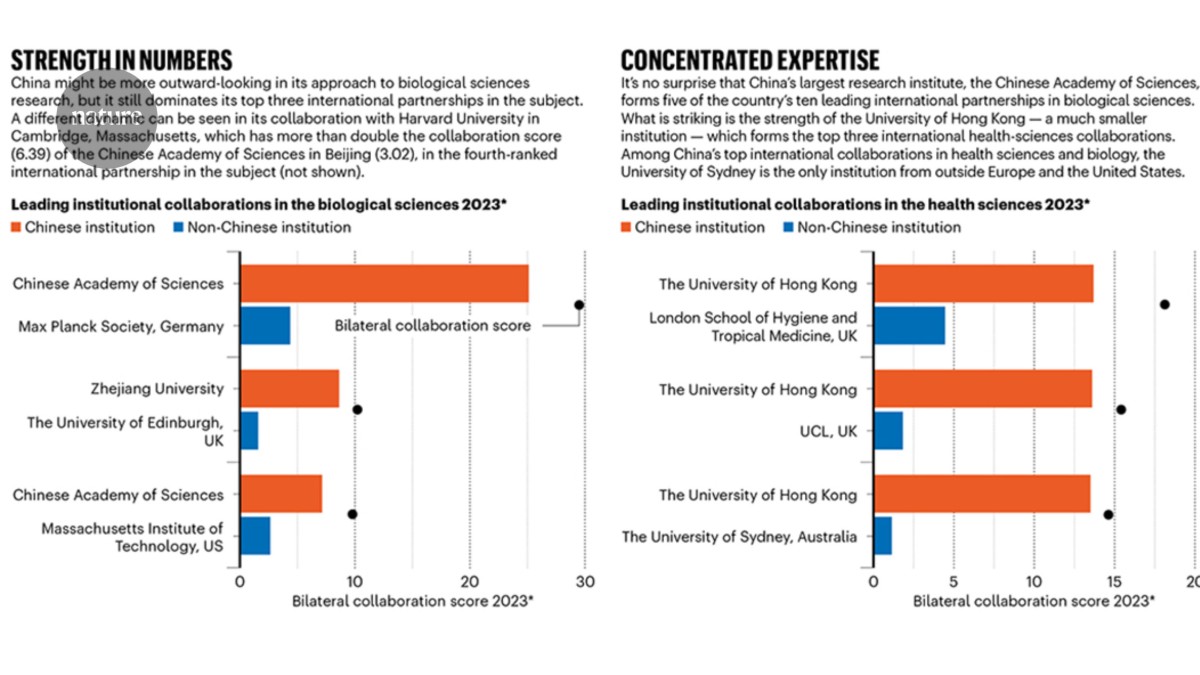
    Strength in numbers

    China might be more outward-looking in its approach to biological sciences research, but it still dominates its top three international partnerships in the subject. A different dynamic can be seen in its collaboration with Harvard University in Cambridge, Massachusetts, which has more than double the collaboration score (6.39) of the Chinese Academy of Sciences in Beijing (3.02), in the fourth-ranked international partnership in the subject (not shown).

    Bar and dot chart showing the leading three international research collaborations between a Chinese and non-Chinese institution in the biological sciences in the Nature Index

    Source: Nature Index. Analysis by Bo Wu. Infographic by Simon Baker, Bec Crew and Tanner Maxwell

    Concentrated expertise

    It’s perhaps no surprise that China’s largest research institute, the Chinese Academy of Sciences, forms five of the country’s ten leading international partnerships in biological sciences. What is striking is the strength of the University of Hong Kong — a much smaller institution — which forms the top three international health-sciences collaborations. Among China’s top international collaborations in health sciences and biology, the University of Sydney is the only institution from outside Europe and the United States.

    Bar and dot chart showing the leading three international research collaborations between a Chinese and non-Chinese institution in the health sciences in the Nature Index

    Source: Nature Index. Analysis by Bo Wu. Infographic by Simon Baker, Bec Crew and Tanner Maxwell

    This article is part of Nature Index 2024 China, an editorially independent supplement. Advertisers have no influence over the content. For more information about Nature Index, see the homepage.

    [ad_2]

    Source link

  • China seeks global impact and recognition

    China seeks global impact and recognition

    [ad_1]

    Aerial view of five people working at a construction site

    Workers at the Jiangmen Underground Neutrino Observatory.Credit: Qiu Xinsheng/VCG via Getty

    China’s new-found position at the summit of the Nature Index in 2023 represented a major — if not unexpected — turning point. A year after overtaking the United States for contributions to natural-science journals tracked by the database, there seems to be no indication that China’s trajectory in scientific performance is plateauing. The gap between China and the United States in natural sciences has already grown, representing a Share of almost 5,000 in the 12 months from August 2022 to July 2023. China is also now ahead in the Nature Index overall, even when including newly added data from health-sciences journals (a subject in which the United States still has a substantial lead).

    The key question is where Chinese research will go next. The country’s growing assortment of large-scale science facilities demonstrates its ambition and hints at a desire for worldwide impact and recognition. In the fast-evolving world of academic publishing, China now has the potential to shape the direction of travel, with the future of open science partially dependent on how the country believes new research is best disseminated. And through its increasing willingness to collaborate with developing nations, there are signs that China might mould a scientific ecosystem that moves the centre of gravity away from the West.

    There are concerns that some of these developments might lead to parallel systems, with international research collaboration — already dented — becoming fragmented. But this does not need to be the case. Challenging established norms has the potential to benefit research across the globe. And provided collaborative networks are kept open, China’s contribution to high-quality research will help to push the frontiers of discovery in a multitude of areas.

    This article is part of Nature Index 2024 China, an editorially independent supplement. Advertisers have no influence over the content. For more information about Nature Index, see the homepage.

    [ad_2]

    Source link

  • Japan’s push to make all research open access is taking shape

    Japan’s push to make all research open access is taking shape

    [ad_1]

    Viewed through a window covered in red handwritten notes, a man wearing safety goggles holds a piece of repaired broken resin glass.

    Japan plans to make all publicly funded research available to read in institutional repositories.Credit: Toru Yamanaka/AFP via Getty

    The Japanese government is pushing ahead with a plan to make Japan’s publicly funded research output free to read. This month, the science ministry will assign funding to universities to build the infrastructure needed to make research papers free to read on a national scale. The move follows the ministry’s announcement in February that researchers who receive government funding will be required to make their papers freely available to read on the institutional repositories from January 2025.

    The Japanese plan “is expected to enhance the long-term traceability of research information, facilitate secondary research and promote collaboration”, says Kazuki Ide, a health-sciences and public-policy scholar at Osaka University in Suita, Japan, who has written about open access in Japan.

    The nation is one of the first Asian countries to make notable advances towards making more research open access (OA) and among first countries in the world to forge a nationwide plan for OA.

    The plan follows in the footsteps of the influential Plan S, introduced six years ago by a group of research funders in the United States and Europe known as cOAlition S, to accelerate the move to OA publishing. The United States also implemented an OA mandate in 2022 that requires all research funded by US taxpayers to be freely available from 2026.

    Institutional repositories

    When the Ministry of Education, Culture, Sports, Science and Technology (MEXT) announced Japan’s pivot to OA in February, it also said that it would invest 10 billion yen (around US$63 million) to standardize institutional repositories — websites dedicated to hosting scientific papers, their underlying data and other materials — ensuring that there will be a mechanism for making research in Japan open.

    Among the roughly 800 universities in Japan, more than 750 already have an institutional repository, says Shimasaki Seiichi, director of the Office for Nuclear Fuel Cycles and Decommissioning at MEXT in Tokyo, who was involved with drawing up the plan. Each university will host the research produced by its academics, but the underlying software will be the same.

    In 2022, Japan also launched its own national preprint server, Jxiv, but its use remains limited with only the few hundred preprint articles posted on the platform to date. Ide says that publishing as preprints is not yet habitual among many researchers in Japan, noting that only around one in five respondents to his 2023 survey1 on Jxiv were even aware that it existed.

    Green OA

    Japan’s move to greater access to its research is focusing on ‘green OA’ — in which authors make the author-accepted, but unfinalized, versions of papers available in the digital repositories, says Seiichi.

    Seiichi says that gold OA — in which the final copyedited and polished version of a paper is made freely available on the journal site — is not feasible on a wide scale. That’s because the cost to make every paper free to read would be too high for universities. Publishers levy an article-processing charge (APC) if the paper is made free to read, rather than being paywalled, a fee that covers a publisher’s costs.

    APCs are increasing at an average rate of 4.3% per year, notes Johan Rooryck, a scholar of French linguistics at Leiden University in the Netherlands, and executive director of cOAlition S.

    Rooryck says that Japan’s green OA strategy should be applauded. “It’s definitely something that one should do,” he says. “Especially for all the content that is still behind the paywall.”

    Kathleen Shearer, executive director of the Confederation of Open Access Repositories in Montreal, Canada, says that the Japanese plan is “equitable”.

    “It doesn’t matter where you publish, whether you have APCs or not, you are still able to comply with an open-access policy,” she says.

    She adds that the policy will mean that Japan has a unified record of all research produced by its academics because all institutional repositories are hosted on the same national server. “Japan is way ahead of the rest of us,” Shearer says. “More countries are moving in this direction but Japan really was one of the first.”

    Focusing on institutional repositories will have another benefit: it will not discriminate against research published in Japanese, Shearer says. “A big part of their scholarly ecosystem is represented in Japanese.”

    The plan to move to OA and support Japanese universities’ repositories comes as Japan grapples with its declining standing in international research.

    In a report released last October, MEXT found that Japan’s world-class research status is declining. For instance, Japan’s share in the top 10% of most-cited papers has dipped from 6% to 2%, placing it 13th on the list of nations, despite Japan having the fifth-highest research output.

    In March, Japan also vowed to triple its number of doctorate holders by 2040, after another report found that the country’s number of PhD graduates is also declining, making it an outlier among the major economies.

    [ad_2]

    Source link

  • trial data show benefits for kidney disease

    trial data show benefits for kidney disease

    [ad_1]

    A young woman suffering from kidney failure undergoes dialysis.

    People who have kidney failure often need dialysis to help clean waste from their blood.Credit: Mohammed Huwais/AFP via Getty

    The blockbuster diabetes drug Ozempic — also sold as the obesity drug Wegovy — can add another health condition to the list of maladies it alleviates. Researchers presented clinical-trial data today at a conference in Stockholm, showing that it significantly reduces the risk of kidney failure and death for people with type 2 diabetes and chronic kidney disease. Scientists are thrilled with the result, and think that the drug, otherwise known by its generic name, semaglutide, will eventually be proved to help a more general population of people with kidney disease. This trial is a first step towards that goal, they say.

    Semaglutide manufacturer Novo Nordisk, based in Bagsværd, Denmark, announced in October that it had halted its kidney-disease trial because of a recommendation from an independent data-safety monitoring board that the overwhelmingly positive results made it unethical to continue to give some participants a placebo. But until now, it hadn’t revealed the full data analysis, which is also published today in The New England Journal of Medicine1.

    Broad benefits

    The phase IIIb trial, which enrolled 3,533 people, showed that those who received semaglutide injections weekly were 24% less likely to have ‘major kidney disease events’, including kidney failure and dying owing to kidney complications, than were those getting a placebo. Kidney failure occurs when either one or both of the kidneys no longer functions on its own, and can be treated with dialysis or a kidney transplant.

    Participants who received semaglutide were also 29% less likely to die from heart attacks and other major cardiovascular incidents than were those who got a placebo, and 20% less likely to die from any cause during the trial period. This is huge because “the links between kidney disease and heart disease are really profound”, says Samir Parikh, a nephrologist at the University of Texas Southwestern Medical Center in Dallas who was not involved in the study.

    People with type 2 diabetes and chronic kidney disease often die of heart disease before their kidney problems progress to failure. Heart disease and chronic kidney disease are strongly linked, Parikh says, and “unfortunately, they are self-reinforcing”. Adding in type 2 diabetes is like throwing “rocket fuel” onto the fire, he adds. This is because type 2 diabetes can damage small blood vessels in the body, including those in the heart and kidneys.

    “We are ecstatic that we are seeing real benefits” for people with chronic kidney disease, says Katherine Tuttle, a nephrologist at the University of Washington School of Medicine in Spokane who co-ran the trial. “These patients benefit broadly.”

    Need for therapies

    Globally, the death rate from heart disease dropped by about 30% between 1990 and 2019, owing to improvements in health care and people changing their behaviour — for instance, stopping smoking. But people with chronic kidney disease have not seen the same drop in heart-related deaths. “In many ways, they are one of the last pockets where the risk of cardiovascular death has not been reduced,” says Vlado Perkovic, a nephrologist at the University of New South Wales in Sydney, Australia, and a co-leader of the trial. The availability of semaglutide as a potential treatment could be game-changing, he says.

    Historically, physicians have treated chronic kidney disease with drugs including blood-pressure medication. But these treatments offer only limited protection for the kidneys. In the past decade, options have expanded. For instance, researchers have demonstrated2 that a class of diabetes drug called sodium-glucose co-transporter-2 (SGLT2) inhibitors can slow the progression of chronic kidney disease, as well as protect against major cardiovascular incidents.

    But “there’s still substantial residual risk in this population”, Tuttle says. Diabetic kidney disease is the leading cause of chronic kidney disease worldwide, accounting for 50% of kidney-failure cases in wealthy countries. “There is a need for more therapies,” she adds.

    A focus on kidneys

    Scientists already knew from other trials that semaglutide, which moderates blood sugar, can help to protect the kidneys, says Hertzel Gerstein, an endocrinologist at McMaster University in Hamilton, Canada. But those trials were testing the drug’s effect on other conditions, such as heart disease, and clinicians just happened to notice kidney benefits.

    What’s special about the latest trial is that it is the first to focus on the progression of kidney disease, Gerstein says.

    The trial also hinted that semaglutide could slow the degradation of a person’s kidneys. Participants receiving the drug maintained a healthier ‘estimated glomerular filtration rate’, which is a measure of the kidneys’ ability to filter waste, and had lower amounts of a protein called albumin in their urine than did those receiving placebo. High levels of the protein are a sign of leaky blood vessels in the kidneys and point to kidney function declining.

    Why exactly semaglutide benefits the kidneys is still unclear, say the researchers who conducted the trial. It could have multiple mechanisms, including reducing inflammation in the kidneys, but more tests are needed.

    Other major questions remain, including whether semaglutide will offer a similar benefit to people who have chronic kidney disease, but who are not diabetic. Researchers must also find out how it stacks up against other medications used to treat chronic kidney disease, such as SGLT2 inhibitors, and whether combining these drugs can offer further benefits.

    [ad_2]

    Source link

  • Guidelines for academics aim to lessen ethical pitfalls in generative-AI use

    Guidelines for academics aim to lessen ethical pitfalls in generative-AI use

    [ad_1]

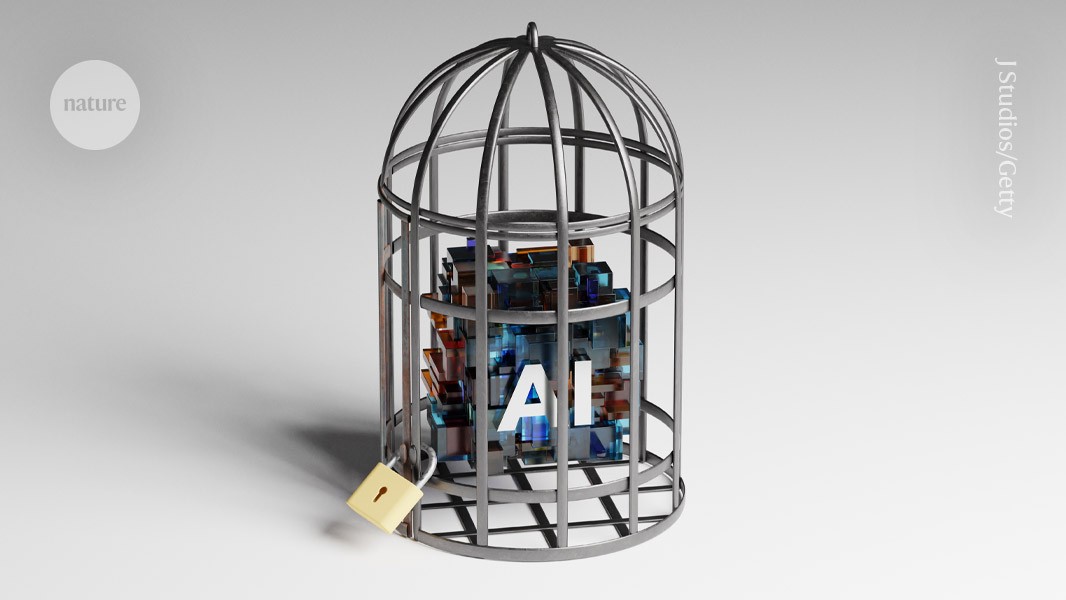
    A computer rendered illustration of a digital cube labelled AI locked in a birdcage.

    New guidelines aim to safeguard researchers and study participants from AI risks.Credit: J Studios/Getty

    A new toolkit to help academics to use generative artificial intelligence (genAI) more ethically is being developed by researchers in the United Kingdom.

    “Generative AI is so new, we just don’t have any guidance,” says Wendy Moncur, a cybersecurity researcher at the University of Strathclyde in Glasgow, UK, who is leading the project. Academics are already considering the potential quandaries with use of genAI tools, she says, “but wouldn’t it be a useful thing, if they had a little checklist to say, ‘These are the things you need to think about; these are the strengths; and these are the threats.’”
    The project focuses on issues that might arise when genAI tools — such as ChatGPT, made by OpenAI in San Francisco, California, and Google’s Gemini, which are powered by large language models (LLMs) — are used to analyse and process personal information from study volunteers.

    It was inspired by an ongoing study, led by Moncur, that is looking into how people going through major life transitions — such as being diagnosed with cancer or undergoing gender reassignment — can manage their privacy online.

    In the work, Moncur and her team are using genAI tools to create teaching materials, on the basis of participants’ stories, that are intended to guide others through similar life changes.

    The participants had shared details about their experiences — such as how their work and relationships were affected — under the assurance that the information would be shared with others only in an anonymized form. But before the team started feeding this information into a genAI program, Moncur suddenly feared that, if the tool pieced together publically available information with the anonymized data that it was being fed, the participants might accidentally be reidentifiable.

    The team was also concerned about LLMs’ tendency to ‘hallucinate’ — generating nonsensical or incorrect information — which could potentially slander reidentified participants. And LLMs can change the meaning of the information fed into them, because they are influenced by social and other biases inherent in their design. For example, Moncur says the program that her team used would distort what the participants had said, making their stories more positive than the participants had intended. “ChatGPT has a bit of a ‘Pollyanna thing’ going on, in that it doesn’t like unhappy endings,” says Moncur. “So, it needs a bit of a nudge to produce a credible story.”

    Outlining the issues

    Moncur’s concerns prompted her to team up with computer scientists Ali Farooq and Ryan Gibson at the University of Strathclyde and Burkhard Schafer, a legal scholar at the University of Edinburgh, UK, to collaborate on solutions. Funded by the UK National Research Centre on Privacy, Harm Reduction and Adversarial Influence Online, they launched a ten-month project to develop guidelines for researchers and university ethics committees, due to be completed in August.

    In March, the European Commission’s European Research Area Forum released guidelines on the responsible use of AI, which will feed into the work that Moncur and her team are doing.

    Moncur says the project has three main objectives: to address the lack of expertise in identifying privacy risks caused by using genAI in research; to address data-management requirements in UK research, many of which don’t account for the growing use of genAI; and to address the legal risks for institutions that are using genAI to analyse or process participant data.

    The project is designed to look at AI use in research broadly, but will include focus areas, such as how to protect privacy when using AI to process medical data, says Farooq.

    The team is doing a literature review to characterize how researchers are using genAI to handle personal data, and is planning to interview academics who serve on ethics committees at UK universities.

    Informed by the insights from these projects, the team will develop a toolkit based on analysis of strengths, weaknesses, opportunities and threats, which ethics committees and researchers can consult when they are reviewing or planning projects that will involve genAI technologies. The team plans to make this tool freely available online.

    Much-needed guidance

    Robert Davison, an information-systems scientist at the City University of Hong Kong, welcomes these efforts to create more-robust ethical oversight for genAI use. “It’s highly likely that it will become normal [to use this technology],” says Davison. But he recalls a point made in an editorial published in January1, which he co-authored: “We do not wish to see a situation where we are lulled into thinking that genAI use is ‘normal’, and that researchers do not need either to pay particular attention to it, or to report their use of it.”

    Davison is keen to see ethical norms be established around genAI use, but is wary of a siloed approach to setting these standards. Broader ethical standards would be ideal, he says, but adds that it’s unclear who would be best placed to provide — and enforce — such guidelines.

    For now, Moncur and her colleagues will target university ethics committees. “Researchers are under such pressure to be efficient — they’re overloaded,” says Moncur. “If you’ve got a tool [such as AI] that’s going to make things more efficient, then it makes sense to use the tool. But we need information to help us use the tools responsibly, and in a way that allows us to do good science.”

    Nature Index’s news and supplement content is editorially independent of its publisher, Springer Nature. For more information about Nature Index, see the homepage.

    [ad_2]

    Source link