


If you’ve never had to endure the relentless clamor of tinnitus, the distress is hard to imagine.
Many sufferers report a mental health nosedive after the condition begins – and, with no known cure and few effective treatments, it can be difficult to imagine life ever improving.
Now, scientists have found evidence that the brain may not respond to tinnitus the same way forever.
Instead, it appears to reorganize itself as the condition becomes chronic, shifting away from the heightened vigilance seen when tinnitus first begins, settling into different patterns of activity over time – perhaps as an adaptation to or compensation for the condition that makes it easier to live with.
However, this may also be part of why tinnitus is so difficult to treat. While the phantom sound is thought to begin in the auditory system, the findings suggest that long-term tinnitus may eventually involve widespread changes across the brain.
“Understanding the dynamic interplay between these networks across the progression of tinnitus is crucial for elucidating its pathophysiology,” writes a team led by neurologist Meng-Fang Gong of the First Affiliated Hospital of Soochow University in China.
frameborder=”0″ allow=”accelerometer; autoplay; clipboard-write; encrypted-media; gyroscope; picture-in-picture; web-share” referrerpolicy=”strict-origin-when-cross-origin” allowfullscreen>
Tinnitus is usually characterized by a continuous sound that only the sufferer can hear – a high-pitched ringing, buzzing, clicking, or low rumble.
There are many pathways to tinnitus. Some are clearly linked to damage in the auditory system, while others occur in people with apparently normal hearing and are less well understood.
Whatever its cause, tinnitus doesn’t seem to remain confined to the auditory system.
To learn more about the brain changes associated with long-term tinnitus, the researchers recruited people who have the condition, but no apparent hearing loss.
The reason was simple: They wanted to isolate the brain changes associated with tinnitus itself. Including people with hearing loss could have made it difficult to distinguish changes caused by the phantom sound from those caused by hearing loss.
The study involved 45 participants: 15 with acute tinnitus lasting less than six months; 15 with chronic tinnitus for more than six months; and 15 tinnitus-free controls.
The researchers fitted each participant with a non-invasive electroencephalography (EEG) cap to record their brain activity while they rested quietly for 10 minutes.
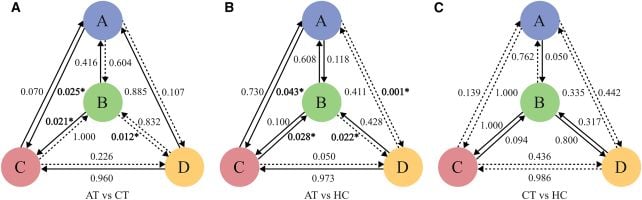
They weren’t just trying to measure the activity levels of different parts of the brain; rather, the team examined how large-scale brain networks switched on and off over time, and how those networks communicated with one another.
The two tinnitus groups showed striking differences, suggesting that patterns of brain activity change as tinnitus becomes chronic.
The brains of people who had been living with tinnitus for less than six months showed much higher activity in the brain’s salience network – a collection of regions that helps the brain determine what stimuli need attention.
At the same time, activity was reduced in the central executive network, which helps with cognitive control and habituation – the process of learning to tune out persistent background information.
In people who had lived with tinnitus for longer than six months, however, that pattern shifted.
Rather than remaining locked in the heightened state seen in recent tinnitus, their brains appeared to settle into a different, more stable pattern of communication between networks.
The researchers interpret this as a sign of neuroplastic adaptation – the brain reorganizing its activity in response to the persistent phantom sound.

That doesn’t mean that tinnitus had improved or lessened in people living with it long-term. Instead, it suggests an adaptation to a ‘new normal’ that allows people to function better around the tinnitus.
Related: Tinnitus Triggers Your Body’s ‘Fight or Flight’ Response, Study Finds
It’s a discovery that could help explain why recent tinnitus and long-term tinnitus sometimes appear to affect patients differently, and suggests that different therapeutic approaches may be warranted based on the duration of the condition.
It’s not a slam-dunk; the researchers caution that their study involved a relatively small group. It also studied people at different stages of tinnitus, rather than following the condition’s development over time.
Future longitudinal studies, they say, should track patients from onset to the chronic stage to see whether an individual’s brain changes over time.
The findings have been published in iScience.
This article was fact-checked by Peter Dockrill and edited by Peter Dockrill. While we pride ourselves on our process, we are only human. If you spot a mistake, please let us know.


