



Materials in a quantum state come with exotic properties that bend the laws of physics and offer huge potential to scientists – but they’re usually also incredibly delicate, and require ultra-low temperatures to exist and function.
That presents a problem when it comes to making the most of these materials and their characteristics: they need to move out of large lab refrigerators.
We’re now another step towards that being possible.
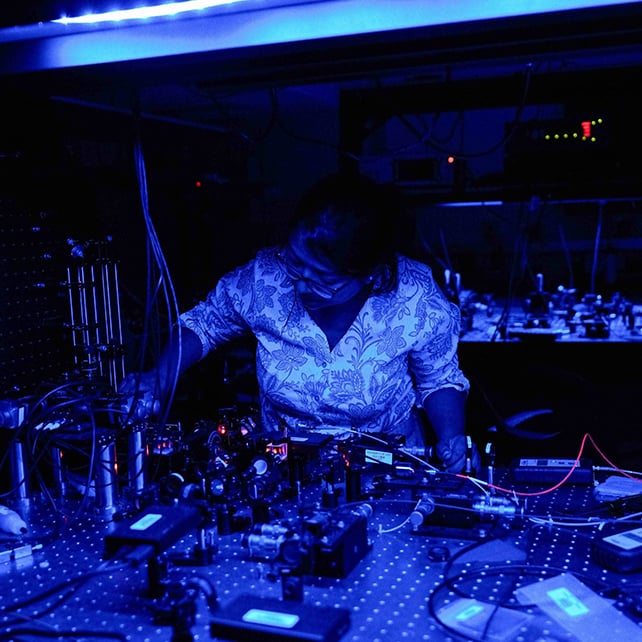
Researchers from Louisiana State University have developed a material that can demonstrate quantum weirdness at room temperature. It’s made of a thin film of gold on a glass chip, carved with microscopic patterns.
A paper on the work has been published in Nature.
Crucial to the new material’s room-temperature operation is the way it shifts the focus from electrons and atoms to photons (particles of light). This overcomes the usual atomic-level disruption that heat brings with it.
The material is what’s known as a plasmonic metacrystal: ‘Plasmonic’ because the light traveling over it makes ripples of electrons known as plasmons, and ‘metacrystal’ because it’s an artificially created crystal.
The tiny slit patterns etched into the material act as artificial atoms (meta-atoms), which dictate how different photon groups pass through (the quantum behavior).
“By engineering the distribution of meta-atoms in the plasmonic metacrystal, we can systematically dictate which quantum statistics are allowed to pass through the structure,” says physicist Riley Dawkins.
“So, our crystal essentially acts as a statistical filter on quantum states.”
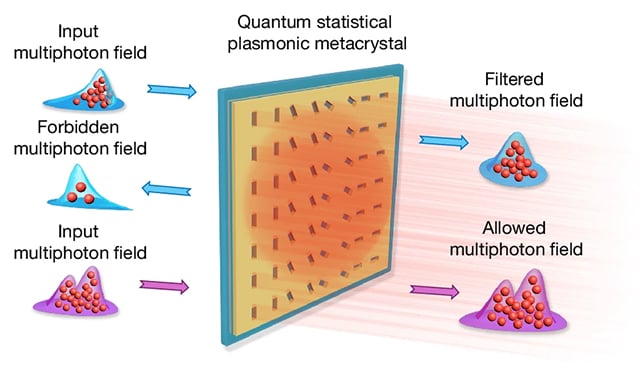
That means as light enters the chip and travels across the gold surface, it’s manipulated by the meta-atoms – and by tweaking the size, shape, and spacing of the slits, different end results can be produced at the quantum level.
In practice, this means that certain quantum states of light can be transported with less disruption.
“We call this robust transport. These quantum states carry information,” says physicist Omar Magaña-Loaiza.
“Our crystal can distinguish them and move them from one point to another in a robust way without requiring cryogenic cooling. That’s what opens the door to practical quantum technologies.”

That could be used, for example, in moving quantum information reliably and without ultra-cold temperatures. This is very much an early, proof-of-concept discovery, but it shows the fundamental science is sound.
“One of the most exciting parts of this project was realizing that we could build a material that does something nature doesn’t provide on its own,” says physicist Chenglong You.
“Seeing it work exactly as we predicted was incredibly rewarding.”
The methods used here can be expanded beyond this one material, the researchers say. Their study acts as a blueprint that other teams can follow, adjusting the size and spacing of the slits as needed to tweak the properties of the crystal, and how light is processed.
Light is itself quantum: Different types of light (from laser light to ultraviolet light) have different properties. While quantum material behavior at room temperature has been seen before, this is the first demonstration of it in an advanced light-sorting chip like this.
More generally, the unconventional behavior of quantum materials promises to be useful in computing, communications (including the quantum internet), and energy – in harvesting more power from sunlight through solar panels, for instance.
The solar cell angle is the one the researchers plan to investigate next, using their new plasmonic metacrystal to better guide incoming light and lose less of it as heat.
Related: Light Usually Speeds Things Up. Scientists Just Caught It Doing The Opposite in The Nanoworld
“For me, this wasn’t just a project – it was a collective effort built around the idea of creating something completely new in quantum technology,” says physicist Jannatul Ferdous.
“What made it truly exciting was that we were not only creating a new class of room-temperature quantum material but also developing the theory to understand and control its behavior.”
The research has been published in Nature.
This article was fact-checked by Rebecca Dyer and edited by Michael Irving. While we pride ourselves on our process, we are only human. If you spot a mistake, please let us know.


