

Autumn arrives so gently here in eastern Maine that it can feel like late summer long after the calendar says otherwise. But finally, a mid-October day comes when the sun sets before dinner, the insects cease singing, and the leaves that turned the entrance to Orono Bog into a tunnel of gold have fallen.
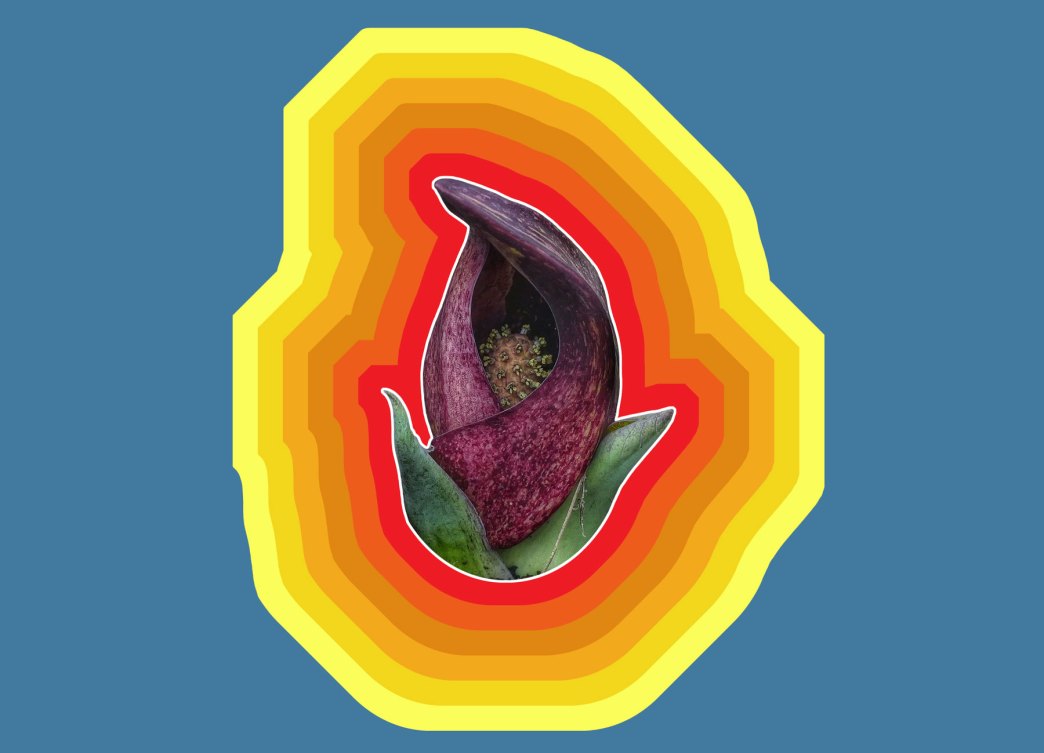
I volunteer at the bog boardwalk on Friday afternoons, and as I make my closing circuit I look closely at the mossy hummocks beside the path. Poking through fallen leaves are the tips of Eastern skunk cabbage plants: narrow green buds a few inches high with a smaller, deep crimson-and-green streaked bud at their base. The buds are sinuously triangular and with a bit of imagination resemble flames, which is only appropriate. Eastern skunk cabbages perform an extraordinary feat of botanical heat generation.
This story is from “The Hot Issue,” the latest from Nautilus.
To get it in print, join by Nov 30.
Early the following spring, when skunk cabbages will be the very first wildflowers to bloom, that smallest bud will have grown into a curved sheath called a spathe—no imagination required to see the likeness of a flame—cupping a stem topped by a flower-studded, robin’s-egg-sized inflorescence that functions as a radiator. For two weeks it produces enough heat to melt a circle of bare ground in surrounding snow and reaches temperatures up to 63 degrees Fahrenheit, warmer than the still-frigid surrounding air. In the process the plant burns as much energy as a small mammal.
“These flowers have the highest rates of energy production of any organism, including all vertebrate animals,” said Roger Seymour, a biologist at Australia’s Adelaide University who specializes in the biology of heat-producing flowers. “The only thing that comes close is the flight muscle of a bee, which has the highest rate of energy production per gram of any animal.”
In the early 1970s, Seymour and fellow biologists Kenneth Nagy and Daniel Odell showed that philodendron, another thermogenic member of skunk cabbage’s Araceae family, not only generated heat but regulated the amount, much like a mammal or bird. Biologist Roger Knutson had previously observed similar regulation in skunk cabbages in a northeast Iowa wetland. Each plant kept its spadix, as the flower cluster is known, at roughly 60 to 72 degrees F even as ambient temperatures swung from 5 to 60 degrees.
A quarter-century after that, Seymour measured skunk cabbage thermoregulation in even greater detail and concluded that the plants fueled their burn with carbohydrates drawn from their root system and rhizome. Two more decades of research by Seymour and others would illuminate much of the biochemistry involved.
As winter’s grip loosens and a skunk cabbage’s flowers mature in their flame-shaped spathe, starches in the roots are broken down into sugars that flow in sap through the plant’s veins and into its spadix. The sugars are in turn disassembled into smaller molecules and sent into the flowers’ mitochondria, the energy-producing organelles that power most cells.
Much the same happens in the mitochondria of all plants and animals, which use electrons stripped from those molecules to fuel a reaction that manufactures adenosine triphosphate (ATP), a basic molecular energy source and building block of life. But here skunk cabbage diverges: Specialized proteins cause energy that would have been stored as ATP to be released as heat.
All plants have this pathway, explains Seymour, but they typically use it to dissipate excess energy absorbed from sunlight. He compares the mechanism to an escape valve on a steam engine. Thermogenic plants are unique in how they fuel and harness the process. “The heat-producing flowers use it to extremes,” Seymour said.
Mitochondria concentrate at exceptionally high densities in a skunk cabbage’s cream-colored flowers, each about a quarter inch across, with a hundred or so clustering on the spadix. The flowers first bloom as females and remain so for about a week; they run hottest during this time, staying near 73 degrees F day and night. That seems to be the temperature at which their pollen is most viable, and heat also helps disperse the insect-attracting, carrion-like scent that gives skunk cabbages their unfortunate moniker.1 (Eastern skunk cabbage’s scientific name, Symplocarpus foetidus, sounds even worse. Also, they are not cabbages.)
After a week or so the flowers transform from female to male. As males, they still maintain optimum daytime temperatures but produce less heat at night. That’s likely because skunk cabbages only have an incentive to keep visitors around while their flowers are female.
The longer a pollen-laden insect stays, the greater their chance of delivering a few grains to receptive pistils as they clamber about—and a heated chamber is a rare comfort in that cold season after insects emerge but before spring’s warmth. When flowers are male, however, a skunk cabbage only needs a visitor to stay long enough for some pollen to stick to them. Once that happens, the plant’s reproductive purpose is best served by the insect leaving and finding female flowers to pollinate. They turn the heat down.
Other heat-generating plants may attain higher temperatures—for the first night of their bloom, Philodendron selloum flowers can reach 115 degrees F—but none regulate themselves with such exquisite precision, responding within minutes to even slight changes in ambient temperature, across days and weeks. Yet for all that is known about the heating mechanism and function of skunk cabbage thermogenesis, the biochemical basis of their thermoregulation remains unexplained.
It’s definitely happening in the spadix, and there are many proposed pathways and even speculation about thyroid hormones or nonlinear dynamics, but nothing has stuck. “We’ve been trying to find out for over 50 years, and we don’t know,” Seymour says.
Scientists have had better luck using fossils and genetic comparisons to extrapolate the plants’ evolutionary history. The Araceae family—which also includes thermogenic voodoo lilies, callas, and the 10-foot-tall corpse flowers of botanic garden fame—likely originated about 120 million years ago, placing them among the first flowering plants. The subfamily containing skunk cabbages arose at least 70 million years ago, with the Symplocarpus genus emerging in eastern Asia about nine million years ago.
Roughly 1.2 million years ago the ancestors of S. foetidus crossed the Bering Land Bridge to North America; year by year, carried by animals or falling a few feet from their parents, they spread eastward. During the last Ice Age, when the Laurentide Ice Sheet entombed much of what is now Canada and the northern United States beneath a miles-thick glacier, Eastern skunk cabbage survived in present-day Pennsylvania, West Virginia, and New Jersey. When a change in Earth’s tilt shifted its energy balance and sent the Laurentide into retreat, they surged north.
By 15,000 years ago the Laurentide had already pulled back from the coast of my home state of Maine, but the ice weighed so much that it had pushed Earth’s crust down, allowing the ocean to flow in. Fine seafloor sediments filled valleys and basins carved by the glacier. When the land finally rebounded and rose above sea level a few thousand years later, those sediments formed near-impermeable liners, slowing drainage and creating wetlands like the Orono Bog.
It was a very different world than the one in which skunk cabbages evolved. Seymour thinks their heat production was originally an adaptation for attracting tropical beetles; now it helps S. foetidus, presently found across much of eastern North America, bloom early and thrive in the cold. Only a few beetles visit, but scientists have observed many other creatures finding springtime shelter and sustenance: dozens of species of flies from at least 20 different families, as well as the spiders preying upon them. Honeybees visit too.
“It appears that they are a primary source of food for honeybees foraging in late winter, when practically no other flowers are available,” said Joanna Coleman, a conservation biologist at Queens College, part of the City University of New York. “Pollen is critically important to honeybees, both as a protein source but also to queens so they can establish their colonies.”
Black bears feast on skunk cabbage flowers and foliage—soon after flowering, their platter-sized leaves unfurl—upon emerging from hibernation. The plants are speculated to help kick-start the bears’ digestive systems, but more likely they’re simply a widely available food.2 Snapping turtles, geese, turkeys, and muskrats also eat springtime skunk cabbage. Later in the season the plants decompose, nourishing a new assemblage of invertebrates, and in late summer the berry-studded spadices feed squirrels, wood ducks, and various ground-dwelling birds.
Nobody has formally mapped the connections between skunk cabbages and all these species, and in turn their connection to other species, and then to nutrient cycles and carbon sequestration and other wetland processes. I like to imagine that web: a pulsing network with skunk cabbage at its center, a biological fire sending its energy outward.
The lifespan of skunk cabbage is estimated at a few centuries, though nobody knows for sure. One early 20th-century botanist wrote they “outrival the sturdiest of the oaks in point of age.” Despite their hardiness, they are not immune to Earth’s warming climate. Although it’s unlikely Eastern skunk cabbages will vanish—after all, they evolved in epochs much warmer than our own—subtler impacts are possible. Warmer temperatures “may eliminate the effectiveness of thermogenesis,” predicted Yasuko Ito-Inaba, a plant biologist at Japan’s Miyazaki University, and colleagues in the journal Ecology and Evolution. “Thermogenic species will not be able to attract pollinators and provide benefits to them in early spring.”
Coleman, who is studying how Eastern skunk cabbages respond to urbanization, agrees. “A central hypothesis in my research is that these plants are especially sensitive to these impacts,” she said. “Their entire reproductive strategy is an evolved adaptation to cold-weather conditions, which gives them the advantage of not trying to compete with other flowers for pollinators.” Changes in the timing of their flowering could disrupt seasonally calibrated relationships.
As for the Orono Bog’s skunk cabbages, their fate will likely come down to whether rising temperatures dry their millennia-old home. The plants are hardy but require wet soil. “It depends on the balance between precipitation and evaporation,” said Ron Davis, a wetland ecologist at the University of Maine and author of Bogs and Fens. “How much drying out is necessary to destroy a peatland? I don’t know.”
There’s no answer to these questions, only uncertainty. But for now the skunk cabbages are still growing, poking their tiny flames through the fallen leaves, the energy of spring and summer banked beneath them, promising to release their life-giving heat when winter ends.
Enjoying Nautilus? Subscribe to our free newsletter.
Lead Image: Brandon Keim