Dark Mode Light Mode
Chemistry, medicine, materials and the technology shaping tomorrow — the best science stories from trusted sources, every day.

The Man Who Saw Cats in Human Faces

The Man Who Saw Cats in Human Faces The Man Who Saw Cats in Human Faces


Imagine feline forms haunting every human face you encounter as you go about your day. Seeing these Cheshire cats flickering into view, you might think you had tumbled down the rabbit hole. It seems phantasmagorical. But this is the experience of a 28-year-old man named Karl who lives in the northeastern United States.

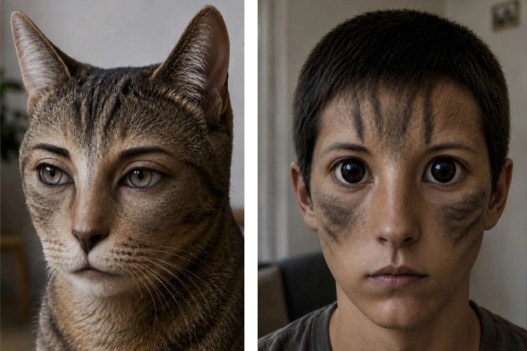
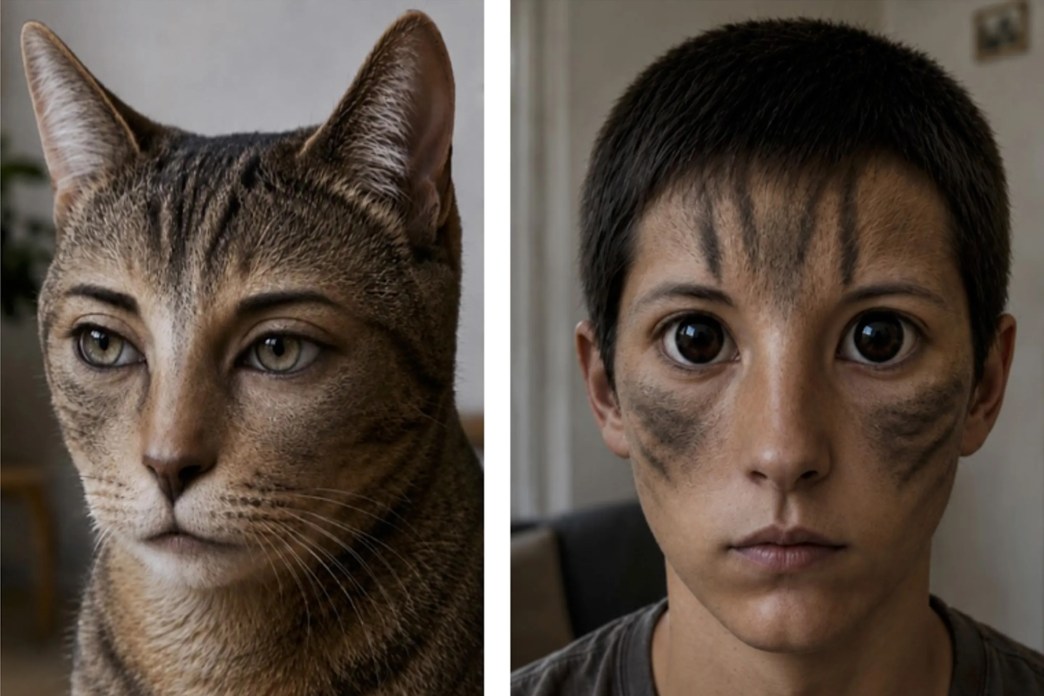
When Karl wakes in the morning, his gray tabby Luna is often the first being he greets, and Luna’s face, the first he gazes upon: the whiskers, the almond eyes, the pink nose, the stripes. When this happens, the image of Luna’s face sticks with him for several hours or even the rest of his day. He sees his feline companion’s eyes and silver stripes superimposed over all of the human faces that he glimpses, both in person and online.

Read more: “How Does Your Brain Know A Cat Is A Cat?”

The reverse is also true: If the first face he sees in the morning is a human one, he will see that person’s pupils and eye shape superimposed on every other face he sees that day, including the furry mug of his pet cat. These superpositions are seamless: The faces otherwise appear normal and coherent.

Karl’s visions began after he had brain surgery to remove some abnormally connected blood vessels from his right posterior temporal lobe, the command center for recognizing a person’s identity and reading their facial expressions. These visions, and more run-of-the-mill face distortions, where faces simply don’t look right, have plagued Karl for two years post-surgery. He appears to have developed a combination of two rare neurological conditions: palinopsia, where an image persists in someone’s field of vision after exposure, and prosopometamorphopsia, where a person sees distorted faces.

Brad Duchaine, a professor and psychologist at Dartmouth University, heard about Karl through Jennifer Nosker, a neuropsychologist at Brigham and Women’s Hospital who worked with Karl after his surgery. When Karl told Nosker about his face distortions, she found Duchaine’s work on the subject, and contacted him. At Dartmouth’s Social Perception Lab, Duchaine has been studying prosopometamorphopsia for many years, collecting accounts through a website dedicated to the condition. Over the past five years, around 275 individuals have contacted the lab through the site.

“Karl finds the transfers between cat and human faces very strange,” writes Duchaine, in an email. “He has had problems with face perception for some time, though, so he has adapted to them and takes them in stride.” All of his distortions began after his surgery, Duchaine explains.

Duchaine and Nosker recently published a case study about Karl in the journal Cortex together with a third colleague, Antonio Mello, a psychologist at Dartmouth.

Ordinarily, people with prosopometamorphopsia see alterations in the shape or position of facial features or in the color or texture of skin. For example, some people with the condition see eyes and mouths stretched into “demonic” shapes, with grooves in the forehead, or they might see features drooping, swelling or twisting. Face substitutions are an atypical expression of this unusual condition. 

Poodle Party: According to a report from 1986, following a stroke, patient 2 transposed the face of a poodle she saw onto every face she saw for at least 30 minutes. Credit: AI-generated images generated by Brad Duchaine

One of the earliest documented cases of face substitution in the scientific literature also involved a pet: a poodle. According to a case study published in Cortex in 1986, a woman known as “patient 2” was riding a bus about 9 months after a stroke when she saw a poodle in the lap of another passenger. After she looked away from the dog, however, she noticed everyone else in the bus seemed to suddenly have the poodle’s face in place of their human one. This visual hallucination continued for another 30 minutes, even after she got off the bus.

At the time, the implications of her experience seemed quite shocking: Her visions suggested that the brain processes faces differently from other categories of visual stimuli, an idea that is now widely accepted. Studies have found that the fusiform gyrus, a region of the temporal lobe, becomes active when a person is looking at faces, and only faces.

The cases of Karl and patient 2 differ in at least two ways, wrote Duchaine. “First, the woman in the 1986 case saw the poodle’s whole face on the bus passengers, but Karl sees only parts carried over, mainly the eyes and pupils. Second, the 1986 transfer went one way, from dog to human. Karl’s goes both ways. If he sees his cat first, its eyes appear on people. If he sees a person first, that person’s eyes can appear on his cat.”

In their recent analysis, Duchaine and his colleagues used artificial intelligence to generate photorealistic versions of the visions that both Karl and patient 2 might have experienced. Karl helped to revise the cat-human hybrids to match his experience, while the poodle heads were generated using line drawings made in 1986.

The images are reminiscent of the works of Matthew Grabelsky, a contemporary American artist who creates hyperrealistic oil paintings of humans with animal heads riding the New York City subway, and surrealist painter and novelist Leonora Carrington, who incorporated horse-headed women and other human-animal hybrids into her works.

Karl and patient 2 remind us that our perception of faces crosses species lines. If a single region of the brain is fundamentally wired to recognize faces in both people as well as cats and dogs, this ability may share a common anatomical blueprint that dates back hundreds of millions of years. It might even help explain why we are so quick to attribute human emotions and personalities to the other creatures with whom we share the planet and our homes.

Enjoying Nautilus? Subscribe to our free newsletter.

Lead Image: AI-generated images co-created by Brad Duchaine and Karl


Source link

Previous Post
What AI regulation could learn from the most hazardous industries in the world

What AI regulation could learn from the most hazardous industries in the world