






There’s no shortage of ways to unsettle yourself. The classic jump-scare or eerie monster story will do the trick. But pondering the depths of space and the extents of time, or the existential risks inherent in both technology and nature, can just as easily leave you reeling. So too can an idea that inverts your assumptions about the world and makes you question the foundations of your own reality. The unlit corners of human knowledge can feel like their own kind of lurking monster.
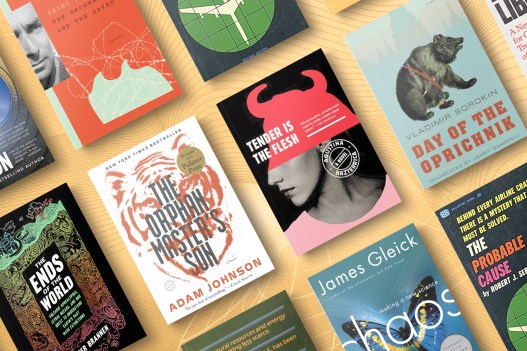
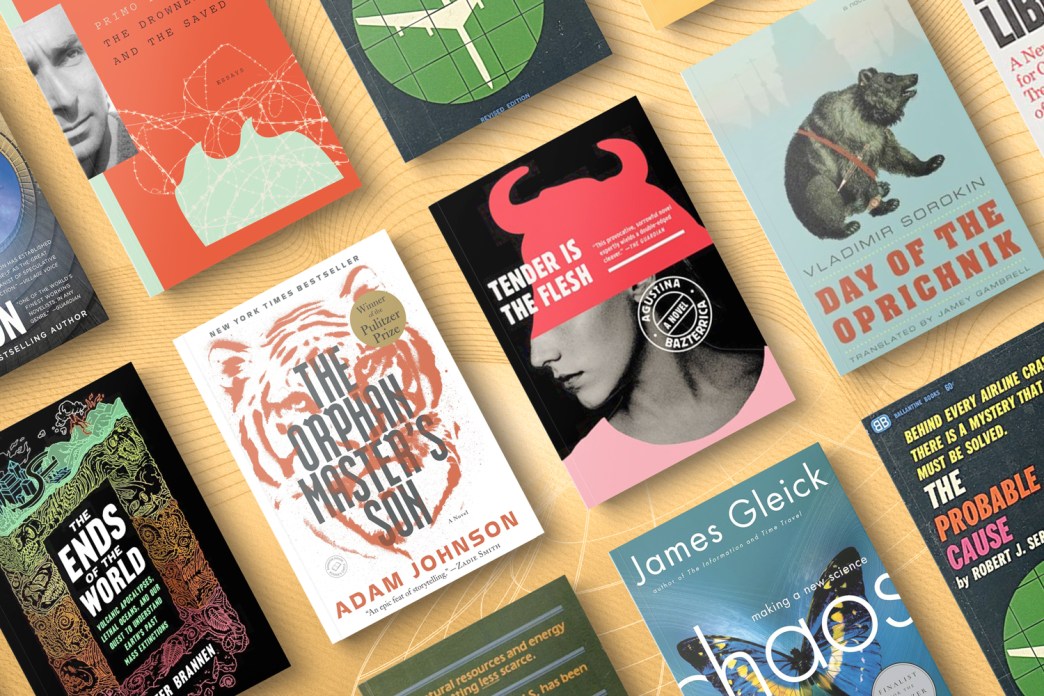
This Halloween, we offer you a dozen books recommended to us by some of our favorite scientific and artistic luminaries, each of which may fill you with both wonder and terror. While you might want to proceed with caution, our scientists and artists warn us, you will find an enriching light at the end of these 12 literary tunnels.
The Ministry for the Future by Kim Stanley Robinon
Katie Mack, theoretical astrophysicist, chair in cosmology and science communication at the Perimeter Institute, author of The End of Everything (Astrophysically Speaking): “It’s a climate change story, but specifically one about how we might, possibly, maybe, find ways to cope and survive in the future. The opening chapter, a vivid description of a deadly, extreme heat event, is horrifying and haunting. I first read it shortly after its publication in 2020, and while I was at the time disturbed by the descriptions of climate disasters, it has become much more unsettling in the years since, with extreme weather events becoming much more frequent, and political shifts making positive change look harder to achieve. It’s a book I find hopeful and unsettling in equal measure, and I’m both eager and terrified to see how it will read ten or twenty years in the future.”
The Ends of the World: Volcanic Apocalypses, Lethal Oceans, and Our Quest to Understand Earth’s Past Mass Extinctions by Peter Brannen
John D. Boswell, filmmaker and composer, whose projects include Symphony of Science, which sets the words of Carl Sagan, Richard Feynman, and other great scientists to music: “No other book has done more to illuminate the ancient past than this one, and in the most disturbing way. It paints a picture of all the major extinction events in Earth’s history, from the mysterious Ordovician extinction to the demise of the dinosaurs, in excruciating detail that feels lifted from a horror film. But the most alarming passages detail just how quickly the Earth can upend itself—systems that appear stable for millions of years can suddenly flip and cause climate chaos, with unpredictable ripple effects through our planet’s ecosystems. I’ve never been more captivated by a book, which manages to excite me and terrify me in equal amounts.”
The School of Night by Karl Ove Knausgaard
David Krakauer, President and William H. Miller Professor of Complex Systems at the Santa Fe Institute: “The novel starts with a claustrophobic and thwarted childhood in Norway, followed by angry disregard in an art school in London, and then an uncanny Faustian pact is made. The protagonists’ success is accelerated until the inevitable decline into hell. This is all achieved in dismal London streets and isolated farmhouses on rainy archipelagos. As in Christopher Marlowe’s original Doctor Faustus, the question this novel asks is, ‘How much is anyone prepared to pay for success and fame?’ The answer is unsettling.”
Chaos: Making a New Science by James Gleick
Robert Sapolsky, neuroscientist, primatologist, and author most recently of Determined: A Science of Life Without Free Will: “This book shows us that the world can be utterly deterministic yet formally unpredictable. And it doesn’t matter how big of a metaphorical magnifying glass we have to look at some phenomenon: Unpredictability is just intrinsic. The book completely destroyed my faith in reductionism as a way to understand complex systems (like us….). And it’s a beautiful read as well.”
Animal Liberation by Peter Singer
Ingrid Newkirk is the co-founder and president of People for the Ethical Treatment of Animals (PETA): “I grew up justice-minded, dead set against tyranny of any kind. Or so I thought. It came as quite a shock to realize I’d forgotten my Biology 101. Here was this book saying what I didn’t realize I must have always believed, which is that it’s not enough to make the chain longer for the dog, make the cage bigger for the monkey in the lab, try to treat them with kindness while they were being used, exploited, killed. It was the fact that they’re just like us. They are us. They’re other individuals. And I thought, my God, it’s true. I had to tell other people what he’s saying. And so I formed People for the Ethical Treatment of Animals to get the Singer message out, the message of animal liberation.”
Tender is the Flesh by Agustina Bazterrica
Rumman Chowdhury, data scientist, AI developer, quantitative social scientist, founder of Humane Intelligence public benefit corporation: The 2017 novel by Argentine writer Agustina Bazterrica “comments on factory farming and the meat industry, but it also reflects how desperately people cling to social normalcy when faced with dehumanization. I see it relating to AI, as technology becomes a convenient tool by which we can dehumanize others while hiding behind a technological veil. Anthropomorphic language conveniently hides corporate misdeeds as ‘advanced technology,’ enables the exploitation of global south workers to create a safer internet for wealthier nations, and allows a handful of men to dictate geopolitics and economics. In this book, veiled language and institutional sanitization allow for abhorrent acts—the optics mattered more than the reality.”
Day of the Oprichnik by Vladamir Sorokin
David Brin, astrophysicist, award-winning science fiction author of novels including The Postman and Startide Rising, and nonfiction works including The Transparent Society: “The novel follows one of the most despicable denizens of any story, ever—a member of the Russian Oprichina secret police, using near-future tech combined with sadism to enforce the power and whims of a new Czar—the long openly-planned goal of Vladimir Putin. Both fast-paced and creepy, this novel belongs in the top rank of dire warning tales alongside 1984, especially as it’s become clear how eagerly oligarchs seek—now with perverted versions of AI—to end our brief enlightenment experiment and restore 6,000 years of dismally-lobotomized and cruel feudalism.”
Never Let Me Go by Kazuo Ishiguro
Anil Seth, neuroscientist, professor of neuroscience at the University of Sussex, author of Being You: A New Science of Consciousness: “Everything starts so normally, but—as often is the case with this brilliant writer—nothing is normal at all. The novel begins in a seemingly idyllic boarding school in the English countryside, with three friends growing up together. Little by little the sheen of normality fades to reveal some very unsettling undercurrents indeed. The book paints a vivid picture of a rural dystopia made all the more real by the contrast between the quotidian and the unimaginable. But Ishiguro does the imagining for us, and we readers reap the consequences. I read it once and have never forgotten it.”
The Drowned and the Saved by Primo Levi
Jamie Metzl, technology futurist and geopolitical expert, whose nonfiction books include Hacking Darwin and Superconvergence, as well as the novel Eternal Sonata: “What I found so deeply unsettling about The Drowned and the Saved is the way it challenges our belief that extreme crisis will somehow bring out the best in us. Levi shows how suffering can deepen humanity, but can also distort, compromise, and diminish it. That recognition has stayed with me because it suggests we need to spend our lives preparing ourselves morally and emotionally for the challenges ahead, while accepting that we can never be fully prepared. Feeling unsettled by that tension is part of the point, and books like this help us understand more clearly who we are and who we have the potential to become, for better and for worse.”
The Orphan Master’s Son by Adam Johnson
Julie Schwartz Gottman, psychologist, co-founder of the Gottman Institute, leader in relationship and love research: “The reason this book [based in North Korea] was so unsettling was that horrific things are happening to these characters with almost no opposition. It’s just unreal what people will subject themselves to because they assume they are helpless and powerless. Given I’m Jewish, it really corresponded to how passive our people were during the Holocaust. The reality is that we probably could have fought back, as they tried to do in the Warsaw Ghetto. I see us going in the same direction, and it is terrifying.”
The Ultimate Resource by Julian Simon
John Tierney, science writer, contrarian, coauthor of Willpower and The Power of Bad: “This optimistic book by the economist Julian Simon was a truly unsettling challenge to the doomsayers predicting an ‘age of scarcity’ due to the ‘population crisis’ and shortages of food, energy, and other resources. His great insight—that shortages would be averted thanks to the ultimate resource, human ingenuity—has been confirmed repeatedly, most famously in a $1,000 bet with ecologist Paul Ehrlich about trends in resource prices. Just as Simon predicted, the real prices of food and natural resources went on declining—as they have for centuries due to innovations that lifted billions out of poverty. There will always be doomsayers, but don’t bet against human ingenuity.”
The Probable Cause: The Truth About Air Travel Today by Robert Serling
Lois McMaster Bujold, award-winning science fiction author of the Vorkosigan Saga: “Published in 1960, this is a history of the development of probable cause investigations in air travel and is one of several books I inherited from my engineering-professor father, nondestructive-testing being very much his field. It’s been quite a while since I reread it, although it did feed into several characters and plots in my work, especially the novel Komarr, which indeed features a probable-cause investigation into a space accident, or was it…? I think about this stuff every time I fly. Because if you’re going to be afraid, it at least should be due to well-documented reasons.”
Enjoying Nautilus? Subscribe to our free newsletter.


