


There are many contrasts between ice and fire in both real and fictional worlds – from the volcanoes of Iceland, to the Game of Thrones fantasy series.
These two elements were at play in the early, formative years of our Solar System, too.
In the region surrounding the early Sun, fire was represented by chondrules, tiny fragments of rock that had been formed through intense heat. For ice, there was matrix, a fine-grained and cold dust loaded with water ice and organic molecules.
We know that from about 2 million years after the Solar System started to take shape, chondrules were winning out over matrix in the formation of planetesimals – the larger celestial objects that had the potential to grow into planets and moons.
From about 4 million years onwards, the icy matrix elements started to win out.
Now, a study published in Nature Astronomy by an international team of researchers has provided the first geochemical evidence of the composition mix for bodies born in the first million years of our patch of space, and it was fire – the chondrules – that were dominating.
“These ubiquitous little beads of rock are the basic building blocks from which the planets themselves were eventually assembled,” says Earth and planetary scientist Damanveer Grewal from Yale University.
“And now we know they were already being sorted and incorporated into the first generation of solid bodies from the very start.”
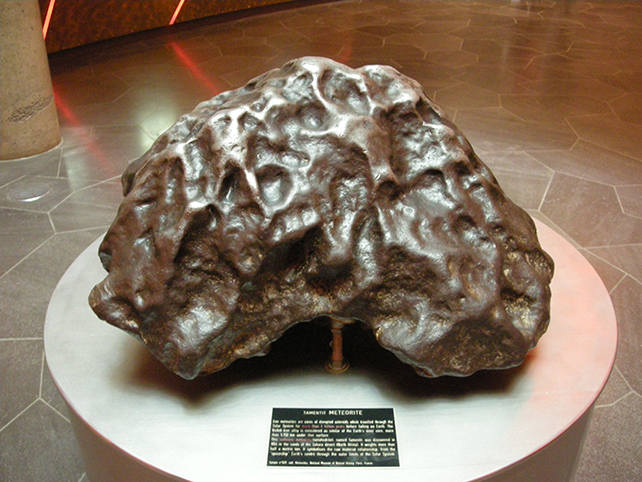
The researchers analyzed data from iron meteorites that had fallen to Earth, containing chemical ‘fingerprints’ of chondrule and matrix mixing. Radioactive dating, and the fact that their parent bodies melted completely, place these meteorites at the very start of the Solar System.
There was very little ice in these objects, the analysis determined, though it increased in bodies that formed later – consistent with what we know from 2 million years onwards.
“The earliest bodies in the outer Solar System were built from 83 percent to 92 percent chondrules, with very little of the icy, volatile-rich dust that dominates later-forming objects,” says Grewal.
The research team was looking for two ‘tracers’ in the meteorites: the estimated level of sulfur, which is much more abundant in matrix than in chondrules, and the oxidation of the iron, which reveals how much water ice and oxidized dust they took in.
While each of these approaches involves some educated guesswork about the larger planetesimals that were once connected to these iron fragments, it’s significant that they both point in the same direction.
“Both tracers independently tell the same story: These early planetesimals were remarkably matrix-poor,” says Grewal. “That convergence is what makes the result robust.”

frameborder=”0″ allow=”accelerometer; autoplay; clipboard-write; encrypted-media; gyroscope; picture-in-picture; web-share” referrerpolicy=”strict-origin-when-cross-origin” allowfullscreen>
The findings also help explain why there are so few early-formed chondrules in the meteorite record: The rocks they were part of later melted due to internal heat, erasing the evidence.
So why did chondrules start out so strong at the very beginning of the Solar System’s existence? The researchers put it down to what’s known as aerodynamic sorting.
This means the physical characteristics of the chondrules – stronger, more compact – increased the chances of them clumping together. Over the next few million years, something changed to affect that, though it’s not yet entirely clear what.
Now we’ve established what happened in our own Solar System, it could give experts a new perspective on the formation of other planets and moons elsewhere in the Universe.
These objects aren’t just a random mixture of whatever materials happen to be around – there’s some level of picking and choosing going on.
“Our work shows that this assembly process was remarkably selective from the very beginning,” says Grewal.
The research has been published in Nature Astronomy.
This article was fact-checked by Peter Dockrill and edited by Peter Dockrill. While we pride ourselves on our process, we are only human. If you spot a mistake, please let us know.


