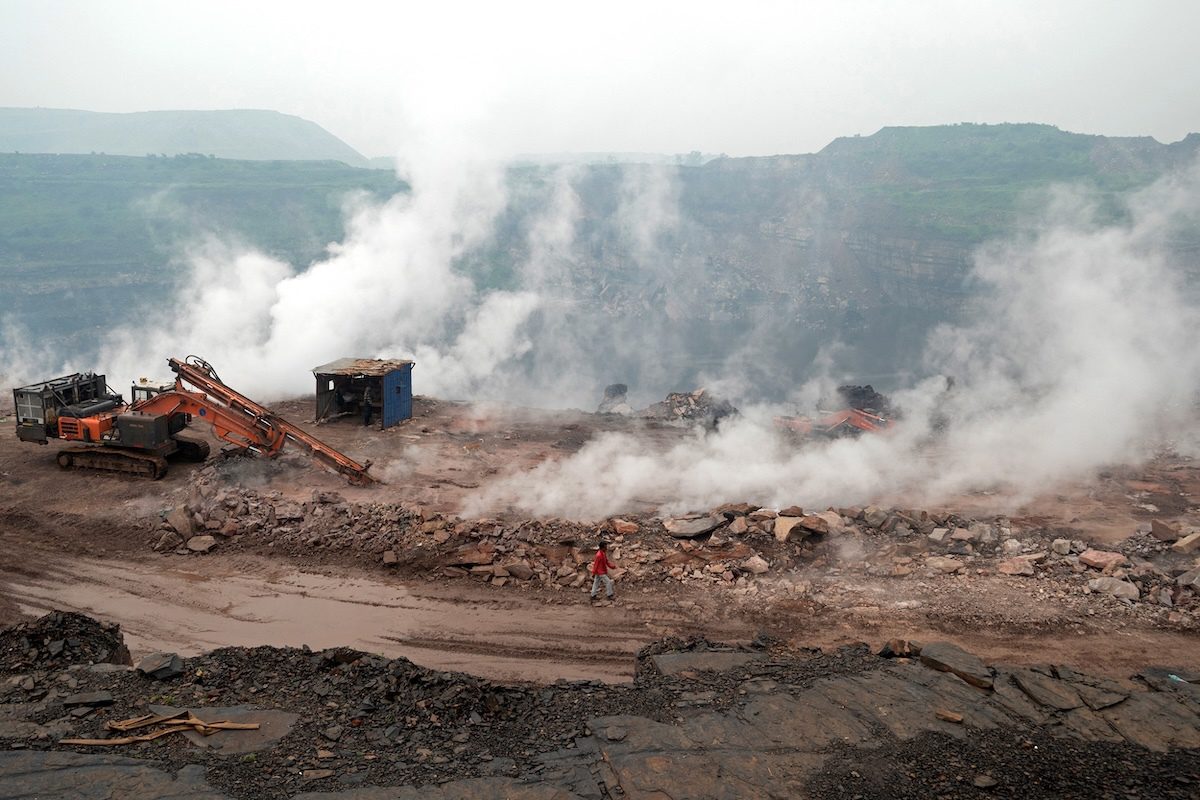




Observations from data-scarce regions, such as low-lying island Tuvalu in the South Pacific, are crucial to weather forecasts, early warning systems and climate-information services elsewhere. Credit: Mario Tama/Getty
When I talk about collecting essential weather and climate data in countries with limited resources, many take it to mean that wealthier countries, institutions and firms should ‘help poorer ones’. But as a development and climate-finance executive, I know that this is an investment rather than an act of charity. Science proves it: better forecasts at home rely on observations abroad.
That’s the resounding conclusion of a report published this month by The European Centre for Medium-Range Weather Forecasts (ECMWF) in collaboration with the World Meteorological Organization (WMO). The report was commissioned by the Systematic Observations Financing Facility (SOFF), a United Nations fund dedicated to basic weather and climate data around the world, of which I am a director.
Its aim was to establish the benefits of filling gaps in the WMO’s Global Basic Observing Network (GBON), which defines member nations’ mandatory weather-station coverage. To comply, each country must have a land station every 200 kilometres, as well as a weather balloon every 500 kilometres over land and every 1,000 kilometres over sea to collect data on essential variables (such as temperature, pressure, humidity and wind).

Global climate body fights for survival: why the IPCC must be saved
But agreeing on standards and sites is not the same as having the economic means to implement them. Since 2023, GBON stations have been required to share their data. Yet, about 90% of weather data from low-income countries and small island nations are not being shared. Some data are not even collected because many stations are missing, stopped working or cannot transmit their measurements.
These gaps don’t just impede local forecasts, they affect regional and global projections too. Daily weather data feed into increasingly sophisticated computer models that predict how weather systems around the world evolve.
Think of a weather forecast as a photograph. It is made up of millions of pixels, each contributing a small piece of information. Weather forecasting is more complex, but the analogy helps to explain the problem: if too many ‘pixels’ are missing, the global picture is blurry or incomplete. And for forecasts, some ‘pixels’, or observations, are more valuable than others. Plugging gaps in data-scarce regions is the best way to improve forecasts everywhere.
It is also a matter of justice: on average, a seven-day temperature forecast in a high-income country is as accurate as a one-day forecast in a low-income country (M. Linsenmeier and J. G. Shrader Nature Commun. 17, 10792; 2026).
The results of the ECMWF simulations are striking. Better coverage in low-income countries and small island states can cut uncertainty in 12-hour local forecasts by more than 30% in parts of Africa and by up to 20% across the Pacific.
Extra data in all countries eligible for development assistance and small island nations would improve the accuracy of temperature and wind forecasts up to six or seven days ahead in the tropics, home to some 40% of the world’s population, and in the Northern Hemisphere’s mid-latitudes, where much of Europe, North America and northern Asia sit. This would help with, for example, aviation and maritime operations, planning of agricultural activities, water management and preparations for severe weather.
Disparity in countries’ capacity to finance weather observations is striking. To quantify the inequality, SOFF developed an indicator comparing countries’ gross dom-estic product (GDP) with the geographical area for which they are mandated to provide observations, including marine exclusive economic zones. For example, although it is a small country, Switzerland has a larger budget than does Tuvalu, a Pacific island nation spread across an immense ocean area (Switzerland’s GDP is around 300,000 times larger per square kilometre). Yet both countries contribute to and benefit from the same global observing system.