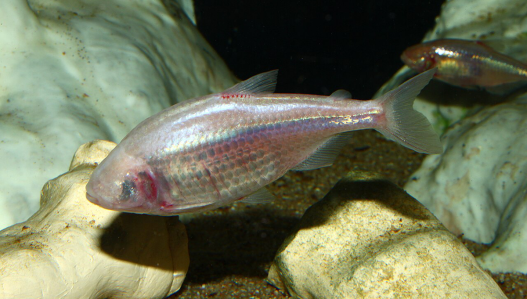
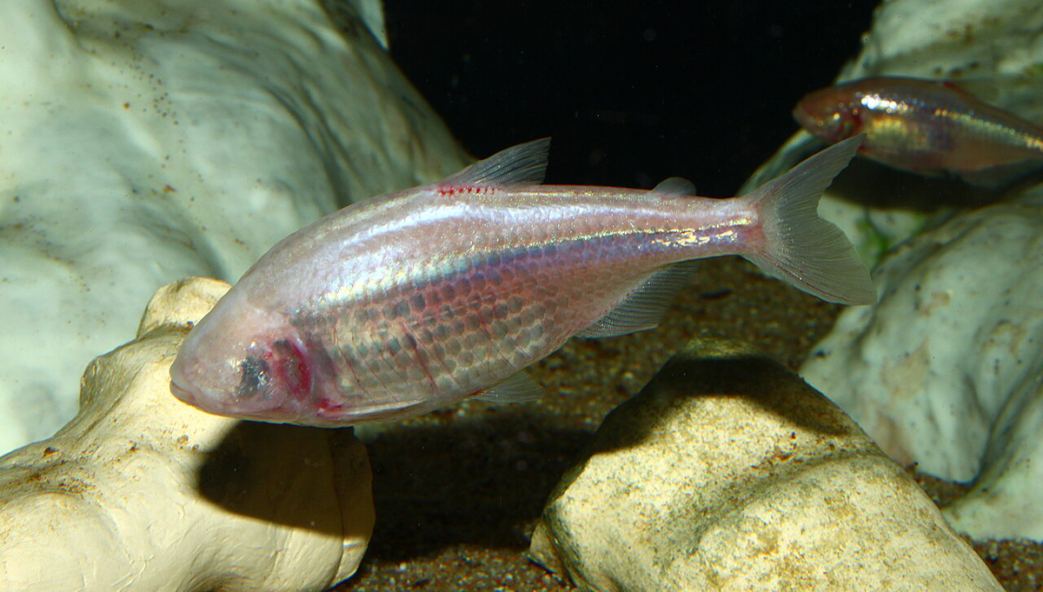
If a population of humans were to move entirely into dark, underground caves, you’d expect to see changes in their behavior. They’d favor other senses over eyesight; their vision might adapt to favor low-light receptors; and they’d learn to subsist on limited resources.
While this scenario sounds apocalyptic for us, it’s run-of-the-mill for blind Mexican cavefish (Astyanax mexicanus) as they’ve evolved over several hundred thousand years to survive in the dark world of caves.
A new study published in Science Advances compared Mexican cavefish to their surface-dwelling relatives to see how their brain and behavior got rewired for a life in darkness. Led by researchers at Florida Atlantic University, the study examined how Astyanax responded to light cues through movements and activation of their neural circuits. Lab-reared fish were videotaped in a custom chamber while exposed to five-minute cycles of light and dark.
The fish with sight responded with hyperactive behavior when submitted to darkness. Conversely, the cavefish became hyperactive when submitted to light. Similarly, a photokinesis index calculated on movements toward or away from light showed surface fish to be light seeking, while cavefish were light averse. In tandem with their contrasting behaviors, light-receptive neurons in the brains of surface fish, but not in the cavefish, responded to the lights on.
Read more: “What We Can Learn from an Insomniac Fish”
By imaging the neuronal responses across brain regions, the researchers homed in on the “caudal posterior tuberculum” of the brain as the place where photokinesis happens. “Remarkably, neurons that respond to darkness in surface fish were found to respond to light in cavefish, suggesting that evolution can repurpose existing neural circuits rather than creating entirely new ones,” explained senior author and Florida Atlantic University biologist Erik R. Duboué in a press release.
When the researchers mated surface fish with cavefish, their responses to light were mixed, indicating a genetic basis for the behaviors. Photokinesis appears to be a gene trait passed from parent to offspring, such that it’s subject to natural selection, which explains how cave populations have evolved to be blind and light averse. Cavefish that avoid light may have a survival advantage by keeping away from cave entrances where predators lurk.
“By understanding how evolution modifies neural circuits to process environmental information,” said Duboué, “we can gain deeper insights into the fundamental principles that shape behavior across the animal kingdom.”
Humans, for example, share many of the same neural pathways with fish (since we’re also vertebrates). Knowing how evolution acts on those pathways gives us a model for how a brain rewires itself to adapt to the conditions at hand.
And so, cavefish are shining a bright light into the mysteries of the brain.
Enjoying Nautilus? Subscribe to our free newsletter.
Lead image: H. Zell / Wikimedia Commons