Dark Mode Light Mode
Join us on a journey where chemistry meets creativity, and the wonders of science unfold. Quench your intellectual thirst with thought-provoking articles that transcend the boundaries of conventional knowledge.

Watching unpaired electrons at work | Research

Watching unpaired electrons at work | Research Watching unpaired electrons at work | Research


Electron paramagnetic resonance (EPR) spectroscopy may not be as mainstream a technique for chemical scientists as nuclear magnetic resonance (NMR) spectroscopy, but Maxie Rößler is determined to show why it deserves greater attention.

‘You can think of EPR a bit like NMR, but for unpaired electrons instead of nuclei,’ explains Rößler. It works by placing a sample in a magnetic field and measuring how its unpaired electrons absorb microwave radiation, which reveals information about its local chemical environment and structure. ‘I think many scientists would probably consider it a niche technique, but it’s definitely underused.’

Because EPR spectroscopy depends on unpaired electrons and most molecules are diamagnetic, this restricts the range of systems that EPR can probe. However, in many cases reactions cycle through important paramagnetic states and increasingly there are tools to capture and interrogate such states. Indeed, for biomolecules, introducing spin labels such as nitroxides has expanded the scope of EPR, opening ‘new directions and areas that people hadn’t considered,’ explains Rößler. Even so, her work has focused more on unpaired electrons that form naturally in biological and chemical reactions alongside developing methods to capture them. 

Another barrier to the wider appreciation of EPR spectroscopy, Rößler says, is because it still isn’t widely taught at undergraduate level. At Imperial College London, UK, Rößler delivers three EPR spectroscopy lectures in the second‑year chemistry course and every year, student feedback includes the same demand: they want more. EPR spectroscopy also features in the third‑year bioinorganic module she teaches, and Rößler has worked to embed the technique into teaching labs too. Students now encounter EPR spectroscopy in a synthetic practical on copper complexes: ‘Copper in the +2 oxidation state is a very nice example for EPR spectroscopy. Its spectrum changes depending on what the ligand field environment is. And you can link that back quite nicely to group theory.’
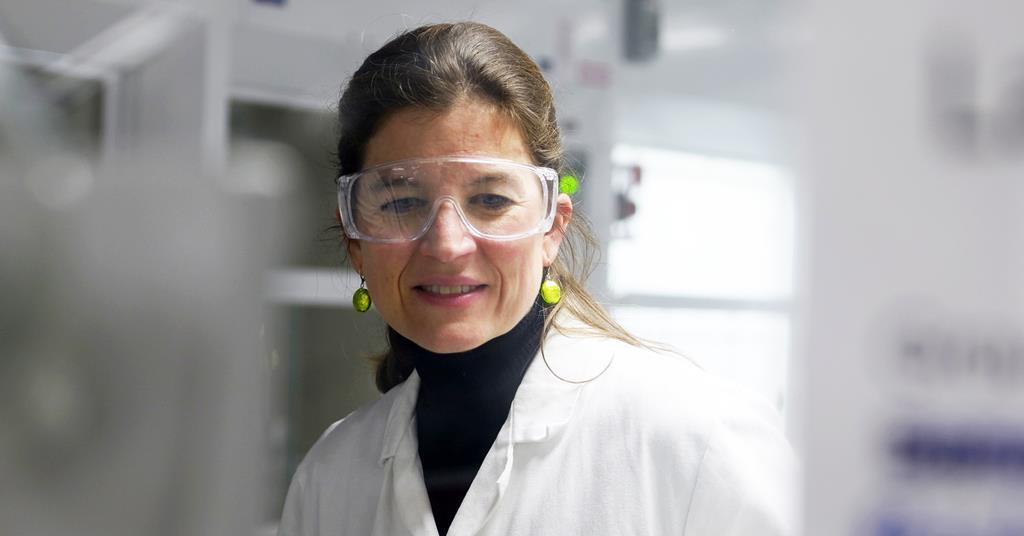
Maxie Rößler

I think many scientists would probably consider EPR a niche technique, but it’s definitely underused

Maxie RößlerSource: © Reel Vision/The New York Academy of Sciences/Blavatnik Awards

When Rößler moved to Imperial in 2019 it had no pulse EPR spectroscopy capability. Backed by a £2.3 million equipment grant from the UK’s Engineering and Physical Sciences Research Council, and supported by her department, the wider university and a network of national and international collaborators, Rößler set about building the Centre for Pulse EPR (PEPR). ‘I completely underestimated how much effort this was going to be, there was no infrastructure at all for what we needed,’ says Rößler, adding that she now knows more than she ever imagined she would about electrical power supplies and chillers.

More than a service facility

Based in Imperial’s Molecular Sciences Research Hub in a room that was originally meant to be a glass blowing facility, PEPR now houses state‑of‑the‑art continuous wave and pulse EPR spectroscopy instrumentation. It is not just a service facility, but also a space for developing new instrumentation and methodologies. ‘We have collaborators at UCL [University College London] with whom we are trying to push the sensitivity limits of EPR.’

‘From the outset, the idea was to create a completely open access facility, so anyone can apply for time at PEPR,’ she says. Rößler is directly involved in many of the projects that pass through PEPR and in some cases they open up new directions for her own research.
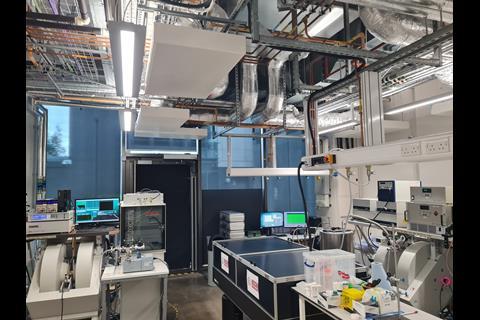
The combination of cutting‑edge instrument development, broad open access and unique capabilities – including film‑electrochemical EPR spectroscopy, a technique pioneered by Rößler – sets PEPR apart from other EPR facilities in the UK.

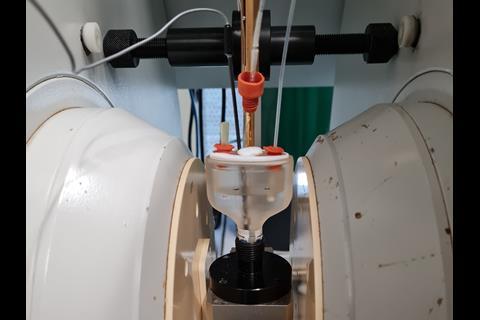
Film‑electrochemical EPR spectroscopy allows electrochemical reactivity and spectroscopic structure to be probed at the same time. It immobilises redox‑active molecules as a thin film on an electrode inside inside the EPR resonator, which makes it possible to control its redox state through an applied potential. Electrochemistry is carried out in situ and intermediates with unpaired electrons are simultaneously captured with EPR. However, paramagnetic species such as metal centres in biomolecules are often too short-lived to be observable at room temperature. In this case, the sample is flash‑frozen so that short‑lived paramagnetic intermediates can be analysed by EPR.

Rößler first began thinking about the approach during her PhD in Fraser Armstrong’s lab at the University of Oxford, UK, where she was something of an outlier using EPR spectroscopy while most of the group focused on protein film electrochemistry. She was trying to prepare EPR samples of hydrogenases to capture their transient states while knowing exactly where the enzyme sat within its catalytic cycle. Existing methods, however, could not connect short-lived paramagnetic intermediates with their electrochemical behaviour. Although ambitious, overcoming that challenge became a central driver of her research.1 ‘I’m hoping that ultimately, we can watch what unpaired electrons are doing in a catalytic reaction, or at least in pseudo real time.’

Tracing the paths electrons take

In 2024, Rößler’s team unveiled an operando version of their film‑electrochemical EPR technique, allowing surface‑immobilised electrocatalysts to be studied as they work.2 Using the method, they tracked short‑lived radical species during redox reactions in real time, under flowing, room‑temperature aqueous conditions. When applied to alcohol oxidation by a nitroxide catalyst anchored to an electrode, the approach revealed that electron transfer at the surface limits catalytic efficiency, offering valuable guidance for designing improved catalysts.

Electron transfer reactions have fascinated Rößler since she was at high school. ‘Fundamental processes in nature – from us breathing in oxygen and making the energy that powers us every single day, to plants taking in the carbon dioxide that we exhale and then turning that into oxygen – involve electron transfer.’ Rößler’s research group is now investigating electron transport within membrane proteins which play important roles in mitochondrial respiration and photosynthesis. These biological catalysts contain numerous electron-transfer centres which can cycle through EPR-visible paramagnetic states, helping to understand how they work.

Photosynthetic complex I was first identified as a homologue of respiratory complex I, the first enzyme in the respiratory chain that’s responsible for energy production in mitochondria. Using a pulse EPR technique that captures the dipolar interaction between paramagnetic iron-sulphur clusters in the enzyme, in conjunction with electrochemistry, and capitalising on the high-sensitivity set-ups developed together with UCL, Rößler’s team uncovered the energetic profile of this enzyme – and how this differs from its mitochondrial homologue.3 Before this work, photosynthetic complex I was understood largely through genetic studies and cryo-electron microscopy snapshots. Now, it is clearer how electrons are channelled through this key enzyme that balances the energy demands of photosynthesis in many cyanobacteria and plants.

Earlier this year, Rößler was named the chemical science laureate at the 2026 Blavatnik Awards for Young Scientists in the UK, in recognition of her work developing powerful electron paramagnetic resonance techniques to track short-lived radicals, revealing how electron transfer powers cellular energy production, photosynthesis and fundamental catalysis. ‘I missed the call because I was in Switzerland giving a talk. And when I got the email, I had to read it five times before I could believe it…. The Blavatnik event was spectacular and the award feels like a huge opportunity, a huge honour, not just for me but for my group and my collaborators.’
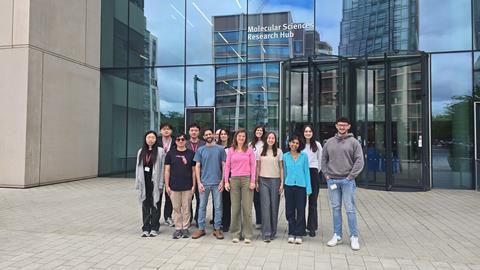
Group photo

‘I have a very diverse group. They’re not necessarily all chemists and they come from all parts of the world. I really love that it’s so international… I try very much to give my team members independence. My own PhD supervisor, Fraser Armstrong, never micromanaged us and I try not to micromanage my group, and instead to really listen to their ideas.’

Rößler sees it as a privilege to work with enthusiastic, energetic and bright young scientists, and to be constantly learning from her team, collaborators and colleagues. That human aspect feeds into her scientific drive: the desire to make a small but meaningful contribution to advancing human knowledge, while helping to train the next generation of researchers. At the heart of her research ambitions is a longer‑term goal – to watch electrons moving through electron‑transfer systems in real time, no matter how complex, and to develop approaches that might not only lead to new breakthroughs in her own work, but also empower others across different fields to do the same.


Source link

Keep Up to Date with the Most Important News

By pressing the Subscribe button, you confirm that you have read and are agreeing to our Privacy Policy and Terms of Use
Add a comment Add a comment

Leave a Reply

Your email address will not be published. Required fields are marked *

Previous Post
Motorola Phones Now Have a Built-In Travel eSIM for Mobile Data Outside the US

Motorola Phones Now Have a Built-In Travel eSIM for Mobile Data Outside the US

Next Post
UKAEA and CFS partner on tritium production for fusion energy

UKAEA and CFS partner on tritium production for fusion energy

Advertisement