




We have identification of humans down pat—a complete human fingerprint can pinpoint the person it belongs to more than 90 percent of the time, according to forensic scientists. To study animals in the wild, biologists also need to identify individuals, but they don’t have reliable proxies for fingerprints. That’s because, other than mammals, vertebrate animals lack unique ridge patterns on their fingers.
But now, a study published in the journal Herpetozoa reports a reliable way to identify individual frogs without having to catch them. Typically, frog tissue samples for DNA analysis are clipped from the ends of toes. The capture and clipping can be stressful, however, especially for tree frogs, which use their toes to stick onto substrates.
Read more: “The Secret Lives of Japanese Temple Frogs”
“Personally, I was uncomfortable with this approach, especially given that these are arboreal frogs that rely on their limbs to climb trees,” explained lead study author Mélissa Peignier from the University of Bern in Switzerland.
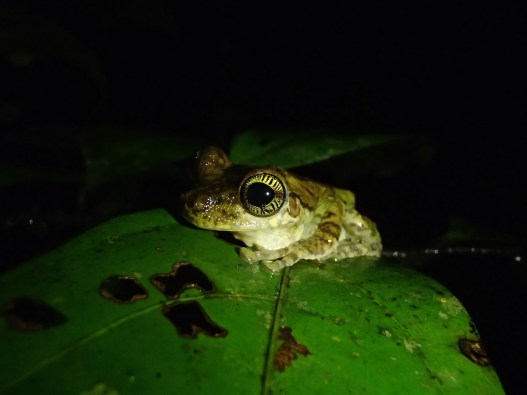
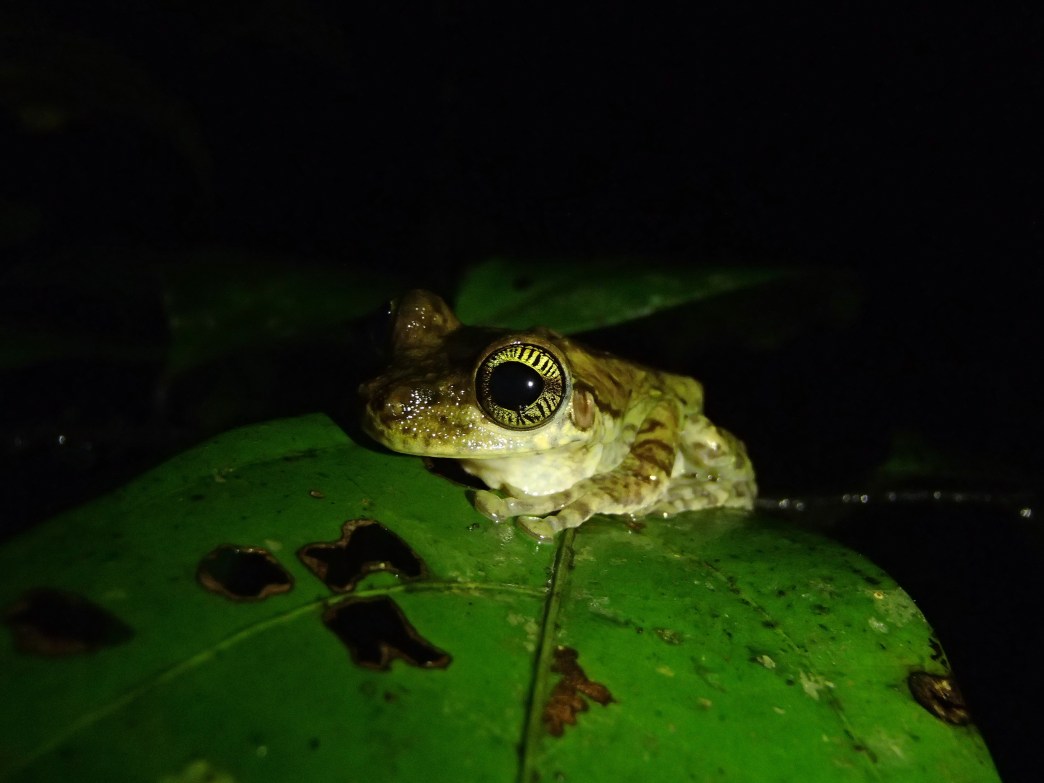
And so, having noticed the unusual eyes of the egg-eating spiny-backed frog (Osteocephalus oophagus)—its irises are golden colored with radial black lines like the spokes of a wheel—Peignier and her coauthors decided to test whether such iris patterns were distinct enough for individual recognition.
They captured and released frogs over several years in lowland rainforests of French Guiana, a stronghold for spiny-backed frogs, which stay in the forest canopy during the day but descend to ponds for breeding during the rainy season. Each frog was hand-caught, then photographed and released. Photos of their eyes were compiled into a reference library for repeat use in identification.
Of the 392 frogs captured, 103 unique individuals were identified by their iris patterns. And within a season, more than half of these individuals were recaptured and consistently reidentified from their irises, showing that iris color patterns are stable at least in the short run—and a much more humane way to potentially track such species in the future.
Or as Peignier put it, “If we can reliably identify individuals using naturally occurring features, we may be able to reduce the need for more invasive marking techniques while still collecting the data needed to answer important scientific questions.”
Enjoying Nautilus? Subscribe to our free newsletter.
Lead Image: Mélissa Peignier et al., 2026


