Dark Mode Light Mode
Chemistry, medicine, materials and the technology shaping tomorrow — the best science stories from trusted sources, every day.

When Texas Bat “Cities” Look Like Thunderstorms

When Texas Bat “Cities” Look Like Thunderstorms When Texas Bat “Cities” Look Like Thunderstorms


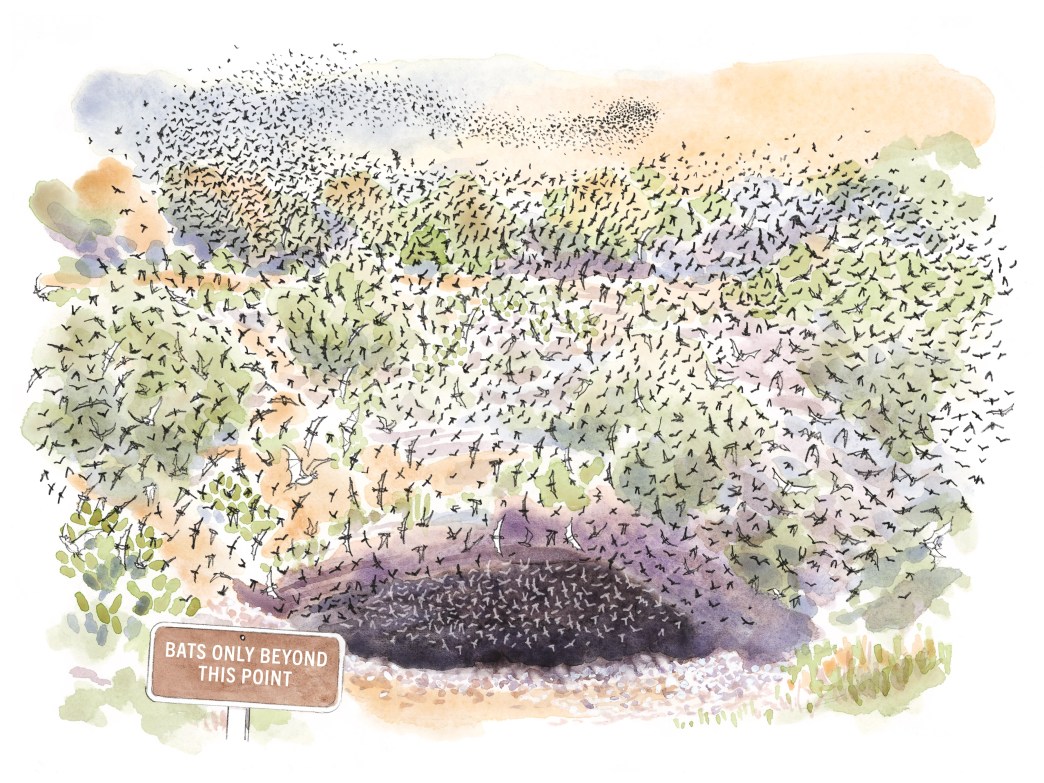
For at least 8,500 years, the community inside Texas’ Bracken Cave has swelled exponentially every spring as up to 10 million free-tailed bats fly 700 miles north from various smaller roosts in and around central Mexico. After mother bats give birth to their pups, the population will double again to nearly 20 million—the largest congregation of nonhuman mammals on Earth.

By midsummer, the millions of hungry pups grow restless as food demand reaches its zenith. The result is a nightly commute of epic proportions, as legions of nocturnal hunters, young and old, flood into the surrounding fields—an event known simply as “the emergence.”

At its peak, Bracken’s population is so dense that it takes over three and a half hours for every bat to hurtle out of the cave’s bottleneck entrance, creating a plume of tiny flapping wings that resembles a serpent extending into the evening sky. Soaring up to 10,000 feet, the adults and pups fan outward, traveling between 60 and 100 miles a night and collectively consuming more than 150 tons of moths, beetles, and other insects, before returning to their hideaway home just before daybreak.

As I watched this mesmerizing scene play out in person from the rim of the cave, one of the cave docents held up his phone to show me the live Doppler radar feed. The nearby New Braunfels radar station, which continuously scans the horizon for approaching thunderheads, soon picked up a massive blob larger than metropolitan San Antonio. 

Weather apps generally modify their default settings to remove such scenes from view, the docent said. Otherwise, even on a clear night, people watching the radar feed would break out their umbrellas, believing they were about to get caught in a torrential downpour.

Bat emergences resemble thunderstorms on Doppler radar. Credit: Austin Bat Refuge

Detecting Animal Metropolises Within Humanity’s Urban Sprawl

There is no universal criteria for what defines a “city” beyond the dictionary definition of an inhabited place of comparatively greater size, population, or importance than a town or village. Generally speaking, it’s understood to be an area in which a large number of individuals gather or live in close physical proximity, usually to gain certain community advantages. In practice, cities also often serve as centralized hubs where cultural activities are carried out. (In the United Kingdom, for instance, a city’s status was once tied to whether or not it had a cathedral.) It’s where the action happens. A space bound by a collective spirit that gives a city its beating heart.

Animal cities are not measured by their concrete, glass, or steel, but by the community itself and the tangible advantages that large-scale cohabitation provides. Safety in numbers, knowledge sharing, services and trade, and environmental changes tied to a population’s sizable footprint are just a few possible reasons for coming together en masse rather than going it alone.

As a general rule, the larger an animal community is, the more information is being passed around, and the better its residents can collectively sense the nuances of the landscape. The increased swirling of knowledge around a community can, in turn, contribute to a sort of collective intelligence.

Some fruit bats, for instance, maintain a mental map of all the trees that could potentially produce fruit, but they don’t always know which ones will bloom next. The speculative knowledge they gather while sussing out the local options is then shared by scent with their close contacts as part of tightly-knit social groups. We don’t know how tight-lipped or active the Bracken bats are about sharing their learnings, but Gary McCracken, a field biologist at the University of Tennessee, Knoxville, who has conducted genetic analyses of the cave’s bats to make sense of their complex relationship dynamics, says “there’s definitely eavesdropping going on.”

When I recounted the staggering experience of watching an entire city of bats collectively burst into the open air to Lee Mackenzie and Dianne Odegard, co-founders of Austin Bat Refuge, Dianne smiled and said, “Well, I don’t know if you’re familiar with Lee’s research that he’s been doing for eleven or twelve years. He’s done Doppler radar research every single day for over a decade monitoring the emergences,” she said. “He has ninety different points that he gets from Doppler radar data. He probably has more data about bat emergences in Central Texas than anybody on Earth. I’m sure Lee would love to show you what he’s got.”

Lee grinned ear to ear. “Come with me.”

An Opaque Megalopolis

Seated in his home office, Lee explained that several years back he had registered for a special training course offered at the National Oceanic and Atmospheric Administration’s National Severe Storms Laboratory in Norman, Oklahoma. The course was designed for US Air Force pilots and other military professionals who need to monitor Doppler weather information in real time. But Lee wanted to take things one step further.

Using raw data from weather stations in San Angelo, Granger, New Braunfels, and Brackettville—the four corners of what he refers to as the “Significant Bat Area of Central Texas”—NOAA agreed to build Lee a calculus-based algorithm that can translate the on-screen blobs into an estimate of how many individuals are in the air. “It’s crazy complicated,” he said.

As he showed me the previous night’s download, he zoomed out beyond Austin’s city limits to point to dozens of other emergences. “That’s Bracken there. That’s Frio Bat Cave. That’s a new place I’m trying to find out,” he said, lingering over an emergence in an area far away from any human roads.

“An unexplored cave, you think?” I asked.

“Probably. Nobody else knows about it because nobody’s looking—except us!”

The sources were carefully labeled based on Lee’s sleuthing. “Chiroptorium,” “Old Tunnel,” “Randolph Air Force Base”—the list went on and on. Highway overpasses, rural caves, construction sites. Bats make themselves at home in any place that fits their needs and desires, he said. And night after night, for more than a decade, he had downloaded massive data sets driven solely by his own curiosity.

A first-of-its-kind map based on Doppler data of bat emergences was created by renowned cartographer Oliver Uberti.

As Lee zoomed back out to the full view and paused, we sat in silent awe, reflecting on all that the radar revealed. As impressive as Bracken is, with its 100 tons of bats screeching nightly through a narrow cave mouth, even that overwhelming sight does not capture the true scale of what’s going on.

There are cities within cities. A seemingly infinite blur of Texas Hill Country landmarks, transit networks, and subcommunities that we are only just beginning to understand. An opaque megalopolis of epic proportions, cloaked in the shadow of nightfall.

This essay was adapted from Ryan Huling’s book The Hidden Nations of Animals, with permission from Penguin Random House.

Enjoying Nautilus? Subscribe to our free newsletter.

Lead Image: Oliver Uberti


Source link

Previous Post
AI poses three big types of risk – here’s how worried we should be about them

AI poses three big types of risk – here’s how worried we should be about them

Next Post
Researchers in Brazil welcome da Silva’s re-election | News

Researchers in Brazil welcome da Silva’s re-election | News