


Dark Mode Light Mode

Keep Up to Date with the Most Important News

By pressing the Subscribe button, you confirm that you have read and are agreeing to our Privacy Policy and Terms of Use
Join us on a journey where chemistry meets creativity, and the wonders of science unfold. Quench your intellectual thirst with thought-provoking articles that transcend the boundaries of conventional knowledge.

Why some primates have even tougher births than humans

Why some primates have even tougher births than humans Why some primates have even tougher births than humans


Scientists have long thought humans have a uniquely difficult birth compared to other primates.

And it’s true that from an evolutionary perspective, we face an obstetrical dilemma. As we evolved to walk on two feet, our pelvis changed shape and size and our birth canal became smaller and oddly twisted. Meanwhile, the evolution of our enormous brain meant that a large-headed baby needed to fit through it.

But our new study found that some primates have to give birth to babies that are squashed even more tightly in the birth canal.

Primate births usually happen at night which makes them difficult to study, especially in the wild. Because of this, we do not know much about them. Rare observations suggest a more solitary, shorter and less noisy labour compared to humans.

To get around this lack of direct observations, in 1949, the Swiss anthropologist Adolph H. Schultz looked for clues in anatomy instead. He measured the size of the pelvic birth canal and of the neonatal head in humans and seven other primates. He wanted to find out how tightly the baby’s head fitted through the birth canal. His results suggested that humans were unique in having a rounder birth canal, one in which the baby’s head only just fitted through. Other great apes seemed to have an oval canal with plenty of space for the baby’s head. Schultz’s influential study shaped how we think about human birth as unusual and harder than other primates.

However, the way he measured the birth canal was based on human anatomy. And the human standard measure Schultz used did not actually reflect how much space there was. He used the distance between the top of the sacrum (a large triangular bone at the base of the spine) and the top of the pubis bone to represent the diameter of the canal (a standard obstetric measurement in humans). Since the sacrum sits higher in the pelvis in other primates, only its lower part forms part of their birth canal. This is why their birth canals appeared so elongated in his diagram.

Our study instead used 3D scans of the pelvis and measurements of the newborn head from 29 primate species, including humans, to revisit Schultz’s study using more appropriate measurements. We found that, in reality, many primates experience a much tighter fit than humans do.

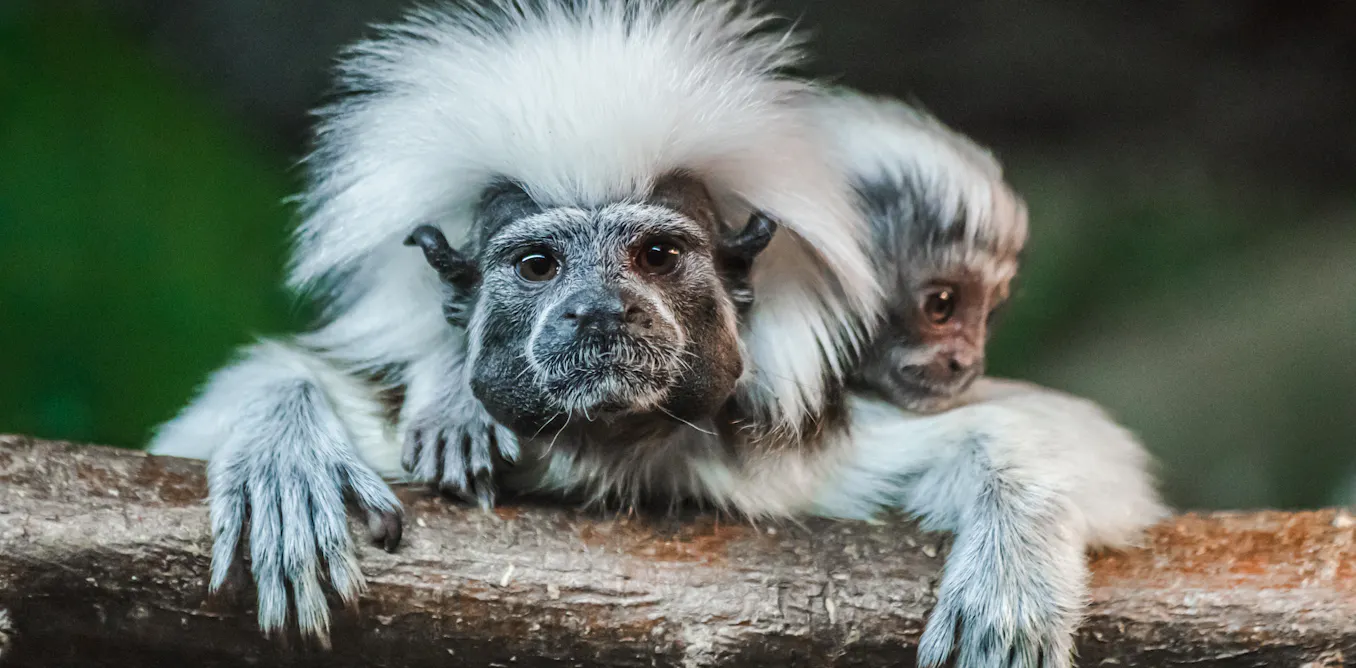
Some of the most striking examples were squirrel monkeys and tamarins, small
primates from Central and South America that live high in the tree canopy. Their
babies are born with heads that are about double the size of the maternal pelvic
canal.

Squirrel monkeys have a tight fit at birth.
dangdumrong/Shutterstock

Birth for squirrel monkeys and tamarins might seem impossible with such a
head-to-pelvis disproportion, but a 1995 study provides an explanation. After many
sleepless nights spent observing squirrel monkeys giving birth in a primate centre, doctoral researcher Melissa Stoller managed to take X-ray images of the labour, revealing that the monkey’s pelvic bones temporarily dislocate, creating extra space for the baby to pass through. We think a similar strategy may help bushbabies, whose newborns also have unusually large heads relative to the mother’s birth canal. As we showed in a 2025 study, the pelvis of female bushbabies (but not males) is open at the front, where their pubic bones do not meet and elastic connective tissue between them can stretch and expand during labour.

Another adaptation concerns the way the baby moves through the birth canal. In
these species, babies usually enter the canal face-first rather than with the top of the head (the orientation assumed by Schultz in his diagrams). This reduces the amount of space needed during birth. Stoller’s X-ray study showed this in squirrel monkeys and baboons, and it may be common in other monkey species too.

Neither of these adaptations could be easily adopted by humans. Because we walk
upright, our pelvis must provide stable support to our body and cannot easily stretch during labour. In fact, when the pelvic ring dilates too much during birth, this can lead to severe pelvic pain, and difficulty in walking after the birth. Instead, our babies have evolved a highly plastic head that can mould to the shape of the maternal birth canal as it passes through it.

The dangers of giving birth

Giving birth is neither easy nor risk free. Despite huge medical advances, we still see three maternal deaths per 1,000 live births worldwide, and more in low-income or war-torn countries. Birth is even riskier for babies, with 17 deaths per 1,000 live births in sub-saharan Africa. Maternal mortality rates were much higher a hundred years ago, before antibiotics and advances in obstetric care.

Golden lion tamarin mother rests with baby nestled against her, surrounded by foliage
Spare a thought for tamarin mothers.
Martens Coyotes/Shutterstock

While these adaptations make birth possible, they do not necessarily make it easy.
Going back to squirrel monkeys, despite their flexible pelvis they have high maternal and foetal mortality.

Looking even more widely across mammals, there are many examples of unique adaptations for apparently impossible births; from female bats having evolved a pelvic girdle fully open at the front so the pelvis is more of a horseshoe structure to accommodate enormous babies, to spotted hyenas having to give birth through their extremely large clitoris.

Primates, and mammals at large, show a diversity of obstetrical dilemmas, each
solved in different ways depending on their anatomy, ecology and movement. If we
are unique, so are all other species.



Source link

Keep Up to Date with the Most Important News

By pressing the Subscribe button, you confirm that you have read and are agreeing to our Privacy Policy and Terms of Use
Add a comment Add a comment

Leave a Reply

Your email address will not be published. Required fields are marked *

Previous Post
Please Stop Making Me Opt Out of AI

Please Stop Making Me Opt Out of AI

Next Post
Best Air Purifiers (2026): Coway, AirDoctor, IQAir, and More

Best Air Purifiers (2026): Coway, AirDoctor, IQAir, and More

Advertisement