








How grounded do you feel in the present moment? It may be a little less than you think.
Even as you fix your gaze on the screen in front of you to read these words, your brain may be flickering between what you’re consciously taking in and other visual information that never quite reaches your awareness.
A new preprint study involving both macaque monkeys and humans suggests that the brain may be switching back and forth between conscious and unconscious information around 15 times a second – raising the strange possibility that something other than visual availability is guiding your conscious experience of the world.
“At any moment, only some of the brain’s activity reaches conscious awareness, while the rest is processed without ever being experienced,” writes a team led by neuroscientists Janis Hesse and Doris Tsao of the University of California, Berkeley.
“How this division arises is among the most basic unsolved problems in neuroscience.”
There are many things our bodies just do automatically, and sensing is one of them. We move through the world under a constant barrage of sensory information, and we cannot turn off our ability to take it in.
What our brains can do is deprioritize some of that information. The famous example is your nose. It’s always sitting bang in the middle of your field of view, but your brain mostly tunes it out. You know it’s there; you don’t need your eyes to keep confirming it.
This is obviously extremely useful. Without it, we’d be overwhelmed by the sheer volume of sensory input our brains receive.
But it also raises a huge question: How does the brain determine which information we consciously experience, and which information remains hidden from awareness?
To seek answers, neuroscientists have spent decades studying which parts of the brain become active when stimuli are being consciously perceived. Over time, however, a problem emerged. The same parts of the brain can respond to unconscious stimuli, too.
Hesse and his colleagues asked a new question. What if those searches were focused on the wrong dimension?
What if the answer lay not in space, but time?
In other words, they thought the way brain activity changed over time might yield clues about how the brain handles conscious and unconscious visual information.
Their research focused on macaques. Macaques wearing anaglyph glasses.
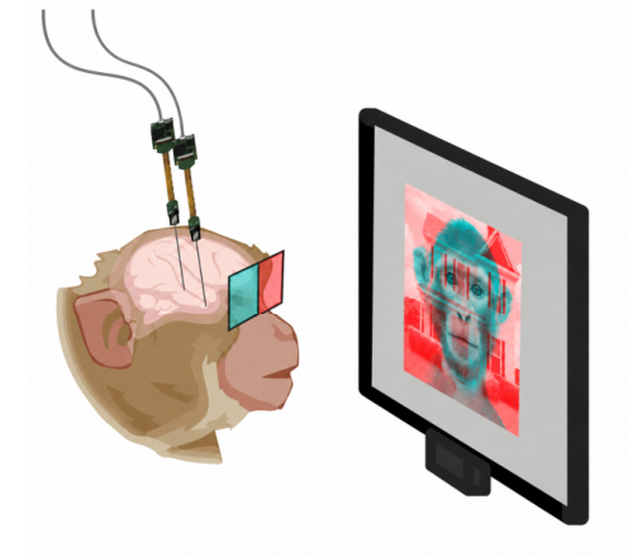
You’re probably familiar with the glasses that have one red lens and one cyan lens, used to trick your eyes into thinking you are seeing a 3D image.
The same system can be exploited to show your eyes two different images. The eye looking through a cyan lens can see a red image but not a cyan one, and the eye looking through a red lens can see a cyan image but not a red one.
The researchers used this trick to show the macaques two different faces. First, they presented one face to one eye. Then, while that image remained in place, they suddenly introduced a second face to the other eye.
Here’s where things get weird. Rather than seeing both faces at once, the brain tends to prioritize the newly introduced face, suppressing the first from conscious awareness.
The first face hasn’t gone anywhere. The eye is still receiving it. But the brain is no longer bringing it into conscious perception.
This phenomenon is called binocular flash suppression; it’s a very useful tool that neuroscientists studying conscious and unconscious visual processing have been using for decades.
Now, the macaques couldn’t tell the researchers which of the two images they were consciously perceiving, so humans were recruited to test the technique and confirm that it was the second image that dominated conscious perception.
Once the researchers had confirmed that the technique worked as expected, they turned their attention to the macaques’ brains.
Using tiny electrodes inserted into regions involved in visual processing, they recorded the electrical activity of hundreds of neurons simultaneously as the monkeys watched the competing images.
They were particularly interested in regions that specialize in recognizing faces. Here, they identified two distinct patterns of brain activity: one linked to the first face and the other to the second face.
Interestingly, a pattern emerged in time, too.
Even though the second face was expected to remain dominant in conscious perception, the neurons didn’t continuously represent that face. Instead, their activity rapidly alternated between the consciously perceived face and the one suppressed from awareness.
This switching occurred around 15 times every second.
So, even though the second face was expected to dominate the macaques’ perception, the first face kept flickering through their brains.
And the researchers found something else intriguing. During conscious moments, neurons responded more sharply to the features of the perceived face than to features of the suppressed face during the suppressed moments, suggesting that the brain may have a way of distinguishing between the two, even as it alternates between them.
The findings do not explain how the brain decides which information reaches consciousness, but the researchers speculate that the process allows the brain to sort through alternative visual information without altering current behavior. Such a process might allow us to continue navigating the world while our brains unobtrusively consider other interpretations of what we’re seeing.
There are also some important limitations. The study involved only two macaques, and they couldn’t report what they were seeing, so their conscious perception had to be inferred from the human experiments. Additionally, the researchers only investigated specific regions involved in visual processing, not the entire brain.
Nevertheless, the results raise a fascinating possibility – that our apparently seamless experience of the world is facilitated by furious, complex neural activity taking place behind the closed doors of our conscious experience.
“Identifying the mechanisms that orchestrate these transitions, and determining why only some temporal segments become available to awareness, will be essential for understanding how temporal population dynamics give rise to conscious perception,” the researchers write.
The findings, yet to be peer-reviewed, are available on bioRxiv.
This article was fact-checked by Rebecca Dyer and edited by Rebecca Dyer. While we pride ourselves on our process, we are only human. If you spot a mistake, please let us know.


