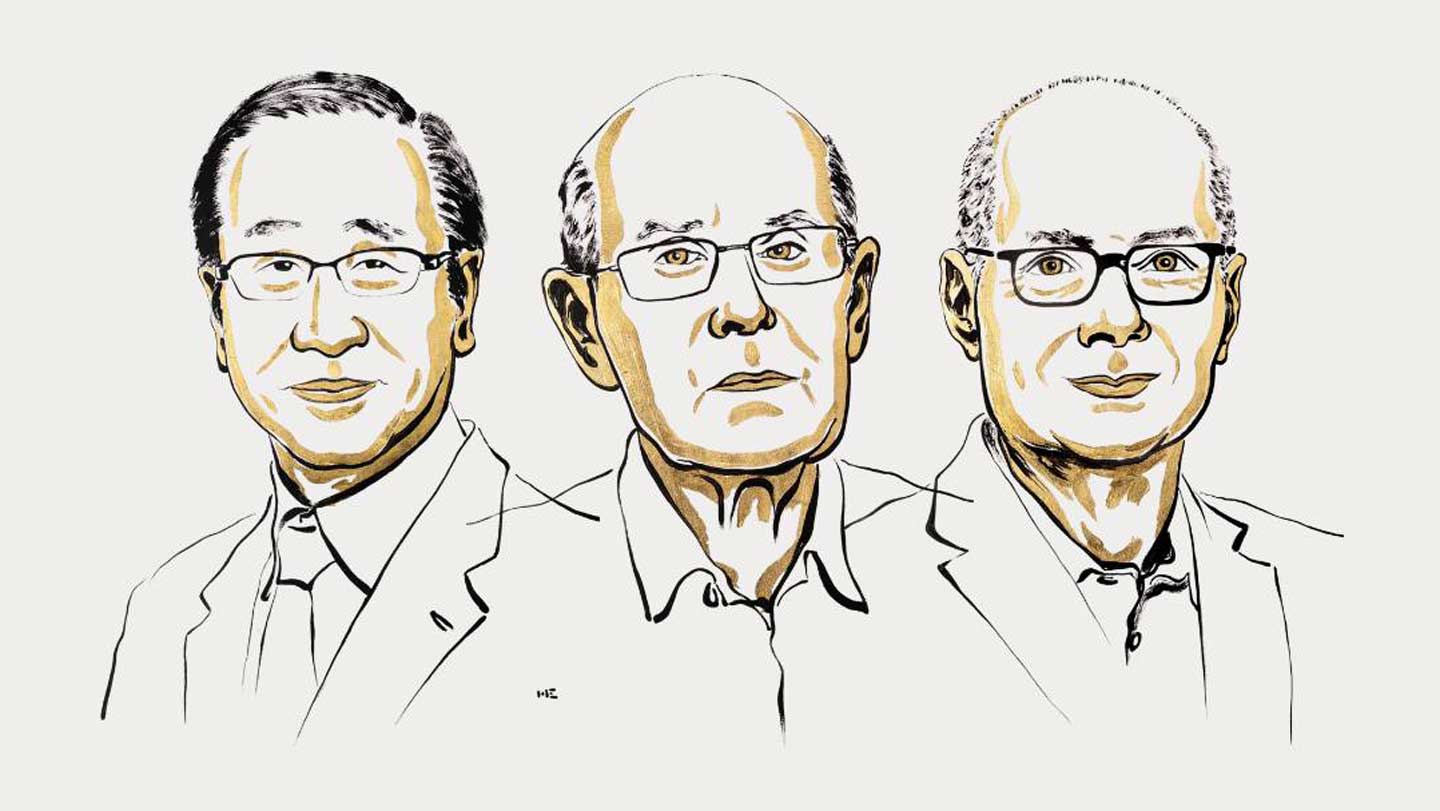



The next Nobel prize in chemistry is just around the corner, and the first predictions of who the winners might be have appeared. The data analytics company Clarivate has released its annual list of which scientists might be in the running, based on its analysis of researchers whose work is among the most highly cited by others in their fields.
Each year, Clarivate – which operates the journal indexing platform Web of Science – adds new names to its list of citation laureates. This year, its Institute of Scientific Information has selected potential chemistry laureates from three different fields: self-assembling nanomaterials, precision gene-editing techniques and research into electron transfer in proteins.
Self-assembled monolayers are groups of molecules that form an ordered, single-molecule thick structure bound to surfaces. Here, Clarivate highlights the groundbreaking work of US-based researchers David Allara from Pennsylvania State University and Ralph Nuzzo from the University of Illinois at Urbana-Campaign, and Jacob Sagiv from the Weizmann Institute of Science in Israel. These researchers helped to lay the foundations of the field with work stretching back to the 1980s, which has today led to wide-ranging applications, for example in coatings, catalysis and electronics.
Harvard University’s David Liu is tipped for his lab’s development of base editing and prime editing. These are gene-editing technologies that can be used to directly and precisely edit DNA in living systems, with potential applications in the treatment of genetic diseases. Numerous potential treatments that make use of base and prime editing are currently in clinical trials being conducted across several countries. Liu was awarded the Breakthrough prize in 2025 for this work, which partly builds on the Cripsr technique for which Emmanuelle Charpentier and Jennifer Doudna won a Nobel prize in 2020.
Finally, research by Harry Gray and Jay Winkler from the California Institute of Technology is listed for exploring the mechanism of electron transfer in proteins. The pair have collaborated over decades to develop understanding of how proteins can exchange electrons over long distances, providing key insights into their biological functions. Clarivate notes that by revealing how cells generate and transfer energy, Gray and Winkler’s findings have ‘fundamentally altered’ approaches to targeted drug therapies and even clean energy production.
Some of the citation laureates that Clarivate has identified for the physics and medicine categories are also closely linked to the chemical sciences. For example, in physics Chihaya Adachi from Kuyushu University in Japan, Stephen Forrest from the University of Michigan, US, and Mark Thompson of the University of Southern California in Los Angeles, US, are cited for their work on phosphorescent organic light-emitting diodes. Meanwhile materials scientist Nicola Spaldin from ETH Zurich in Switzerland is recognised for her work on magnetoelectric multiferroics – a class of material with have potential applications in ultra-low-power computing.
In physiology or medicine, the work behind recent blockbuster anti-obesity drugs such as Wegovy and Mounjaro has been highlighted. Daniel Drucker from the University of Toronto, Canada, Jens Juul Holst from the University of Copenhagen in Denmark, and Svetlana Mojsov from the Rockerfeller University in New York appear on Clarivate’s list for identifying and characterising glucagon-like peptide-1 (GLP-1) and investigating into its biological activity.
Since the list’s launch in 2002, almost 500 citation laureates have been named. 89 of these scientists have gone on to receive Nobel prizes, although not necessarily in the same year in which they were identified by Clarivate. In 2024, the list correctly identified John Jumper, Demis Hassabis and David Baker who scooped the chemistry Nobel prize just a few weeks later for their work on predicting how proteins fold. We’ll soon know whether this year’s predictions have been so accurate.