



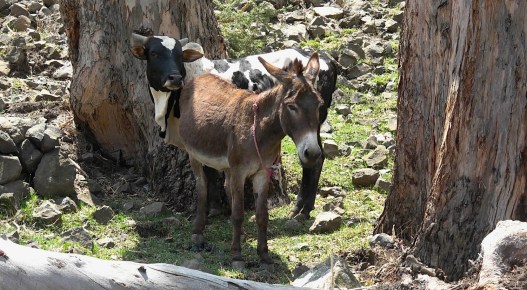
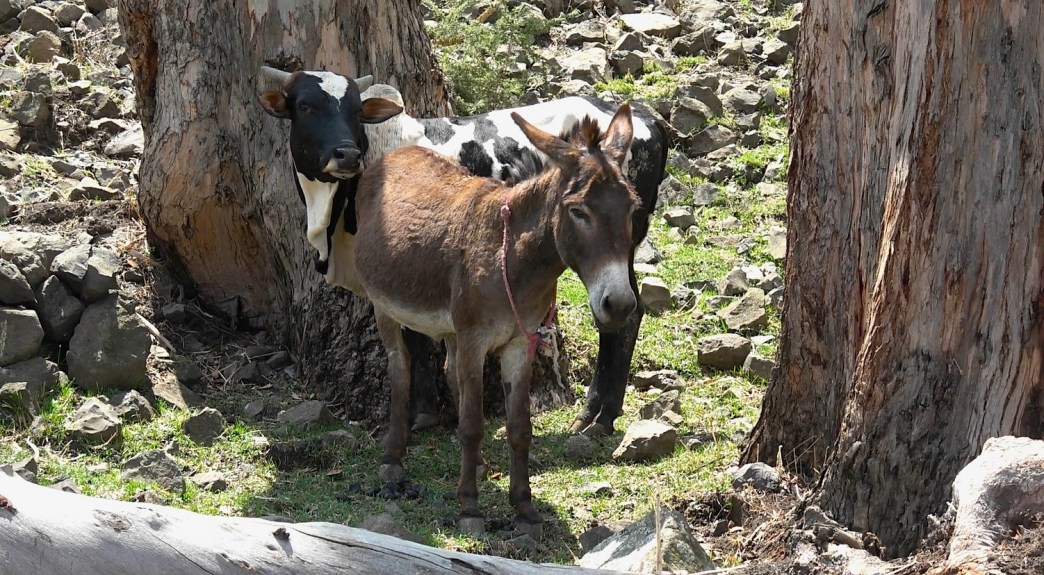
Love is a many splendored thing. Powerful bonds can form where and when you least expect them. For instance, in the Ethiopian highlands between a black and white spotted bull and a tawny male donkey.
Recently, field scientists documented a kind of love affair between the two herd animals, who grazed together on a rocky plateau outside the village of Debre Libanos in a region known as Oromia, the breadbasket of the Horn of Africa. Over a period of weeks, the hoofed pair copulated dozens of times, nipped, licked, and nuzzled each other, and generally hung close during grazing time in open pasture and under the succulent shade of Sycamore trees.
Read more: “Why Are So Many Animals Homosexual?”
When the team of scientists brought the story back home to Italy, their students decided to name the bull and the ass after characters in Homer’s epic poetry: The four-year-old bull, a species of humped cattle with drooping ears, was named Achilles, after a Greek warrior from The Iliad. His buddy, a nine-year-old domestic donkey, was named Patroclo, after Achilles’ dearest companion and fellow soldier in the war against Troy.
While Homer doesn’t explicitly describe the pair as lovers in The Iliad, same-sex relationships were integral to the ancient Greek world and later authors interpreted their intimate relationship as a romantic or sexual one. “Their deep attachment is central to the story” of The Iliad, wrote Elisabetta Palagi, an Italian evolutionary biologist from the Università di Pisa in Toscana, Italy, who was part of the team in Ethiopia, in an email.
Likewise, the story of our donkey and our bull.
The donkey-bull bond came to the scientists’ attention accidentally, while they were studying a primate known as the bleeding-heart monkey, which has distinctive hairless red patches on its chest and is native to the Ethiopian highlands. After the scientists observed the first tryst between the Achilles and Patroclo, they set out to document the interspecies romance in a methodical way.
Over a period of less than two weeks in March of 2026, the scientists made eight separate observations, and recorded the details of 51 mountings, the majority of which involved copulation, as well as other friendly behavior between the two animals. They published their results today in Current Biology.
When local herders noticed the keen interest the scientists were taking in the bull-donkey affair, they offered a bit of back story. Achilles and Patrocolo never spent the night together, as Achille was housed with another adult bull, a cow, and a calf, while Patroclo was housed with two other male donkeys. The two animals belong to different herds, and only interacted during daily shared pasture time, which, depending on the particular day, might include 3-6 bulls, 3-7 cows, 3 male donkeys, and 2-7 female donkeys.
Standard explanations for same-sex cross-species relationships between animals—which have been observed but are rare—tend to be somewhat uncharitable. Scientists have proposed that they may be the result of sexual coercion, mistaken identity or limited access to opposite sex or same species partners.
But none of these explanations hold for Achilles and Patroclo, Palagi told me. They had plenty of access to other potential partners from their own species, of both sexes. And when Achille mounted Patroclo, the donkey never kicked or resisted. On the contrary, Patroclo was an active participant in their encounters, pressing his haunches back toward Achille and nipping at him. “The recurring feature was the close association between sexual behaviour and friendly social contact,” said Palagi.
Why would a bull and a male donkey want to mate? Palagi speculates that the bond between the two animals probably helped with stress and offered reward. “A preferred partner might provide opportunities for rewarding physical contact, social support, or reduced tension,” she wrote. “Sexual interactions could themselves be rewarding and encourage the animals to continue seeking each other’s company.” The scientists did not test these hypotheses, however. They also don’t know which came first: Did the donkey and the bull begin as friends, then become friends with benefits, or did they feel sexual attraction from the start?
Domestication may have had something to do with it, by “altering social environments, opportunities for interspecific interactions, and behavioural flexibility,” the study authors wrote. Or it’s possible the pair’s behavior emerged “as a consequence of the social bonding systems of the two species.”
Other donkeys, at least, did not share Patrocolo’s affection for Achilles’ advances: In the only other two instances in which Achille attempted to mount another donkey, they showed clear signs of aversion, flattening their ears and making threatening facial expressions. None of the other animals in the herd engaged in cross-species mounting, either, and the only other time another bull attempted to mount Achilles he actively rejected it.
After the study was over and the scientists departed, Achille and Patroclo were separated. Grass was no longer available where they had been grazing together, so their owners set them to pasture in different fields. Palagi wonders what would happen if they were reunited. Would they remember one another? Would they pick up where they left off? We may never know. In matters of the heart, it is often impossible to tell what the future holds.
Enjoying Nautilus? Subscribe to our free newsletter.
Lead Image: André B. da Cruz / UNIPI