Dark Mode Light Mode
Chemistry, medicine, materials and the technology shaping tomorrow — the best science stories from trusted sources, every day.

Dinosaur Blood Cells Detected in 115-Million-Year-Old Fossil

Dinosaur Blood Cells Detected in 115-Million-Year-Old Fossil Dinosaur Blood Cells Detected in 115-Million-Year-Old Fossil


We’ve found plenty of dinosaur bones. We’ve found their teeth, skin, feathers, eggs, and even their poop.

And now, we’ve found dinosaur blood.

A team led by scientists at Curtin University in Australia has identified what appear to be fossilized red blood cells, along with blood-derived molecules, preserved for over 100 million years, inside an unassuming dinosaur leg bone.

If the claim sounds familiar, that’s because several teams have claimed to detect proteins and cells in dinosaur fossils over the last few decades. But these finds have been difficult to replicate and confirm that the cells indeed belonged to the original animal, and weren’t just outside contamination after death.

In the new study, the identity of the suspected cells was backed up by chemical analysis.

“Something that looks like a blood cell under a microscope is interesting, but morphology by itself isn’t enough to establish its biological origin,” Kliti Grice, organic geochemist at Curtin University, told ScienceAlert.

“Our approach brings together microscopic observations with chemical evidence associated with the structures. The convergence of independent lines of evidence is much more powerful than saying, ‘this looks like a red blood cell’.”
Dinosaur Blood Cells Detected in 115-Million-Year Old Fossil
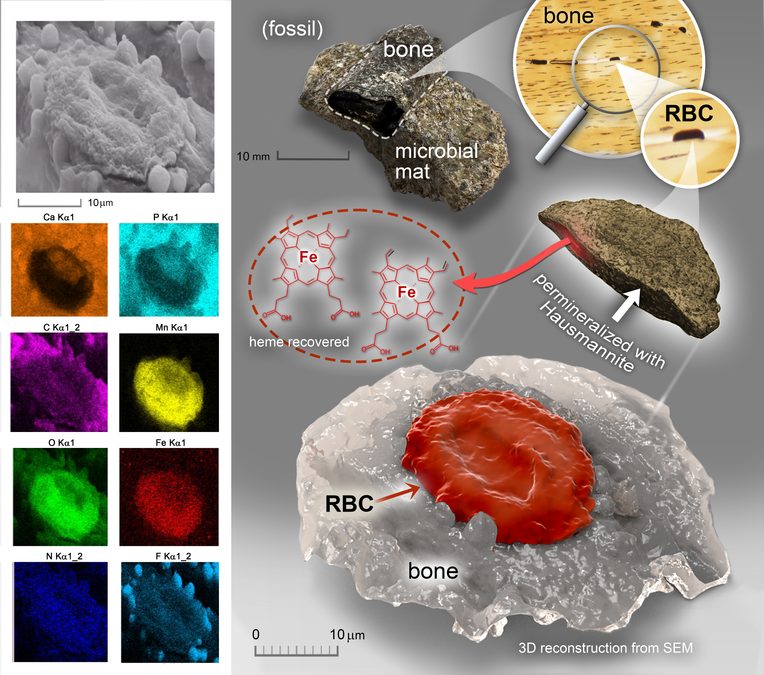
Microscope images of the fossil structures that appear to be red blood cells. (Curtin University)

The discovery was made in a fossil recovered from a mine in Brazil in 2008. These bones were from the right leg of an Aratasaurus museunacionali, a small theropod dinosaur that lived around 115 million years ago.

On close inspection, fossilized vascular canals were detected inside the bones – and inside those canals, the team found a treasure trove of ellipsoidal microstructures.

“When we examined the Aratasaurus bone at the microscopic and chemical level, we encountered structures that were remarkably cell-like, in the order of right size, and a lot of them in the right location in the vascular canals,” Grice said.

“But as a scientist, excitement has to be followed very quickly by skepticism. The more extraordinary the observation, the more carefully you have to test alternative explanations.”

To do so, the team conducted a series of imaging, spectroscopic, and molecular analyses on the suspected cells, as well as the material surrounding the bones.

It was a possibility, for instance, that the microstructures were the preserved remains of fungi or other microbes that colonized the bones after death but before fossilization. But if that were the case, you’d expect to see traces of filaments, spores, biofilms, or other structures – and the team found none.

Geochemical analysis also revealed no traces of pyrite mineralization or sedimentary grains that could masquerade as cellular structures.

While it’s nice to find an absence of contaminants, it’s even better to detect the presence of compounds linked to blood cells – specifically heme, a key molecule that helps blood cells carry oxygen.

High-performance liquid chromatography–mass spectrometry revealed the bone extract was dominated by heme B, very different from the molecular signatures in the surrounding rock, which seemed to have been produced by photosynthetic microbes.

The team also conducted elemental mapping to investigate which elements were associated with which parts of the fossil. The cell-like microstructures were found to be correlated with iron, carbon, and nitrogen – potential constituents of heme. The rest of the bone was made up of phosphorus, calcium, fluorine, and carbon.

Being around 115 million years old, this fossil marks the oldest known example of possible dinosaur blood cells – previous finds date back “only” about 80 million years at most.
Dinosaur Blood Cells Detected in 115-Million-Year Old Fossil
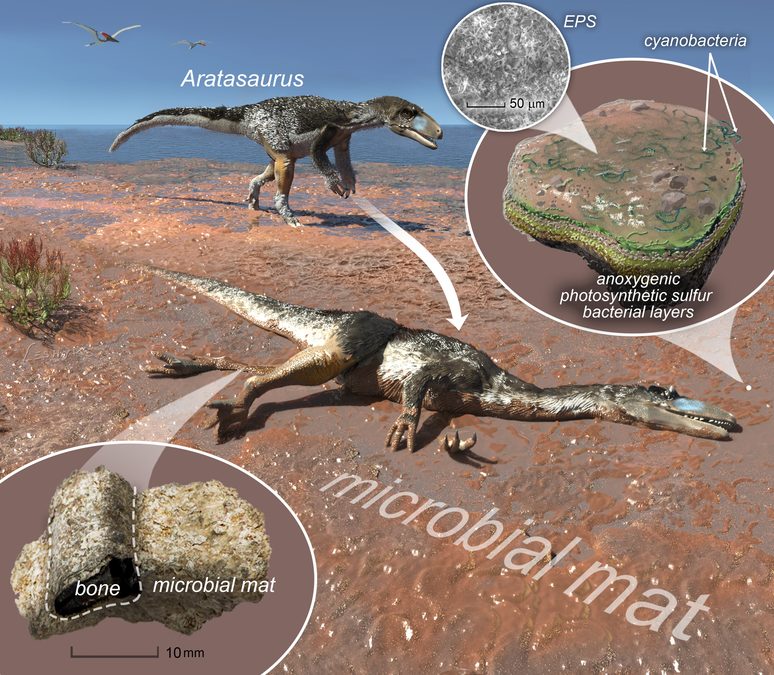
An artist’s impression of the fossilization conditions of the Aratasaurus specimen that favored soft tissue preservation. (Victor O. Leshyk)

So how can these tiny, soft tissues persist for so long? The team suggests that it’s largely due to the specific geological setting in which this Aratasaurus was preserved: a microbial mat in shallow waters almost completely starved of oxygen.

“Our interpretation is that manganese mineralization may have contributed to stabilizing or replicating these extremely delicate structures during fossilization,” Grice said.

“Rather than imagining a pristine biological cell surviving unchanged for 115 million years, I think it is more useful to think of the original biological structure interacting with its surrounding geochemical environment. That may have created a mineralized record of something that would normally disappear very rapidly.”

Still, as with any potential landmark studies, it’s important to temper excitement with a healthy dose of caution, while scientists perform follow-up studies on this and other specimens.

“The immediate priority is replication,” said Grice.

“We need to examine additional fossils, different geological settings and other parts of the dinosaur family tree using complementary microscopic, chemical and molecular techniques. If similar signals can be demonstrated independently, we can begin asking much bigger questions about preservation and, cautiously, about ancient physiology.”

Related: We Have The First Direct Evidence That Ticks Really Did Feast on Dinosaur Blood

It means that the next big dino discovery might not come from a chance find in a desert dig, but from a curator rummaging through a forgotten drawer.

“What particularly excites me is that thousands of fossils already sitting in museum and university collections could potentially be revisited,” said Grice.

“A specimen collected decades ago for anatomical study may also contain molecular, mineralogical, isotopic, and microscopic information that nobody thought to look for at the time.”

The research was published in the journal Proceedings of the National Academy of Sciences.

This article was fact-checked by Fiona MacDonald and edited by Fiona MacDonald. While we pride ourselves on our process, we are only human. If you spot a mistake, please let us know.


Source link

Previous Post
Listen to the Earliest Known Recordings of a Nearly Dead American Language

Listen to the Earliest Known Recordings of a Nearly Dead American Language

Next Post
A Collapsing Star Produced an Afterglow Brighter Than Its Galaxy

A Collapsing Star Produced an Afterglow Brighter Than Its Galaxy