


Dark Mode Light Mode
Join us on a journey where chemistry meets creativity, and the wonders of science unfold. Quench your intellectual thirst with thought-provoking articles that transcend the boundaries of conventional knowledge.

A new, ultrabright laser powers a cryo-EM advance 15 years in the making

A new, ultrabright laser powers a cryo-EM advance 15 years in the making A new, ultrabright laser powers a cryo-EM advance 15 years in the making


Key Insights

  • Cryo-electron microscopy has been a transformative technique for structural biologists, but it’s plagued with low-contrast images.
  • Fifteen years ago, physicists worked out a method to increase image contrast by hitting the electron imaging beam with an ultrabright laser.
  • Back then, a laser so bright didn’t exist. Now it does, and structural biologists say it could enable major advances.


When physicist Holger Müller went to a Chan Zuckerberg Initiative (CZI) visual proteomics workshop in 2021, he was a little intimidated. The meeting was filled with prominent microscopists—“all the real big shots that I had read about but never met in person,” he says.

Müller, a soft-spoken professor from the University of California, Berkeley, was there to speak about a technique to overcome low contrast in electron microscopy images. Low contrast is one of the key problems in using cryo-electron microscopy (cryo-EM) for structural biology, and Müller had worked to solve it for a decade.

As the conference concluded, moderator Stephani Otte asked attendees for one wish. Müller recalls how the first person to answer named the proof-of-concept instrument that Müller had presented, “and then the next person gets up and says the same thing.” One by one, he says, nearly everyone at the conference said they wanted to use his instrument.

After a formal peer-review process, CZI (which last year rebranded three labs and its imaging center into a single entity known as Biohub) invested in Müller’s research. The result of that project, a piece of hardware called a laser phase plate (LPP) that improves the contrast of cryo-EM images, has now been published (Science 2026, DOI: 10.1126/science.aeh0665). Researchers say it represents a dramatic improvement in primary data that could bring structural biology to smaller proteins and could bring new capabilities for in situ structural biology within reach.


A very bright laser to improve cryo-EM

To image biomolecules like proteins, the microscopes used for cryo-EM shoot a beam of electrons through a sample. The way that the electrons scatter allows researchers to see what’s there. The microscopes let chemists collect enormous detail on materials, such as uncrystallizable proteins and complex biological specimens.

But biological substances are almost completely transparent to electrons, so only a small proportion of the electrons in an imaging beam are scattered. Most of the electrons pass through a sample without interacting with it at all. “That means that a perfect image gives nearly no contrast,” Müller says. A raw micrograph resembles a blizzard; researchers obtain detail by averaging many images.

Microscopists solved an analogous problem with visible light in the 1930s by inventing phase-contrast microscopy. This approach takes advantage of the phase difference between scattered and unchanged light. A filter plate shifts the phase of unscattered background light back into phase with the scattered light. The resulting interference between the two types of photon turns the invisible phase difference into a detectable difference in brightness.

But it has been much harder to find a material that could be used to make a filter plate for electrons. “If you put something physical in the microscope, it interacts in a bad way with the electrons themselves: it charges up, it deteriorates, it changes,” says David Agard, the founding scientific director of imaging at Biohub.

Müller and his colleagues theorized back in 2010 that one might use photons to shift electrons’ phase instead (New J. Phys., DOI: 10.1088/1367-2630/12/7/073011). By shooting a laser at a microscope’s electron beam after it passes through a sample, they calculated, one could alter electrons that had not been scattered by the sample more dramatically than those that had.

The only problem was it would take a laser brighter than anyone had ever built.

Müller says he thought it should be possible, but he wasn’t absolutely certain. “Physics calculations have a habit of being off by π or 2π or something like that, because you screwed up somewhere.”

“Physics calculations have a habit of being off by π or 2π or something like that, because you screwed up somewhere.”


Holger Müller, physicist, University of California, Berkeley

Share

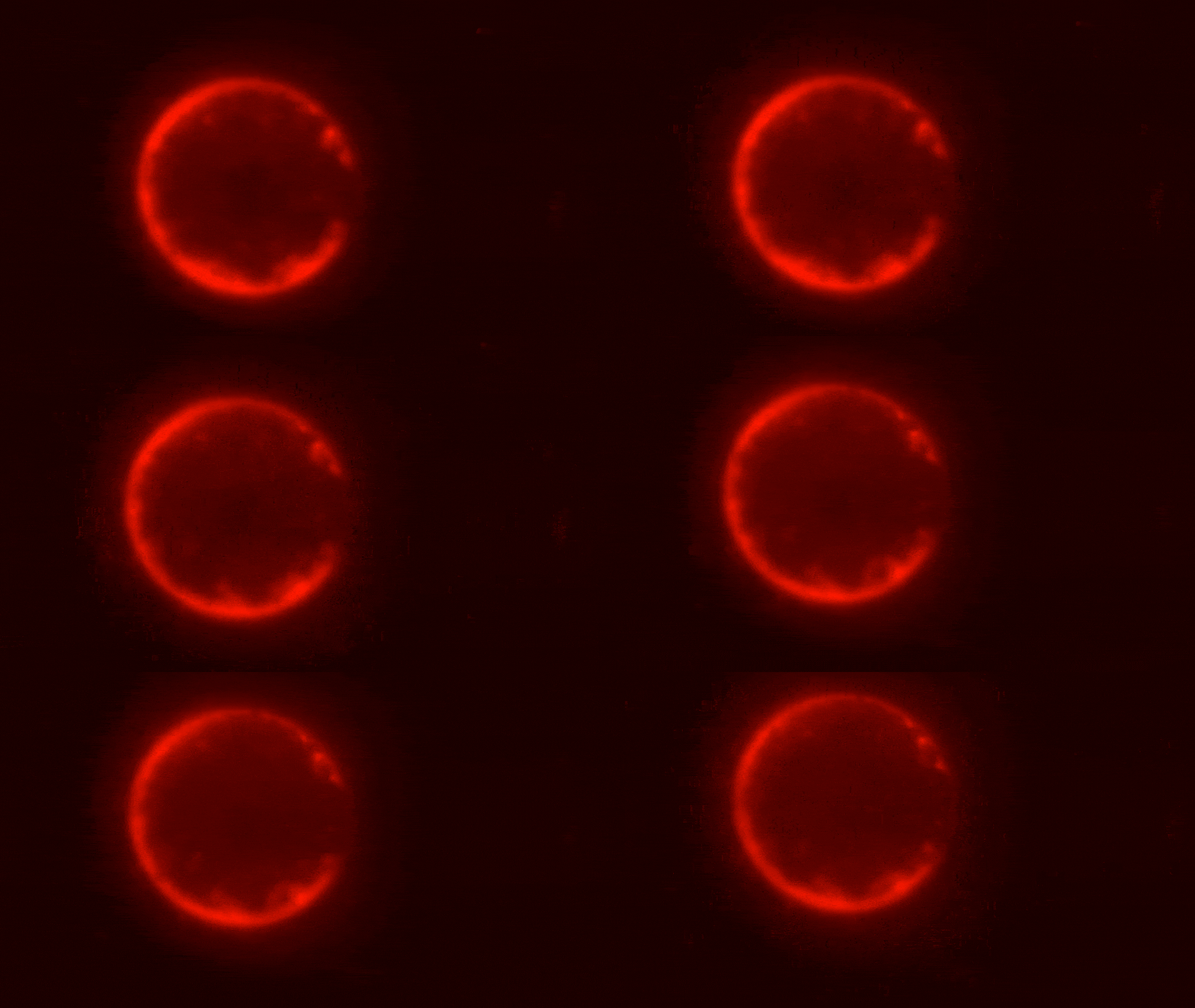
To make the exceptionally bright laser, Müller and his lab developed an optical resonator—two perfectly aligned, highly smooth spherical mirrors. When light from a 12 W laser enters, it bounces back and forth between the mirrors, picking up more energy from the incoming laser with each reflection. Eventually, it reaches a very bright equilibrium. “The laser phase plate has the highest continuous light intensity in the solar system, outside of the inner regions of the sun,” Müller says.

The physicists also engineered feedback loops to keep the mirrors aligned as they heat up under the illumination, which is equivalent to the output of three power plants per square millimeter. After more than a decade of work building an LPP into an older electron microscope, they showed it could shift the phase of the electron beam and hold steady for long enough to capture a structure (Rev. Sci. Instr. 2021, DOI: 10.1063/5.0045496).

This study was the proof of principle that Müller presented at the CZI conference. To find out if the LPP could improve on the state of the art in microscopy, he needed to install it in an up-to-date microscope.

Laser-on cryoEM captures smaller proteins with greater clarity

With a Biohub grant, Müller and his team installed an LPP into a modern electron microscope adjusted to leave space for the extra hardware. They found it delivered much higher-resolution structures of the smallest protein they tested.

Joachim Frank at Columbia University, who received the 2017 Nobel Prize in Chemistry for his role in inventing cryo-EM, says in an email to C&EN that the advance is “highly significant as it opens up the whole technology for much smaller biological molecules.”

Capturing the shape of purified small proteins, and the way they interact with ligands, could be a boon for the pharmaceutical industry. But what especially excites many in the structural biology community is the prospect of identifying small proteins in heterogeneous mixtures—like images from cell samples, where researchers currently can pick out just a few large features.

Improving “the weak contrast that you get in single-particle [cryo-EM] is even more crucial for tomography, because you just don’t know what you’re looking at without more contrast,” says Anthony W. P. Fitzpatrick, a Columbia University biophysicist who received a grant from CZI for a related approach to phase shifting, manipulating an electron beam with a bright high-speed laser pulse. (Fitzpatrick recently published on the approach but has yet to install it into a microscope.) He adds, “The challenge will be the price. The price will be astronomical.”


Postdoctoral researcher Jessie Zhang prepares to install a laser phase plate in a cryo-electron microscope. She works under a HEPA filter; because the laser is so bright, the tiniest grain of dust in the spherical mirrors used to amplify it can incinerate and ruin the mirrors. “We became so paranoid to keep the mirrors clean,” Holger Müller says.

Credit:
Petar Petrov

According to Bronwyn Lucas, a Berkeley biophysicist who has been working with Müller to develop tomography approaches using the LPP, the tool is “massively expanding the proportion of the proteome that can be captured in cells.”

In a companion preprint, published before peer review, a group of researchers at Biohub announce that they have built a second LPP-enabled microscope (bioRxiv 2026, DOI: 10.64898/2026.06.05.730245). This one features a different LPP design, called a dual phase plate, which uses two crossed laser beams that demand half the intensity and therefore less-perfect mirrors. Müller and his team just published the theory supporting the dual phase plate (Nat. Commun., DOI: 10.1038/s41467-026-74060-6).

According to Agard, who is a cocorresponding author on the Biohub preprint showing that the design works, “One of the referees for that paper had said, ‘Oh, nobody will ever be able to build this, it’s too challenging, it’s too complex.’” But they did. Besides showing that phase-contrast cryo-EM can work in someone else’s hands, the preprint also includes a proof-of-concept image of a slice of a bacterial cell.

Research teams at Berkeley and Biohub are continuing to push the two LPP-equipped microscopes from demonstration projects toward genuine data collection. Müller says he’s focused on collecting images in sharper focus.

While there’s a lot more work to do, Agard says, he hopes soon that “we’ll be able to really start doing structural cell biology at scale, which for us has been a dream.”

“The big hope here is that cryo-electron tomography would have a similar resolution revolution to what single-particle cryo-EM had,” Fitzpatrick says. It hasn’t happened yet. But he adds, “For tomography to have that big jump . . . the primary data itself has got to get better.”


Source link

Keep Up to Date with the Most Important News

By pressing the Subscribe button, you confirm that you have read and are agreeing to our Privacy Policy and Terms of Use
Add a comment Add a comment

Leave a Reply

Your email address will not be published. Required fields are marked *

Previous Post
Coenzyme works as a molecular brake for labor

Coenzyme works as a molecular brake for labor

Next Post
Toxic chemicals accumulate in vapes as their juice runs low

Toxic chemicals accumulate in vapes as their juice runs low

Advertisement