







Forty percent of the world’s insect species are at risk of extinction in the coming decades, mainly because of habitat loss, pollution, pathogens, introduced species, and climate change.
Artificial light at night is included among those stressors, because it disrupts the natural behaviors of insects.
More than 60 percent of invertebrates are nocturnal, so any artificial light within their habitat is going to affect them during their most active hours.
It’s a widespread problem: all around the world, vivid sodium and LED lights cast our surroundings in permanent light, mainly in the name of human safety, along roads, footpaths, railways, shopping strips, and almost anywhere else in the built environment.
frameborder=”0″ allow=”accelerometer; autoplay; clipboard-write; encrypted-media; gyroscope; picture-in-picture; web-share” referrerpolicy=”strict-origin-when-cross-origin” allowfullscreen>
But according to a team led by researchers at the Leibniz Institute for the Analysis of Biodiversity Change in Germany, there might be a simple way to keep insects a little safer, without compromising human needs.
“It is estimated that around one billion insects are affected every summer night in Germany, often dying from artificial light sources,” the researchers explain.
Insects can respond to artificial light in a few ways.
Moths, of course, are renowned lamp-lovers, helplessly attracted to the light.
Some estimates suggest that one third of insects attracted to stationary artificial light sources, like the humble moth, will die before the morning comes, either due to exhaustion or predation.
Other insects, like New Zealand’s weta, are known to avoid artificial light at night, meaning that permanently-illuminated areas (and all the resources within) become unavailable to them as habitat.
“The global increase in light pollution and the brightening of the night sky in recent decades therefore pose major threats to insect diversity and are of growing importance for national and international nature conservation,” the Leibniz Institute team says.
What they’ve found is that if we’re going to use artificial lights all night, the kind of light can make a big difference for insects.
They designed a study carried out at six different railway platforms – sites where the lights are often kept on all through the night, although they are within the Westhavelland Nature Park, a designated dark sky reserve.
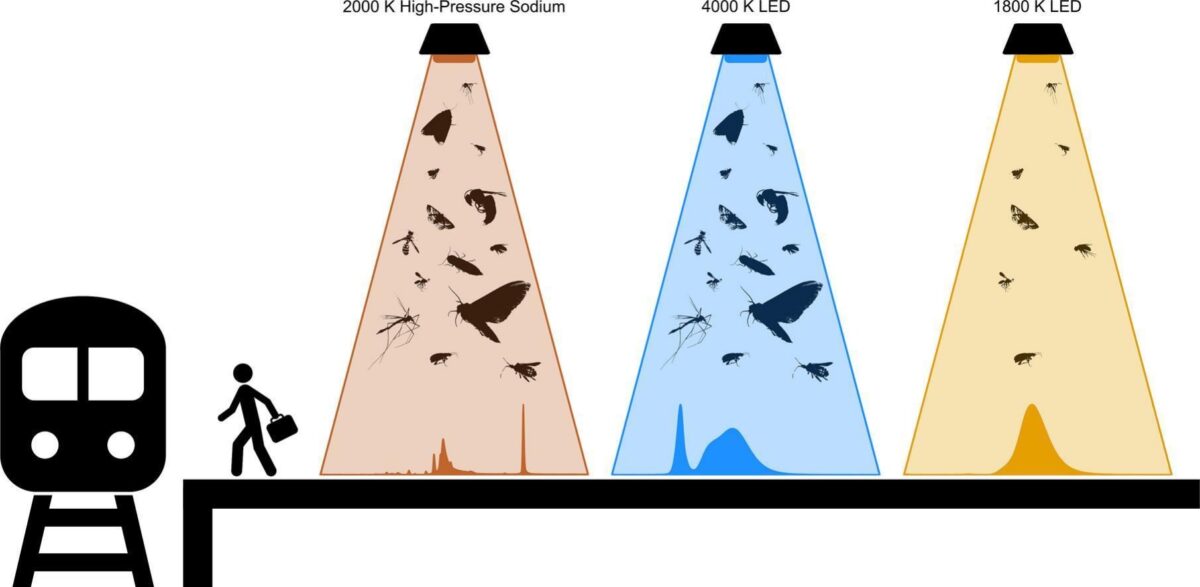
Before the experiment, all these stations were lit up by a series of warm white 2000 Kelvin (K) high-pressure sodium (HPS) lamps.
These are more expensive to run than LEDs, which is why in many parts of the world you’ll notice the warm glow of sodium lights has been swapped out for their more energy-efficient counterparts.
To get a sense of the impact different kinds of night lighting have on insects, the researchers kept two adjacent HPS lamps and replaced the globes in two other pairs of lamps: one pair with cool white 4000 K LEDs, and one pair with amber 1800 K LEDs.
They also monitored two extra control sites nearby, where no lights were installed, to get a sense of normal insect behavior outside of illuminated zones.
To measure the kinds, numbers, and volume of insects who were active at these sites, the researchers used traps to catch samples from July to October in 2023, and April to June in 2024, and analyzed these samples using AI-based image analysis and DNA metabarcoding.
“Our results indicate that insect attraction by outdoor lighting and possible population declines can be reduced through optimized light sources,” they report.
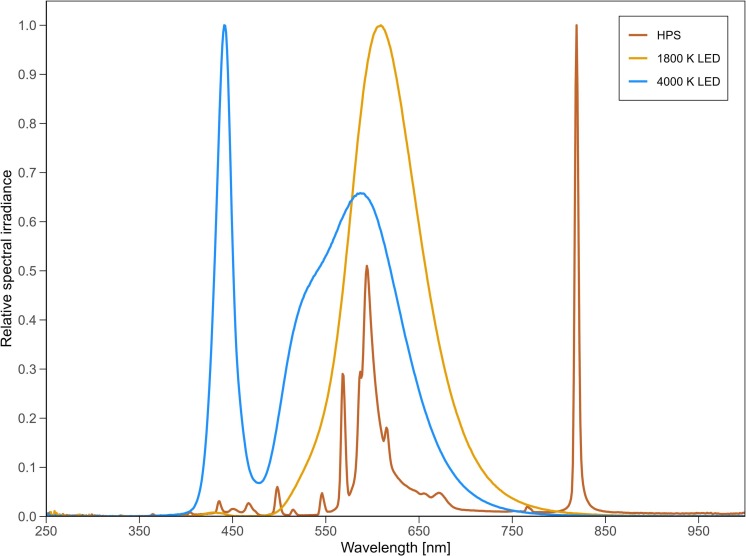
“Amber LED lights (1800 K) with low blue light content attracted significantly fewer individuals and species, as well as threatened and legally protected taxa than conventional cool white LEDs (4000 K) and high-pressure sodium lights (2000 K).”
“This reduced attraction is primarily driven by the narrow spectral composition and the absence of short-wavelength blue light in the 1800 K LED.”
Based on these findings, all of the railway platform lights in Westhavelland Dark Sky Reserve have already been replaced with 1800 K LEDs.
While this research was conducted at railway platforms, the implications are far-reaching.
Similar effects could be achieved with streetlights, garden lights, along footpaths, and in parks, in an effort to protect insect biodiversity.
Not all insects react to light in the same ways, so this strategy might not help all species equally. The study only focused on nocturnal flying arthropods, so it’s unclear what effects these experiments might’ve had on ground-dwelling species, for instance.
And while attraction to light can mean death for many kinds of insects, the authors also note that their measured variable – lower observed attraction to light – may not necessarily mean that the 1800 K LED addresses all the potential ecological consequences of artificial light.
Related: Insects Are Vanishing Even in Remote, Human-Free Places
“Further studies at the species level are essential to improve understanding of taxon-specific responses to artificial light at night, particularly for threatened or legally protected species,” they note.
Nonetheless, it’s a good place to start in making our world a little more insect-friendly, even with just a trip to the hardware store.
The research was published in Biological Conservation.
This article was fact-checked by Michael Irving and edited by Michael Irving. While we pride ourselves on our process, we are only human. If you spot a mistake, please let us know.


