


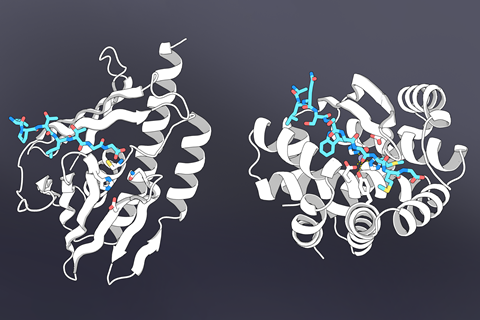
Generative AI models developed in the lab of 2024 Nobel prize winner David Baker have been used to design novel versions of two types of protease capable of cutting peptide bonds.1,2 The computational methods helped create entirely new cysteine proteases and zinc(II) metalloproteases that could find use in cosmetics, consumer product or medicines.
Baker explains that proteases are, ‘among the most sophisticated molecular machines in biology and learning how to design them from scratch is an interesting challenge with really compelling applications’.

Designed proteases will lead to a new class of therapeutics and enzymes as a whole can have wide-ranging applications like degrading microplastics and pesticides, transforming global manufacturing processes
A similar design pipeline was employed for both enzymes and started with known active sites. The generative AI model RFdiffusion then built possible protein backbones around them. Next, another model predicted amino acid sequences that could fit the backbone. This can also be used to model things like metals, cofactors and small molecules and it helped to design the metalloprotease. Finally, AlphaFold was used to predict the structure of the new protein designs based on their amino acid sequence.
For the cysteine protease the active site was modelled on a yeast protease and the design pipeline produced 69 genes which coded for 12 unique backbones. Of these, 13 genes representing three of 12 backbones showed catalytic activity.
For the zinc(II) metalloprotease the active site was a combination of two naturally occurring sites because no single site conformed to how the software scaffolds the backbones. ‘We reasoned that it would be way more successful in terms of the success rate and activity,’ says postdoc Kejia Wu of the decision to combine active sites.
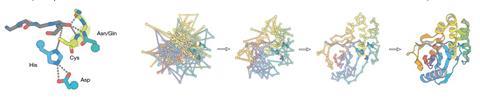
The metalloprotease faced a second hurdle because, while initial designs appeared sound based on the computations, they showed little activity. It wasn’t until a colleague suggested including a water molecule in the active site that activity improved.
While it is known that water is essential for zinc(II) proteases it was not included in initial designs. ‘Nobody models water in their design,’ says Wu. ‘Nobody really realised that the position of water or dehydrated zinc was a critical factor to ensure active enzymes.’
After incorporating water into the models, 31 of 38 designs showed catalytic activity.
Manual optimisation still required
The designer proteases were unique structurally and folded like natural enzymes. Further optimisation was achieved by mutating each amino acid within 4 angstroms of the active site, cycling through every possibility. In both cases most of these mutations decreased activity while a small number of combinations improved activity. None of these were predicted by the AI models.
While the proteases could cleave peptide bonds, they were not as efficient or fast as natural versions. After optimisation the catalytic activity of the top performing variants for each class of protease were roughly one to two orders of magnitude lower than their top performing native counterparts.
Catalytic activity is influenced by several factors including the structure of the target. The initial targets for both designed proteases were peptide sequences produced computationally during enzyme design and not fully folded proteins. The zinc(II) metalloproteases were further tested on several human proteins implicated in diseases like Alzheimer’s disease and were capable of cleaving them.
‘Amide bonds are extremely hard to break and proteases are extremely finicky enzymes – everything has to be placed just so at sub-angstrom precision,’ explains Caroline Lynn Kamerlin, a computational biophysicist at Georgia Institute of Technology, US.
‘It’s pretty amazing that they could get a new fold to work, but it was very inefficient,’ says Chris Overall, a protease biochemist at the University of British Columbia, Canada. He says that future iterations will likely improve and that the novel structures provide unique insights into protease evolution. ‘The first protease that would have evolved wouldn’t be very good,’ he notes. ‘Maybe some of these folds might reflect ancient folds of a protease that were subsequently lost for more efficient designs.’
Baker says his goal is to create biological capabilities evolution has never come up with. ‘Designed proteases will lead to a new class of therapeutics,’ he says, ‘and enzymes as a whole can have wide-ranging applications like degrading microplastics and pesticides, transforming global manufacturing processes and more.’
Charles Craik, a pharmaceutical chemist at the University of California, San Francisco, US, agrees that proteases could have therapeutic potential but thinks turning the design tools on enzymes that already work in people is a faster approach. ‘Let’s take the ones we have right now and speed the ability to change their specificity without making them immunogenic,’ he says. ‘Because if you make something immunogenic and you inject it into people, it’s only going to be used one time.’


