
Dark Mode Light Mode
Chemistry, medicine, materials and the technology shaping tomorrow — the best science stories from trusted sources, every day.

The Human Brain May Organize Emotions Using a Hexagonal Grid

The Human Brain May Organize Emotions Using a Hexagonal Grid The Human Brain May Organize Emotions Using a Hexagonal Grid


Nature may abhor a vacuum, but it adores a hexagonal grid.

The six-sided shape is an exquisitely efficient way of dividing space, from seafoam to honeycombs.

And now, scientists have found hints that the human brain uses this same geometry to organize our emotions.

Using functional magnetic resonance imaging (fMRI), a team of neuroscientists has detected a hexagonal signature in brain activity as people evaluate emotional information – suggesting that a grid-like system may help the brain sort this information.

“These findings suggest that emotion knowledge is structured by a grid-like coordinate system in the human brain,” write neuroscientists Yumeng Ma and Philip A. Kragel of Emory University in a paper published in PLOS Biology.

We often consider emotions one of the messier parts of being human. They can be fleeting or enduring, contradictory, overwhelming, and difficult to understand, even for the person experiencing them.

Yet how we feel about the world seems to be vitally important. Emotions help us assess risks, make decisions, respond to changing circumstances, and form bonds with others.

When our ability to experience or regulate emotions is disrupted, the effects can ripple through almost every aspect of our lives.

So, in order to navigate the world, we need to be able to recognize emotions, distinguish between them, and understand how they relate to one another.

And although scientists have long known that our understanding of emotions follows a surprisingly orderly structure, exactly how the brain codifies that structure has remained a mystery.

For decades, researchers have described emotions along two axes. There’s valence, which refers to how pleasant or unpleasant an emotion is; and arousal, which is how calming or activating it is.

Together, they make up the affective circumplex, a two-dimensional map of emotional concepts. Contentment and excitement, for example, may both be pleasant, but one is calming and the other considerably less so. Likewise, anger and elation are similarly highly activating, but are at opposite ends of the valence axis.

There are, however, clues from other studies investigating how the brain organizes and represents information – such as spatial information about our surroundings.

And this brings us to a type of neuron known as the grid cell.

First identified in rats in 2005, grid cells are neurons that become active when an animal moves through particular locations in its environment.

But here’s the really fascinating detail. If you plot all the places where a particular grid cell lights up on a map of the animal’s surroundings, they form a repeating pattern of equilateral triangles, creating a grid with sixfold, or hexagonal, symmetry.

That is, a single cell lights up when the rat visits the center or any of the six corners of an imaginary hexagon – and the pattern repeats across the animal’s surroundings.

YouTube Thumbnail

frameborder=”0″ allow=”accelerometer; autoplay; clipboard-write; encrypted-media; gyroscope; picture-in-picture; web-share” referrerpolicy=”strict-origin-when-cross-origin” allowfullscreen>

Different grid cells respond to different arrangements of locations, collectively giving the brain a coordinate system that helps the animal track where it is as it moves.

But grid-like coding may not be limited to navigating physical spaces. Previous research has found evidence that the brain uses similar patterns of neuronal activity to organize abstract information, from visual concepts to the relative value of different choices.

And that raised an intriguing possibility. If emotions can be organized on a two-dimensional map, could the brain use the same kind of coordinate system to navigate them?

This is where it gets really juicy.

Ma and Kragel studied 18 people and showed them “emotion-laden stimuli” – facial expressions morphing from one emotion to another, and sequences of emotionally evocative phrases – while taking non-invasive fMRI images of their brain activity.

Each stimulus involved a transition across the affective circumplex, which allowed the researchers to track brain activity as the participants followed movement through this two-dimensional emotional ‘space’.

And there it was.

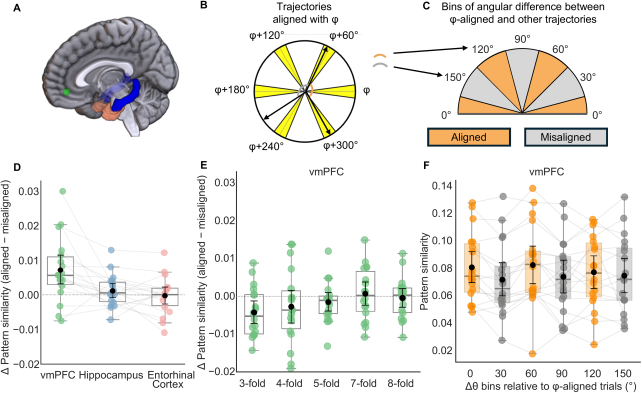
In a region of the brain called the ventromedial prefrontal cortex, the researchers detected the telltale signature of a hexagonal grid as the study participants thought about emotional states.
Your Brain May Organize Emotions Using a Hexagonal Grid
The researchers found a sixfold pattern in activity in the ventromedial prefrontal cortex, consistent with grid-like coding of emotional information. The brain’s responses were more similar when transitions through emotional space aligned with the same hexagonal grid. (Ma & Kragel, PLOS Biology, 2026)

Brain activity varied according to the direction of movement through the emotional map, following a repeating pattern of sixfold symmetry – just as grid-like coding does when the brain navigates physical space.

What’s more, the pattern appeared regardless of whether participants were evaluating facial expressions or written phrases, suggesting that the brain was encoding the relationships between emotional concepts, rather than just reacting to what the participants saw.

The researchers also found that brain activity reflected the distance between emotional concepts on the affective circumplex – and that this signal was associated with how participants judged changes in emotional information.

Now, there are some limitations. The study was pretty small – 18 people is not a large cohort – and further research will be needed to understand how this grid-like system operates and whether it plays a direct role in how we process emotional information.

Still, it’s a very intriguing result – suggesting that the brain may use the same principles to organize our emotional world as it does to navigate the physical one.

“These findings,” the researchers write, “suggest that the structure evident in self-report may reflect how the brain organizes emotion knowledge using mechanisms similar to those implicated in spatial and conceptual navigation.”

The research has been published in PLOS Biology.

This article was fact-checked by Fiona MacDonald and edited by Fiona MacDonald. While we pride ourselves on our process, we are only human. If you spot a mistake, please let us know.


Source link

Previous Post
Microbes can make valuable chemicals more sustainable

Microbes can make valuable chemicals more sustainable

Next Post
Food contains thousands of overlooked chemicals. This physicist is mapping them

Food contains thousands of overlooked chemicals. This physicist is mapping them