








The largest study of its kind has now found that wearing tight underwear really is linked to poorer sperm quality.
For years now, men have been warned that close-fitting underpants may increase the temperature of their groin and possibly impact the health of their sperm.
But large-scale evidence is surprisingly limited.
In a new study from China, researchers compared the sperm quality of 21,221 men who reported wearing loose underwear with 5,615 men who wore tight underwear.
All the participants were seeking fertility assessments, but after adjusting for other health factors, researchers found tight underwear was associated with modest reductions in measures of semen quality and quantity.
Compared with looser undergarments, for instance, tighter options were linked to 18 percent higher odds of producing less semen.
Tight undies were also linked to 12 percent higher odds of having fewer motile sperm, 48 percent higher odds of having fewer normally shaped sperm, and 108 percent higher odds of having more sperm with DNA fragmentation or damage.
In a secondary analysis, researchers also found that erectile dysfunction and premature ejaculation were more prevalent in the tight underwear group.
The findings are published in the Asian Journal of Andrology.
“In conclusion, tight underwear was associated with poorer semen quality and a higher prevalence of erectile dysfunction and premature ejaculation,” the authors write, led by urologist Xue-Chun Hu from the University of Science and Technology of China (USTC).
“Choosing loose underwear may represent a simple, modifiable approach to help protect semen quality and sexual function.”
For now, however, that’s just a hypothesis. This study can’t prove that tight underwear is causing a reduction in sperm quality or quantity, or that wearing looser underwear can help someone conceive.
But there is reason to suspect they might. Higher temperatures in and around the scrotum are known to adversely affect testicular function, and it’s possible that this can have an impact on male fertility.
Within the scrotum, hormone levels are most stable, and sperm cells mature and develop best at approximately 2–3 °C below the core body temperature.
Beyond that, it’s possible that higher temperatures can increase sperm death and dysfunction.
Tight briefs reduce breathability, which can increase scrotal temperature by up to 1 °C compared to looser underwear.
That’s enough to theoretically affect the final stage of sperm development, possibly impacting sperm shape and how well they can swim.
In 2018, for instance, a Harvard study of 656 men found that those who reported wearing boxers most frequently had higher sperm concentrations and total sperm counts.
At the time, it was the largest study to show that types of underwear may be linked to semen quality.
This new analysis is more than 40 times larger.
It was performed among participants seeking fertility assessments at The First Affiliated Hospital of the University of Science and Technology of China. The median age of participants was 30.
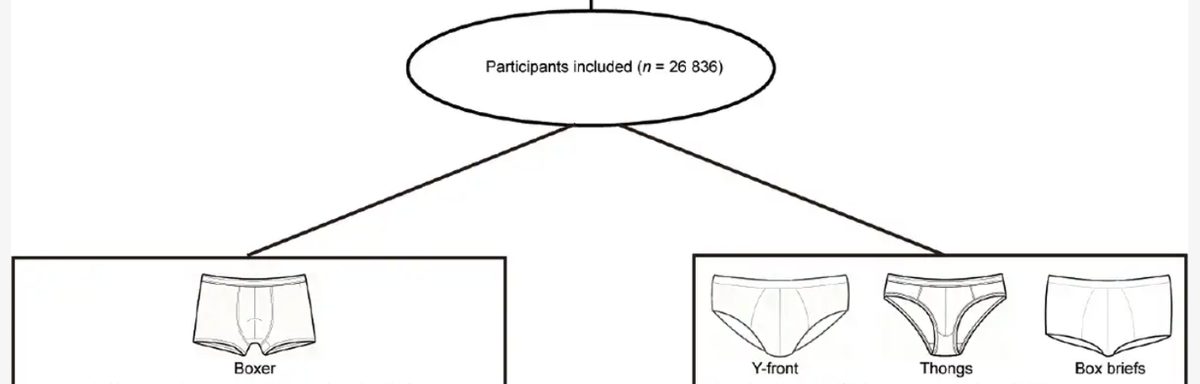
For the study, men seeking fertility evaluation reported whether the underwear they had worn most frequently in the past 3 months was “loose (boxer)” or “tight (Y-front, thongs, and boxer briefs)”.
Tight underwear was ultimately associated with several markers of poorer semen quality, including lower semen volume, fewer moving sperm, a smaller proportion of sperm with a normal shape and structure, and a larger proportion of sperm with damaged or fragmented DNA.
“These findings are consistent with the hypothesis that scrotal heat stress contributes to impaired spermatogenesis,” the authors write.
“Taken together, these findings indicate that tight underwear is a readily modifiable lifestyle factor that may negatively affect spermatogenesis, sperm DNA integrity, and male sexual function.”
But whether that has an impact on actually conceiving is less clear.
For instance, high levels of sperm DNA fragmentation were found in 10.7 percent of men wearing tight underwear, compared with 5.8 percent wearing loose underwear.
This means the vast majority of men in both groups did not have abnormally high levels of sperm DNA fragmentation.
In 2022, researchers analyzed data from 3,041 couples residing in the US or Canada and found little evidence that the probability of conception is tied to heat around the scrotum, including sauna use, hours of laptop use on one’s lap, seat heater use, or wearing tight-fitting underwear.
Most studies have mainly focused on associations with sperm quality and quantity.
To investigate further, Hu and colleagues conducted an exploratory analysis of sexual function among the same cohort.
These findings are preliminary and must be interpreted with caution, but they suggest that tight underwear may be linked not only to sperm quality, but also to sexual function.
“In addition to heat stress, prolonged use of tight underwear can reduce testosterone secretion and lead to sexual dysfunction,” the study authors hypothesize.
More research is needed to understand exactly how tight underwear impacts testicular function at a cellular level.
To be safe, fertility doctors often suggest men avoid tight-fitting underwear, but that advice doesn’t necessarily apply to the general population, as biomedical scientist Tim Moss explained in 2022.
“The studies that are often cited, even by supposedly reputable sources,” Moss wrote for Healthy Male, “are usually conducted in groups of men who are seeking help for fertility problems, so you can’t generalize the results to the whole population.”
The same limitation exists in this new study from China, although the cohort is much larger than ever before.
Sperm counts are falling worldwide, but that possibly has more to do with exposure to pollutants than the type of underpants people are wearing.
Loose-fitting underwear may improve someone’s sperm count or sperm quality, but whether that has an impact on their ability to conceive is still largely unknown.
The research has been published in the Asian Journal of Andrology.
This article was fact-checked by Rebecca Dyer and edited by Rebecca Dyer. While we pride ourselves on our process, we are only human. If you spot a mistake, please let us know.


