

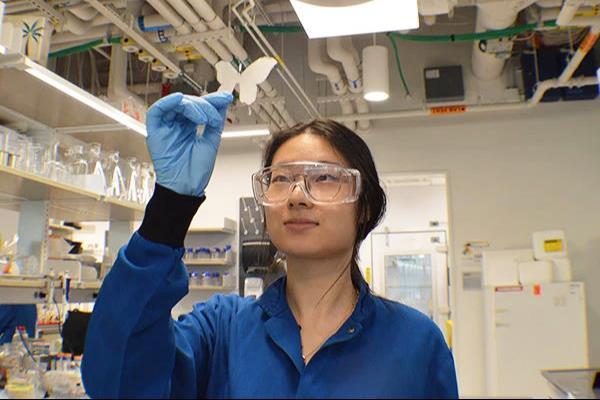
Chemists at Northeastern University in Boston are developing new colourants that are based on structural colour rather than pigments and are therefore longer lasting, more vibrant and safer. The yet-to-be published research, carried out in the lab of Leila Deravi, was presented by her graduate student Clara Wen Dou at the American Chemical Society meeting on 26 August in Chicago.
Structural colour is based on the physical architecture of a material, where complex nanostructures are responsible for reflecting light. By contrast, the colour in traditional pigments and dyes colour is a result of chemicals that absorb specific wavelengths of visible light, while reflecting or scattering others.
‘Structural colour is purely physical – it arises from light interacting with microscopic or nanoscopic physical features whose dimensions are comparable to the wavelength of visible light,’ explains Dou. ‘For structural colour to form there must be an ordered or semi-ordered surface structure in which there are microstructures or nanoparticles that have some repeated units that allows for the maximum light interference.’
This work was inspired by examples of colour found in nature, especially on the wings of butterflies in the Pieridae family, which contain light scatterers known as pterins. In these insects, pterin derivatives like pterine and ixosanthopterin are deposited as dense microscopic granules on the wings of these butterflies.
Compared with common pigments and dyes, structural colour holds up better over time. ‘The pigmentary colours rely on the absorbance of light, and this creates instability in the molecule over the long-term where photobleaching can happen, radicals can form … and then loss of colour,’ Dou explains. ‘But for structural colours it’s the organisation of the molecules – the particles themselves – that create part of the colour and so they can avoid photobleaching because they don’t absorb light as much.’
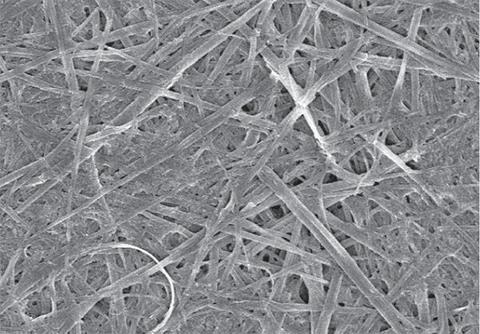
To study structural colours from pterins, Dou and the team produced and modified pterin crystals in Deravi’s lab. This required synthesising pterin granules that mimic the structures on butterfly wings. The researchers found that colour intensity can be adjusted by controlling the size and packing of the pterin crystals, rather than requiring many different pigments. ‘This work showed that I can either create highly reflective white materials using ixosanthopterin or structurally coloured blue, with the same material, by just tuning the specific conditions like pH,’ Dou tells Chemistry World.
Forming microscopic crystals out of pterins has historically required organic solvents like dimethyl sulfoxide (DMSO), which can pose safety concerns for human health and the environment. But the Northeastern team used water, salt and acidity to precipitate the crystals. In addition, crystallisation using DMSO takes several weeks to complete, but with the new method Dou was able to induce the crystallisation in a matter of minutes by adjusting the pH.
‘In the long term, we are hoping to be able to replace a lot of these synthetic pigments that we know have several limitations – some of them are super toxic – with these natural, bio-inspired materials,’ Dou says.
This work is currently able to produce only milligram-size amounts of structural colours, but the Northeastern team is currently working to scale up production.
The researchers are interested in creating new and safer food colourants. This follows action by the US Food and Drug Administration (FDA) to revoke several food dyes for certain uses. Beyond new food dyes, the team would also like to eventually develop new and safer cosmetics that, for example, overcome some of the toxicity concerns associated with the metal oxides used in cosmetic glitter.
Vinothan Manoharan, a chemical engineer and physicist at Harvard University, is enthusiastic about the research and its findings. ‘I like the idea and think it’s worth pursuing,’ states Manoharan, who was not involved in the work. However, he notes that the challenge is finding and developing materials that are sustainable and non-toxic but can also be synthesised at large scales and processed using eco-friendly methods.