



Intertwined Creatures: The Embodied Cognitive Science of Self and Other Anthony Chemero Columbia Univ. Press (2026)
Consciousness research is having an AI moment. Will the hype help the field?
What does it mean for a machine to be intelligent, sentient or conscious? Can the idea of legal rights for machines ever be meaningfully justified? Those were once esoteric research questions; they have now moved into public debate. Such discussions usually start from the presumption that questions of human cognition, intelligence and consciousness are settled. But that’s far from the case.
In Intertwined Creatures, cognitive scientist Anthony Chemero explains how much of the buzz around the consciousness of artificial intelligence is built on, at best, reductive notions of cognition and consciousness and, at worst, a misconception of what human minds are and do.
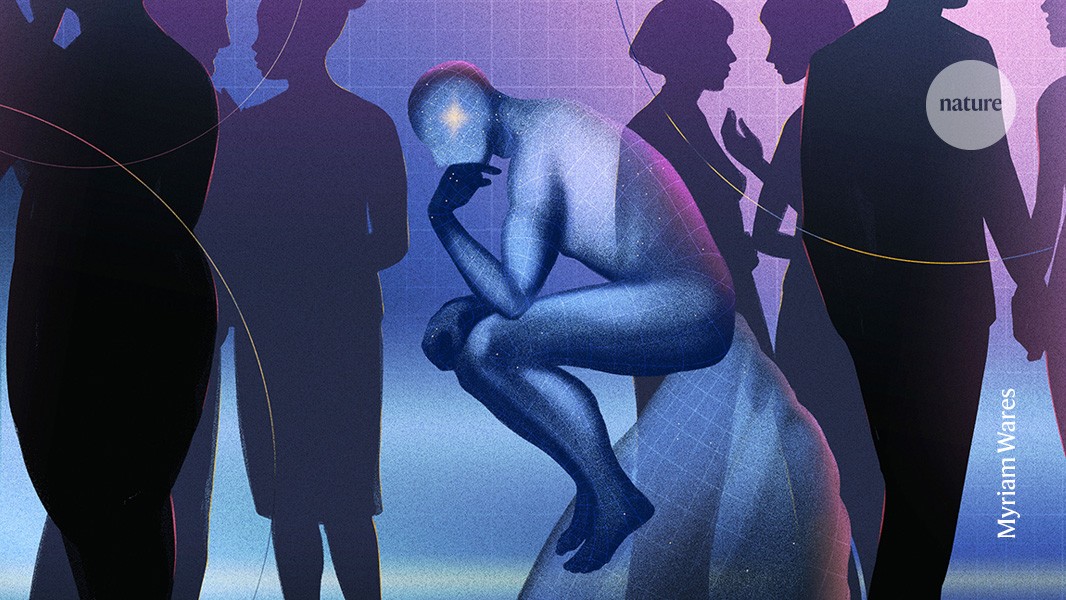
Western philosophy and psychology have long anchored their theories and scientific practices of the mind on the idea of a lone, disembodied thinker that contemplates the world from afar in a supposedly disinterested and objective manner. There, the mind is static, discrete and hidden from view, accessible only through introspection. These assumptions lead to a view of behaviour as being controlled through specific brain processes and of cognition as a purely intellectual activity that entails manipulating abstract representations on the basis of rule-like mechanisms.
Chemero articulates a radically different view. He draws on a rich intellectual lineage that includes ecological psychology, enactivism (the view that cognition arises from interactions between an organism and its environment) and non-linear dynamics theory, in which complex behaviour emerges through reciprocal interactions between a person and their environment. Human minds, in his account, are embodied, dynamic, social phenomena that are inextricably connected to their environments and to other people — especially those “who provide us with the warmth, food and love required to keep us going”. Perceiving, experiencing and thinking are inherently embodied activities. The body is not just a physical object, it is a living organism that is in constant flux. It is also part of the social, cultural and material world. To Chemero, it is not the interaction between the brain and body that matters most, but the fact that this brain and this body are engaging with a particular environment.
Can consciousness ever be understood — this side of death?
Chemero writes with a clarity and accessibility that is rare in a field burdened by jargon. He grounds abstract ideas in a vivid manner through relatable examples. Take a seemingly mundane sequence: you notice that you’re late for work, search for your keys and become distracted by a pile of laundry, which reminds you that you need to buy detergent. While checking whether you have the book you wanted to bring along, you spot an apple core in your bag. You clean your laptop before rushing out the door, only to forget the book you originally intended to take. These inner speeches are inextricably intertwined with our interactions with others and with our environment, Chemero explains.
Even the counterfactual cases you might imagine, such as what things would be like if pigs could fly or if every nation elected a Black woman as its head of state, are not simply products of a hidden mental realm. These non-existent scenarios are informed by your perceptions and interactions with other people, as well as the political, cultural and material world. Imagining a Black woman as president might be informed by your experiences of Black women in positions of authority, your experiences of political institutions and your social context, which shapes your expectations about who can occupy such positions.
According to Chemero, ‘real’ thinking unfolds through ongoing engagement with the environment, not separate from the physical world. Imagination and creativity are not hidden mental processes; they emerge through situated action and interaction with the world. This account of human cognition without resorting to invisible minds makes Chemero’s embodied cognitive science radical.
The human brain isn’t a computer
The implications of Chemero’s embodied cognitive science are profound for debates on AI consciousness. Many such arguments rely, implicitly or explicitly, on overly simplistic analogies of human cognition and computational processes. Chemero undercuts these comparisons. Sophisticated AI systems, such as large language models, do not need to navigate interpersonal interactions to maintain their existence. And they do not have the capacity to care.
We need a new ethics for a world of AI agents