




In July 2024, residents of the New York metropolitan area were treated to a rare spectacle as a fireball exploded in the sky, rattling the region with a sonic boom.
One New Jersey homeowner got an even closer encounter – a high-speed meteorite fragment punched through her ceiling, shattered, and came to rest on her bedroom floor.
The Hillsborough meteorite, as it was later named, was a spectacular boon for science: It was recovered almost immediately, and landing in a house, had escaped rain and soil, minimizing Earth contamination – and preserving its chemistry in unusually pristine condition.
Now, scientists have found evidence that concentrated salty brines once flowed through its parent asteroid, driving complex chemistry and leaving behind unusual minerals and a rich suite of organic compounds.
The discovery, published in Science Advances, suggests that pockets of salty water inside primitive asteroids may have been far more chemically active than scientists realized – potentially helping produce some of the ingredients for life that later arrived on the young Earth.

frameborder=”0″ allow=”accelerometer; autoplay; clipboard-write; encrypted-media; gyroscope; picture-in-picture; web-share” referrerpolicy=”strict-origin-when-cross-origin” allowfullscreen>
“A forensic study of the fragments revealed that they contained preserved bits from near the surface of a small primitive asteroid where it experienced concentrated salty fluids – a process not previously known from this type of proto-planet world,” says meteor astronomer Peter Jenniskens of the SETI Institute and NASA’s Ames Research Center.
Meteorites preserve a mineral and chemical record of parts of the Solar System, but of the tens of thousands of meteorites recovered to date, most were collected long after they first fell to Earth, by which point they can be significantly altered by prolonged exposure to the terrestrial environment.
The Hillsborough meteorite is a rare example of a meteorite that fell in broad daylight over a heavily populated area; its spectacular atmospheric entry was possibly observed by millions, and it was recorded by multiple cameras, from doorbell cameras to dedicated meteor-observing networks.

frameborder=”0″ allow=”accelerometer; autoplay; clipboard-write; encrypted-media; gyroscope; picture-in-picture; web-share” referrerpolicy=”strict-origin-when-cross-origin” allowfullscreen>
As the meteor plummeted, it broke apart in spectacular fashion. Meteors falling through the sky are often shattered into pieces as air is forced into microscopic cracks and pores, increasing the internal pressure until the whole thing goes kablooey.
The fragments rained down over Staten Island toward New Jersey, but only the one that crashed through the Hillsborough home was recovered.
The homeowner used gloves and aluminum foil to scoop up the meteorite fragments and contain them in glass jars.
“Thanks to the homeowner’s quick reaction, these are the most pristine CM1/2 meteorites we know of,” Jenniskens says.
Calculations of the rock’s trajectory suggested that it originated from the asteroid belt that occupies a ribbon of space between the orbits of Mars and Jupiter.
Its minerals revealed that Hillsborough’s parent body belonged to the same class of carbon-rich asteroids that produced CM meteorites, named after the Mighei meteorite that fell over Ukraine in 1889.
These meteorites are rare – and they’re thought to preserve some of the earliest material in the Solar System, back when it was still in the throes of formation.
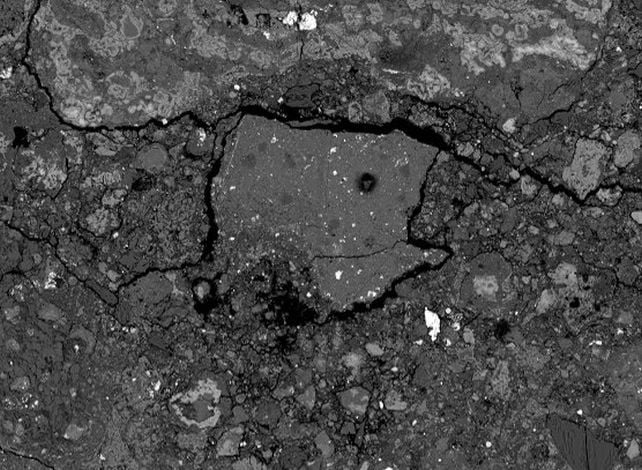
One of the more fascinating things Jenniskens’ team discovered about Hillsborough is that it preserved salt-rich inclusions that likely originated near the surface of the parent asteroid.
Moreover, other minerals within suggested that Hillsborough may have experienced aqueous alteration – that is, liquid water had changed them long ago.
Taken together, the evidence suggests the parent asteroid once contained brines: salt-rich water even saltier than Earth’s oceans.
Those brines appear to have helped produce a wide variety of organic compounds, including a large number of amino acids – compounds that may have been critical for the emergence of life.
What the Hillsborough meteorite gives us is the environment where that amino acid formation takes place.

We already knew that such amino acids could form within asteroids and be preserved in meteorites when they fall to Earth.
Related: Scientists Looked Inside Tiny Meteorites And Found a Big Surprise
It’s the clearest evidence yet that this type of primitive asteroid once hosted pockets of salty water where complex chemistry could unfold – strengthening theories that meteorites like this may have delivered some of the ingredients needed for life to arise on baby Earth.
But it’s also possible, the researchers note, that the compounds detected in the brines were chemical leftovers from earlier collisions.
It’s difficult to know more about the meteorite, its origins, or its context within the CM family tree without going to space.
But what it reveals about the early Solar System adds to a growing picture of a surprisingly dynamic place, where water, minerals, and organic chemistry mixed inside even tiny asteroids long before life emerged on Earth.
The research has been published in Science Advances.
This article was fact-checked by Clare Watson and edited by Rebecca Dyer. While we pride ourselves on our process, we are only human. If you spot a mistake, please let us know.


