
Although it not always obvious, sound guides how we experience the world around us. And the latest archaeoacoustic techniques show that even the world’s earliest architects understood this.
The ancient pre-Roman society of Etruria in central Italy, for example, embedded sound throughout its culture, using ritual calendars dedicated to recognising key noises of nature, such as thunder. They were also early pioneers of musical instruments in the southern Mediterranean region.
Surviving Etruscan painted tombs in towns such as Tarquinia, Chiusi and Orvieto are known for their dynamic scenes of music, feasting and the afterlife. But our latest research shows how these tombs – built for Etruscans of higher socioeconomic and political status – were designed to offer sophisticated sensory experiences.
This study springs from our existing research involving AI and acoustics. This includes the University of Oxford-led Sounds of Silence project, which has used new acoustic techniques to investigate the soundscapes surrounding these Etruscan tombs. At Duke University, meanwhile, the Neuroartifact project is using neuroscience and AI to better understand the cognitive impact of archaeological artefacts.
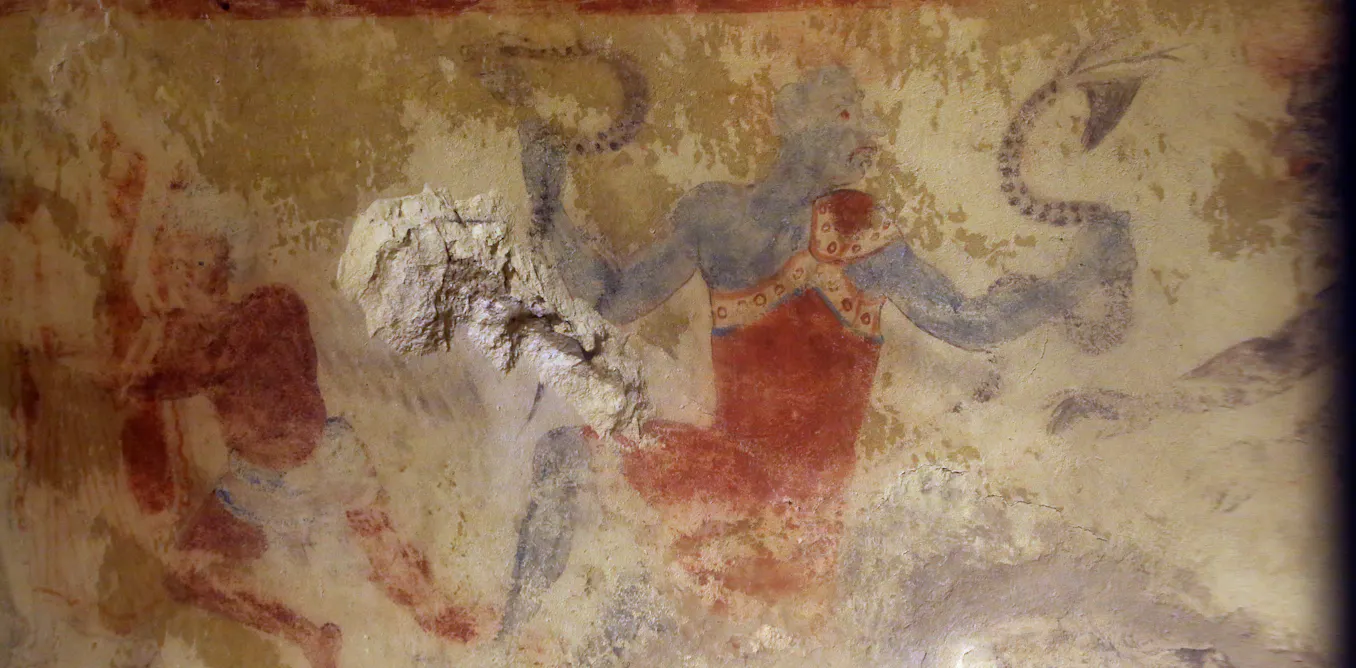
We have combined all these techniques to shed fresh light on two 5th-century BC Etruscan painted tombs: Tomba dei Demoni Azzurri (Tomb of the Blue Demons) and Tomba del Gallo (Tomb of the Rooster).
Our research suggests these tombs were designed and constructed not simply to house the dead, but to affect the living through a sensorily immersive environment similar to a modern 3D film experience.
Archaeologists have tended to look at the paintings in these burial chambers as two-dimensional images to analyse. Our goal was to capture the “performing power” of these ancient monuments, using a combination of acoustic, visual and AI technology.
Upon walking into the Blue Demon tomb for the first time, I (Jacqueline) was immediately struck how the paintings seemed to confront me wherever I turned. Merry banqueters on the rear wall appeared unaware of the demons crawling up the side wall, as though ready to burst into the chamber itself.
My experience was, though, shaped by modern LED lighting. Ancient viewers would have relied on beeswax and tallow candles, incense burners and torches. The dim lighting would have both constrained their movement through the tomb and heightened their experience of what they were seeing.
How senses were heavily manipulated
Our research presents the first investigation of subterranean funerary spaces in Etruria as “transitional spaces” between life and death.
The senses of anyone entering these tombs were heavily manipulated. Intense sound effects – such as the exceptionally long reverberation and echoes inside the Blue Demon tomb – gave a dramatic soundtrack to this intense, immersive experience.
Torchlight or candles flickering across painted figures would have created movement amid the shadows. Incense and the smell of libations (ceremonial liquids) added yet another sensory dimension.
Our reconstructions support the idea that some Etruscan painted tombs were used and reused to perpetuate the legacy and power of their families or clans. They may have been kept open throughout the year for rituals commemorating important dates and festivals, as well as the worshipping of the dead.
The sophisticated design of these tombs is striking. While the Blue Demon induces perceptual disorientation, the Rooster privileges visual attention and the architectural discipline of gaze.
Jacqueline Ortoleva, Author provided (no reuse)
The tomb’s entrance passage, with narrowing walls and descending axis, creates a liminal stage to orient the body before entering the burial chamber. There, trenches, benches, niches and other architectural devices are carved into the floor and walls – adding to the drama of the paintings covering the walls.
Together, these architectural and symbolic elements mediate between order and chaos, memory and transformation. Our work re-imagines these ancient tombs as theatrical spaces, built to perpetuate a form of metaphysical human experience.
A deep impression on the living
In our interpretation, these tombs should not simply be viewed as depositories for the dead. They would have made a deep impression on the living, through their physical and sensory organisation.
In turn, perhaps it is time to reconsider the category of funerary architecture throughout the ancient Mediterranean and beyond. The combined engineering of spatial, acoustic and visual experiences is, perhaps, still not fully appreciated.
But the story does not end here. Our research is already leading in new directions beyond ancient interiors. We are using similar acoustic and AI techniques to investigate exterior landscapes that were used for ritual activities, both in the wider southern Mediterranean and beyond.