Dark Mode Light Mode
Chemistry, medicine, materials and the technology shaping tomorrow — the best science stories from trusted sources, every day.

Dogs May Smell a Complete Stranger’s Seizure Without Ever Being Trained, Study Finds

Dogs May Smell a Complete Stranger’s Seizure Without Ever Being Trained, Study Finds Dogs May Smell a Complete Stranger’s Seizure Without Ever Being Trained, Study Finds


Epileptic seizures are notoriously unpredictable and difficult to detect.

Sometimes, not even the patient themself knows that one has occurred.

But a dog just might, and it doesn’t even have to be the patient’s pet.

A new study suggests that even untrained dogs with no prior exposure to epilepsy and no experience with medical detection tasks may still sniff out the seizure of a complete stranger.

Researchers at the University of Milan collected sweat samples from a non-hospitalized 6-year-old female volunteer with epilepsy when she was and wasn’t having a seizure.

The samples were then presented to 30 dogs of various breeds, both mixed and purebred, unfamiliar with the patient or her scent.

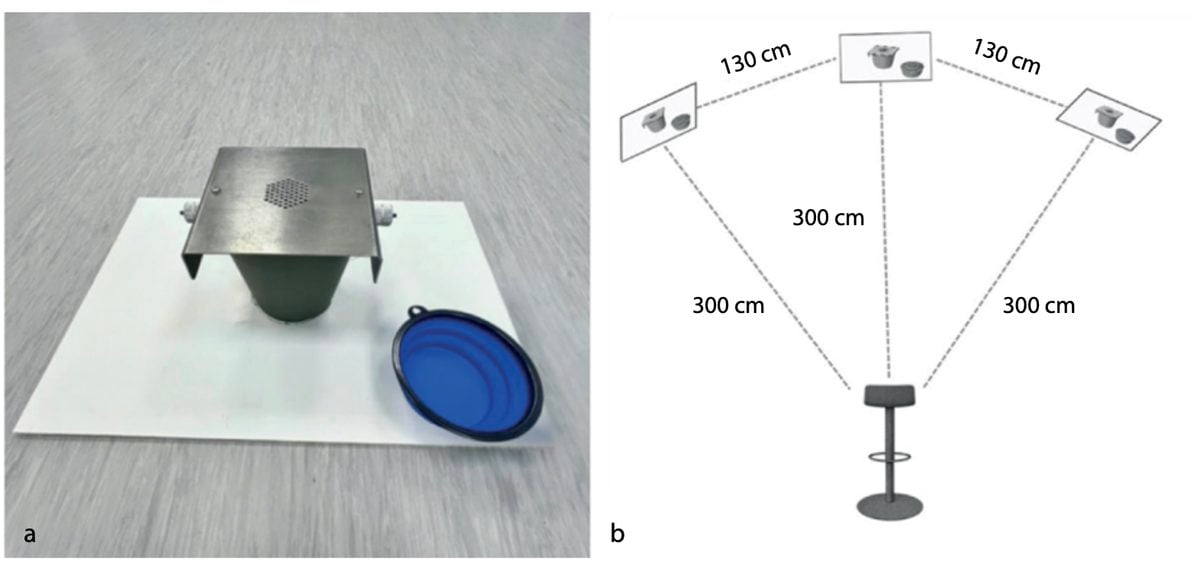
Each dog was accompanied by their human guardian and given two minutes to freely investigate three different scents at three different stations in a room.

The scents included sweat collected during a seizure, sweat collected six hours before or after a seizure, and a sterilized gauze pad as a control.

Researchers watched remotely via a video stream. Neither the dog guardians nor the researcher knew where the seizure scent was located during each trial.

In the end, 14 of the dogs approached the seizure sample first – 40 percent more often than is expected by chance.

The findings are published in the journal Annals of the Italian National Institute of Health, and they suggest that even untrained dogs may have a spontaneous sensory reaction to the smell of a seizure.

It doesn’t even need to be from their owner.
Dogs May Smell a Human Seizure Without Ever Being Trained⁠
The experimental setup used to test dogs’ responses to seizure-related odors. (a) An odor station containing a sweat sample and an empty food bowl. (b) Three odor stations, each positioned 3 meters from the dog’s starting point. (Pirrone et al., Annali dell’Istituto Superiore di Sanità, 2026)

While it’s true that some of the dogs in the experiment did not approach some of the scent stations, the seizure scent was not avoided any more than the others.

The scent did not seem to put dogs off or upset them, but it did tend to draw some individuals in faster than other scents.

“No behavioral signs of distress, fear, or anxiety were observed,” the study authors write.

“Stations that were not investigated were simply ignored and were not
associated with any observable signs of discomfort or withdrawal.”

To encourage more dogs to investigate the odor stations, researchers added empty food bowls next to each of the scents.

Again, it was more likely that the dogs investigated the seizure scent first.

There were no differences in how long the dogs spent sniffing the various scents or how often they went back to a scent.

The results suggest that dogs prioritize the seizure smell, but they don’t necessarily spend more time trying to ‘figure the scent out’.

Perhaps there are odor cues present in seizure samples that contain distinctive volatile organic compounds, and these may be rapidly detected by the nose of a dog, the authors suggest.

“In this case,” the team explains, “extended investigation would not be necessary for perceptual differentiation, and exploration would not increase beyond the initial approach.”

Since the 1990s, dogs have been trained to respond to seizures and even alert epileptic patients to seizures before they happen.

It’s similar to how canines can learn to detect the smell of Parkinson’s disease, COVID-19, or some types of cancer.

But despite some amazing anecdotes about untrained dogs predicting the seizures of their owners, remarkably few studies have tested whether this skill is innate.

Most reports out there are based on survey responses from dog guardians or trainers.

It’s not even really known how canines detect seizures in the first place. Do they rely on visual cues, or are they using their powerful sense of smell?

One small study among five patients, for instance, found that dogs can learn to identify seizure-associated odors.

But is this a product of specialized training, like learning the smell of an illicit drug, or is it a natural, spontaneous instinct?

This new study suggests it’s more of the latter.

“To our knowledge,” the authors write, “this is the first study specifically
designed to characterize the spontaneous olfactory strategy of untrained dogs responding to seizure‑associated human odor under controlled, socially neutral conditions.”

In 2024, a review of the evidence argued that while “using dogs in epilepsy management shows considerable promise,” we need more controlled experiments to take place.

This new study helps fill that gap somewhat, although it still has limitations.

For instance, because the experiment only involved odor samples from a single patient, it remains unclear whether the olfactory signature of a seizure, sniffed out by dogs, is shared across individuals.

The research team is now extending their project to include multiple sweat donors.

If their results hold up, it could indicate that specific volatile organic compounds associated with seizures are detectable by dogs.

This could open the door to better screening methods for patients.

Our dogs may guide us to the answers.

The research has been published in Annals of the Italian National Institute of Health.

This article was fact-checked by Rachel Garner and edited by Rebecca Dyer. While we pride ourselves on our process, we are only human. If you spot a mistake, please let us know.


Source link

Previous Post
Scientists discover metals that defy the deep freeze at -424°F

Scientists discover metals that defy the deep freeze at -424°F

Next Post
Scientists Recovered 22,000-Year-Old Human DNA From Cave Dirt

Scientists Recovered 22,000-Year-Old Human DNA From Cave Dirt