

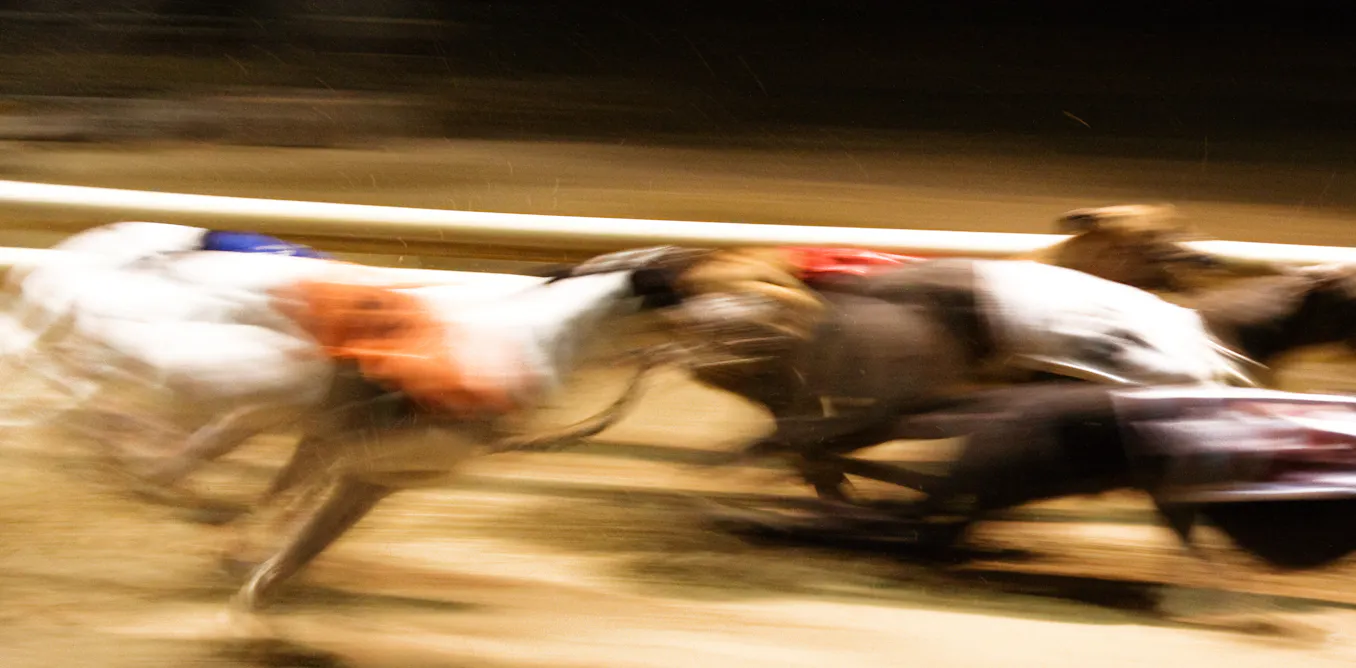
This year, greyhound racing in Britain turns 100 years old. The first race ran on July 24 1926 in Manchester, where six dogs chased a mechanical hare around a track.
Recently, the Greyhound Board of Great Britain (GBGB) published its 2025 welfare figures, under a reassuring headline: licensed racing “maintains high welfare standards”.
Look closely, and those same welfare figures show that a dog in 2025 was 77% more likely to die at the racetrack (from fatal injury or being put down following an injury) than when the industry’s welfare strategy was introduced in 2022, even accounting for the fact there have been fewer races and fewer racetracks operating.
In terms of a percentage of race starts, that increase in likelihood of death seems small – from 0.03% to 0.05%. But behind that percentage are 161 dogs who died at the track in 2025: more than three dogs a week.
The GBGB is responsible for both promoting and running greyhound racing, and for regulating it. This means the same entity that works to keep the sport thriving is also the one that reports on how its dogs cope.
The numbers that guide approval
Most of the public seem to believe that people have a moral responsibility to prevent, or at least minimise, poor welfare in animals that they use for any purpose. If an industry using animals loses public approval, the activity is probably operating on borrowed time. The case for greyhound racing continuing rests largely on the industry’s own records.
Read more:
Ringling Bros circus closure shows our changing attitudes to animals in captivity
The UK government said in October 2025 that it has no plans to ban greyhound racing in England, pointing to improvements made by the GBGB, such as its 2022 welfare strategy, and the laws already in place, which require a vet at every race meeting and set standards for record keeping.
UK law recognises dogs as sentient beings – that they have feelings like joy or frustration. Once you accept that (as animal welfare scientists do), our responsibility when caring for animals doesn’t stop at minimising suffering. It extends to enabling the good experiences a life worth living requires.
What the industry figures leave out
The GBGB publishes annual figures on injuries, deaths and where dogs go when they leave racing, and presents them to the Department for Environment, Food and Rural Affairs. Few animal-reliant industries are this forthcoming.
A combined total can be accurate in reporting the national injuries dogs sustained while racing, but not tell the whole story. When we built a more complete picture using AI agents (under human supervision) and public websites, more details became visible.
Our research used five public-facing websites that together contained information about 31,028 dogs and 1.27 million races between 01 January 2022 and March 31 2026.
It is a new use for this technology, one that makes the data fully visible.
The data from these websites gave us a fuller picture of the greyhounds that race. Our findings showed us that equal numbers of male and female dogs race, most dogs are black, and they typically start racing before turning two years old. We can also pull out the story of individual dogs, to better understand their experiences.
For example, the 12,999th dog (selected at random and anonymised) in our dataset was a black male, bred in Ireland. He raced at Kinsley stadium (West Yorkshire) 15 times from March 2023, winning four times in early races. The records then show he experienced a succession of rough races from May, jostled by the pack and constantly checking his stride to avoid crashing into the dogs around him. This resulted in him finishing at or near the back of the pack, until his final race in August 2023, when his racing and public record stop, just five months after starting.
David Merrett/flickr, CC BY
This dataset found that some racetracks recorded serious incidents while racing (such as a dog striking a rail or being knocked over by another dog) up to five times as often as others. This is something the annual, nationally aggregated data release does not illuminate, although government committees have been asking for it.
Of individual dogs racing, 85% were bred and reared in the Republic of Ireland, beyond the reach of the GBGB, which regulates racing but has no oversight of their breeding and early lives. Most dogs only race for around one year, and the rate at which they leave racing has not changed since 2022 when the GBGB’s A Good Life for Every Greyhound welfare strategy was introduced. Welfare charities have raised concerns about oversupply and “wastage” (dogs bred in large numbers and then discarded), with animal shelters often shouldering the role of rehoming.
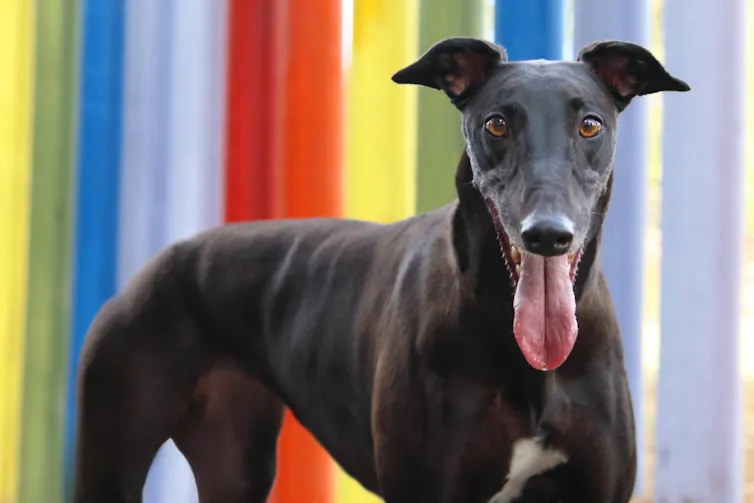
Waggles Photography, CC BY
Once dogs exit racing, most vanish from public view. Over 95% of dogs that have left racing cannot be checked, as they are no longer subject to public reporting requirements.
What are the most likely causes of poor welfare?
A report released in July 2026 from Blue Cross, Dogs Trust, Hope Rescue and the RSPCA outlines the systemic welfare challenges they believe that greyhounds in the UK face.
The report suggests that poor welfare can arise at every life stage. The charities say they are concerned about breeding practices that are harmful such as surgical artificial insemination (banned in Britain but still used in the Republic of Ireland where most racing dogs are bred) and inbreeding; estimates some dogs spend 95% of their time in kennels; and health issues (such as teeth and limb problems) that follow dogs once they exit racing.
Britain isn’t deciding the future of animal-reliant industries like greyhound racing in isolation. In the past year, New Zealand, Wales, Scotland, and a second state in Australia have all decided to end greyhound racing on animal welfare grounds.
Public acceptance and government policy should not rest on figures provided by the industry, but on independent data assemblies which are available for deeper interrogation.
Before trusting any welfare claim, consider these three things:
- Can you see the data behind it?
- Who collected it, and do they profit?
- Does it really show you the animals’ lives?
A hundred years of industry record keeping has not answered whether the welfare of these dogs is acceptable in 2026. Independent scrutiny might.
Editor’s note: A spokesperson for the Greyhound Board of Great Britain (GBGB) said:
“As the sport’s regulator, GBGB is the only organisation with access to the full, verified dataset relating to injuries and fatalities across licensed greyhound racing in Great Britain. GBGB publishes an independently verified summary of this dataset annually, providing a level of transparency and detail that exceeds the reporting requirements set by Defra.”