

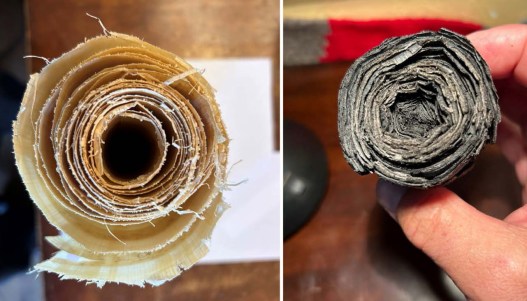
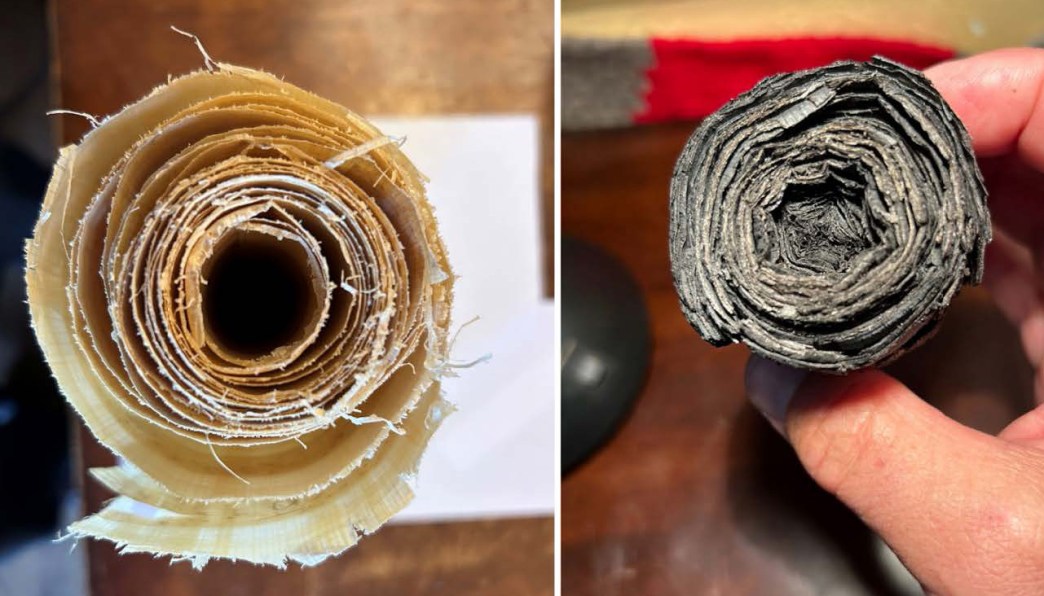
When Mount Vesuvius erupted in 79 CE, it didn’t just destroy Pompei, it also laid waste to the nearby town of Herculaneum. There, a library containing Greek and Roman papyrus scrolls was quickly covered in ash and hot volcanic gases, transforming more than 1,800 scrolls to charcoal, but preserving them in their ruin.
When the library was discovered in the 18th century, efforts were made to unroll and read the carbonized scrolls (one method involved painstakingly unfurling them a few millimeters a day in a custom contraption, a process that took four years for a single scroll). Unfortunately, many of the attempts resulted in their destruction, and Italian officials halted the operations.
Read more: “The Deep Space of Digital Reading”
Fast forward to the 21st century, and modern technology has given researchers another bite at the apple. Using X-ray CT scans and artificial intelligence, portions of the ashy scrolls—some of which were already centuries old when Vesuvius erupted—have now been translated. That process took months instead of years, but now a new paper published in PLOS One could speed things up even more.
An eclectic group of researchers from the world of physics, chemistry, archaeology, computer science, the classics, and the search for extraterrestrial life has developed their own process for quickly identifying and reading some of the Herculaneum scrolls. But they started by making their own.
To replicate the materials used by ancient scribes, study author Douglas Seiler of the University of California, Berkeley sourced carbon-based ink, papyrus, and reeds and tasked high school students with making their own scrolls. (Instead of treatises on Epicurean philosophy they used lines from Star Wars, the Bible, the Outer Limits, etc.) Their ink contained different concentrations of lead nitrate, a common additive to ancient writing pigments. When they were done, the scrolls were rolled up, placed into metal canisters, and tossed into a furnace to simulate volcanic carbonization.
Why?
Well, lead absorbs X-rays, like the ones from CT machines (which is also why Superman can’t see through the metal). According to the team, this should make scrolls written in lead ink a lot easier to read. “With lead in the ink, you would get a huge friggin’ signature, so you really need to be looking for scrolls with lead in them,” Seiler explained in a statement.
Scanning their crispy homemade scrolls in a CT machine showed some very promising results. “If you look at the images, the letters lit up like a Christmas tree,” Seiler said. Even the smallest concentration of lead used produced a strong signal. The next step was to virtually unroll them using a custom computer program and voila—the model scrolls were readable.
According to the team, this could be a game-changer in the centuries-long effort to translate the Herculaneum scrolls. Many of these charred lumps haven’t been scanned for lead, something that could be done with handheld instruments. “They’re having problems reading a lot of them because of the low contrast of carbon ink on carbon paper,” Seiler said. “We’re relatively certain that if they start searching for lead, or they let us search for lead, it will help this whole process. This is the Holy Grail.”
Ancient wisdom lost to the ages, rediscovered by a motley crew of interdisciplinary researchers wielding technology that would have seemed like magic to the original authors. What’s not to love?
Enjoying Nautilus? Subscribe to our free newsletter.
Lead Image: Douglas Seiler



.jpg?w=527&resize=527,703&ssl=1 "It Still Feels Like Summer in Parts of the US. Blame El Niño")