

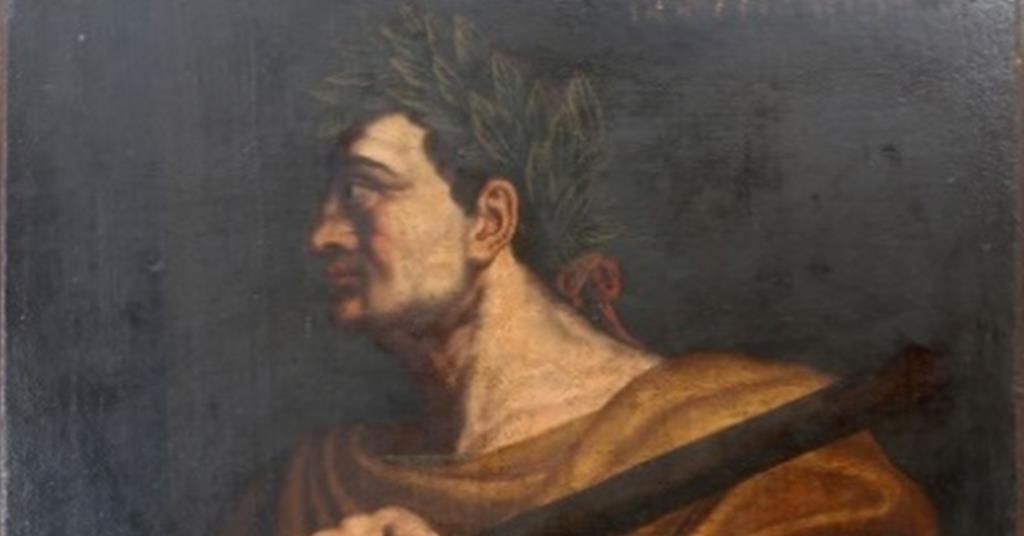
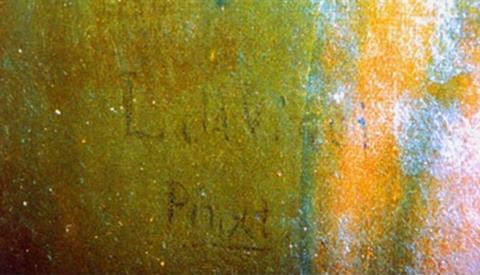
Chemical analysis of a painting of the Roman emperor Domitian has thrown light on the mystery of who painted it. Interest in its provenance dates back to the discovery, hidden below Domitian’s right arm in a blackened area, of these words: L da Vinci. Pinxt.
Could it be an unknown Leonardo da Vinci painting? This is what two siblings, the owners of the painting who wish to remain anonymous, have wondered for over 30 years. When they inherited the Domitian in 1994, they chanced upon the faint inscription beneath centuries of soot. ‘At first there was a certain sense of excitement – almost of celebration,’ they explain. ‘We were naive enough to imagine that the question might be resolved relatively quickly, perhaps within a few months.’
The siblings say the painting has been in their family since 1938 when their grandfather bought it at auction. Previously, before the trail goes cold, Christie’s auction house listed it for sale in the 1920s as a work of Titian, another Renaissance master.
Historians agree that Titian never painted Domitian. But he did paint a famous series called The Eleven Caesars. Painted between 1536 and 1540 for an Italian duke, years after Leonardo’s death in 1519, it comprised portraits of the first eleven Roman emperors. Titian took inspiration from a 121AD Roman biography The Twelve Caesars by Suetonius, but sources suggest that Titian’s intention was only ever to paint 11 emperors.
However, their fame saw numerous copies emerge, with patrons and artists preferring to ‘complete’ the set by adding Domitian, says Frances Coulter, an independent art historian and expert on Titian’s Caesars based in Dublin, Ireland.
Titian’s original 11 were sold in 1631, but historical inventories hint that another painting ‘by another hand’ joined them, raising the possibility that Domitian was added to Titian’s set too. Titian’s paintings, however, were destroyed in a fire in 1734, probably along with the original, added Domitian, if it existed.
Can science solve the mystery?
Now, scientists have analysed the siblings’ Domitian with Raman spectroscopy in order to identify the chemical make-up of the pigments and establish if it’s possible the artwork could have been painted by Leonardo or be the original addition to Titian’s 11 emperors.
‘It was really exciting to have the chance to work on such an impressive and delicate object,’ says Tomas Edvinsson at Uppsala University, Sweden, who led the work. Edvinsson and his colleagues selected 13 sampling locations on the painting to analyse a wide range of colours.
First, they cleaned the areas to remove layers of soot, grime and varnish that can block or interfere with the Raman lasers. Next, the researchers took microscopic samples from each area and placed these directly under the Raman microscope, which allowed them to focus on individual pigment grains.
They identified 12 pigments that were widely used in medieval times, including chalk, red ochre and carbon black, the last of which was used for the mystery signature. However, another pigment was identified as Prussian blue, which was first synthesised in the 18th century.
X-ray images revealed the painting had alterations where Prussian blue was found – with Domitian’s laurel wreath becoming more elaborate – suggesting this pigment’s presence was from later restoration work.
Following the pigment analysis, other researchers have carbon dated the canvas to around 1470. And the inscription has been confirmed to be behind aged varnish, so not recently added. Altogether, the findings keep the possibility alive that the painting could be by Leonardo or someone from his workshop. However, Edvinsson cautions that the pigments and the canvas could have equally been used by any 16th century artist or forger.
‘Whilst rigorous scientific analysis, such as this one, can identify, with a reasonable amount of certainty, the timeframe in which a painting was produced, they cannot identify the hand that created it without additional supporting information,’ explains Coulter.
There’s also a chronological conundrum. The earliest documented painting of Domitian comes from 1561 when Bernardino Campi was commissioned to copy Titian’s Caesars and add Domitian to the set. If Leonardo had painted the Domitian in the late 15th century, it would mean he painted it decades before Titian’s work and subsequent copies.
‘There is no reason why Leonardo should have painted a Domitian years before Titian painted the other 11 emperors,’ says Charles Hope, an Italian art specialist at the UK’s Warburg Institute. ‘The picture looks nothing like any work by Leonardo or any of his close followers. The inscription was presumably added by an unscrupulous dealer in the hope of selling the picture to extraordinarily naive clients,’ he says.
Coulter also doubts it was produced during Leonardo’s lifetime. ‘The overall style of the piece seems to me far too robust and defined to have been created in the late 15th century or by Leonardo’s studio,’ she says.
‘What this research does tell us is that this Domitian is most likely a work from the 16th century. We don’t know what happened to the original Domitian – there remains the possibility that this painting is that original,’ Coulter adds. ‘Without further research it remains impossible to confirm. The mystery of the missing, or original, Domitian continues.’