





I used to visit a neighbourhood bookshop that had an unusual approach to pricing. Every second week, the prices would be marked down by a pound. The result was a delicious game of chicken, balancing my desire against my stinginess.
I was reminded of this during a recent chat with a journalist who wanted to write about the synthetic drugs that have started to make inroads into the black market. Back in the 1990s, I had spotted a thick black paperback with the cryptic word ‘Pihkal’ in white capitals on the spine. Written by a Berkeley chemist, Alexander Shulgin, it detailed his career exploring the chemistry and psychoactive effects of a broad class of organic compounds of which MDMA (ecstasy) is the best known. The title was an acronym: Phenylethylamines I Have Known And Loved; he described his experiences making and testing the effects of these molecules, something he did at carefully supervised parties with his California (where else?) friends, provided ‘tasting’ notes, and ended with the experimental sections of his many publications. At a mere £10, the cult book was a bargain used by generations of students, experimenters and ‘entrepreneurs’.
My journalist friend wanted to know how one might define and regulate the multifarious variants of these compounds, given that they were classic examples of the ‘methyl, ethyl… futile’ approach that medicinal chemists have traditionally used to optimise the efficacy of particular drugs. In the UK, the 2016 Psychoactive Drugs Act defines such drugs as anything ‘capable of producing a psychoactive effect in a person who consumes it, and is not an exempted substance’. It therefore covers anything that is not explicitly permitted (examples of permitted substances include alcohol, caffeine and nicotine). By contrast, the earlier Misuse of Drugs Act of 1971 classifies named drugs into Classes A, B and C. These lists that have expanded steadily over the decades as ever more potent opioids, cannabinoid receptor agonists and more have been identified. For regulators the dilemma is to decide how minor a variant warrants listing.
The difficulty of making such definitions is nothing new. For patent attorneys and chemical informaticists you can summarise many decades of struggle with variants with a single name: Markush.
Jenö Armand Marcus was born into a Jewish family in Budapest in 1887, the last of five siblings. His father, Orban, died rather mysteriously in the public baths – it may have been suicide – when Jenö was barely a teenager. In spite of this tragedy, his mother remarried and Jenö went to university in Budapest to study chemistry and chemical engineering, eventually graduating with a doctorate. Soon after, in 1913 he emigrated to the US, changed his name to ‘Eugene A Markush’ and is said to have done postdoctoral work at Columbia University, New York (although the university has no record of this). He then found a job working as chemist with the pharmaceutical firm Lederle Laboratories.
But Markush wanted independence. In 1917 he struck out on his own, setting up the Pharma Chemical Company in a wooden shack in Bayonne, New Jersey. Two years later he married a fellow Hungarian emigrée, Stella Podvinets, with whom he lived in Jersey City.
Expansion plans
Markush began making Salophen (an antipyretic forerunner of paracetamol/Tylenol) under license from Bayer, along with creosote and guaiacol carbonates, and phenacetin. The influenza epidemic created a huge demand for pharmaceuticals like these and Markush’s business grew. Needing to increase the scale of his production he got wind that a French company, Nuyens, was closing down. His visit to the plant netted Markush not just a couple of 500 gallon autoclaves and some distillation apparatus, but also a lifelong partnership with one of the owners, Albert Farmer, who invested in the new startup. The money allowed Markush to move to larger premises and diversify his operation into the invention and manufacture of dyes for wool and silk.
In 1923 he filed a patent for the preparation of a set of pyrazolone dyes – a process which he described in great detail. But because the process worked for a number of analogues, and to ensure that a competitor might not start manufacturing something almost identical, his claim was written quite generically:
‘The process for the manufacture of dyes which comprises coupling with a halogen-substituted pyrazolone, a diazotized unsulphonated material selected from the group consisting of aniline, homologues of aniline and halogen substitution products of aniline.’
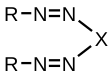
The application was immediately rejected as too broad. After all, the ‘inventive step’ had involved a small number of ‘novel’ compounds, but the claims covered much wider territory. Although the patent came with no diagrams or structural formulae, it implicitly covered all structures with substituents R and X on the starting materials – a potentially huge number of ‘prophetic’ structures.
To Markush’s likely relief, the Patent Office accepted his appeal and ultimately approved his application. In doing so it also set a crucial precedent that remains to this day – the Markush doctrine – that variant structures of basic frameworks are patentable, with generic groups or substituents, typically represented by letters on structural diagrams.

For Markush, his victory may not have seemed immediately significant. His wife gave birth to a daughter in 1925 and his business was growing steadily. His stepbrother, Frank, an engineer, became a close coworker. The company was almost alone in the US in preparing pyrazolones, useful starting materials for a variety of dyes and pharmaceuticals. Over the next decade it steadily developed (and patented) a variety of dyes marketed under names like Pharmacine, Pharmatex and Pharmasol that were designed to make things as simple as possible for the textile workers using them.
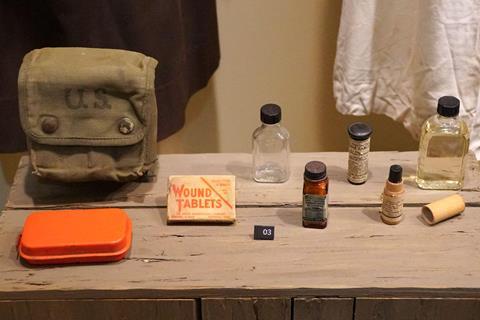
During the second world war the US government put out a call for the production of Atabrine, an antiprotozoal agent that was crucial to combat malaria in troops fighting in Southern Europe and in the Pacific. At a meeting in Pittsburgh, Markush impulsively declared that his firm could produce a batch ‘within a week’, to the horror of his colleagues. But Markush’s gamble paid off – the route to the compound was very similar to what his firm used to make dyes.
By the end of the war the quality of Pharma’s products was such that it was recognised by the US government. In 1949, the company was so profitable that it paid its employees a particularly large bonus to avoid paying additional tax. But as competition in the dyestuffs industry hotted up and prices fell, the small company eventually became a target for a takeover by Bayer. Markush died aged 80 in 1968.
A structural problem
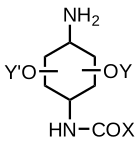
But the Markush doctrine, so favourable to firms – a clever patent agent could use it to build a formidable defence against rivals making anything similar – would prove a major headache for patent offices. While searching the literature for a specific compound using indexes like Beilstein or Chemical Abstracts was tedious but simple, finding Markush structures was a nightmare. Two quite similar molecules might look completely different when written in Markush form. As the number of patents soared through the 1950s and 1960s it became ever harder to spot whether a molecule might be covered by the ‘prophetic’ structure of an existing Markush patent claim. The due diligence required steadily lengthened the time between the filing of a patent and its approval.
In the late 1950s Montagu Hyams, a British chemist, started a subscription service called Derwent to provide patent abstracts to companies wanting to get ahead of the game. He soon realised that it would be impossible to keep up with both the millions of known molecules and the millions more potentially covered by a Markush structure.
In 1963 Hyams announced a computer-assisted fragmentation approach to Markush searching. Each molecule was split into a series of functional fragments – pyrrole, amide, carboxylate – coded onto punch cards. It was then easy to conduct a search by simply looking for the various subgroups. Soon after, Chemical Abstracts and the French patent office INPI introduced topological searches that took account of molecular linkage. Eventually they all joined forces, with chemical informaticists adding sophisticated visualisations that make it possible to ‘see’ molecules in a virtual ‘patent space’ as companies battle for molecular and commercial supremacy. It is a far cry from the small shack in a New York suburb where all this thinking originated.
And what happened to my copy of Pihkal? It was borrowed over the years by successive students who spotted it in my office. Eventually it never came back. At first I was a bit miffed. But in an age where libraries have been turned into hot-desking workspaces and old professors’ books are tossed into skips, I fantasise that it’s still being shared from one person to another. Books – even potentially naughty ones – should never sit idle on a shelf.
Acknowledgment
I am grateful to Peter Bakos for sharing information about the Markush family.


